
B2B vs B2C Buyer Behavior: 9 Powerful Differences Marketers Should Understand
Introduction
In modern marketing, success is no longer determined solely by creative campaigns or media spend. It is shaped by a deeper force: buyer psychology. Organizations that understand how customers think, evaluate risk, and justify purchases consistently outperform competitors.
Nowhere is this more evident than in the contrast between B2B vs B2C behavior differences.
While both models ultimately aim to drive revenue, the difference between B2B and B2C behavior lies in motivation, decision structure, emotional triggers, and perceived risk. For a Dubai-based marketing agency operating in one of the world’s most competitive commercial ecosystems, mastering these distinctions is not optional—it is strategic infrastructure.
As management thinker Peter Drucker once noted: “The aim of marketing is to know and understand the customer so well the product or service fits them and sells itself.” Understanding B2B vs B2C buyer behavior allows marketers to design conversion strategies aligned with real decision-making processes rather than assumptions. This guide explores the nine most powerful differences shaping modern purchasing patterns—and how marketers can translate them into measurable growth.
What is B2B vs B2C Behavior?
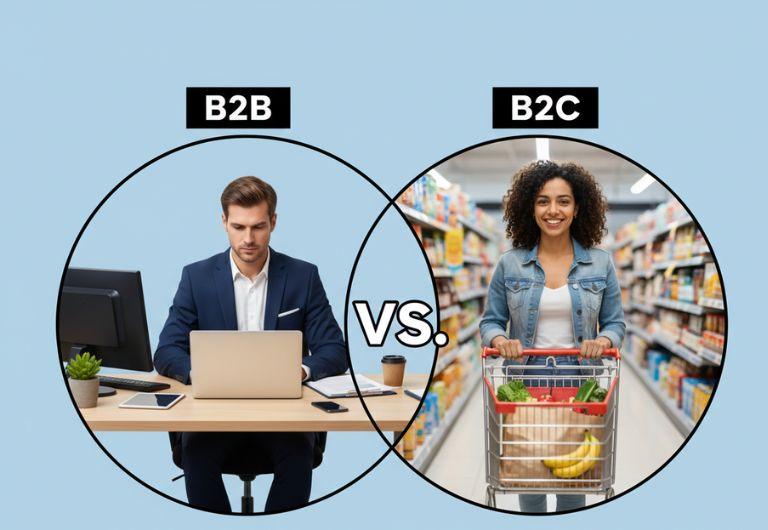
At its core, business to business vs business to consumer behavior reflects two fundamentally different purchase environments.
B2B customer behavior is driven by organizational goals such as efficiency, profitability, compliance, and long-term value creation. Purchases are evaluated through ROI models, stakeholder approval, and operational impact.
B2C customer behavior, by contrast, is influenced by identity, aspiration, convenience, and emotional resonance. Even when logic is present, emotion often initiates the purchase journey.
Research from Gartner suggests that 77% of B2B buyers describe their purchase process as extremely complex, involving multiple decision makers and extended evaluation cycles. Meanwhile, consumer purchases are increasingly shaped by micro-moments—instant decisions triggered by relevance and personalization.
Understanding this contrast forms the foundation for every effective marketing strategy, from lead generation to conversion architecture.
B2B vs B2C Behavior Differences Explained
Before exploring each dimension individually, it is helpful to frame the broader reality:
B2B buyers manage risk. B2C buyers manage desire. One seeks operational certainty; the other seeks experiential satisfaction. This distinction influences the customer journey, sales funnel design, messaging hierarchy, and even pricing strategy.
The sections that follow examine the key differences between B2B and B2C buyer behavior through a strategic lens.
1. Decision-Making Structure: Committees vs Individuals
The most visible contrast in consumer vs organizational buying behavior is who makes the decision.
In B2C environments, the buyer is often the user. Even when family members influence the purchase, authority remains relatively centralized.
B2B purchasing, however, is rarely individual.
A typical enterprise buying group includes:
- Financial stakeholders
- Technical evaluators
- Operational users
- Procurement leaders
- Executive sponsors
This distributed authority transforms the B2B vs B2C decision making process into a consensus-building exercise.
According to McKinsey research, the average B2B buying group now includes 6–10 decision makers, each armed with independent research.
Strategic Application
Marketing must shift from persuasion to alignment.
Rather than crafting a single value proposition, high-performing agencies build multi-layer messaging:
- CFO → financial outcomes
- CTO → integration and scalability
- Operations → efficiency gains
The sale happens when internal friction disappears.
2. Emotional vs Rational Buying Behavior in Marketing
A long-standing myth suggests B2B buyers are purely rational. Neuroscience tells a more nuanced story.
While B2B purchases rely heavily on logical decision making, emotion still plays a role—particularly fear of making the wrong choice.
As Nobel laureate Daniel Kahneman observed:
“People think they make decisions based on evidence. In reality, they use evidence to justify decisions they’ve already leaned toward emotionally.”
In B2C markets, emotion is not hidden—it is leveraged openly through storytelling, brand identity, and aspirational positioning.
Impulse buying remains a powerful economic force, especially when supported by personalization engines and frictionless UX.
Strategic Application
- B2C campaigns should amplify emotional resonance.
- B2B campaigns should reduce psychological risk.
Both strategies require trust—but expressed differently.
3. B2B Buyer Journey vs B2C Buyer Journey
The stages of the B2B buying process tend to be deliberate and research-intensive.
A simplified framework:
- Problem identification
- Solution exploration
- Vendor comparison
- Risk evaluation
- Stakeholder approval
- Implementation planning
Each stage expands the timeline.
By contrast, the B2C consumer decision-making process explained often compresses into minutes or days—especially in digitally native markets like the UAE.
Strategic Insight
The length of the journey directly shapes content strategy.
B2B requires depth. B2C requires immediacy.
Whitepapers, ROI calculators, and executive briefings support relationship-driven sales, while short-form video, reviews, and social proof accelerate consumer conversions.
4. Why B2B Purchase Decisions Take Longer
One of the most predictable B2B vs B2C sales cycle differences is duration.
Enterprise purchases can extend from three months to over a year. The reason is not indecision—it is exposure.
A failed consumer purchase may cost hundreds.
A failed enterprise decision may cost millions.
This triggers extensive due diligence.
Harvard Business Review reports that B2B buyers complete nearly 70% of their research before engaging with sales teams.
Strategic Application
Agencies should invest heavily in authority-building assets:
- Thought leadership
- Industry reports
- Expert webinars
- Case-backed insights
Visibility during the research phase is often more influential than the final pitch.
5. Factors Influencing B2B Buying Decisions vs Consumer Motivation
The factors influencing B2B buying decisions typically revolve around measurable impact:
- Return on investment (ROI)
- Operational efficiency
- Competitive advantage
- Vendor reliability
- Scalability
Consumers evaluate differently.
Their triggers often include:
- Status signaling
- Convenience
- Price perception
- Brand trust
- Customer experience
Neither model is inherently superior—they simply optimize for different outcomes.
Strategic Insight
Effective marketers map messaging to purchase intent rather than demographics.
Intent predicts behavior. Profiles do not.
6. Relationship-Driven Sales vs Transactional Purchases
In B2B ecosystems, relationships are not soft advantages—they are revenue multipliers.
Long-term contracts, recurring revenue, and account expansion all depend on trust accumulated over time.
This explains why relationship-driven sales consistently outperform purely transactional outreach.
Conversely, many B2C purchases prioritize speed. Loyalty exists, but switching costs are low unless emotional attachment is strong.
Strategic Application
For B2B brands:
- Invest in executive visibility
- Build advisory positioning
- Maintain post-sale engagement
For B2C brands:
- Reduce friction
- Optimize checkout flows
- Strengthen personalization
The objective shifts from retention mechanics to experiential continuity.
7. Risk Evaluation vs Impulse Buying
Risk tolerance sharply separates B2B vs B2C purchasing behavior.
Organizational buyers conduct layered risk evaluation because their professional credibility is tied to the outcome.
A poor decision can damage careers.
Consumers face fewer reputational consequences, allowing for spontaneity—particularly when return policies and digital payments reduce perceived danger.
Strategic Insight
Trust signals must scale with perceived risk.
For high-value B2B offers:
- Certifications
- Security assurances
- Proven implementation frameworks
For B2C environments:
- Reviews
- Guarantees
- Influencer validation
Confidence accelerates conversion.
8. Personalization vs Value Proposition Depth
Personalization dominates consumer marketing—and for good reason.
Accenture reports that 91% of consumers are more likely to buy from brands that recognize and remember them.
However, in B2B markets, relevance is less about first names and more about contextual intelligence.
Executives expect vendors to understand their industry pressures, regulatory constraints, and growth targets.
Strategic Application
Move beyond surface personalization toward strategic empathy.
Demonstrate that you understand the client’s problem-solving approach, not just their profile.
That is where differentiation emerges.
9. Brand Loyalty vs Strategic Partnerships
Consumers can be loyal—but convenience often wins.
Organizational buyers behave differently. Once a vendor proves capable, switching becomes operationally disruptive.
This creates partnership economics rather than simple repeat purchases.
The strongest B2B brands position themselves not as suppliers but as growth enablers.
Strategic Insight
Shift the narrative from selling products to delivering outcomes.
When the value proposition aligns with strategic priorities, loyalty evolves into dependency—a powerful competitive moat.
Case Study: Enterprise Transformation in the UAE
A Dubai-based logistics technology provider sought to modernize its lead generation engine after experiencing stalled growth.
Initial campaigns mirrored consumer tactics: heavy paid media, broad messaging, and promotional language. Engagement remained shallow because the strategy misunderstood how B2B buying behavior differs from B2C.
The agency repositioned the brand around operational intelligence.
Instead of advertising features, the campaign introduced a research-led report quantifying supply chain inefficiencies across Gulf markets. Executive roundtables followed, bringing decision makers into curated discussions about risk mitigation and automation.
Within nine months:
- Average deal size increased by 38%
- Sales cycle shortened by nearly six weeks
- Enterprise pipeline doubled
The turning point was not creative—it was behavioral alignment.
The strategy acknowledged that organizational buyers seek certainty before commitment.
Case Study: Luxury Retail Acceleration
Contrast this with a premium retail brand targeting affluent consumers relocating to Dubai.
Here, aspiration—not risk—drove demand.
The agency deployed AI-powered personalization, dynamically adapting product recommendations based on browsing patterns and lifestyle indicators. Messaging emphasized identity and exclusivity rather than product specifications.
Results were immediate:
- Conversion rates rose 42%
- Cart abandonment dropped significantly
- Repeat purchases accelerated within one quarter
The lesson is clear:
Examples of B2B vs B2C buying behavior reveal that strategy must mirror motivation.
Emotion thrives where consequence is low; evidence dominates where stakes are high.
Strategic Framework for Modern Marketers
To operationalize these insights, agencies should anchor planning around three diagnostic questions:
1. What risk does the buyer perceive?
Higher risk demands deeper proof.
2. How many decision makers are involved?
More stakeholders require layered messaging.
3. Is the purchase identity-driven or outcome-driven?
Identity favors storytelling; outcomes favor analytics.
This framework aligns naturally with contemporary conversion strategy design.
The Future of Buyer Behavior
Digital maturity is narrowing some historical gaps between B2B and B2C markets.
Today’s executives expect seamless digital experiences, while consumers increasingly conduct extensive research before purchasing.
The convergence suggests a hybrid future:
- B2B journeys becoming more intuitive
- B2C decisions becoming more informed
Yet the fundamental divide remains—organizations optimize for performance; individuals optimize for meaning.
For agencies operating in innovation hubs like Dubai, this evolution presents a strategic opportunity.
Those who decode buyer psychology will not merely execute campaigns—they will shape markets.
Conclusion
Recognizing B2B vs B2C behavior differences is far more than a theoretical exercise—it is a strategic advantage that directly influences market performance. When marketers align their approach with authentic decision-making patterns, they create the conditions for stronger pipelines, faster conversions, deeper brand trust, and long-term, sustainable growth. Organizations that internalize buyer psychology move beyond reactive marketing and begin shaping demand with intention.
Leading agencies understand that modern marketing is no longer defined by visibility alone; it is about decision architecture—crafting ecosystems where selecting your brand feels both rational and inevitable. In fast-growing, globally competitive markets, this level of strategic clarity becomes a differentiator. Because at its core, effective marketing does not start with channels or campaigns—it begins with a profound understanding of what ultimately drives buyers to choose.
FAQ
1. What is the main difference between B2B and B2C customer behavior?
The main difference lies in decision-making complexity. B2B buying behavior is typically more rational, longer-term, and involves multiple stakeholders, while B2C behavior is often faster, emotionally driven, and based on individual preferences.
2. How does the buying journey differ between B2B and B2C customers?
B2B journeys are longer and involve research, evaluation, approvals, and negotiations. B2C journeys are shorter, with fewer touchpoints, and often driven by immediate needs, emotions, or convenience.
3. What role does trust play in B2B vs B2C decisions?
Trust is critical in both, but it plays a larger role in B2B due to higher investment, risk, and long-term relationships. In B2C, trust influences brand preference and repeat purchases but decisions may still be made quickly.
4. How does content strategy differ for B2B and B2C audiences?
B2B content focuses on education, ROI, case studies, whitepapers, and problem-solving. B2C content emphasizes storytelling, entertainment, emotional appeal, and product benefits. Content tone and depth vary significantly between the two.
5. How should digital marketing strategies adapt for B2B vs B2C?
B2B strategies prioritize lead nurturing, account-based marketing, and relationship building, while B2C strategies focus on scale, personalization, and impulse triggers. Understanding behavioral differences ensures messaging and channels align with audience expectations.