
AI Copilot Analytics for Manufacturing, Field & Logistics
AI Services > AI Copilot Analytics for Manufacturing, Field & Logistics
AI Copilot Analytics for Manufacturing, Field & Logistics
Revolutionize manufacturing, field ops, and logistics with AI copilots.
Boost quality with Visual QA, ensure uptime through Predictive Maintenance, and optimize routes using Dispatch Planning—all powered by real-time insights for smarter supply chain decisions.
Track Supply in Real Time
Monitor your supply chain with real-time data visibility powered by AI copilots—faster alerts, smoother flow
Field Force Insights
See team performance, dispatch status, and delay risks instantly with live field service dashboards
Factory Floor Clarity
Get predictive insights into production efficiency, equipment downtime, and quality metrics
Why Choose Us
Streamline Ops with Smart BI
Our AI copilots simplify analytics for manufacturing, field services, and logistics—optimizing workflows, reducing delays, and improving real-time decisions
“AI copilots help us monitor field ops in real time and cut logistics lag. It’s changed how fast we operate”
Omar Petrovic
― Ops Director

Live Logistics Performance Layer
Track fleet movement, inventory status, and shipment delays in real time. AI copilots help surface risk patterns, exceptions, and performance gaps across regions
- Delay risk alerts
- Fleet heatmaps
Factory Floor Intelligence Core
Analyze machine uptime, workforce output, and production flow with one dashboard. Copilots answer “why” issues happen and “what” to do next—without coding
- Downtime analytics
- Workforce KPIs
Our Services
End-to-End BI for Industry Ops
Explore AI-powered subservices designed for manufacturing, field services, and logistics. From floor to fleet, we give you full control of operational data

Factory BI Systems
Monitor factory output, downtime, and quality metrics through predictive dashboards powered by AI copilots
Field Ops Monitoring
Track technician status, field movement, and service times using real-time AI dashboards and alerts
Logistics Flow Mapping
Get real-time visibility of shipment status, fleet routes, and warehouse turnover with smart visualizations

IoT Data Integration
Stream machine sensor data into BI systems for live insights into equipment health and usage
Inventory Forecasting
Use AI copilots to predict inventory needs, restocking dates, and order fluctuations across regions

Delay Risk Modeling
Analyze patterns that lead to delivery or service delays and let AI copilots surface early alerts
AI Copilot Analytics for Manufacturing, Field & Logistics
Manufacturing, field operations, and logistics lie at the core of many businesses. When these operational pillars are powered by real-time data and AI copilots, the transformation is not only measurable—it’s exponential. At Octopus, we deliver AI-driven business intelligence solutions built specifically for industrial-scale operations, where time, coordination, and efficiency are non-negotiable.
With AI copilots embedded into your operational ecosystem, you no longer wait for reports. You ask questions and get immediate answers. From factory output to technician dispatch to logistics performance, our analytics foundation is designed to give leaders instant clarity and confidence. Welcome to the new era of operational intelligence.
Streamlined Factory Intelligence with Real-Time BI
Factories generate massive volumes of data across equipment, output, quality control, and workforce productivity. However, traditional BI systems often fail to make this data useful in real time. Octopus AI copilots change this by connecting your floor-level data systems into a centralized dashboard, enabling proactive decision-making and predictive performance management.
Through IoT integrations and predictive modeling, we help manufacturers detect bottlenecks before they escalate, forecast output based on past performance, and predict equipment failures before they happen. AI copilots add a conversational layer on top of all this, so plant managers can simply ask, “Why was production down yesterday?” and receive data-backed diagnostics and resolutions.
From lean manufacturing dashboards to Six Sigma process analytics, our solutions are tailored to help you hit targets, reduce waste, and drive continuous improvement.
AI-Driven Field Operations Oversight
For field service businesses, visibility into on-ground operations is often limited. Missed appointments, unclear technician status, and service delays all erode customer trust. With Octopus analytics powered by AI copilots, you gain a live window into every field operation—from technician dispatch to service resolution.
Our BI dashboards integrate location data, ticketing systems, service logs, and customer feedback into one real-time environment. Managers can ask, “Where is the closest available technician?” or “Which jobs exceeded SLA today?”—and get instant clarity. This not only optimizes response times but improves field team performance and customer satisfaction.
Field operations BI includes route optimization, workload balancing, predictive maintenance for service equipment, and automated SLA breach warnings. All accessible via mobile-optimized interfaces that field supervisors and technicians can use on the go.
Full-Spectrum Logistics Intelligence
Logistics is the nervous system of any supply chain. One delay in transport or breakdown in inventory flow can affect the entire operation. Octopus analytics systems enable real-time tracking and proactive logistics management with the power of AI copilots.
From tracking fleet movement via GPS integration to analyzing shipping route performance and warehouse load balancing, we unify logistics data into decision-ready dashboards. Logistics managers can ask questions like, “What’s the average delay by route?” or “Which regions are missing delivery SLAs this week?” and receive live insights.
We support last-mile logistics, cold-chain tracking, customs bottlenecks, and vendor SLAs—all in one dashboard. AI copilots allow operations leaders to pinpoint inefficiencies before they become problems, making logistics smoother, faster, and more transparent.
Predictive and Preventive Maintenance Intelligence
Breakdowns don’t wait for convenient times. Unplanned downtime is expensive and disruptive. Our analytics platform connects machine data from factory equipment, field tools, or fleet vehicles into predictive models. AI copilots help forecast failure points and recommend preventive maintenance.
By asking, “What equipment is likely to fail in the next 30 days?” your team can reprioritize maintenance, avoid disruption, and extend asset life cycles. We use machine learning models trained on your historical data to surface signals before they become problems—reducing costs and improving uptime.
Unified BI for Warehousing and Inventory
Warehousing is no longer about storage—it’s about speed, visibility, and orchestration. Octopus brings AI copilots into the warehouse, providing managers real-time data on space utilization, order fulfillment cycles, picking accuracy, and staff productivity.
Want to know which warehouse has space for incoming inventory? Or how long a specific SKU has been sitting idle? Ask the AI copilot. We unify warehouse management systems (WMS), inventory databases, and order systems into a centralized, queryable platform.
These insights help reduce overstocking, speed up fulfillment, and rebalance inventory intelligently across the supply chain.
Dispatch Optimization for Field and Fleet Teams
The cost of inefficient dispatching goes beyond fuel. It affects customer experience, SLA compliance, and field team morale. Our system uses AI copilots to track technician availability, vehicle location, and job duration in real time.
Need to find the nearest available technician with the right tools for a job? The AI copilot answers instantly. We also layer in performance metrics—like first-time fix rate, average job duration, and travel time—to help managers make smarter dispatch decisions.
This boosts productivity, reduces idle time, and improves customer satisfaction with faster, more accurate service delivery.
Energy and Cost Efficiency Tracking
Manufacturers and logistics firms operate on thin margins. Our analytics foundation includes energy usage monitoring, operational cost tracking, and waste analytics. With AI copilots, you can quickly identify which lines, routes, or shifts are consuming the most energy or underperforming.
This transparency enables you to set and hit efficiency KPIs, reduce energy consumption, and improve profitability without compromising output. Sustainability reporting becomes part of your operational fabric, not an afterthought.
Compliance and SLA Tracking
Whether it’s equipment certifications, workforce compliance, or logistics SLAs, regulatory adherence is critical. Our BI system includes compliance dashboards where AI copilots can answer queries like, “Which contracts are nearing SLA breach?” or “Which assets are overdue for inspection?”
We help standardize compliance metrics across regions and provide automated reminders, status reports, and audit logs. For logistics providers and manufacturers in regulated industries, this ensures nothing slips through the cracks.
On-the-Go Analytics with Mobile BI
Not every decision happens at a desk. Field supervisors, warehouse managers, and drivers need insights on the move. Our mobile-optimized BI dashboards give real-time access to KPIs, alerts, and AI-generated insights directly from smartphones and tablets.
Users can ask their AI copilots for updates, alerts, or diagnostics via voice or text, eliminating the need to log into a laptop or contact HQ. This brings a new level of responsiveness to operational decisions, wherever they happen.
Embedded Analytics in Workflows
We don’t believe in adding more tools—we believe in integrating smarter ones. Our embedded analytics framework lets you place dashboards, alerts, and AI copilots directly into existing platforms. Whether it’s your ERP, CRM, logistics hub, or custom manufacturing software, we meet users where they already work.
This drastically improves analytics adoption, shortens the insight-to-action cycle, and ensures decision-making happens in context.
Built to Scale and Evolve with You
Octopus builds analytics foundations that scale with your business. As you add new factories, expand logistics networks, or grow your service teams, our systems adapt with zero compromise on performance.
From regional dashboards to global operations centers, we configure multi-site, multi-user BI environments with granular permissions, unified metrics, and consistent performance.
And we don’t stop there. Our strategic reviews and performance audits ensure that your analytics maturity continues to evolve with your growth, giving you a data advantage at every stage.
Why Choose Octopus for Operational Analytics?
Because your operations deserve more than spreadsheets and stale dashboards. We bring speed, intelligence, and real-time visibility to the core functions that power your business.
With AI copilots, your teams don’t need to be analysts—they just need to ask. We handle the rest. Our platform is secure, scalable, and built to align with the workflows of manufacturing, logistics, and field services.
From supply chain bottlenecks to technician downtime, we turn every pain point into a performance insight. Whether you’re a regional player in the UAE or a global logistics network, we deliver operational clarity that drives results.
Manufacturing, Field & Logistics: Driving Efficiency Across Complex Operations
The Problem: High Volume, Manual Work & Operational Delays
Manufacturing plants, field service teams, and logistics networks all share a common challenge: large volumes of repetitive, time-sensitive tasks. Typical pain points include:
- Manual data entry → from production logs, delivery receipts, or field reports into ERPs and tracking systems.
- Delayed updates → shipment status, inventory levels, or maintenance activities often lag behind real-world events.
- Inefficient scheduling → field technicians waste hours due to poor routing or job allocation.
- Low visibility → fragmented systems make it hard for leaders to monitor operations end-to-end.
The result is higher costs, slower turnaround times, and lower customer satisfaction.
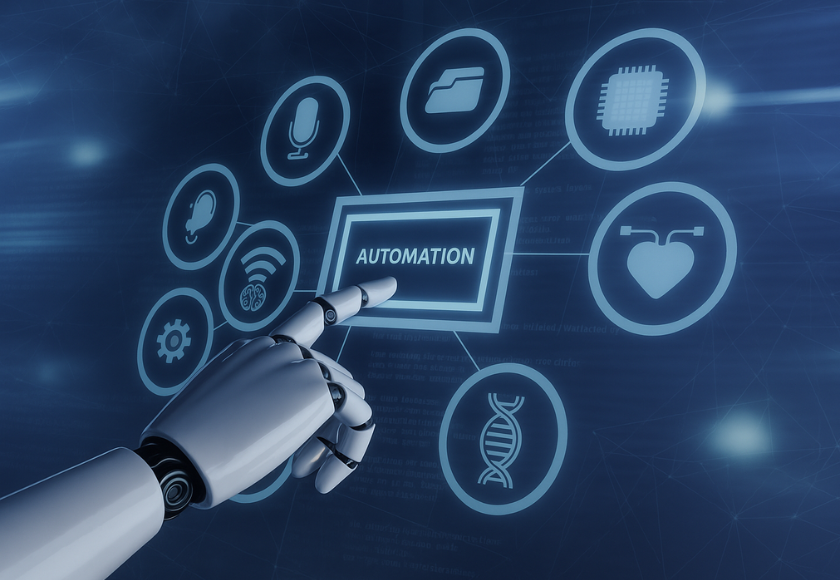
The Solution: Automation Across the Value Chain
Automation streamlines critical workflows across manufacturing, field, and logistics environments:
- Manufacturing
- RPA bots update production and quality data in ERP automatically.
- IoT + AI predictive maintenance detects issues before machines fail.
- Automated reporting ensures compliance with safety and regulatory standards.
- RPA bots update production and quality data in ERP automatically.
- Field Services
- AI-powered scheduling optimizes technician routes and assignments.
- Mobile apps auto-sync job updates, photos, and signatures to back-office systems.
- Chatbots provide real-time support for technicians in the field.
- AI-powered scheduling optimizes technician routes and assignments.
- Logistics
- Automated shipment tracking sends live updates via WhatsApp, email, or web portals.
- AI-driven demand forecasting ensures the right inventory at the right place.
- Document automation (POs, GRNs, bills of lading) eliminates manual paperwork.
- Automated shipment tracking sends live updates via WhatsApp, email, or web portals.
Together, these solutions create real-time visibility, faster response times, and lower operational friction.
The Impact: Resilient, Data-Driven Operations
Organizations that automate manufacturing, field, and logistics processes typically achieve:
- 10–20% reduction in operational costs through efficiency gains.
- 30–50% faster turnaround times in scheduling, deliveries, and reporting.
- Fewer defects and downtime, thanks to predictive maintenance and automated checks.
- Higher customer satisfaction, with real-time visibility and timely service.
- Scalable growth, as automation absorbs volume increases without requiring proportional headcount.
In industries where margins are thin and competition is fierce, automation provides a strategic advantage—turning operational complexity into a source of resilience and speed.
Conclusion
Manufacturing, field, and logistics automation is redefining operational efficiency by uniting smart factories, connected field services, and intelligent supply chains. From predictive maintenance on the shop floor to optimized delivery routes in logistics, automation reduces downtime, improves compliance, and cuts costs—while enabling businesses to scale seamlessly. Companies that embrace these technologies gain not only higher productivity and resilience but also the agility to meet rising customer expectations in a competitive global market.
Let's get started
Be part of the future
Outpace your rivals with Octopus Marketing Agency – be the brand that leads, not follows

Ask Us Anything We’re Ready To Help
Looking for answers? Browse our quick FAQs. Need more details? Explore our comprehensive guide
01. How can AI optimize production for hyper-personalization in the Industry 5.0 era, beyond simple automation?
AI goes beyond automating repetitive tasks to creating adaptable, self-optimizing factories capable of personalized production at scale. By using generative AI, manufacturers can accelerate the design of customized products based on customer data and market trends. AI-powered Digital Twins—virtual replicas of physical production lines—allow engineers to simulate and test custom product runs without disrupting real-world operations.
02. What is the role of Agentic AI in future manufacturing, and how does it differ from existing AI applications?
Agentic AI will act as autonomous decision-makers, managing complex, multi-variable processes that currently require human oversight. Unlike existing AI that assists humans, agentic AI will independently:
Manage supply chain disruptions: Adjusting production schedules and reordering materials based on real-time data.
Optimize energy use: Adjusting machine settings in real-time to minimize consumption and costs.
Negotiate with suppliers: Finding and communicating with suppliers to secure optimal terms.
03. How does the convergence of AI, blockchain, and digital twins create resilient supply chains?
The integration of these three technologies creates an advanced layer of transparency, security, and real-time optimization.
Blockchain provides an immutable, transparent ledger for all transactions and data related to raw materials, components, and finished goods.
AI algorithms analyze this blockchain data to identify potential fraud, ethical sourcing issues, and risks before they cause major disruptions.
Digital twins use this trusted data to simulate potential supply chain disruptions and test different mitigation strategies in a virtual environment before they occur in the real world.
04. Beyond predictive maintenance, how can AI be used for proactive service to anticipate customer needs before they are even aware of an issue?
AI can move field service from reactive to proactive by analyzing a combination of IoT data, service history, and customer behavior.
Proactive issue resolution: An AI system can detect potential connectivity problems with a smart device, automatically alert the customer, and dispatch a technician before the customer experiences a full service outage.
Personalized, proactive communication: AI can create service reminders or offer upgrades based on asset usage history and customer preferences, building stronger relationships and justifying premium service contracts.
Autonomous agents: AI-powered agents can manage scheduling, dispatch, and customer communications around the clock, with technicians only intervening for complex problems.
05. What role does AI-powered augmented reality (AR) play in upskilling and empowering field technicians, and what are its long-term impacts?
AI-powered AR equips technicians with on-the-job, interactive guidance, reducing the need for extensive in-person training and cutting time-to-resolution.
Real-time guidance: AR headsets can overlay step-by-step repair instructions or allow a remote expert to visually guide a field technician through a complex procedure.
Reduced ramp-up time: For complex systems, AR can dramatically shorten the time it takes for new hires to become proficient, moving the workforce from months of training to just weeks.
Improved first-time fix rates: With expert assistance readily available, technicians are more likely to complete the job correctly the first time, increasing customer satisfaction and efficiency.
06. How can generative AI be used to optimize complex logistics networks beyond standard route planning?
Generative AI can create optimal solutions for multi-variable logistical problems that traditional algorithms can’t handle.
Supply chain simulations: Generating and testing thousands of network design scenarios to determine the most efficient and cost-effective setup.
Dynamic pricing models: Creating flexible pricing strategies based on real-time market data, demand, and environmental factors.
Risk mitigation: Generating contingency plans for unexpected events like weather, traffic, or supplier issues, enhancing overall supply chain resilience.
07. How is the integration of Edge AI and IoT sensors on delivery fleets transforming logistics for last-mile delivery?
By combining Edge AI and IoT sensors, logistics companies can gain real-time, hyperlocal insights for optimizing last-mile delivery, which is often the most complex and expensive part of the supply chain.
Real-time route optimization: Edge AI processes data from in-vehicle sensors to adjust routes dynamically based on real-time traffic, weather, and delivery locations, reducing fuel consumption and delivery times.
Fleet maintenance: Sensors on vehicles, combined with predictive AI, can identify maintenance needs before a breakdown occurs, preventing costly delays.
Autonomous delivery: Edge AI powers the navigation and decision-making for autonomous drones and last-mile delivery vehicles, enabling faster and more efficient deliveries in hard-to-reach or congested areas.