
What Is AI SEO? How Dubai Businesses Get Found in ChatGPT, Gemini and AI Overviews
Search is evolving beyond the traditional list of blue links. Today, people can ask ChatGPT to compare service providers, use Google Gemini to explore a topic, or read an AI Overview at the top of Google Search. Instead of visiting several websites to gather information, they can receive a summary that brings together explanations, recommendations and links to relevant sources.
For businesses in Dubai, this shift raises an important question: how can your company become visible when customers use artificial intelligence to search for products, services and recommendations?
AI SEO is the practice of improving a website and its wider online presence so that AI-powered search systems can discover, understand and potentially reference its information in generated answers. It builds on traditional search engine optimisation through useful content, technical accessibility, credible information, structured business details and a trustworthy online reputation.
For a Dubai business, this could mean making its services easier to understand, publishing authoritative answers to customer questions, maintaining accurate local information and building a stronger presence across relevant websites.
However, AI SEO is not a shortcut to guaranteed recommendations. Different platforms use different retrieval systems, ranking processes and sources. The objective is to improve discoverability, provide information worth referencing and measure whether those efforts lead to meaningful business outcomes.
In this guide, we explain what AI SEO means, how it differs from traditional SEO, how ChatGPT, Gemini and Google AI Overviews discover information, and how businesses in Dubai can prepare for the changing search landscape.
What Is AI SEO?
AI SEO, or artificial intelligence search engine optimisation, refers to the methods used to improve a business’s visibility in search experiences that use artificial intelligence to retrieve, interpret or generate information.
Traditional SEO helps search engines discover webpages, understand their relevance and determine whether they should appear in organic search results. AI SEO extends this objective to search experiences where a system may summarise several sources, answer a conversational question or provide links supporting a generated response.
Consider a Dubai business owner searching for a digital marketing agency.
They might enter a traditional query such as:
Digital marketing agency in Dubai.
Alternatively, they might ask ChatGPT:
Which factors should I consider when choosing a digital marketing agency in Dubai for an e-commerce business?
The first query can return a list of websites. The second may produce an explanation covering industry experience, advertising expertise, conversion optimisation, reporting and pricing. Depending on the platform and its available information, the response might also include cited webpages or mention specific companies.
A business that clearly explains its services, demonstrates relevant experience and maintains an accessible website has more opportunities to be discovered and understood. These qualities do not guarantee that an AI platform will recommend it, but they support a stronger search presence.
AI SEO generally involves six connected activities:
- Content optimisation: Publishing accurate, helpful information that answers customer questions.
- Technical SEO: Ensuring important webpages can be discovered, crawled and indexed by relevant search systems.
- Entity optimisation: Making the business’s identity, services, expertise and location clear.
- Authority building: Establishing credibility through genuine expertise, relevant publications, customer reviews and trustworthy third-party references.
- Structured data: Using appropriate schema markup to describe the organisation and its content.
- AI visibility measurement: Monitoring mentions, citations, referral traffic and business outcomes across relevant search experiences.
These activities are closely connected to established SEO principles. The difference is that businesses also need to consider how their information may be retrieved and represented in generated answers.
The two meanings of AI SEO
One reason AI SEO can be confusing is that the term describes two different activities.
1. Using AI tools to improve SEO
This involves using artificial intelligence to assist with keyword research, content briefs, competitor analysis, technical audits, content optimisation and reporting.
For example, an SEO specialist might use an AI tool to organise a list of customer questions into topic clusters. The specialist would then validate the keywords, research the subject and develop useful content.
2. Optimising for AI-powered search
This focuses on improving the chances that a business’s information will be discovered, understood or cited by platforms such as ChatGPT, Gemini, Perplexity and Google AI Overviews.
For example, a Dubai accounting firm might improve its website by explaining its services, identifying its qualifications, providing answers to common tax questions and linking to relevant official guidance.
Both activities can support a digital marketing strategy. However, this article focuses primarily on the second meaning: improving visibility when customers use AI-powered search experiences.
How Does AI SEO Work?
AI search platforms do not all work in the same way. Some use web search and retrieval systems to obtain current information. Others may draw on information learned during model training, and some combine several approaches.
When a platform retrieves web information to answer a question, the process can involve understanding the query, discovering relevant sources, evaluating information and generating a response.
1. Understanding the user’s search intent
AI-powered search systems can interpret the meaning of a question rather than relying only on exact keyword matches.
For example, a customer might ask:
- Which SEO agency in Dubai works with online retailers?
- How can a UAE e-commerce store increase organic traffic?
- What should I check before hiring an SEO company?
- Is AI search optimisation useful for a small business?
Although these questions use different wording, they relate to connected topics. A search system may interpret the user’s underlying needs and identify relevant concepts or sources.
This is why effective AI SEO starts with understanding customers rather than simply inserting keywords into webpages.
A business should identify the questions people ask before making a decision, the information they need to compare options and the evidence that helps them evaluate a provider.
2. Discovering and retrieving relevant information
When an AI platform searches the web, it may use search indexes, crawlers and retrieval systems to identify potentially useful information.
Imagine a Dubai property consultancy publishing detailed guides about buying property, transaction costs, rental yields and neighbourhood comparisons.
If these pages are accessible and relevant to a user’s question, they may become candidates for retrieval. If important content is blocked, missing from the relevant index or difficult to interpret, the platform may have fewer opportunities to use it.
The precise mechanisms vary between platforms. Google Search, ChatGPT search, Gemini and Perplexity should not be treated as a single system with identical indexes or rules.
Businesses should therefore understand the documentation and technical requirements of the platforms that matter to their audiences.
3. Evaluating sources and selecting information
A relevant webpage is not automatically included in a generated answer.
Search and retrieval systems may consider relevance, information quality, source credibility and other signals when selecting material. The exact factors and their relative importance are not fully disclosed for every platform.
For example, a page explaining a UAE compliance requirement with accurate definitions, a clear publication date and links to official documentation may provide stronger supporting information than a generic page filled with unsupported claims.
This does not mean that length or a particular formatting technique guarantees inclusion. The content must actually address the user’s question and provide useful information.
4. Generating the answer
Once relevant information has been retrieved, a language model may use it to produce a conversational response.
Depending on the platform, the answer might include a summary, a comparison, a list of recommendations or citations linking to supporting sources.
A company can benefit in different ways:
- Its website may be cited as a source.
- Its brand may be mentioned in an answer.
- A customer may discover its expertise without clicking a link.
- A visitor may click through to compare services or make an enquiry.
These outcomes are different and should be measured separately wherever possible.
5. Why AI answers can change
AI-generated answers are not fixed rankings. Responses can vary depending on the question, language, location, date, platform, available sources and other contextual factors.
A Dubai marketing agency might appear in response to a question about e-commerce SEO but not in response to a question about healthcare marketing.
Likewise, an answer may cite different sources when the user asks for a comparison instead of a general explanation.
For this reason, businesses should not judge AI SEO performance using a single prompt or screenshot. Repeated testing across relevant questions provides a more useful indication of visibility.
AI SEO vs Traditional SEO: What Is the Difference?
AI SEO and traditional SEO share the same foundation, but they address different search experiences.
| Factor | Traditional SEO | AI SEO and AI search optimisation |
| Main objective | Improve visibility in organic search results | Improve discoverability and potential inclusion in AI-generated answers |
| Search experience | Organic listings, rich results and search result pages | AI Overviews, conversational answers and cited sources |
| Content focus | Relevant, helpful pages aligned with search intent | Helpful pages with clear explanations and useful supporting evidence |
| Technical foundations | Crawling, indexing, site structure and performance | The same foundations, with platform-specific retrieval and access considerations |
| Authority | Expertise, content quality, backlinks and reputation | These foundations plus relevant external evidence and brand mentions |
| Local visibility | Local rankings, Maps and business listings | Accurate local information and relevant evidence across accessible sources |
| Measurement | Rankings, impressions, clicks and conversions | Traditional metrics plus AI mentions, citations and referral traffic |
The distinction should not be overstated. AI SEO is not a completely separate discipline with a universally accepted list of new ranking factors.
Traditional SEO remains important because AI search experiences can use existing web content, indexes and established discovery systems. Strong content, technical accessibility and credibility continue to support discoverability.
Does AI SEO replace traditional SEO?
No. Businesses should not abandon traditional SEO to focus exclusively on AI search.
A company with a slow, confusing or poorly structured website may struggle to serve visitors regardless of how many AI-related tactics it implements. Similarly, a business with useful content but inaccurate contact details may create confusion for both customers and search systems.
The practical approach is to maintain strong SEO fundamentals while adapting content and measurement to emerging search experiences.
Is SEO still worth it in 2026?
Yes, although the value of individual search queries may change as AI-generated answers become more common.
Some informational questions can be answered directly on a search results page. Other queries require users to visit websites to review prices, assess products, check availability, compare providers or complete a transaction.
Businesses should evaluate SEO based on its contribution to visibility, qualified traffic, enquiries and revenue rather than rankings alone.
AEO vs GEO vs LLMO: How Are They Different?
AI search discussions frequently use the terms Answer Engine Optimisation, Generative Engine Optimisation and Large Language Model Optimisation. These terms overlap, and their definitions are not completely standardised.
What is Answer Engine Optimisation (AEO)?
Answer Engine Optimisation focuses on making information useful for systems that respond directly to questions.
A Dubai business consultancy might publish a guide answering:
What documents are needed to establish a company in Dubai?
The page could explain the general requirements, identify circumstances that may affect the process and direct readers to official sources for current information.
AEO commonly emphasises direct answers, descriptive headings, clear definitions and content that addresses specific questions.
What is Generative Engine Optimisation (GEO)?
Generative Engine Optimisation focuses on improving the discoverability and potential representation of information in responses generated by AI systems.
A Dubai property consultancy, for example, could publish an original analysis of rental market trends using clearly identified data sources and an explained methodology.
Such content may help users understand the market and provide useful information that search systems can retrieve or cite when relevant.
GEO does not guarantee that a platform will use a particular page. It is best understood as an approach to creating accessible, credible and useful information for generative search experiences.
What is Large Language Model Optimisation (LLMO)?
Large Language Model Optimisation generally describes efforts to improve how a brand or its information is represented in experiences powered by large language models.
The term can overlap with GEO and AEO, particularly when the discussion involves retrieval, source citations and business discoverability.
It should not be interpreted as a way to directly control a model’s internal knowledge or force it to recommend a company.
Which approach should Dubai businesses prioritise?
Most businesses do not need three separate optimisation programmes.
Instead, focus on useful content, technical accessibility, accurate business information and a credible online reputation. Then evaluate whether your content answers customer questions effectively and whether your business is appearing in relevant AI search experiences.
The appropriate priorities depend on your industry, target audience and the platforms your customers use.
What Does AI Search Read About Your Business Beyond Your Website?
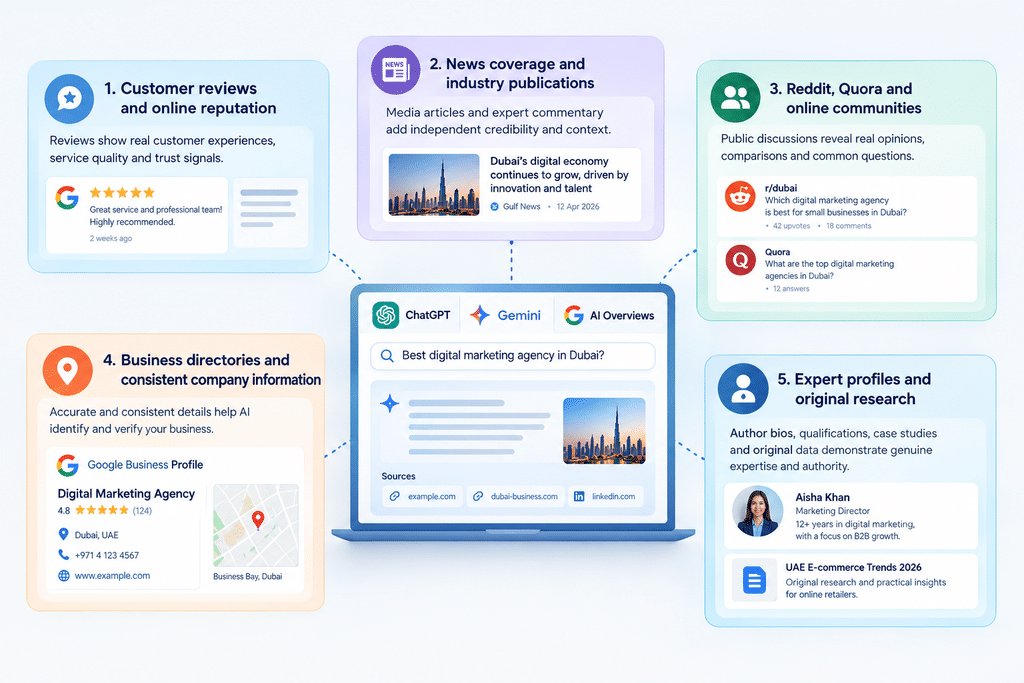
Your website is an important source of information, but it is not necessarily the only source an AI-powered search system may use.
Depending on the platform and the question, retrieved information may include business listings, reviews, news articles, industry publications and other publicly accessible sources.
This matters because a company can describe itself as an industry leader without providing independent evidence that helps customers evaluate the claim.
1. Customer reviews and online reputation
Reviews can provide useful information about service quality, customer experience and common strengths or weaknesses.
For a Dubai restaurant, retail business or professional services firm, genuine reviews can help prospective customers understand what to expect.
Businesses should encourage honest feedback, respond professionally to concerns and correct inaccurate details where possible. They should never buy fabricated reviews or assume that a high rating guarantees AI recommendations.
2. News coverage and industry publications
Relevant editorial coverage can provide independent context about a company’s expertise, achievements and work.
For example, a Dubai technology company that contributes expert commentary to a recognised industry publication can build a stronger public record of its experience.
Digital PR should prioritise genuine expertise and editorial relevance instead of producing large volumes of low-quality mentions simply to influence search systems.
3. Reddit, Quora and online communities
Public discussions can reveal how people evaluate services, compare providers and solve problems.
A user asking for recommendations may encounter conversations about different companies and their strengths. Depending on the platform, relevant public discussions may also be retrieved or referenced in AI-generated answers.
Businesses can participate by providing accurate information and helpful expertise. Promotional posts disguised as independent recommendations can undermine trust and damage reputation.
4. Business directories and consistent company information
For local businesses, accurate information helps people identify the correct company and understand its services.
Maintain consistent details wherever appropriate, including:
- Business name and official website.
- Physical address or clearly stated service area.
- Telephone number and contact information.
- Services, operating hours and qualifications.
- Locations served and languages supported.
A Dubai consultancy should not publish conflicting addresses or outdated phone numbers across its website and business directories.
Consistency reduces confusion, but it does not guarantee that a platform will cite or recommend the business.
5. Expert profiles and original research
Author biographies, professional qualifications, case studies and original research can help demonstrate experience and expertise.
For example, a Dubai accounting firm could publish a practical guide to a common compliance issue, identify the author and their relevant qualifications, and reference official UAE guidance.
The objective is to make important claims understandable and verifiable rather than simply publishing more pages.
How Can Dubai Businesses Improve Their AI Search Visibility?
Dubai’s business environment is competitive across industries such as real estate, hospitality, professional services, healthcare, e-commerce and technology.
A useful AI SEO strategy should reflect the questions customers ask, the evidence they need before making decisions and the information available about the business.
1. Create clear, answer-first content
Begin by identifying the questions customers ask before choosing your products or services.
A real estate company might address property ownership, transaction costs, rental yields and neighbourhood comparisons. A digital marketing agency might explain local SEO, advertising budgets, conversion optimisation and campaign reporting.
Structure each page around a clear purpose.
- Use descriptive headings that reflect the reader’s question.
- Answer the question near the beginning of the relevant section.
- Support important claims with reliable evidence.
- Explain unfamiliar terms in straightforward language.
- Update information when regulations, prices or business details change.
For example, instead of opening a VAT services page with several paragraphs about the company’s history, explain what the service covers, who may need it and which factors affect the requirements.
This structure improves usability and makes the page’s key information easier to identify.
2. Build topical authority with useful supporting content
A single webpage cannot answer every question about a complex subject.
A Dubai SEO agency, for example, could create a central AI SEO guide supported by detailed articles about technical SEO, AI Overviews, content optimisation, AI crawlers and visibility measurement.
The central page introduces the topic and links to supporting articles. Each supporting article explores a distinct question in greater depth.
This structure helps visitors continue their research and helps search engines discover relationships between related pages.
Use internal links when they genuinely help the reader. Avoid creating dozens of thin articles that repeat the same explanation with slightly different keywords.
3. Strengthen technical SEO and crawlability
Useful content cannot achieve its full search potential if important pages are difficult to discover or interpret.
Review these technical foundations:
- Indexability: Ensure important pages can be indexed by the search engines you target.
- Robots directives: Check robots.txt, meta robots tags and other access controls.
- JavaScript rendering: Confirm that essential content is available to supported crawlers.
- Canonical tags: Identify the preferred URL when similar or duplicate pages exist.
- XML sitemaps: Include important, indexable URLs that you want search engines to discover.
- Mobile usability: Make pages readable and functional on mobile devices.
- Core Web Vitals: Address meaningful loading, responsiveness and visual stability problems.
- HTTPS: Protect connections and use secure URLs consistently.
AI platforms have different crawlers, indexes and access policies. Being accessible to one platform does not guarantee access through another.
4. Use structured data where appropriate
Structured data helps search engines interpret information about a webpage, organisation or other entity.
Depending on the page, suitable schema types may include:
- Organization for an organisation.
- LocalBusiness for an eligible local business.
- Article for editorial content.
- Person for an appropriately represented individual.
The markup should accurately reflect visible page content and comply with the relevant documentation.
For example, a Dubai marketing agency can use appropriate organisation markup to identify its name, website and official profiles. Its editorial articles can use suitable article markup with accurate authorship and publication information.
Does schema markup guarantee AI visibility? No. Structured data can help search engines interpret information, but it does not guarantee rankings, AI citations or recommendations. It should support accurate, useful content rather than replace it.
5. Improve Google Business Profile and local SEO
Local information can be particularly important for businesses serving customers in Dubai.
Maintain an accurate Google Business Profile where eligible. Check that the business category, services, address or service area, opening hours and website link are correct.
Make your service locations clear on the website. If you genuinely serve Business Bay, DIFC, Dubai Marina or Downtown Dubai, explain what you offer in those areas without creating repetitive location pages with little unique value.
Local SEO also involves building a consistent reputation through relevant directories, genuine reviews and accurate contact information.
Never claim to have a physical office in a location where your business does not operate merely to target local searches.
6. Earn credible brand mentions and reviews
AI search visibility is not exclusively an on-page activity.
Build a credible public presence through expert commentary, industry publications, relevant partnerships, original research and useful resources.
For example, a Dubai cybersecurity consultancy could publish an analysis of common security risks, explain its research methodology and contribute expert commentary to relevant technology publications.
These activities create information that customers and third parties can evaluate independently.
Prioritise relevance and credibility rather than the raw number of mentions. A small number of genuinely relevant references may be more useful than a large collection of low-quality listings.
7. Create useful Arabic and English content
Dubai serves residents, visitors and businesses with different language preferences. Some customers search in English, while others use Arabic or combine Arabic and English terms.
A bilingual SEO strategy should reflect the actual questions each audience asks.
For example, a property consultancy could publish an English guide to buying property in Dubai and a carefully adapted Arabic version for Arabic-speaking customers.
Effective bilingual content requires more than translating keywords word for word. It should use natural language, appropriate terminology and examples relevant to the audience.
Consider these practices:
- Research search intent separately for Arabic and English.
- Use accurate translation and professional review.
- Implement appropriate language and regional signals, such as hreflang, where applicable.
- Keep services and contact information consistent across language versions.
- Ensure Arabic pages display correctly in right-to-left layouts.
Arabic search behaviour and terminology can differ by audience. Test relevant queries rather than assuming that an English-language strategy will work identically in Arabic.
8. Review AI crawler access and robots.txt
AI-related crawlers have different purposes, so businesses should understand which agents they allow or block.
| Crawler or file | General purpose |
| OAI-SearchBot | OpenAI crawler associated with search functionality |
| GPTBot | OpenAI crawler associated with potential model-training uses |
| ChatGPT-User | Fetching pages in certain user-initiated ChatGPT interactions |
| Google-Extended | Controls certain uses of content for Google’s generative AI systems; it is not a general Google Search crawling directive |
| PerplexityBot | Perplexity’s web crawler |
| ClaudeBot | Anthropic’s crawler associated with model-training uses |
| llms.txt | An emerging convention for providing language models with curated website information |
Crawler behaviour and policies can change. Consult each provider’s current documentation before modifying access rules.
A business should review the commercial and privacy implications of its crawler policies before making changes. Do not block crawlers indiscriminately if doing so conflicts with your intended search visibility.
The llms.txt proposal is not a universally established ranking factor. Adding the file does not guarantee that AI platforms will read or use it.
Does Schema Markup Guarantee AI Visibility?
Schema markup deserves attention because businesses sometimes treat it as a shortcut to AI recommendations.
Structured data can clarify information about an organisation, an article, a person or a local business. It can help supported search systems interpret that information more consistently.
However, schema markup does not force an AI platform to select a webpage or recommend a business.
Which schema types should Dubai businesses use?
Choose schema types that accurately describe the page and the information presented.
For example:
- Use Organization when describing an organisation.
- Use an appropriate LocalBusiness subtype when the business qualifies.
- Use Article for relevant editorial content.
- Use Person when representing a real individual with appropriate information.
Validate your implementation using the relevant testing tools and follow the current search engine documentation.
Avoid adding unsupported ratings, inventing business details or marking up content that is not visible to users. Accurate structured data supports a stronger technical foundation, but the overall quality and relevance of the website still matter.
Is AI SEO Worth It If AI Overviews Reduce Clicks?
AI-generated summaries can answer some questions directly on a search results page, potentially reducing the need for users to visit individual websites.
This matters for businesses that rely on informational organic traffic. However, a reduction in clicks for some queries does not mean that every SEO activity has lost its value.
What does the research say?
A Pew Research Center study published on 22 July 2025 examined browsing behaviour among US Google users. It found that users clicked a traditional search result in approximately 8% of visits when an AI summary appeared, compared with 15% when one did not.
Ahrefs also published an analysis in 2025 reporting a 34.5% reduction in clicks to the top-ranking page for the queries it studied when AI Overviews appeared.
SparkToro’s 2024 zero-click search research separately highlighted how a substantial proportion of Google searches do not result in clicks to the open web.
These studies provide useful context, but their results should not be treated as universal forecasts. They use different datasets and methodologies and do not establish the exact click impact for every query or for Dubai businesses specifically.
Why SEO still matters
People still need detailed information when comparing providers, checking prices, evaluating availability, verifying qualifications and deciding whether to make a purchase.
A generated answer might explain what SEO is, but a business owner may still visit an agency’s website to review its case studies, service details, pricing and evidence of results.
Businesses should therefore adapt their content and measurement strategies rather than abandon SEO.
Prioritise pages that help customers make decisions, provide useful information that a generic summary cannot fully replace, and demonstrate genuine expertise. Measure both visibility and the quality of the traffic you receive.
How to Measure AI SEO Performance
AI SEO needs measurement just like any other marketing activity. However, no single metric captures the full picture.
A business should track whether it is becoming more discoverable, whether people are visiting its website and whether those visits contribute to meaningful outcomes.
1. Monitor Google Search Console
Google Search Console helps you monitor traditional search performance, including impressions, clicks, click-through rate and average position.
Review the queries and pages associated with your AI SEO content to understand whether your visibility in Google Search is improving.
Where a dedicated AI performance report is available in your Search Console account, examine its scope and definitions. Do not assume that every AI Overview appearance or citation is independently reported in every account.
2. Track AI referral traffic in Google Analytics 4
Google Analytics 4 can help identify visits referred by AI platforms when the referral information is available.
Look for relevant sources, such as ChatGPT and Perplexity, and inspect other identifiable AI-related referrals where recorded.
Referral attribution is not always complete. A user might discover your business in an AI answer and later visit your website directly, through another search engine or on a different device.
Treat referral traffic as one indicator rather than a complete record of AI influence.
3. Test relevant prompts manually
Create a consistent set of customer questions and test them periodically across ChatGPT, Gemini and Perplexity.
For a Dubai digital marketing agency, prompts might include:
- What is AI SEO for Dubai businesses?
- How can a small business in Dubai improve its visibility in AI search?
- What should I look for when choosing an SEO agency in Dubai?
- Which factors matter when comparing digital marketing agencies in the UAE?
- How can a Dubai company improve its chances of appearing in Google AI Overviews?
Record whether your business is mentioned, whether its website is cited, which competitors appear and which sources support the response.
Repeat the tests using consistent wording and relevant locations. Responses can vary by platform, date, account, language and context, so one result should not be treated as a definitive visibility ranking.
4. Track brand mentions and citations
A brand mention and a website citation are not the same thing.
A platform might mention a company without linking to its website. Alternatively, it might cite an article from the company without explicitly recommending the business.
Track these outcomes separately where possible:
- Brand mentions in relevant AI answers.
- Citations linking to your website.
- Pages most frequently referenced.
- Competitors appearing for the same prompts.
- Changes in visibility over repeated tests.
This information can help identify which topics and pages deserve further improvement.
5. Connect visibility to business outcomes
The ultimate objective is not simply to collect AI mentions. It is to help the business reach relevant customers.
Track enquiries, booked consultations, purchases and revenue where measurable. Compare identifiable AI referrals with other traffic sources, while recognising that assisted conversions and untracked discovery may also play a role.
For example, a professional services company could evaluate whether its educational articles generate qualified enquiries, even when the initial discovery source cannot be conclusively identified.
This approach helps distinguish visibility that looks impressive from activity that contributes to business performance.
A Five-Step AI SEO Checklist for Dubai Businesses
If you are unsure where to begin, use this practical checklist to establish a starting point.
Step 1: Audit your website.
Check important pages for crawlability, indexability, mobile usability, clear navigation and accurate business information. Identify technical problems before adding new content.
Step 2: Improve your most important content.
Identify the questions customers ask and ensure your main service pages and supporting guides provide direct, useful answers backed by appropriate evidence.
Step 3: Strengthen your business identity.
Make your company name, services, locations, qualifications and contact information consistent across your website and relevant external profiles.
Step 4: Build credibility beyond your website.
Encourage genuine customer reviews, publish original insights, contribute relevant expert commentary and maintain accurate business listings.
Step 5: Establish a measurement baseline.
Record traditional search performance, relevant AI citations, brand mentions, referral traffic and conversions. Repeat measurements regularly and prioritise improvements based on evidence.
This process cannot guarantee inclusion in AI-generated answers. It provides a structured way to improve discoverability and evaluate whether your work is producing useful results.
Conclusion
AI search is changing how people discover businesses, compare solutions and gather information before making decisions. For Dubai companies, the opportunity is to become a useful, credible source wherever their potential customers search.
That does not require abandoning traditional SEO or chasing every new acronym. It requires making your website accessible, answering customer questions clearly, demonstrating real expertise, maintaining accurate local information and building a trustworthy presence beyond your own website.
Start with the fundamentals, test how your business appears in relevant AI search experiences and measure what happens next. Over time, this evidence can help you identify which improvements deserve the greatest attention.
Frequently Asked Questions
1. What is AI SEO called now?
AI SEO is also discussed using terms such as AI search optimisation, Generative Engine Optimisation (GEO), Answer Engine Optimisation (AEO) and Large Language Model Optimisation (LLMO). These terms overlap, and there is no single universally accepted naming system. The shared objective is to improve how businesses and their information are discovered and represented in AI-powered search experiences.
2. What is the difference between SEO and AI SEO?
Traditional SEO focuses on improving visibility in organic search results. AI SEO extends those efforts to AI-generated answers and citations. Both rely on useful content, technical accessibility and credibility. AI search optimisation also considers how information is retrieved, interpreted and presented by different AI platforms.
3. How do I get my business mentioned in ChatGPT?
Publish accurate, useful information about your business, make important pages accessible, explain your expertise clearly and build a credible presence across relevant sources. Check OpenAI’s current crawler documentation and test realistic customer prompts. These actions may improve discoverability, but they cannot guarantee that ChatGPT will mention or recommend your business.
4. How can my business appear in Google AI Overviews?
Follow Google’s established search guidelines, publish helpful and reliable content, ensure important pages can be crawled and indexed, and provide clear information that addresses users’ questions. Google determines which sources appear in its AI features. No separate optimisation technique guarantees inclusion.
5. Can ChatGPT do SEO for my business?
ChatGPT can assist with keyword research, content planning, title suggestions, content analysis, technical troubleshooting and reporting workflows. However, it should not replace expert review, technical validation, original research or performance monitoring. AI-generated content and recommendations need to be checked for accuracy, usefulness and compliance with search engine guidelines.
6. Will AI replace SEO?
AI is changing how people search, but it does not eliminate the need for discoverable websites, relevant information or trustworthy sources. SEO is evolving to address new search interfaces, changing click behaviour and AI-generated answers. Businesses should combine strong SEO fundamentals with measurement of emerging search experiences.
7. Does AI SEO work for Arabic content?
Arabic content can support AI search visibility when it accurately answers users’ questions and is accessible to the platforms involved. Businesses should use natural Arabic, appropriate terminology, accurate translation and suitable right-to-left layouts. They should also test Arabic-language queries separately because audience needs and search behaviour may differ from English-language searches.
8. How long does it take to improve AI search visibility?
There is no universal timeline. Results depend on the website’s existing authority, technical condition, content quality, competition and the platform being evaluated. Technical improvements may make pages accessible sooner, while building a credible reputation and appearing consistently in relevant answers can take longer. Measure progress over time instead of relying on a fixed guarantee.
9. What are the best AI SEO tools?
Useful tools depend on the task. Google Search Console helps monitor search performance, Google Analytics 4 measures website activity, and SEO platforms such as Semrush and Ahrefs offer research and visibility-analysis features. AI answer monitoring tools can support prompt testing and citation tracking. Validate each tool’s coverage and methodology before relying on its reports.
10. How can I check whether AI platforms mention my business?
Prepare realistic customer questions and test them across ChatGPT, Gemini and Perplexity. Record business mentions, cited pages, competitors and the date of each test. Repeat the checks periodically and compare the results with website referrals and conversions. Because responses vary, use a consistent testing process and treat results as directional rather than definitive rankings.