
Query Fan-Out in Google AI Mode: Why One Question Becomes Twenty Searches
A search for the best CRM for a growing B2B SaaS company rarely ends with a product name. The decision also depends on pricing, integrations, security, implementation time, reporting, customer support, and long-term scalability. Traditional search often requires users to investigate these questions individually. Google AI Mode can help connect these related information needs within a single research experience.
This is where query fan-out becomes important. Google describes query fan-out as a technique in which AI systems generate multiple related searches across subtopics and data sources to gather information for a response. The retrieved information helps Google address complex questions and present relevant links for further exploration
For SEO professionals, the implication is significant: understanding one primary keyword may not be enough to understand the full range of questions behind a user’s search. Content needs to answer meaningful related questions, provide trustworthy evidence, and make important information easy to discover.
However, query fan-out does not mean every prompt generates exactly twenty searches. The number and nature of related searches can vary, and Google does not promise a universal count.
This guide explains how query fan-out works, how it relates to semantic search and retrieval-augmented generation, and how marketing teams can adapt their content strategies without creating unnecessary pages or abandoning established SEO practices.
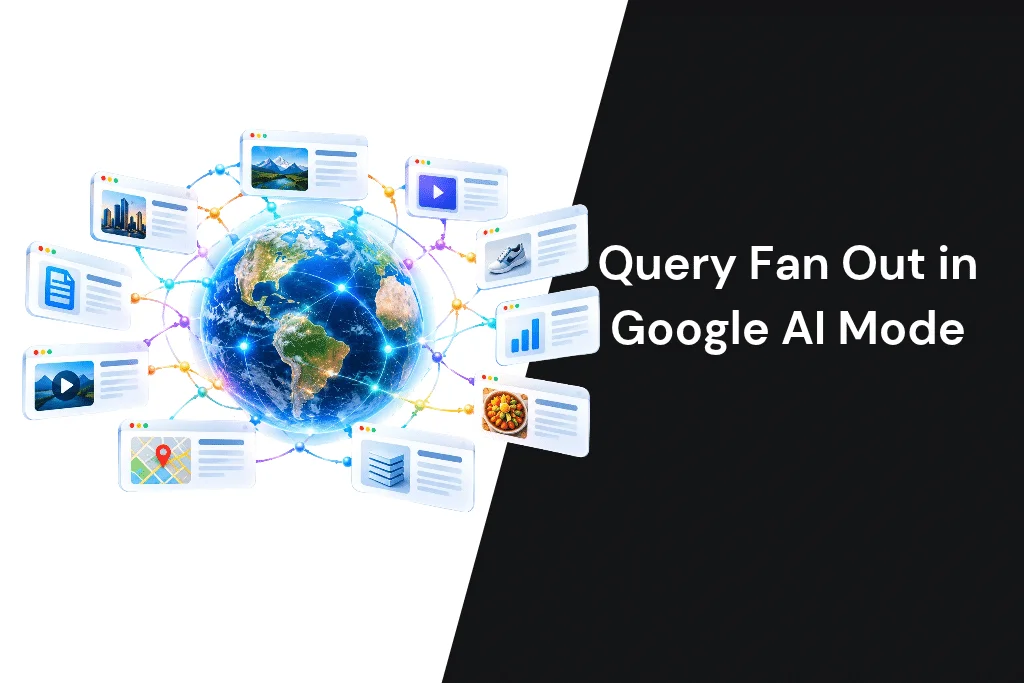
Query fan-out in Google AI Mode is a process in which a single user question is expanded into multiple related searches to explore different aspects of a topic. Instead of relying only on the original query, AI-powered search can investigate subtopics such as pricing, features, comparisons, integrations, and user requirements to gather relevant information from multiple sources.
For SEO professionals, query fan-out highlights the importance of creating comprehensive, trustworthy, and well-structured content that answers related user questions. By covering relevant subtopics, using clear headings, supporting claims with credible evidence, and maintaining technically accessible pages, websites can improve their usefulness for AI-powered search experiences. However, covering these topics does not guarantee that Google AI Mode will cite a particular website.
What Is Query Fan-Out and How Does It Work?
Query fan-out is a search technique in which an AI system generates multiple related queries from an original user question to retrieve information about different aspects of the problem.
Instead of relying exclusively on the initial wording, the system can investigate related topics, compare relevant information, and gather additional evidence before generating a response. Google identifies query fan-out as part of the technology used in AI Mode and AI Overviews.
Consider the question: “How can I improve organic traffic for a new ecommerce website?”
The original question contains several possible information needs. The user may need technical SEO guidance, keyword research, category-page optimization, product descriptions, internal linking recommendations, and measurement advice. Investigating these areas can produce a more comprehensive response than answering only with a generic definition of SEO.
A simplified representation looks like this:
Original question → related queries → information retrieval → relevant evidence → synthesized response
The important distinction is that query fan-out is not simply a list of synonyms. Related queries can explore different dimensions of a task, including causes, comparisons, alternatives, constraints, and implementation steps.
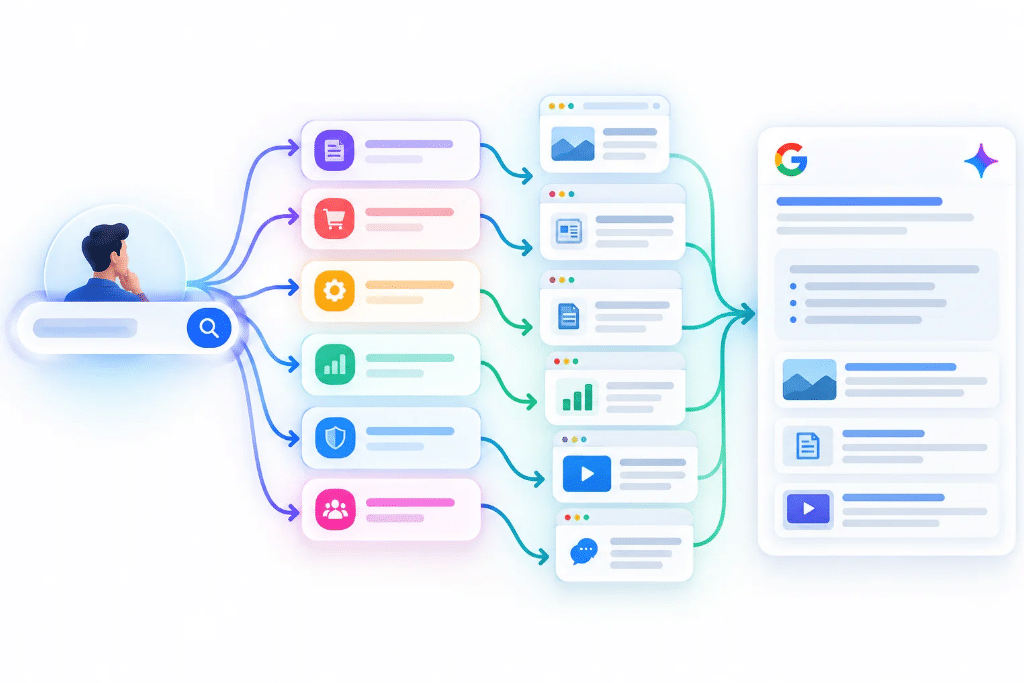
The Anatomy of an AI-Driven Search
Imagine a marketing director asking, “Which analytics platform is best for a subscription business with a small team?”
A search system could need information about:
- Subscription and recurring-revenue reporting.
- Integration with payment and customer relationship management systems.
- Implementation effort and ongoing maintenance.
- Pricing and team access.
- Privacy, data governance, and reporting limitations.
- Differences between competing platforms.
Each dimension represents a different information need. A useful response must connect the original question to evidence relevant to those needs.
This illustrates the relationship between search intent analysis, query decomposition, and semantic relevance. The system needs to interpret what the user is trying to accomplish, identify related aspects of the question, and retrieve information that can help answer them.
For content teams, the practical lesson is to research the complete decision rather than focusing exclusively on the exact phrase entered into a search box.
From Query Expansion to Parallel Retrieval
Traditional query expansion can involve identifying related words, concepts, or alternative expressions. Query fan-out extends the idea by allowing related searches to investigate different aspects of a question.
For example, “best project management software for agencies” might lead to research around client collaboration, resource allocation, time tracking, integrations, pricing, and reporting.
These searches may retrieve different documents or different parts of the same document. The resulting evidence can then contribute to the final response.
However, marketers should distinguish this general explanation from undocumented implementation details. Google does not publicly expose every generated query for every AI Mode response. An SEO monitoring tool that produces a list of possible subqueries is offering a useful research model, not necessarily a verified record of Google’s internal retrieval activity.
The distinction matters because optimization decisions should be based on observable evidence, documented search guidance, and genuine user needs rather than assumptions about a hidden algorithm.
The Five Stages of the Query Fan-Out Process
Query fan-out can be understood through five conceptual stages: intent analysis, subquery generation, retrieval, passage selection, and synthesis. This framework makes the process easier to understand, although it should not be interpreted as a complete or fixed technical specification of Google’s systems.
Stage 1: Intent Analysis and Classification
The first challenge is understanding what the user wants to accomplish.
A query such as “What is customer churn?” primarily requests a definition. A question such as “How can a SaaS company reduce customer churn without increasing its acquisition budget?” asks for strategic advice and introduces a financial constraint.
The second question implies a richer set of information needs: churn measurement, customer retention, onboarding, product adoption, customer feedback, pricing, and cost-effective interventions.
This is why user intent mapping is useful for SEO. Content teams can classify questions as informational, comparative, transactional, or procedural and then investigate the additional context that changes the answer.
A strong content brief should record the audience, the problem being solved, the decision the reader needs to make, and the evidence required to support the recommendation.
Stage 2: Decomposition and Subquery Generation
After interpreting the question, an AI search system can generate related queries that explore relevant subtopics.
For example, “How do I improve website conversion rates?” may imply questions about landing-page clarity, form length, mobile usability, trust signals, checkout friction, and experimentation.
These are not interchangeable keywords. Each represents a different potential cause of poor conversion performance.
This distinction separates meaningful query decomposition from superficial keyword expansion. A useful supporting question adds a new dimension to the problem. A near-identical rephrasing may add little.
Content strategists can apply the same principle manually by collecting questions from customer interviews, support tickets, sales calls, search results, and product documentation. The result is a more complete picture of the topic’s informational requirements.
Stage 3: Parallel Retrieval Across Sources
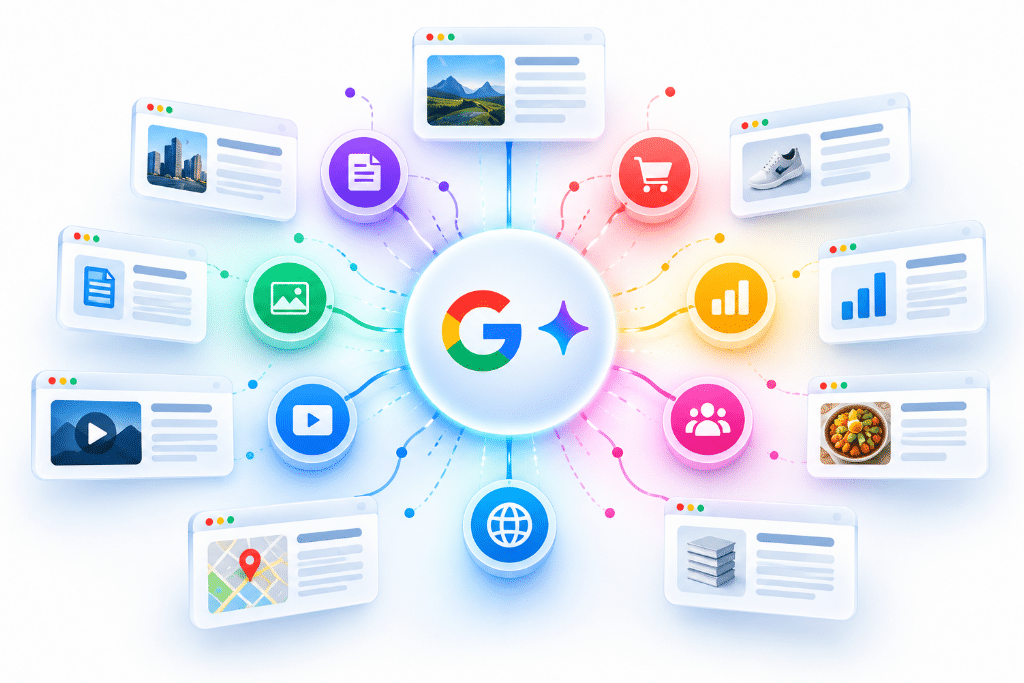
Google describes query fan-out as issuing multiple related searches concurrently across subtopics and data sources. This enables the search experience to gather information from different areas relevant to the original request.
In practice, one source may explain a technical concept, another may document a product limitation, and another may provide a comparison or example.
This is closely related to AI information retrieval, semantic search, and contextual search. The system needs information that is relevant to a particular part of the user’s question, not merely a page containing the original keyword.
For website owners, technical accessibility remains important. A page that cannot be crawled or indexed appropriately may not be eligible to appear as a supporting link in Google Search’s AI features.
Retrieval is not guaranteed, however. A technically accessible page can still be excluded from a particular response because its information is not selected, sufficiently relevant, or useful for that query.
Stage 4: Passage Selection and Relevance
A long article may contain several useful answers, but the relevant information can be difficult to identify if it is buried beneath vague headings or surrounded by repetitive text.
Clear section titles, accurate definitions, concise explanations, useful examples, and well-supported claims improve the experience for readers and help search systems interpret the page.
For example, a section titled “How to Calculate Customer Churn” communicates its purpose more clearly than “Important Business Considerations.”
This does not mean every paragraph must follow a rigid template. It means that passage-level relevance starts with making the content’s meaning explicit.
A practical approach is to give each substantial section a distinct purpose, explain the key concept directly, support important claims with evidence, and connect the explanation to the larger topic.
Stage 5: Synthesis and Citation Generation
The final response combines information into an answer that addresses the original question. The response may include summaries, comparisons, recommendations, and links to relevant sources.
Different sources may support different parts of the answer. One page might explain the underlying concept, while another provides the strongest evidence for a particular implementation detail.
This creates an important distinction between being relevant to a broad topic and being useful for a specific information need.
A website may publish excellent general content about analytics yet lack the detailed information needed to support a comparison of privacy controls. Improving the relevant section may make the resource more useful, but it does not guarantee that Google will cite it.
AI search visibility therefore depends on more than repeating a primary keyword. It involves creating useful information that can satisfy distinct questions while maintaining accuracy, originality, and trustworthiness.
Why Traditional Keyword SEO Is No Longer Enough
Traditional keyword research remains valuable, but a list of target phrases does not always reveal the full information needs behind a complex question.
A keyword such as “project management software” could represent a beginner researching the category, a manager comparing products, or a buyer looking for a specific integration. Those users may need substantially different answers.
Query fan-out makes this distinction especially relevant because AI-powered search can explore multiple aspects of a question and retrieve information from different sources.
Why Ranking for the Main Keyword May Not Earn an AI Citation
Organic rankings and AI citations are related but different outcomes.
A page may rank well for a broad keyword because it is relevant to that query. However, an AI-generated response may need a specific detail that the page does not provide clearly or substantiate adequately.
Consider a company publishing a guide titled “The Complete Guide to Email Marketing.” The guide explains campaign strategy but says little about unsubscribe compliance, deliverability monitoring, or segmentation for multilingual audiences.
A competing resource may offer more specific evidence on one of those questions. Depending on the query and retrieval process, the second resource could be more useful for supporting that part of an AI-generated response.
This is a practical illustration, not a claim that specificity always beats authority or that rankings have no relationship to AI visibility.
Google’s AI features documentation states that established SEO best practices remain relevant. Pages must meet the applicable technical requirements to be eligible for inclusion, and eligibility does not guarantee that a page will be crawled, indexed, or displayed.
Consequently, marketers should not interpret AI citations as a completely separate ranking system with an entirely independent set of optimization rules.
How Semantic Coverage Helps Meet Multiple User Needs
Semantic SEO involves helping users and search systems understand the relationships among concepts, entities, and information needs.
A guide about CRM software may reasonably cover contact management, sales pipelines, reporting, integrations, implementation, and security. Those topics are related because they influence the same purchasing decision.
The goal is not to insert every related phrase into one article. The goal is to provide the information readers need at the appropriate level of detail.
A comprehensive guide can introduce each topic and link to deeper resources when the information warrants a separate page. A dedicated integration guide, for instance, may serve a different purpose from a general CRM buying guide.
This approach supports topic clustering, internal linking, and coherent content architecture.
It also reduces the risk of keyword stuffing. Repeating “best CRM,” “top CRM,” “CRM software,” and “leading CRM solution” without adding useful information does not make a page more comprehensive.
The stronger strategy is to identify meaningful subtopics, answer them accurately, and organize the material so that readers can navigate from a broad question to the details they need.
How to Optimize Content for Query Fan-Out: A Practical Framework
The most useful response to query fan-out is a repeatable editorial process, not an attempt to reverse-engineer every hidden search.
A practical framework has six steps: define the core question, identify related needs, map existing content, strengthen the evidence, improve technical accessibility, and measure outcomes.
Build Topic Clusters Around Real Decisions
Begin with a core question that your audience genuinely needs answered.
For a project management software company, the parent topic might be “How to Choose Project Management Software for a Growing Team.”
Related questions could cover collaboration, workflow automation, permissions, reporting, integrations, and pricing.
Group the questions by the underlying task. Some belong in the main buying guide; others may require separate resources because they involve substantial technical detail or a different audience.
A useful rule is to create a new page when it provides distinct value, not merely because a new keyword variation exists.
For example, a detailed guide to connecting a project management tool with an accounting platform may justify a dedicated page. A page that repeats the same buying advice under a slightly different headline probably does not.
Use Search Questions to Discover Subqueries
Keyword tools provide a starting point, but customer language often reveals needs that conventional keyword lists miss.
Collect questions from:
- People Also Ask and related searches.
- Customer support conversations and frequently asked questions.
- Sales objections and product demonstrations.
- Product reviews and relevant public forum discussions.
- Search Console queries and landing-page performance.
- Customer interviews and onboarding feedback.
Classify each question by intent, audience, importance, and the evidence needed to answer it.
A spreadsheet can include the question, its source, the relevant URL, the current answer, the evidence supporting the answer, and the next editorial action.
Public forum discussions can help reveal authentic concerns, but individual comments should not be treated as universal facts. If an article uses a direct quotation from Reddit, verify the original wording and link to the actual discussion. Never invent a quotation to make an article appear more authentic.
Create Self-Contained, Evidence-Rich Content Sections
Each major section should answer a specific question clearly enough that readers understand its point without having to reconstruct the explanation from several distant paragraphs.
Start with the answer, explain the reasoning, provide supporting evidence, and then add an example or qualification where useful.
For instance, a section about CRM implementation costs should distinguish subscription fees from migration, training, integration, and ongoing administration. It should also explain which costs vary by company size and system complexity.
This structure improves usefulness without reducing the article to disconnected snippets.
Use descriptive headings, comparison tables where they genuinely help, original examples, and source links for material claims. Explain limitations rather than presenting every recommendation as universally applicable.
These principles align with Google’s guidance on creating helpful, reliable, people-first content.
Implement Structured Data and Consistent Entity Information
Structured data provides machine-readable information about the content of a page. Depending on the page, appropriate markup may describe an article, organization, product, or other supported entity.
For example, accurate Article markup can identify an article’s headline, author, and publication details. Organization markup can help describe a business and its identity.
Structured data should reflect the actual content visible to users and follow the requirements for the relevant search feature. It is not a shortcut to AI citations, nor does adding markup guarantee enhanced search results.
Maintain consistent business names, product descriptions, author information, and relevant facts across your website. Update outdated details and avoid publishing conflicting claims across different pages.
The purpose is to communicate clearly, not to manufacture artificial authority.
Strengthen Brand Authority With Verifiable Information
Trust grows when readers can understand who created the content, how claims were established, and why the recommendations should be taken seriously.
For product comparisons, provide clear evaluation criteria. For research-based articles, link to original studies when possible. For practical guides, distinguish first-hand experience from general recommendations.
A page discussing analytics software, for example, should not claim that a particular platform is the most accurate unless the statement is supported by a credible methodology and relevant evidence.
Independent reviews, original research, documented case studies, and transparent limitations can strengthen the usefulness of a resource.
This is particularly important when content influences significant decisions. Google’s Search Quality Evaluator Guidelines emphasize the role of main-content quality, effort, originality, reputation, and trustworthiness in assessing pages.
These concepts should inform editorial standards, but they should not be misrepresented as a checklist that guarantees a particular search ranking.
Keep Technical SEO Fundamentals in Place
Content cannot help readers discover a page through search if the page is inaccessible to the relevant crawling and indexing systems.
Review crawlability, indexability, canonicalization, internal links, mobile usability, page rendering, and appropriate use of robots directives. Ensure that important resources are connected to the site’s information architecture.
Use Google Search Console to investigate indexing problems and understand organic search performance.
Technical eligibility is a prerequisite for potential inclusion, not a promise of visibility. Equally, technical SEO does not compensate for content that fails to answer the user’s question.
A Worked Example: Turning One Question Into a Content Plan
Consider the following hypothetical search:
“What is the best CRM for a 20-person B2B SaaS company with Slack integration?”
The question sounds like a product comparison, but it contains several constraints. The business operates in B2B SaaS, has a team of twenty people, and requires Slack integration.
A useful response needs to address more than the generic features of a CRM. It should explain how the options fit the company’s working environment.
The example below demonstrates how an editorial team can use query fan-out as a planning model. It is not a record of Google’s actual generated subqueries.
Map the Parent Query to Its Supporting Questions
Start by breaking the decision into meaningful dimensions.
| Information need | Supporting question | Content requirement |
| Pricing | What does a CRM cost for a 20-person team? | Explain per-seat pricing, tiers, and additional costs |
| Integration | How does the CRM integrate with Slack? | Document supported features and limitations |
| Security | What security and access controls are available? | Provide current, verifiable product information |
| Implementation | How long does CRM implementation take? | Explain migration, configuration, and training factors |
| Reporting | Can the CRM report on pipeline and revenue? | Describe reporting capabilities and limitations |
| Support | What support options are available? | Compare documented service and support arrangements |
| Alternatives | Which products meet the same requirements? | Use transparent comparison criteria |
The table provides a starting point for research. Each question corresponds to a genuine decision criterion rather than a superficial variation of the primary keyword.
The team can then investigate which questions are already answered well on the website and which require additional evidence.
Build an Evidence and Coverage Matrix
A content gap should be defined by missing or inadequate information, not merely by the absence of a keyword.
For each supporting question, record the current page, evidence, freshness, and next action.
| Supporting question | Existing resource | Evidence required | Editorial action |
| CRM pricing | Buying guide | Current pricing and billing conditions | Verify and update |
| Slack integration | Integration article | Official feature documentation | Expand integration details |
| Security | Product documentation | Current security and access-control information | Add sourced explanation |
| Implementation | Onboarding guide | Migration and training requirements | Add a realistic implementation checklist |
| Reporting | Feature comparison | Documented reporting capabilities | Improve comparison criteria |
| Support | Support page | Current service terms | Clarify available options |
| Alternatives | CRM comparison | Consistent evaluation criteria | Review competing products fairly |
This process prevents a common editorial mistake: creating another article before checking whether an existing page could answer the question better.
It also makes research more efficient. The writer knows which claims require verification and where the final resource needs improvement.
Decide What to Update, Expand, or Publish
Suppose the existing buying guide already explains pricing, reporting, and team collaboration. Publishing three new articles with almost identical information may create duplication rather than additional value.
A better approach could be to update the buying guide, improve its comparison table, and link to an existing detailed integration guide.
A separate security resource may be justified if the subject requires extensive technical explanation or serves a different audience.
The decision should depend on user intent, topic depth, available evidence, and the role of each page in the site’s information architecture.
After publication, the team can monitor organic search performance and a consistent sample of AI Mode prompts to understand whether the updated resources are appearing in relevant experiences.
The central lesson is simple: use query fan-out to discover missing information, not to justify publishing a page for every possible question.
Measuring Query Fan-Out SEO Performance
AI-generated answers introduce a measurement challenge because a website may receive visibility through a cited link even when the user does not click it. Conversely, a page may perform well in conventional search without appearing in a particular AI response.
SEO teams should therefore distinguish among search performance, AI visibility, referral traffic, and business outcomes.
Track AI Mentions, Cited URLs, and Citation Context
Build a repeatable set of prompts based on real audience needs.
For a CRM company, the sample might include questions about pricing, Slack integration, security, implementation, and product comparisons.
For each test, record:
- The date and exact prompt.
- Whether the brand appears in the response.
- Which website URLs are cited.
- The context in which the brand is mentioned.
- Whether the information attributed to the brand is accurate.
- Whether competing resources appear instead.
- Whether the result changes across repeated observations.
Keep the prompts consistent when comparing periods. Otherwise, changes in the wording of the question can be mistaken for changes in visibility.
Also distinguish between a brand mention and a citation. A system may mention a company without linking to its website, or cite a page without recommending the company as the best option.
Because AI responses can vary, treat a single observation as a data point rather than a definitive performance verdict.
Combine AI Visibility With Search Console Data
Google Search Console provides information about a site’s organic search performance, including impressions, clicks, click-through rate, and average position.
Use those metrics to understand how conventional search visibility changes as content is updated. Then compare them with AI visibility observations and referral traffic from relevant sources where analytics data allows.
These measurements answer different questions.
- Organic impressions indicate how often results from the site were shown in the applicable search reporting context.
- Clicks measure visits resulting from those impressions.
- AI citation observations show whether a resource appeared in the AI responses tested.
- Conversions measure whether visits or other attributable interactions contributed to business goals.
Do not assume that every AI appearance will be reported as a distinct metric in Search Console. Reporting behavior and available segmentation depend on Google’s systems and reporting tools.
Use Google Search Console to establish an organic performance baseline, and document the methodology used for any additional AI visibility tracking.
Run a Quarterly Content Coverage Audit
A quarterly review can help teams decide which content needs maintenance and which gaps matter most.
Start with the priority questions associated with the business’s core topics. Check whether each question has a clear, accurate answer, whether supporting claims remain current, and whether the right page is linked from relevant resources.
Then prioritize updates using three factors:
- Audience importance: How consequential is the question for the reader?
- Evidence gap: Is the existing answer incomplete, outdated, or weakly supported?
- Business relevance: Does improving the resource support an important customer need or business objective?
A high-priority security question may deserve immediate attention even if it has modest search volume. A minor wording variation that adds little value may not justify a separate project.
The objective is to build a sustainable content system rather than continuously chase changing search prompts.
Common Query Fan-Out SEO Mistakes to Avoid
Query fan-out is useful as a model for understanding complex information needs, but it can be misapplied. Several common mistakes waste editorial resources and can undermine the quality of a website.
Publishing Thin Pages for Every Keyword Variation
One tempting approach is to generate a separate page for every related question identified during research.
A team might publish separate articles for “best CRM for SaaS,” “top CRM for SaaS companies,” “leading SaaS CRM platforms,” and “CRM tools for SaaS teams,” even when all four pages answer essentially the same question.
The result can be a collection of overlapping resources with little original value.
Instead, group closely related questions and decide whether they belong in one comprehensive resource. Create separate pages when the audience, intent, evidence requirements, or task genuinely differs.
Google’s guidance on generative AI optimization explicitly warns against producing separate content for every possible variation of a query or fan-out query primarily to manipulate visibility. More pages do not automatically make a site more helpful or relevant.
Treating Speculative Fan-Out Counts as Google Specifications
The title of this article uses “twenty searches” as an illustrative framing. It should not be interpreted as a fixed technical rule.
The number of related queries may vary according to the question, the search experience, and the techniques used to generate a response. Google’s documentation describes query fan-out but does not promise that every prompt produces a set number of queries.
Likewise, third-party tools may estimate related questions or model possible retrieval paths. These outputs can support research, but they should not be presented as a direct view into Google’s internal systems unless the tool has a verified basis for that claim.
Focus on the informational needs that can be observed and served well.
Optimizing for AI Extraction Instead of Reader Value
Content written exclusively to appear in AI answers can become repetitive, unnatural, and unhelpful.
For example, an article may repeat a definition under several headings, add dozens of nearly identical FAQs, and bold every variation of the primary keyword. The page may appear optimized, but the reader gains little additional understanding.
A better resource answers the question directly, explains the reasoning, supplies relevant evidence, and makes limitations clear.
Google’s people-first content guidance encourages publishers to create satisfying, reliable content for people rather than producing material primarily to manipulate search rankings.
Use formatting to improve comprehension. Use keywords where they communicate meaning. Use FAQs when they answer genuine questions, not simply to increase page length.
Ignoring Evidence Quality and Content Maintenance
A comprehensive article can still be unreliable if its statistics are outdated, its quotations are inaccurate, or its recommendations lack support.
This is particularly important for software comparisons, pricing advice, technical instructions, and other topics where details change frequently.
Maintain source links, verification dates, and clear ownership for important claims. Update information when the underlying facts change rather than changing a publication date without substantive revisions.
For any content that makes a claim about Google’s systems, prioritize official Google documentation and clearly label interpretations as interpretations.
The aim is not to sound certain about every aspect of AI search. It is to explain what is known, identify what remains uncertain, and give readers a reliable framework for making decisions.
Conclusion: Build Content That Answers the Whole Question
Query fan-out changes how marketers should think about the information needs behind a search. A single question can involve several related decisions, and AI Mode can investigate those subtopics to generate a response with supporting links.
For SEO teams, the opportunity lies in identifying those real information needs and making the website’s best resources useful, accurate, accessible, and easy to understand.
Start by mapping the questions your audience actually asks. Review existing pages before creating new ones. Strengthen weak explanations with evidence, clarify technical details, connect related resources through internal links, and measure AI visibility separately from conventional search performance.
Avoid assuming that every related question needs a dedicated page or that a particular number of subqueries guarantees inclusion in an AI response.
Google’s published guidance continues to emphasize established SEO fundamentals and helpful, reliable, people-first content. Those principles remain a sound foundation for adapting to AI-powered search.
Ultimately, the best query fan-out strategy is not about predicting every search a model might perform. It is about building a resource that genuinely helps people explore a topic, evaluate their options, and make informed decisions.
FAQ
What is query fan-out in Google AI Mode?
Query fan-out is a technique in which an AI system generates multiple related searches across subtopics and data sources to gather information for answering a user’s question. Google documents its use in AI Mode and AI Overviews. It helps address complex questions that may involve several related information needs.
How many searches does Google AI Mode perform for one question?
There is no guaranteed fixed number of searches for every question. The number of related queries can vary with the task and the search experience. Google’s documentation describes the technique without promising a universal count. Claims about a specific number should be treated as examples or estimates unless supported by an appropriate source.
Does query fan-out mean traditional SEO is dead?
No. Google states that established SEO best practices remain relevant to its AI features. Technical accessibility, crawlability, indexing, useful content, and search relevance still matter. Query fan-out adds context for understanding how AI-powered search can investigate multiple information needs, but it does not eliminate the foundations of organic search optimization.
How can I optimize my website for Google AI Mode?
Start by identifying the questions your audience needs answered. Create clear, accurate content that addresses those questions, support important claims with credible sources, maintain sound technical SEO, and organize related resources logically. Review content for gaps and outdated information. These practices improve usefulness and eligibility, but they cannot guarantee a citation in an AI-generated response.
Does appearing in Google’s top 10 guarantee an AI citation?
No. An organic ranking does not guarantee inclusion in an AI-generated response. AI Mode may retrieve and synthesize information according to the particular question and available evidence. Maintain strong organic SEO while separately monitoring AI visibility, cited URLs, referral traffic, and business outcomes.