
AEO vs GEO vs LLMO: What the New AI Search Terms Actually Mean
Search is changing. Instead of typing a short keyword into Google and opening several websites, people can now ask AI-powered search engines detailed questions, compare businesses through conversational interfaces, and receive synthesized answers with links to supporting sources.
For businesses, this creates a new challenge: being visible in search results is no longer the only way to be discovered. Brands also need to be understandable, credible, and discoverable within AI-generated answers.
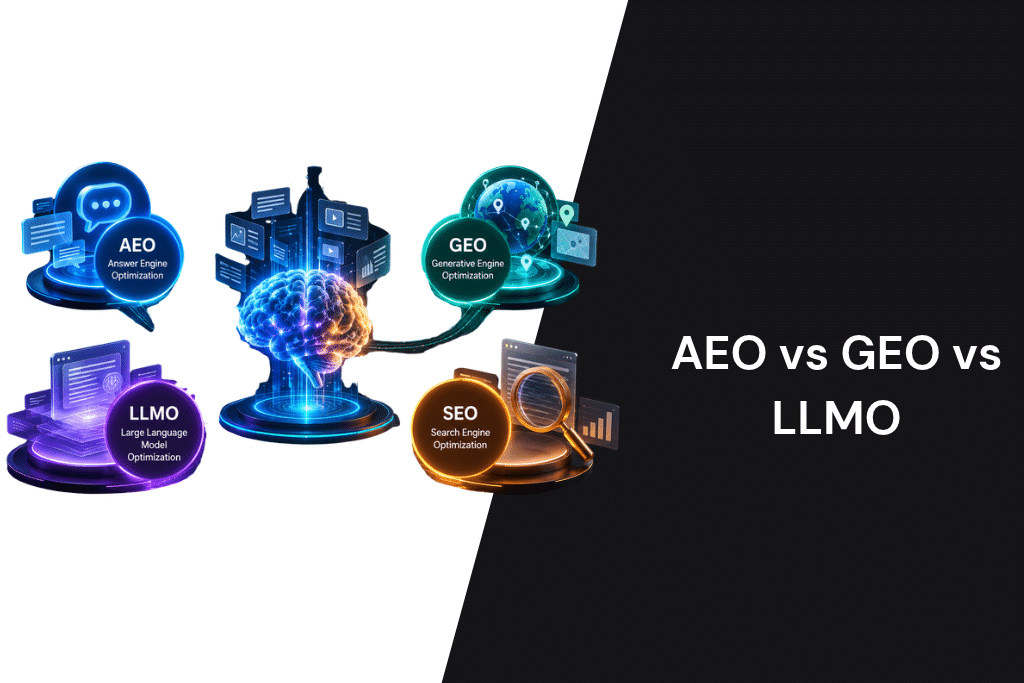
This shift has introduced three increasingly popular terms in digital marketing: Answer Engine Optimization (AEO), Generative Engine Optimization (GEO), and Large Language Model Optimization (LLMO).
Although these terms overlap, they describe different ways of thinking about visibility in AI-powered discovery. AEO focuses on providing direct answers to users’ questions. GEO emphasizes visibility within generative search experiences, including citations and brand mentions. LLMO focuses on how a brand’s information can be accessed, understood, and represented across large language model-powered systems.
However, the terminology is not universally standardized. Different marketers and platforms may use these labels differently, and none guarantees that a particular brand will appear in an AI response.
For businesses investing in SEO, content marketing, digital PR, and online brand building, understanding the differences can help turn confusing industry terminology into a practical strategy.
In this guide, we explain what AEO, GEO, and LLMO mean, how they work, where they overlap, and how businesses can combine them to improve their visibility across traditional search engines and emerging AI experiences.
Why AI Search Has Created a New Set of Optimization Terms
Traditional search engine optimization has largely focused on helping webpages appear prominently in search results for relevant queries. Businesses research keywords, publish useful content, improve technical performance, build authority, and work to attract qualified organic traffic.
These practices remain important. What is changing is how people discover, consume, and evaluate information.
AI-powered search experiences can interpret complex questions, combine information from different sources, summarize key findings, and present relevant links alongside generated responses. Conversational AI assistants can also answer questions using information available to them through training, search tools, retrieval systems, or connected applications.
Google’s documentation on AI search explains that experiences such as AI Overviews and AI Mode continue to rely on foundational search systems and can use techniques such as query fan-out to explore related subtopics. This means a single complex question may lead to multiple related searches rather than one simple keyword lookup.
Consider a business owner searching for a digital marketing agency in Dubai.
A traditional search might involve entering:
- Digital marketing agency Dubai
- SEO services in Dubai
- Best digital marketing company for ecommerce
The business owner then visits several websites to compare services, expertise, reviews, and pricing.
With an AI-powered search experience, the same person might ask:
“Which digital marketing agencies in Dubai are suitable for an ecommerce brand that needs technical SEO, paid advertising, and conversion optimization?”
The answer may synthesize information from agency websites, service pages, industry publications, comparison articles, and other available sources. Depending on the platform, it may also provide citations or links for further investigation.
This changes the visibility challenge. A business needs more than a page that targets a keyword. It needs information that is relevant to the question, accessible to the system, credible enough to be considered, and useful in the context of the answer.
The difference between ranking and being referenced
Traditional SEO commonly measures rankings, impressions, clicks, and conversions. AI search introduces additional questions:
- Does the AI system mention the business when relevant questions are asked?
- Does it describe the company’s services accurately?
- Does it cite the business’s website or other authoritative sources?
- Does the business appear in relevant comparisons?
- Can potential customers discover and evaluate the brand through an AI-generated response?
These questions do not replace traditional SEO metrics. They expand the way businesses evaluate discoverability.
This is where AEO, GEO, and LLMO become useful concepts. They help marketers organize their work around different aspects of search visibility rather than treating every AI-related activity as a completely new discipline.
What Is Answer Engine Optimization (AEO)?
Answer Engine Optimization (AEO) is the practice of making content easy for search systems and AI-powered tools to interpret and use when responding to specific questions.
The central idea is straightforward: understand what the audience wants to know, provide a clear and accurate answer, and structure the supporting content so that users and search systems can understand it.
AEO builds on established SEO practices such as search intent analysis, useful content creation, semantic structure, and technical accessibility. It places particular emphasis on question-based discovery and direct answers.
For example, a user might ask:
“What is the difference between SEO and paid search advertising?”
A useful page would explain the difference immediately, then provide supporting details, examples, advantages, limitations, and guidance on choosing the right approach.
Rather than hiding the answer beneath a long introduction, the content gives the reader a clear starting point.
How AEO works
AEO begins with understanding the questions people ask before making decisions.
These questions can arise at different stages of the customer journey:
- Awareness: What is generative engine optimization?
- Consideration: How is GEO different from traditional SEO?
- Evaluation: Which AI search optimization services does my business need?
- Decision: How much does an AI SEO agency charge?
Content should address each question in a format appropriate to its complexity.
A simple definition may require only a few sentences. A comparison between two services may need a table. A technical question may require a detailed explanation with examples and supporting evidence.
The objective is not to make every page short. It is to make the answer easy to find and understand while providing enough context to satisfy the user’s intent.
AEO can support visibility across several types of search experiences:
- Featured snippets and other answer-oriented search features, where eligible.
- Voice and conversational search.
- Search results that highlight direct answers.
- AI-powered search experiences that retrieve and summarize relevant web content.
These placements depend on the search platform’s systems and eligibility rules. Writing a direct answer does not guarantee that it will be selected.
Key AEO strategies
1. Target real customer questions
Keyword research should extend beyond short commercial phrases.
Instead of targeting only “SEO services Dubai,” identify the questions potential customers ask before hiring an agency:
- What do SEO services include?
- How long does SEO take to produce results?
- How much does SEO cost in Dubai?
- Is technical SEO necessary for ecommerce websites?
- How can a business measure SEO performance?
These questions can inform service pages, educational articles, comparison guides, and FAQs.
The most useful questions are those that reflect genuine customer needs, not simply variations generated to increase the number of pages on a website.
2. Provide a clear answer early
Use a question as a heading when it accurately reflects the topic, then answer it directly.
For example:
What is Answer Engine Optimization?
Answer Engine Optimization is the practice of structuring useful, accurate content so that search systems can identify and use it to answer relevant questions. It builds on SEO fundamentals, including search intent, content quality, and technical accessibility.
The page can then explore implementation, benefits, examples, and limitations.
This format improves readability and makes the relationship between the question and the answer explicit.
3. Organize content with descriptive headings
A well-organized article should follow a logical hierarchy.
Use an H1 for the main topic, H2 headings for major sections, and H3 headings for related subtopics. Headings should describe the content that follows rather than exist solely to include keywords.
Short paragraphs, numbered steps, comparison tables, and relevant examples can also help readers navigate complicated topics.
4. Use structured data appropriately
Structured data can help search engines interpret specific information about a webpage, organization, product, or other supported entity.
However, schema markup should accurately reflect visible page content and follow the relevant platform’s documentation. Adding FAQ or other schema does not guarantee a featured snippet, rich result, or AI citation.
The priority should be accurate content and technically sound implementation, with structured data used where it is appropriate.
5. Answer questions across the customer journey
AEO should not be limited to FAQs.
A business may need definitions for early-stage discovery, detailed guides for education, comparison pages for evaluation, and transparent service information for purchase decisions.
The strongest approach connects these resources through internal links so that readers can move naturally from understanding a problem to evaluating solutions.
When should businesses prioritize AEO?
AEO is particularly useful for businesses whose customers frequently ask questions before making a purchase.
Examples include:
- Professional service providers explaining complex offerings.
- Healthcare, finance, and legal organizations that need clear and carefully qualified explanations.
- SaaS companies answering product and integration questions.
- Ecommerce brands addressing product specifications, sizing, compatibility, and purchasing concerns.
- Local businesses answering questions about service areas, availability, pricing, and processes.
For a Dubai-based digital marketing agency, an AEO-focused content strategy could include clear service definitions, pricing factors, local SEO guides, campaign FAQs, and practical explanations of marketing performance.
The goal is to answer genuine customer questions while creating a useful path toward the next step.
What Is Generative Engine Optimization (GEO)?
Generative Engine Optimization (GEO) is the practice of improving the likelihood that a brand’s content and expertise will be discovered, referenced, or cited in AI-generated search responses.
While AEO emphasizes answering questions effectively, GEO focuses more broadly on how information contributes to responses generated by AI-powered search experiences.
These responses may combine information from multiple webpages, summarize different viewpoints, and link to sources that support particular claims. As a result, businesses need to think about how their expertise can contribute meaningfully to the wider body of information available online.
The term GEO gained academic visibility through research presented at the ACM SIGKDD 2024 conference. The research examined how content optimization could improve visibility in generative engines, including through approaches such as adding relevant statistics, quotations, and credible source material. Its findings provide a research foundation for the concept, although they should not be interpreted as a universal formula for ranking in every AI platform.
How GEO works
Imagine a company that provides ecommerce SEO services.
A potential customer asks an AI-powered search engine:
“How can an online store improve organic traffic without increasing its advertising budget?”
The generated answer might discuss technical SEO, category-page optimization, product descriptions, internal linking, and content strategy. It may draw on several sources rather than reproduce one complete article.
For the ecommerce agency, the opportunity is to publish material that contributes useful, credible information to this discussion.
That could include:
- An original analysis of common ecommerce indexing problems.
- A detailed guide to optimizing category and product pages.
- A case study explaining how a specific technical issue was diagnosed.
- A comparison of different approaches to improving organic visibility.
- Expert commentary supported by evidence and practical experience.
The aim is not simply to repeat popular SEO advice. It is to provide information that helps answer a question better than generic content alone.
GEO also involves understanding the difference between a brand mention and a citation. An AI system might name a company without linking to its website, cite one of its articles without recommending its services, or mention competing businesses instead. These outcomes are related, but they are not interchangeable.
Key GEO strategies
1. Publish original and evidence-based content
AI search systems can draw on many sources covering the same subject. Content that contributes original information gives readers a stronger reason to consult it.
Useful forms of original material include:
- Industry surveys and research.
- First-hand case studies.
- Expert interviews and commentary.
- Data-backed comparisons.
- Practical experiments and documented results.
- Detailed explanations of lessons learned from real projects.
For example, rather than publishing another article titled “10 SEO Tips for Ecommerce,” an agency could investigate recurring technical SEO issues across a defined sample of ecommerce websites.
It could explain the methodology, present the findings, discuss limitations, and provide actionable recommendations.
This creates a more distinctive resource for readers, journalists, industry publications, and potentially AI-powered discovery systems.
Any results should be accurately represented, and claims should not be presented as universal when they come from a limited sample.
2. Build credibility through external sources
A website’s own claims are only one part of how people evaluate a business.
Third-party references can help establish that a company, product, or individual has a verifiable presence in its industry.
Relevant sources may include reputable industry publications, professional associations, expert interviews, business directories, independent reviews, and legitimate editorial coverage.
For a digital marketing agency in Dubai, this could mean contributing practical insights to respected marketing publications, publishing original research, participating in relevant industry discussions, and maintaining accurate company information across legitimate business profiles.
The goal is to earn credible recognition, not to manufacture mentions or distribute repetitive promotional content across unrelated websites.
3. Cover topics comprehensively
A useful GEO strategy considers the range of related questions that make up a customer’s information need.
For example, a guide to local SEO might cover:
- Google Business Profile optimization.
- Local keyword research.
- Location-specific landing pages.
- Business information consistency.
- Customer reviews and reputation management.
- Local links and community relevance.
- Performance measurement.
These subjects should be connected naturally and explained with enough depth to help readers make informed decisions.
Comprehensive coverage does not mean writing the longest possible article. It means covering the important dimensions of the topic without unnecessary repetition.
4. Make claims specific and verifiable
Vague statements are difficult for readers to evaluate.
Compare these two examples:
- “Our SEO strategy delivers outstanding results.”
- “Our process includes technical audits, category-page analysis, internal-link reviews, and monthly reporting on organic visibility and qualified leads.”
The second statement provides concrete details that a potential customer can evaluate.
When publishing statistics or performance claims, include the relevant source, timeframe, context, and methodology. When describing a case study, explain the work performed and avoid implying that one result guarantees the same outcome for every business.
This approach supports both human trust and the broader objective of making information reliable and easy to interpret.
5. Strengthen content relationships
Generative search may explore several related questions to answer a complex request. Google describes this process as query fan-out in some AI search experiences.
Businesses can respond by building well-connected topic clusters.
For example, a central guide to AI search optimization might link to supporting articles on:
- AEO vs GEO vs LLMO.
- Training data vs live retrieval.
- How AI search systems find sources.
- Technical SEO for AI discovery.
- Measuring AI search visibility.
- Building brand authority through digital PR.
Each article should contribute distinct value. Internal links should help readers understand relationships between subjects rather than exist simply to increase link counts.
When should businesses prioritize GEO?
GEO is especially relevant for companies that want their expertise to be visible when customers research solutions, compare providers, or explore complicated subjects through AI search.
Examples include:
- B2B companies with long consideration cycles.
- Professional service firms competing on expertise.
- Technology companies explaining complex products.
- Ecommerce brands targeting product comparisons.
- Agencies building authority in competitive markets.
- Businesses that depend on research-driven customer journeys.
For Octopus Marketing Agency, GEO can be incorporated into an integrated strategy combining high-quality SEO content, technical accessibility, digital PR, original insights, and clear service information.
However, no agency can guarantee a specific citation, mention, or recommendation from a generative search platform. GEO should be treated as a disciplined approach to improving discoverability and credibility, not a promise of placement.
What Is Large Language Model Optimization (LLMO)?
Large Language Model Optimization (LLMO) is an emerging term for efforts to improve how a brand’s information is discovered, understood, and represented in large language model-powered systems.
A large language model, or LLM, is an AI model trained to process and generate language. These models can power conversational assistants, content tools, research applications, customer support systems, and search experiences.
The term LLMO is used inconsistently across the industry. Some practitioners use it to describe visibility in AI assistant responses, while others emphasize how brand information is structured, retrieved, or represented in LLM-powered applications.
It is therefore best understood as a practical working concept rather than a universally standardized marketing discipline.
How LLMO works
An important starting point is understanding that an AI model does not necessarily obtain every answer from the same source.
Depending on the product and its configuration, a response may draw on:
- Training-derived knowledge: Information and patterns learned during model training.
- Live search and retrieval: Information retrieved from webpages or other available sources during a session.
- Connected data sources: Information supplied through authorized tools, documents, databases, or integrations.
- User-provided context: Information included in the current conversation or supplied to the application.
These mechanisms have different implications for business visibility.
A model’s training-derived knowledge may not reflect the latest business updates. A search-enabled assistant may retrieve current information but still overlook a relevant page. An enterprise AI application may answer using a company’s internal knowledge base rather than public search results.
This is why a business should not assume that every AI assistant learns about brands in the same way.
For example, a company might update its website to reflect a new service offering. That change could become discoverable through search after crawling and indexing, but it does not follow that every LLM will immediately incorporate the update into its underlying model.
Similarly, an AI assistant may retrieve a current service page in one conversation without retaining that information as permanent model knowledge.
Key LLMO strategies
1. Maintain a consistent brand identity
Businesses should communicate their identity consistently across their website and relevant external sources.
Important information includes:
- Official business name.
- Core services and product categories.
- Geographic locations and service areas.
- Leadership and team expertise.
- Contact information.
- Company history and credentials.
- Clearly documented specializations.
If a company describes itself as a digital marketing agency on one platform, a software vendor on another, and a branding consultancy elsewhere, readers may struggle to understand its actual positioning.
Some differences may be legitimate, but the company’s identity and core facts should remain clear.
Consistency does not mean copying the same promotional paragraph everywhere. It means maintaining a stable set of accurate facts while tailoring the message to each platform and audience.
2. Build authoritative brand information
A business should provide clear, factual information about what it does, whom it serves, and what distinguishes its expertise.
For an agency, this may include detailed service pages, team biographies, case studies, methodology descriptions, original articles, and transparent information about its location and experience.
External coverage can also help people independently verify the company’s presence and expertise.
The aim is to create a reliable body of information that can be consulted through multiple discovery paths. No single page or directory guarantees that a model will learn about or recommend the business.
3. Make important information accessible
A brand’s expertise has limited discovery value if its essential information cannot be accessed by relevant systems.
Review whether key pages can be crawled and indexed, whether service descriptions are available as readable text, and whether important content depends entirely on inaccessible interfaces or images.
Technical reviews should consider:
- Robots directives and crawl restrictions.
- Indexability and canonical URLs.
- Internal linking and navigation.
- JavaScript rendering where applicable.
- Page performance and mobile usability.
- Consistent and accurate structured data.
- Access policies for the specific AI or search services the business wants to support.
Access requirements differ across platforms. A page being accessible to one search crawler does not mean it is accessible to every AI service.
4. Monitor brand representation
Businesses should periodically test how relevant AI systems describe them.
Questions might include:
- What does this company do?
- Which services is it known for?
- Which industries does it serve?
- Where does it operate?
- What evidence supports its expertise?
- Which alternatives might a customer compare it with?
The purpose is to identify incorrect information, missing context, and gaps in the company’s public footprint.
Testing should use a consistent set of queries and record the platform, date, context, and sources cited. Results may differ between sessions and platforms, so one answer should not be treated as a definitive assessment of visibility.
5. Distinguish public visibility from private AI knowledge
A company may use an internal AI assistant connected to its own documents. Improving that assistant’s accuracy could require better document organization, metadata, permissions, retrieval settings, and knowledge-base maintenance.
That work differs from optimizing a public website for AI-powered search.
Both may be called LLMO in some discussions, but they solve different problems. Businesses should establish whether their objective is public discovery, accurate brand representation, or better performance within a private AI application before selecting tactics.
When should businesses prioritize LLMO?
LLMO is a useful lens for companies that want to maintain accurate brand representation across AI-powered experiences.
It can be especially relevant for:
- Businesses with complex product or service portfolios.
- B2B brands with specialized expertise.
- Companies with multiple locations or business units.
- Brands operating across several languages or markets.
- Organizations that use AI assistants connected to internal knowledge bases.
- Companies monitoring how AI platforms describe their products and services.
For a business serving customers across Dubai and the wider GCC, the practical priority is to maintain accurate service information, clear geographic coverage, credible evidence of expertise, and consistent brand details across relevant sources.
This work can support AEO and GEO as well. In practice, LLMO is often most valuable when treated as part of a broader information-quality and search-visibility strategy rather than a separate campaign built around an acronym.
AEO vs GEO vs LLMO: What Are the Key Differences?
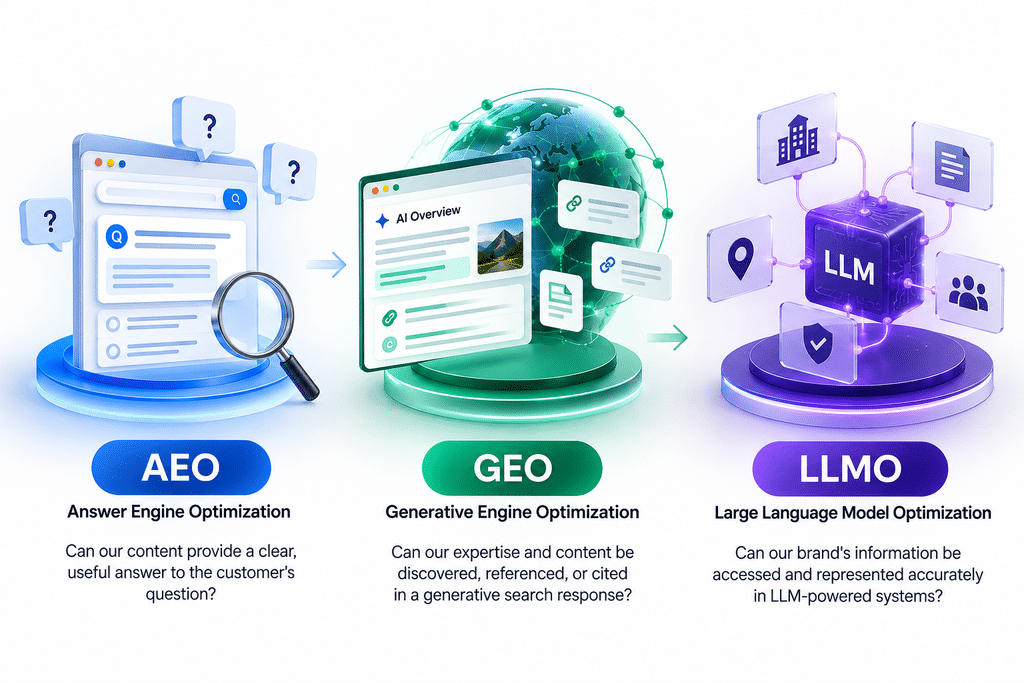
The easiest way to understand AEO, GEO, and LLMO is to compare the primary question each approach helps a business address.
- AEO: Can our content provide a clear, useful answer to the customer’s question?
- GEO: Can our expertise and content be discovered, referenced, or cited in a generative search response?
- LLMO: Can our brand’s information be accessed and represented accurately in LLM-powered systems?
These distinctions are useful for planning, but they are not rigid technical boundaries. A single well-researched, technically accessible article may support all three objectives.
AEO — Answer visibility
Focus on direct answers, question-led content, and making information easy to understand.
Example: A concise explanation of what technical SEO includes.
GEO — Generative search visibility
Focus on useful evidence, original insights, credible sources, and content that can support AI-generated answers.
Example: An evidence-based guide cited in an AI-powered search response.
LLMO — Brand information and representation
Focus on accessible, consistent, and authoritative information about a business across LLM-powered systems.
Example: An AI assistant accurately identifying a company’s services and geographic coverage.
Detailed comparison: AEO vs GEO vs LLMO
| Factor | AEO | GEO | LLMO |
| Main focus | Answering questions | Visibility in generative search | Brand discoverability and representation |
| Content priority | Clear, direct explanations | Evidence-rich, distinctive content | Accurate, consistent brand information |
| Common activities | Question research, FAQs, structured content | Original research, expert content, digital PR | Entity consistency, information accessibility, brand monitoring |
| Desired outcome | Useful answers and relevant answer placements | Relevant citations, references, and mentions | More accurate and consistent brand information in AI systems |
| Measurement | Answer visibility, relevant search performance | Citations, mentions, referral traffic | Accuracy, mentions, source coverage, consistency |
| Relationship to SEO | Builds on SEO | Builds on SEO and authority | Builds on accessible, reliable information |
The main distinction is one of emphasis. The underlying practices frequently overlap.
A clear service page may answer a question effectively, provide a useful source for a generative search system, and help an AI assistant understand what a business offers.
Are AEO, GEO, and LLMO replacing SEO?
No. Traditional SEO remains foundational to all three approaches.
Technical accessibility, crawlability, indexability, helpful content, internal links, and credible information continue to matter. Google’s published guidance for AI search explicitly states that established SEO best practices remain relevant and that there are no additional technical requirements specifically for appearing in AI Overviews or AI Mode beyond the applicable Search requirements.
This has an important implication for businesses: avoid abandoning proven SEO practices to chase unverified AI optimization tactics.
Instead, expand the SEO strategy to account for additional discovery experiences and measurement opportunities.
For example, a company should continue improving its organic search visibility while also checking whether its content is referenced in relevant AI responses. It should maintain accurate business information while investing in original expertise that can serve customers across multiple channels.
The goal is broader discoverability, not a replacement acronym for every existing SEO task.
Which Strategy Should Your Business Prioritize?
The right starting point depends on your audience, business model, current search performance, and the type of discovery you want to improve.
Rather than choosing one approach exclusively, identify the most important gap in your current visibility.
Prioritize AEO if customers need clear answers
AEO should receive attention when potential customers frequently search for explanations, definitions, instructions, or answers to specific questions.
For example, a SaaS company may need to answer questions about integrations, implementation, security, and pricing. A local service provider may need to explain service areas, appointment processes, and costs.
Start by identifying the questions customers ask before contacting the business. Build useful resources around those questions and make the answers easy to locate.
Primary objective: Help customers find and understand the information they need.
Prioritize GEO if your market depends on research and comparisons
GEO deserves particular attention when customers research several alternatives before deciding.
A B2B buyer comparing agencies, software platforms, or specialist consultants may want evidence, independent perspectives, case studies, and detailed comparisons.
In this situation, generic service descriptions may not be sufficient. The business needs content that demonstrates expertise and helps the buyer evaluate available options.
Primary objective: Make your expertise and evidence discoverable in relevant generative search experiences.
Prioritize LLMO if brand accuracy is a concern
LLMO is a useful starting point when AI systems misidentify the company, provide outdated service information, confuse it with another business, or omit important context.
Begin with an audit of the company’s public information. Check the official website, business profiles, relevant directories, third-party coverage, and other sources that customers may consult.
Correct inaccuracies where possible and ensure that the business’s services, location, expertise, and identity are clearly documented.
Primary objective: Improve the accuracy, consistency, and accessibility of brand information.
Why an integrated strategy is usually more practical
Consider a Dubai-based agency that offers technical SEO, paid media, content marketing, and conversion optimization.
An integrated strategy might include:
- AEO: Publish clear answers to questions about SEO pricing, campaign timelines, and service deliverables.
- GEO: Publish original case studies, useful research, and detailed comparisons that demonstrate the agency’s expertise.
- LLMO: Maintain consistent service descriptions, accurate company information, credible external references, and accessible website content.
- Traditional SEO: Continue improving keyword relevance, technical performance, internal links, and organic rankings.
These activities reinforce one another. They also produce assets that can support several channels, making the approach more efficient than running three disconnected campaigns.
How to Build an Integrated AEO, GEO, and LLMO Strategy
An effective implementation plan begins with the business’s customers and information needs, not with the latest terminology.
The following seven steps provide a practical framework.
Step 1: Audit your existing search visibility
Before publishing new content, establish how the business currently appears online.
Review organic search performance, important landing pages, branded search results, business profiles, third-party mentions, and AI-generated responses for relevant questions.
For a website audit, examine:
- Which important pages are indexed.
- Which pages attract relevant organic impressions and clicks.
- Whether key service information is easy to find.
- Whether internal links connect related resources.
- Whether titles, headings, and page content accurately describe each page.
- Whether business information is consistent across major profiles.
For AI visibility, test a repeatable set of realistic questions across the platforms relevant to your audience.
Examples might include:
- Which agencies specialize in ecommerce SEO in Dubai?
- What should a business look for when choosing a digital marketing agency?
- Which services can help an online store increase organic conversions?
- How do technical SEO and conversion optimization work together?
Record whether the brand appears, what the response says, which sources are cited, and whether the information is accurate.
This baseline helps identify whether the priority is content quality, technical accessibility, brand consistency, or broader authority.
Step 2: Research customer questions and decision criteria
Traditional keyword research remains useful, but it should be combined with an understanding of customer questions and the decisions those questions support.
Use customer interviews, sales conversations, website search data, support queries, keyword research, and relevant industry discussions to identify recurring information needs.
Organize them by intent:
| Customer stage | Typical question | Suitable content |
| Awareness | What is GEO? | Educational guide |
| Understanding | How does GEO differ from SEO? | Comparison article |
| Consideration | What should a GEO strategy include? | Detailed implementation guide |
| Evaluation | How do agencies measure AI search visibility? | Framework and comparison |
| Decision | What does an AI search optimization service include? | Service page and FAQs |
This structure creates a content plan that serves users throughout the customer journey.
It also helps prevent a common mistake: producing many articles about closely related keywords without addressing distinct questions or offering additional value.
Step 3: Create helpful, differentiated content
Build content around the questions and problems your audience genuinely needs to solve.
Each page should have a clear purpose and deliver value beyond repeating commonly available information.
For an agency website, this may involve a combination of:
- Educational articles.
- Service pages.
- Original research.
- Case studies.
- Comparison guides.
- Expert commentary.
- Industry-specific resources.
- Detailed FAQs where they genuinely help users.
Use direct explanations for simple questions and more comprehensive treatment for complex topics.
For example, an article comparing AEO, GEO, and LLMO should do more than define three acronyms. It should explain how they differ, acknowledge their overlap, show practical use cases, and help readers decide which actions to take.
That is more useful than creating three separate pages that repeat the same generic recommendations.
Step 4: Strengthen technical SEO and content accessibility
Even valuable content needs to be discoverable.
Review your website’s technical foundation to ensure important information can be crawled, rendered, indexed, and accessed by the systems you want to reach.
Focus on the following:
Crawlability: Check robots directives, server responses, and relevant infrastructure restrictions.
Indexability: Review canonical URLs, duplicate pages, noindex directives, and index coverage.
Internal linking: Connect important service pages with relevant guides, case studies, and supporting resources.
Content accessibility: Ensure important information is available in readable text rather than only in images or inaccessible interface elements.
Mobile experience: Make sure pages are readable and usable across devices.
Structured data: Implement supported schema types accurately when appropriate, keeping the markup consistent with visible content.
Business information: Maintain accurate company details and relevant business profiles.
Do not assume that every AI system uses the same crawler or that a single technical change will improve visibility across all platforms.
Google’s official guidance specifically advises website owners to focus on established SEO fundamentals instead of relying on special files, markup, or optimization tricks that have no demonstrated requirement for its AI search features.
Step 5: Build credible authority beyond your website
Your website is the primary place to explain your business, but it is not the only source people use to assess credibility.
Develop a sustainable approach to earning relevant external recognition.
This may include:
- Contributing expert commentary to reputable publications.
- Publishing original research that others can reference.
- Participating in industry events and professional communities.
- Developing genuine partnerships and collaborative content.
- Encouraging honest customer reviews.
- Maintaining accurate business profiles.
- Sharing documented case studies with appropriate context.
Quality matters more than raw mention counts. A relevant editorial reference can be more valuable to a potential customer than dozens of repetitive listings on unrelated websites.
Avoid purchasing fabricated reviews, creating fake expert profiles, or manufacturing brand mentions solely to influence AI outputs. Such practices undermine credibility and may violate platform policies.
Step 6: Monitor AI answers and correct information gaps
Once the foundational work is in place, establish a repeatable monitoring process.
Select a representative group of questions related to your services, industry, brand, and competitors. Test them periodically across relevant AI search platforms.
Record:
- Whether the business is mentioned.
- Whether its website is cited.
- Which other sources appear.
- Whether the description is factually accurate.
- Whether the response reflects the intended service positioning.
- Whether the answer changes over time.
If a response contains incorrect information, investigate where the error may originate. It could reflect an outdated third-party page, ambiguous company positioning, incomplete public information, or the AI system’s own limitations.
Correcting the underlying source where possible is generally more useful than repeatedly editing unrelated pages in the hope of changing one AI answer.
Remember that responses can vary by query, session, location, and platform. A single test is not a reliable measure of long-term performance.
Step 7: Measure business outcomes and refine the strategy
Visibility is useful only insofar as it contributes to meaningful audience engagement and business goals.
Track both intermediate indicators and outcomes.
Intermediate indicators might include relevant citations, brand mentions, organic impressions, source coverage, and engagement with educational resources.
Business outcomes might include qualified leads, enquiries, product sales, assisted conversions, and revenue.
Review the results regularly and prioritize improvements based on their potential impact.
For example, if a service page receives relevant organic traffic but generates few enquiries, the next task may be improving the offer, evidence, user experience, or call to action—not producing another AI-focused article.
The objective is to build a sustainable discovery system that helps the right customers find, understand, and trust the business.
Common AEO, GEO, and LLMO Mistakes Businesses Should Avoid
The growing interest in AI search has created opportunities, but it has also encouraged misleading claims and unnecessary optimization work. Businesses should distinguish evidence-based practices from speculative tactics.
1. Treating the three terms as completely separate disciplines
AEO, GEO, and LLMO overlap considerably. Building three disconnected strategies can lead to duplicate content, fragmented reporting, and wasted resources.
Instead, organize your work around customer questions, content quality, technical accessibility, brand authority, and measurable outcomes. Use the three terms to identify different objectives within one integrated strategy.
2. Assuming schema markup guarantees AI citations
Structured data helps describe supported entities and content, but it is not a guarantee of visibility.
A page with valid schema may never appear in a particular AI answer. A page without elaborate structured data may still be discovered and referenced.
Use schema when appropriate, ensure it accurately reflects the visible content, and prioritize the usefulness and accessibility of the underlying information.
3. Publishing large quantities of generic AI content
Producing hundreds of similar articles does not automatically create authority.
Generic content often repeats familiar advice without offering original evidence, practical experience, or meaningful distinctions. This can leave readers with little reason to choose one source over another.
AI tools can support research, drafting, and content organization, but the final material should be reviewed for factual accuracy, relevance, originality, and usefulness.
4. Confusing mentions with recommendations
An AI assistant may mention a company as one example without endorsing it. A citation may support a factual claim without recommending the source’s services.
Businesses should track mentions, citations, recommendations, and referrals separately whenever the data allows.
This distinction helps prevent inflated reports about AI visibility.
5. Ignoring traditional SEO
AI search does not eliminate the need for crawlable pages, relevant content, internal links, good site performance, and a technically sound website.
Neglecting these fundamentals in pursuit of speculative AI tactics can weaken visibility across both traditional and AI-powered discovery.
6. Expecting immediate or guaranteed results
Changes to content and external references may take time to be discovered and processed. Different AI platforms also have different retrieval methods, source-selection systems, and update cycles.
No legitimate optimization strategy can guarantee that a particular brand will be cited, recommended, or mentioned in every relevant response.
Set realistic expectations, establish a baseline, and assess trends over time.
How to Measure AEO, GEO, and LLMO Performance
Measurement is one of the most important parts of an integrated AI search strategy. Businesses need to understand whether their work is improving discoverability and whether that visibility contributes to meaningful outcomes.
A practical measurement framework can be divided into four categories.
1. Answer visibility
For AEO, examine whether the business’s content appears in relevant answer-oriented search experiences.
Useful indicators include:
- Featured snippet appearances, where applicable.
- Search impressions for question-based queries.
- Organic clicks to educational pages.
- Performance of question-led landing pages.
- Engagement with content that addresses common customer questions.
These indicators help evaluate whether the content is reaching the intended audience.
2. Generative search visibility
For GEO, monitor how often the business or its content appears in relevant AI-generated responses.
Possible indicators include:
- AI-generated answer citations.
- Brand mentions in relevant responses.
- Number of distinct target questions where the brand appears.
- Sources cited alongside or instead of the brand.
- Referral sessions from AI platforms.
- Conversions associated with identifiable AI referrals.
A simple visibility rate can be calculated as:
VisibilityRate=RelevanttestswithabrandmentionTotalrelevanttests100
For example, if a brand appears in 18 out of 60 consistently tested queries, its measured mention rate is 30%.
This is a measurement of that particular test set, not a universal share of AI search visibility. The query set, platforms, dates, and criteria should remain consistent when comparing results.
3. Brand accuracy and representation
For LLMO, evaluate whether AI systems accurately describe the business.
Track:
- Correct business name and location.
- Accurate descriptions of services and products.
- Correct specialization and industry information.
- Consistency with official business details.
- Relevant source citations.
- Frequency and type of factual errors.
You can use a simple accuracy score:
AccuracyScore=CorrectfactsassessedTotalfactsassessed100
A score based on a defined set of facts is more useful than a subjective judgment that an answer “sounds right.” Sensitive or commercially important claims should be verified against authoritative sources.
4. Business outcomes
Ultimately, marketing performance should be evaluated against business objectives.
Monitor:
- Qualified enquiries.
- Lead-to-customer conversion rate.
- Ecommerce transactions.
- Revenue from identifiable referral sources.
- Assisted conversions, where measurable.
- Engagement with high-intent service and product pages.
Use analytics data and appropriate attribution methods to understand how search visibility contributes to customer acquisition.
Do not assume that every AI-influenced customer will appear as an AI referral in analytics. Someone might discover a brand through an AI answer and later visit the website directly or search for the brand separately.
Measurement should acknowledge this limitation rather than assigning all brand growth to a single channel.
The Future of AEO, GEO, and LLMO
The terminology around AI search will continue to evolve. New tools, retrieval methods, interfaces, and optimization frameworks may emerge as AI becomes more integrated into how people research products, services, and businesses.
However, the most durable principles are unlikely to depend on a particular acronym.
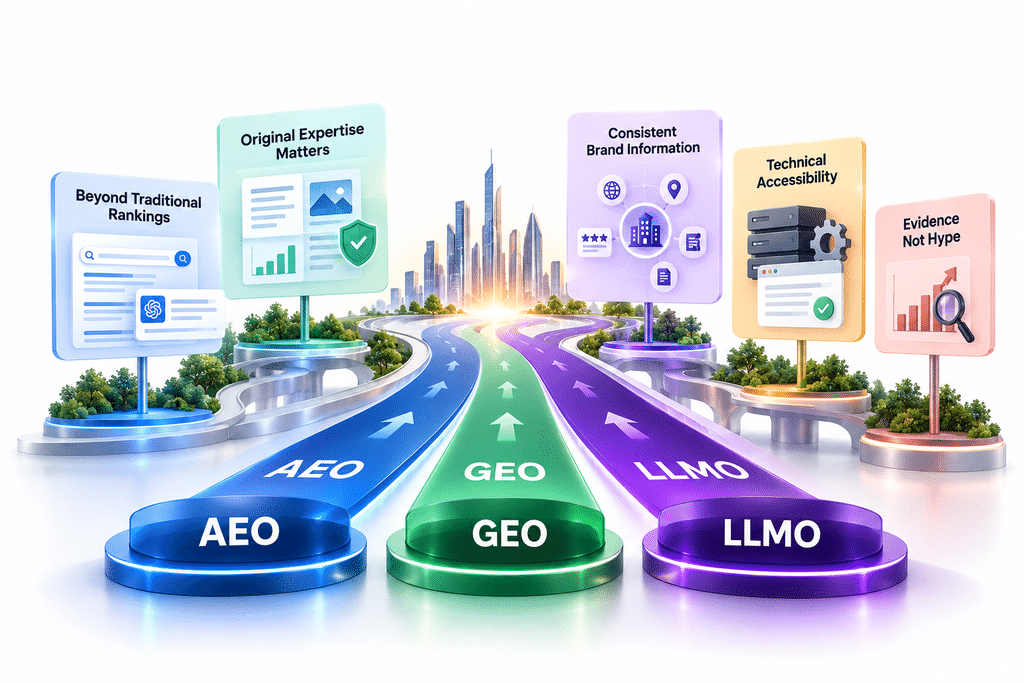
Search visibility will involve more than traditional rankings
Search rankings remain valuable, but businesses should also understand how their content is represented in AI-generated responses and how customers discover brands through conversational interfaces.
This requires broader monitoring without abandoning established SEO measurement.
Original expertise will remain a competitive advantage
As generic content becomes easier to produce, businesses need stronger reasons for people to trust their information.
First-hand experience, original research, detailed case studies, clear methodologies, and verifiable claims can help distinguish a brand from sources that simply repeat existing material.
Brand consistency will matter across discovery channels
Customers may encounter a business through its website, a search engine, a professional directory, a news article, a review platform, or an AI assistant.
Maintaining accurate information across these sources makes it easier for people to understand the business and verify its claims.
Technical accessibility will remain important
Useful content needs to be discoverable by the systems that serve it.
Crawlability, indexability, accessible content, internal linking, and sound technical implementation remain important foundations. As new AI applications emerge, businesses should also review the access requirements and controls specific to each platform.
Optimization should follow evidence, not hype
Not every new AI-related tactic deserves investment. Businesses should test recommendations, examine official platform guidance, measure meaningful outcomes, and avoid strategies based on unsupported guarantees.
The strongest long-term approach is to combine sound technical SEO, useful content, credible authority, consistent brand information, and ongoing measurement.
Conclusion:
AEO, GEO, and LLMO describe three related perspectives on visibility in an increasingly AI-powered search environment.
Answer Engine Optimization emphasizes providing clear answers to relevant questions. Generative Engine Optimization focuses on making useful content and expertise discoverable within AI-generated search responses. Large Language Model Optimization emphasizes how brand information is accessed, understood, and represented in LLM-powered systems.
Although the terminology differs, the practical foundations overlap: understand your audience, publish reliable information, demonstrate expertise, maintain technical accessibility, and ensure that your business is represented accurately across relevant sources.
For businesses, the priority should not be choosing one acronym over another. It should be building a search strategy that helps customers discover, evaluate, and trust the brand wherever they look for information.
For companies in Dubai and the wider GCC, this means combining traditional SEO with thoughtful content strategy, technical optimization, digital PR, and systematic monitoring of AI search visibility.
At Octopus Marketing Agency, the opportunity is to help businesses build that broader discoverability through a joined-up approach to SEO, content marketing, brand authority, and AI search optimization. The objective is not to chase every new industry term. It is to create a credible digital presence that supports sustainable visibility and measurable business growth.
Frequently Asked Questions
1. What is the difference between AEO, GEO, and LLMO?
AEO focuses on making content suitable for answering users’ questions. GEO focuses on improving the discoverability and potential citation of content in generative search experiences. LLMO focuses on how brand information is accessed and represented in large language model-powered systems. The three approaches overlap and are not universally standardized.
2. Is GEO replacing traditional SEO?
No. GEO builds on many established SEO principles, including useful content, technical accessibility, and authority. Traditional SEO remains important for organic search visibility and can also support discovery through AI-powered search experiences.
3. Does AEO help businesses appear in ChatGPT answers?
AEO practices, such as publishing clear and accurate answers, can make content more useful and understandable. Whether ChatGPT references a particular business depends on the product’s capabilities, available sources, query, and response-generation process. AEO cannot guarantee a mention or citation.
4. How does LLMO improve brand visibility in AI search?
LLMO strategies can include maintaining consistent brand information, publishing authoritative content, improving information accessibility, and monitoring AI-generated descriptions. These activities can support discovery and accurate representation, but they do not guarantee that a model will learn about or recommend a business.
5. Can one content strategy support AEO, GEO, and LLMO?
Yes. A well-researched article with clear answers, original evidence, credible sources, and accurate brand information can support all three objectives. An integrated strategy is usually more efficient than creating separate, repetitive campaigns for each term.
6. How can businesses measure AI search visibility?
Businesses can test relevant questions across selected AI platforms and track brand mentions, citations, source links, factual accuracy, and identifiable referral traffic. These results should be evaluated alongside organic search performance and business outcomes.
7. Does schema markup improve visibility in AI-generated answers?
Structured data can help search systems interpret supported information, but it does not guarantee AI citations or recommendations. Businesses should use appropriate schema accurately and prioritize accessible, helpful content and established technical SEO practices.