
Which Search Index Does Each AI Assistant Use, and Why It Changes Your SEO Priorities
For years, SEO ran on a fairly simple mental model. A person typed a query into Google, Google’s crawler discovered webpages, Google’s index stored them, and Google’s ranking systems decided which results appeared. Businesses built strategies around crawling, indexing, relevance, authority, links, content quality and user experience, and the model worked well enough that most teams never questioned it.
AI assistants have made that picture far more complicated. Someone looking for a product, a service, a restaurant, an investment idea or an explanation may now skip the results page entirely and ask ChatGPT, Google Gemini, Microsoft Copilot or Perplexity instead. That shifts the question marketers need to ask. It is no longer only “How do I rank on Google?” It is increasingly “How does the AI system my audience uses discover, retrieve, interpret and select information?”
The answer is not one universal index. Some assistants lean on dedicated search infrastructure, some retrieve through a major search engine, some run their own crawling and indexing, and many combine live retrieval with what the model already learned in training. This article explains what is publicly known about how the major assistants approach web search and, more importantly, how those differences should change your SEO priorities.
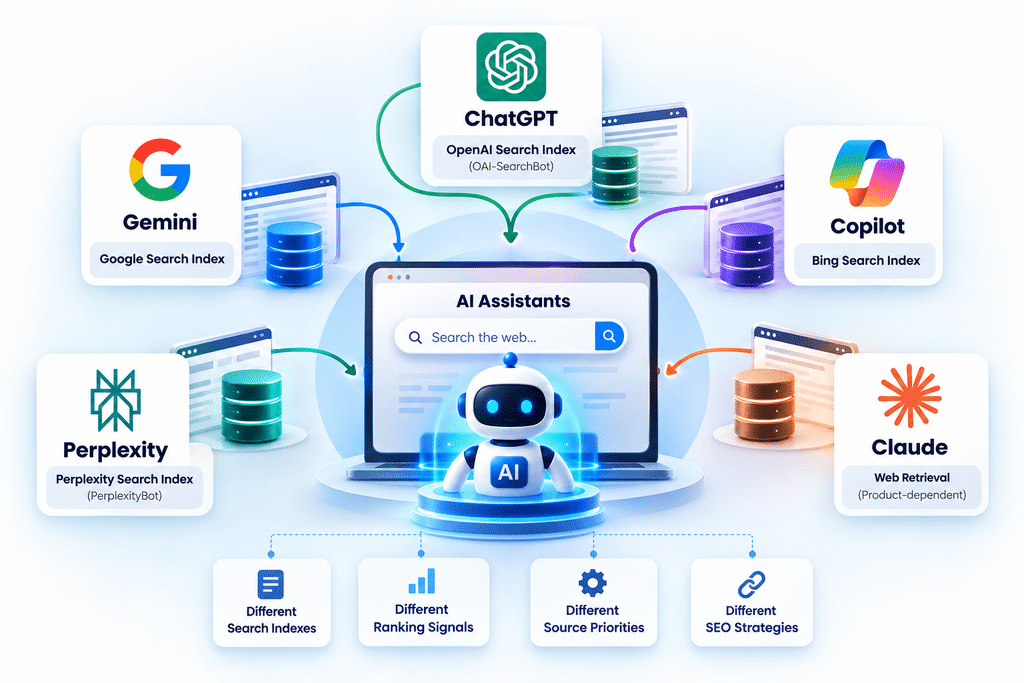
AI assistants do not all rely on the same search index or retrieval system. When a user submits a question, the assistant may first interpret the intent, generate or refine search queries, retrieve relevant information from its available web or search ecosystem, evaluate the quality and relevance of sources, and then synthesize the findings into a conversational answer. ChatGPT uses OpenAI’s web-search and retrieval ecosystem, Gemini operates within Google’s search ecosystem, Microsoft Copilot can use Bing for web search, while Perplexity uses its own search and crawling infrastructure. Other AI assistants may use web retrieval depending on the product and tools available. This means SEO is no longer only about achieving high rankings on one search engine; businesses also need to ensure their content is crawlable, authoritative, relevant, current, clearly structured and useful enough to be retrieved and cited by multiple AI systems.
Search Is Moving From Rankings to Retrieval
Traditional search is organised around results. You enter a query such as “best digital marketing agency in Dubai” and a search engine returns a ranked collection of pages, maps, ads, videos and images. You then decide what to click.
An AI assistant changes that interaction. It interprets your question, decides whether current web information is needed, generates one or more search queries, retrieves sources, evaluates what it finds, combines information from several of them, writes an answer and cites or links to the sources it selected. The user may never see where your page ranks for any of the underlying queries.
That has two consequences. Your page might be the fifth or tenth result for an underlying query and still become part of an AI-generated answer if the retrieval system judges it useful. Equally, a page that ranks well in traditional search can fail to appear in an AI response at all. Ranking visibility and retrieval visibility are related, but they are not the same thing, and SEO teams now need to care about both.
What Exactly Is a Search Index?
A search index is a large, organised representation of information discovered from websites and other sources. Search engines crawl content, process it and store it so that it can be found when someone searches. In simplified form the pipeline runs crawl, process, index, retrieve, rank and display. AI search adds further layers on top: interpret, synthesise and cite.
Traditional indexes are built to answer queries by retrieving potentially relevant documents, using signals such as text relevance, page structure, links, freshness, quality, authority, user behaviour, entity relationships, location and search intent. That foundation still matters. What AI changes is what happens after retrieval, and how many different systems might be doing the retrieving.
Search Index vs AI Model Knowledge
One of the most common misconceptions in AI SEO is treating a model’s training data as if it were a search index. They are different things. A language model has learned patterns from the material it was trained on, but that does not mean it is continuously reading the live web. A model may know a company exists because it appeared in training data, yet have no idea that the company launched a new service last month unless the system retrieves current information.
This is where web search comes in. ChatGPT’s search functionality can retrieve information from the internet and show sources alongside its answers, and OpenAI documents a dedicated crawler, OAI-SearchBot, whose purpose is to surface websites in ChatGPT search results.
It helps to separate four layers. Model knowledge is what the model already learned. Search retrieval is what the system discovers from current external sources. Indexed content is the information available through a search or retrieval infrastructure. The generated answer is the final response, created after the system interprets and synthesises what it has gathered. Optimisation opportunities differ at each layer, which is why lumping them together leads to muddled strategy.
Why There Is No Single “AI Search Index”
It is tempting to build a neat table with one assistant per row and one index per assistant. That is misleading. AI products evolve quickly, different versions can use different sources, enterprise products may search private data, and specialised experiences can use entirely different retrieval systems from the consumer product. Even one assistant can behave differently depending on whether web search is switched on, what the user asks, where the user is and which mode is selected.
A more accurate way to think about it is that each assistant has a retrieval ecosystem rather than a single static index. That ecosystem can include search indexes, web crawlers, cached pages, third-party search providers, structured databases, product feeds, news sources, academic databases, connected applications, proprietary content and real-time web information. For SEO, this means optimising for an ecosystem is more useful than optimising for a label.
Which Search Index Does ChatGPT Use?
ChatGPT shows clearly why the old “one AI, one search engine” model breaks down. OpenAI says ChatGPT search provides current information from the web and links to relevant sources. It also maintains OAI-SearchBot, which it describes as the crawler used to surface websites in ChatGPT’s search features. Sites that block OAI-SearchBot are not eligible to be shown in ChatGPT search answers, although they may still appear as navigational links.
This is a significant development for SEO. It means ChatGPT search comes with its own publisher-access considerations and is not simply a transparent mirror of Google’s rankings. The experience is not a conventional results page pasted into a chatbot either. The system interprets a natural-language question, searches, considers multiple sources, produces a conversational answer with citations and can keep searching as the conversation continues. OpenAI describes this as combining current web information with the reasoning and summarising abilities of its models.
The optimisation opportunity is different as a result. A traditional engine might rank a page because it matches a keyword well. An AI system has to judge whether the page contains information that can contribute to an answer.
What ChatGPT Search Means for Your SEO
The first priority is surprisingly basic: make sure your website is accessible to the relevant crawler. OpenAI recommends allowing OAI-SearchBot when a publisher wants its site to be eligible for ChatGPT search results. If a firewall, CDN rule, bot-protection setting or robots.txt entry blocks it, no amount of content work will fix the problem. Teams should review robots.txt, firewall and CDN restrictions, server responses and status codes, JavaScript rendering and general content accessibility.
Once access is sorted, the priorities are familiar but sharper. Important information should not be buried behind confusing navigation. Pages should clearly address the topic they claim to cover. Original data and expert insight give an AI system something worth retrieving. External references and reputable mentions reinforce trust, time-sensitive pages need to stay current, and the content should contain statements another system could confidently cite.
Which Search Index Does Google Gemini Use?
Gemini is a different case because Google owns both the assistant and one of the largest search ecosystems in the world, built on decades of crawling, indexing and ranking. Gemini can use web information to answer questions, but it would be a mistake to reduce it to the idea that it simply searches Google and copies the top result. Modern AI retrieval is more nuanced than that.
The practical takeaway is that Google’s search ecosystem remains highly relevant to Google’s AI experiences. Its infrastructure around entities, knowledge graphs, local search, news, shopping, maps, images, reviews and structured data does not disappear because the interface becomes conversational. AI can become another layer over that existing foundation, which is why businesses should not respond to AI search by abandoning traditional SEO. The better strategy is to strengthen it while making content easier for AI systems to understand and retrieve.
For Google-oriented visibility, that means making sure important pages can be crawled and indexed, understanding what users actually want, covering the concepts around a topic rather than repeating a keyword, and establishing clearly who your business is, what it offers and where it operates. Appropriate structured data helps search engines interpret content, accurate local information matters for location-based businesses, first-hand expertise beats generic summaries, and pages should be updated when facts change.
Which Search Index Does Microsoft Copilot Use?
Microsoft is unusually clear about how Copilot handles web search. When web search is enabled, Copilot generates a short query from the user’s prompt and sends that query to the Bing search service. The results then help compose the response. In other words, Bing visibility matters for Copilot’s web-grounded answers.
Notice what this implies. Copilot does not necessarily send the user’s whole prompt to Bing. Imagine someone asks, “I’m opening a premium skincare business in Dubai. What digital marketing strategies should I use to compete with established brands?” Copilot may turn that into shorter searches around Dubai skincare marketing, premium beauty marketing in the UAE or skincare ecommerce strategies. The retrieval system then works from those searches, not from the original conversational request.
If your audience uses Copilot, optimising only for Google creates a blind spot. SEO teams should consider Bing indexing, Bing Webmaster Tools, crawlability, clear content, entity signals, authority and freshness. Copilot Search also shows the sources and links behind its responses, so being visible as a source is part of the opportunity.
Which Search Index Does Perplexity Use?
Perplexity is perhaps the easiest assistant to understand because it is search-first. Its Pro Search documentation describes running multiple searches across the web and synthesising information from sources such as articles, academic papers, forums and videos, with direct links to the sources. Perplexity has also publicly described its own search infrastructure, including its crawler PerplexityBot, a large and fresh search index, and content-understanding systems that parse websites to extract meaningful information.
That matters because it shows AI search does not depend entirely on the traditional Google and Bing model. It also makes citations central to the experience, which changes what good content means. A page no longer only needs to attract a click. It needs to contain information that can support an answer.
Consider two statements about luxury watches. One says that luxury watches are a great investment because some brands hold their value. The other says that certain Rolex, Patek Philippe and Audemars Piguet references have historically shown stronger resale demand than many other categories, while noting that performance varies by reference, purchase price, condition, market cycle and liquidity. The second is far more useful as a source. It names specific entities, adds conditions and nuance, and gives a reader criteria for making a decision, which is exactly the kind of material an AI research system can use.
To be a good source for Perplexity-style retrieval, invest in original research, support important claims with reputable references, use tables and clearly defined sections where they help, explain why something is true rather than just stating it, keep fast-changing data fresh and answer the follow-up questions readers are likely to ask.
What About Claude?
Claude needs a more careful explanation. An AI model and an AI search system are not the same thing, and depending on the product and the tools available, Claude can operate with or without external web retrieval. It would be inaccurate to describe it as having one universal public search index comparable to a traditional engine.
The practical lesson matters more than the label. If an AI product can reach external sources, those sources need to be discoverable, accessible, relevant, authoritative, understandable and useful. If it is answering from model knowledge instead, your opportunities are different. This reinforces a principle that applies across every assistant: do not optimise for an AI brand, optimise for the information ecosystem through which that AI obtains knowledge.
AI Search Index Comparison
The summary below is a strategic model, not a claim that any platform has one fixed, permanent index.
| AI assistant | Major web retrieval ecosystem | What SEO teams should watch |
| ChatGPT | OpenAI search and retrieval ecosystem, including OAI-SearchBot | Accessibility, relevance, authority, citations |
| Gemini | Google search ecosystem and web retrieval | Google SEO, entities, content quality, freshness |
| Copilot | Bing search service for web grounding | Bing visibility, crawlability, relevance |
| Perplexity | Perplexity’s own search and crawling infrastructure | Citability, authority, freshness, semantic extraction |
| Claude | Depends on product, tools and available web access | Source quality and retrieval accessibility |
These systems will keep changing. Search infrastructure is not a static specification, so your strategy needs to hold up when retrieval providers and AI architectures shift.
The Difference Between Ranking and Retrieval
Traditional SEO asks where your page ranks. AI-era SEO adds a second question: can your page be retrieved as evidence for an answer? Imagine your site ranks fourth for “best luxury handbag investment brands”. An assistant receives a longer question, “Which luxury handbag brands are most likely to retain value, and why?”, and may retrieve a financial publication, a resale marketplace, an auction house, a fashion title and a specialist investment guide. Your fourth-place ranking does not guarantee inclusion.
But if your page contains original resale data and clearly explains why particular brands hold value, it can still become a strong retrieval candidate. The exact algorithms remain proprietary, yet in practice content usefulness is acting as a retrieval signal.
There is a second shift hiding here: query expansion. Ask an assistant “What’s the best CRM for my startup?” and it may interpret that as several underlying questions about company size, budget, integrations, features, alternatives, pricing and reviews, then search for each. Content built around a single exact keyword will struggle. Content that offers semantic coverage of the whole topic has far more chances to be retrieved.
From Keyword Optimisation to Topic Optimisation
Old SEO repeated “digital marketing agency Dubai” at strategic points. Modern SEO builds authoritative coverage of digital marketing in Dubai: strategy, SEO, Google Ads, social media, local search, WhatsApp marketing, ecommerce marketing, AI SEO, lead generation, conversion optimisation and analytics, ideally with industry-specific examples. The result is a network of related content that helps search engines understand the topic, gives AI systems more to retrieve and gives users more complete answers.
It also helps to build content around questions rather than only keywords. For any major topic, map the core question, the follow-up questions a reader would ask next, the comparison questions about alternatives, the decision questions about what determines the choice, the implementation questions about how to do it and the risk questions about what could go wrong. An AI SEO cluster, for example, might cover what AI SEO is, how ChatGPT, Gemini and Copilot search work, GEO and AEO, how to get cited, how to measure AI visibility and how it applies to ecommerce and local businesses. Instead of one giant page trying to do everything, you create a connected information ecosystem, and deliberate internal linking between the pillar page and supporting pages reinforces that structure.
Why Entity SEO Is Becoming More Important
AI systems do not only need to understand words. They need to understand things: companies, people, products, services, locations and brands. Consider a company called ABC Marketing. If one page calls it ABC Marketing Agency, another calls it ABC Digital, a third uses ABC Marketing LLC and third-party sites use yet other descriptions, the entity becomes harder to interpret. Consistent information creates a clearer digital identity.
The fix is to keep brand information consistent across your website, About page, Organisation schema, business directories, social profiles, press coverage, industry listings, reviews and partner sites, and to state plainly who you are, what you do, where you operate, who you serve and what makes you different. This is especially important for local businesses. A Dubai agency should make its location, services and market focus unmistakable.
E-E-A-T, Original Research and Citation-Worthy Content
Google’s concept of experience, expertise, authoritativeness and trustworthiness remains relevant, and AI search makes the underlying principle easier to see. If an assistant has to answer “Which luxury watch is best for resale value?”, there are thousands of generic pages to draw on. A specialist publication with historical prices, resale data, reference numbers, market trends, authentication guidance, expert commentary and a transparent methodology has clearly stronger informational value than a generic affiliate article.
This is why original research is such an advantage. Surveys, market research, customer studies, pricing analysis, product testing, benchmark reports, case studies and first-party datasets give AI systems something unique to retrieve, because generic information can be reproduced by thousands of sites. Original information also invites other publishers to cite you, which strengthens your wider authority.
A useful test for every article is this: if an AI assistant needed one sentence from this page to answer a user’s question, what would it cite? If you cannot point to one, the page may be too generic. Citation-worthy content tends to contain clear definitions, original statistics, specific explanations, expert observations, comparisons, methodologies, examples and evidence. That does not mean writing like an academic paper. It means replacing vague statements with useful information.
Formatting supports this. Descriptive headings, short paragraphs, lists for multiple factors, tables for genuine comparisons, clear definitions and FAQs for predictable follow-ups make complex information easier for both people and machines to process. The aim is not to game AI. It is to make information easier to understand.
Why External Mentions Matter
Your website is not your entire digital identity. AI systems can discover information about your company across the wider web, so businesses should think beyond backlinks. Editorial mentions, industry publications, news coverage, reviews, interviews, expert quotes, conference appearances, partner websites and relevant directories all contribute evidence that your organisation exists, knows its subject and is recognised within its field. The goal is not thousands of low-quality mentions but credible ones.
That is where digital PR and SEO increasingly overlap. Your website tells the AI, “We are this company.” The rest of the web can supply supporting evidence that other sources recognise this company in this context. The objective is no longer “get 500 backlinks” but “become a recognised source within the topic we want to own.”
Structured Data and Technical SEO Still Matter
Structured data gives search engines explicit information about page content. Depending on the site, relevant types include Organisation, LocalBusiness, Person, Article, Product, Service, BreadcrumbList, Event and Review. It should not be treated as a magic AI ranking factor. Its real value is helping machines interpret content and entities more consistently, so use it accurately and not simply because it exists.
Technical SEO has not become irrelevant either. It has become more important, because if a crawler cannot reach your page, the quality of the content does not matter. Check that crawlers can access important pages, that nothing is accidentally blocked, that key URLs return 200 responses, that canonicals are correct, that legitimate crawlers are not blocked in robots.txt, that important content does not depend excessively on client-side JavaScript, that internal links make information reachable and that the site performs well.
Robots.txt deserves extra attention now because AI search introduces more crawlers. OpenAI, for instance, documents separate crawler identities, with OAI-SearchBot used for search and GPTBot associated with crawling for model training. Site owners may want to make different decisions about search visibility and model training, so SEO and security teams should review crawler policies deliberately instead of blocking every bot automatically. The new technical question is not just whether Google can crawl a page but whether the relevant search and AI systems can access it, including Googlebot, Bingbot, OAI-SearchBot and other legitimate crawlers. Verify crawler identities and understand each one’s purpose rather than allowing every bot blindly.
Freshness, Local Search and Ecommerce
AI systems often deal with current information. A three-year-old page may still rank for an evergreen query, but for prices, products, technology, regulations, market trends, software and events, freshness becomes far more important. A better content workflow is publish, monitor, update, expand and revalidate, rather than publish and forget.
Local businesses have a particular opportunity. A user might ask for the best digital marketing agencies in Dubai, or which SEO agency near Downtown Dubai specialises in ecommerce. AI systems can combine business information, websites, reviews, location, service descriptions and third-party mentions, so local SEO now extends beyond Google Maps. Keep details consistent across your website, Google Business Profile, Bing Places, directories, review platforms and social profiles.
Ecommerce is changing in a similar way. Someone asking for the best lightweight laptop for a student under $1,000 may have an assistant compare options instead of visiting five stores. That raises the value of accurate product descriptions, specifications, reviews, pricing, availability, buying guides, Product schema and first-party product data, all of which need to be both machine-readable and genuinely useful.
AI Search and Brand Discovery
One of the biggest shifts is that users may discover brands they did not know existed. Traditional search often starts with a brand or category, while AI search can start with a need, such as “I need a luxury handbag for everyday use that holds resale value.” The assistant becomes part of discovery, so brands need category-level relevance and not only branded searches.
This makes brand building more important, not less. If users ask AI systems for recommendations, recognisable, well-established entities can have an advantage, and strong branding tends to generate more searches, mentions, reviews, conversations, citations and third-party references. SEO and brand building are increasingly the same project.
SEO, AEO and GEO: How They Fit Together
Three terms keep surfacing. SEO optimises visibility in search engines. Answer engine optimisation, or AEO, focuses on visibility when systems provide direct answers. Generative engine optimisation, or GEO, focuses on visibility within generative AI systems. They overlap heavily and should not be treated as separate disciplines. A technically strong website with authoritative content supports all three: SEO creates discoverability, AEO improves answer relevance and GEO expands generative visibility.
The funnel has changed too. Traditional search runs from query to results to click to website. AI search runs from question to interpretation, retrieval, synthesis, citation, recommendation and, possibly, a click. The website is no longer necessarily the first destination, because the AI answer can act as an intermediary. That makes brand inclusion and citation visibility important metrics.
How to Measure AI Visibility
Traditional reporting focuses on rankings, impressions, clicks, click-through rate, organic traffic and conversions. AI search needs extra measures. Mention rate shows how often an assistant names your brand. Citation rate shows how often your site is cited, and citation share compares that with competitors. Recommendation rate tracks how often the assistant recommends your business. Entity accuracy asks whether the assistant describes you correctly, and retrieval coverage counts how many target questions result in your content being retrieved.
You do not need an enterprise platform to start. Build a spreadsheet of 50 to 100 important customer questions, such as the best marketing agencies in Dubai, AI SEO services in Dubai, how GEO works or how to improve local SEO. Test each across the assistants your market uses, and record whether your brand was mentioned, whether your site was cited, which competitors appeared and which sources were used. Over time this becomes a benchmark.
Competitor visibility deserves the same attention. Ask not only whether AI mentions you but who it mentions instead. If competitors are repeatedly cited because they publish original statistics, that tells you exactly what your content strategy is missing.
When an assistant does not mention you, resist the urge to add more keywords. Treat it as a diagnostic problem. Can the crawler access the page? Is it indexed? Does it clearly answer the question? Does the site demonstrate authority? Does another source offer better information? Is your brand mentioned elsewhere? Is the content outdated, too generic, or hiding key facts deep in the page? If the AI describes your company incorrectly, look at the information ecosystem: an unclear About page, outdated third-party profiles, poorly defined services, conflicting location data or weak external authority are common culprits.
A Practical AI Search Optimisation Framework
If you are starting from zero, do not try to optimise for every assistant at once. Begin by identifying where your customers actually search, whether that is Google, Bing, ChatGPT, Gemini, Copilot, Perplexity or an industry-specific system, and prioritise those ecosystems. Then build an entity map documenting your brand, founders, products, services, locations, industry, expertise, customers and partners, and make sure your website and external profiles describe them consistently.
Next, build topic clusters around the subjects you want to be known for, using pillar pages, supporting guides, comparison pages, FAQs, case studies, research and glossaries. Write retrieval-friendly content with direct answers, clear headings, definitions, tables, statistics, expert commentary and sources, and avoid burying important information beneath long introductions. Strengthen external authority through digital PR, expert contributions, industry publications, original research, partnerships, interviews and reviews. Audit technical accessibility, including robots.txt, XML sitemaps, canonicals, status codes, internal links, JavaScript rendering, CDN and firewall rules, and AI crawler access. Finally, test real customer questions across the assistants that matter, record mentions, citations, competitors, sources and accuracy, and fix the underlying information whenever the AI gets something wrong.
In priority order, that comes down to technical accessibility, index eligibility, search intent, topical authority, entity clarity, original information, citation-worthy content, external authority, freshness and measurement.
Common AI SEO Mistakes
The most common mistake is assuming Google is the only search engine that matters. Google remains enormously important, but it is no longer the only place where people discover information. A related error is assuming every assistant uses the same index, when ChatGPT, Gemini, Copilot and Perplexity each have different retrieval ecosystems. Others confuse training data with search, accidentally block legitimate AI search crawlers through security tools or CDNs, publish volumes of generic AI-written content that adds no authority, ignore external mentions, write only for keywords, neglect freshness, or chase supposed secret “AI ranking factors”. Most AI companies do not publish complete retrieval or ranking algorithms, so it is wiser to focus on observable fundamentals: accessibility, relevance, quality, authority, freshness, clear information and strong sources. And treating GEO as a replacement for SEO misses the point. The strongest strategy combines both.
Generic content deserves a special warning. If ten thousand sites publish near-identical articles on “10 benefits of digital marketing”, an assistant has little reason to prefer one over another. The advantage comes from content that is specific, original, accurate, well researched, experience-led, data-backed, locally relevant and better explained. AI can help produce content, but it should not become a substitute for expertise.
Why This Matters for Dubai and GCC Businesses
For businesses in competitive markets such as Dubai and the wider GCC, AI search is a real opening. Many companies fight over the same traditional keywords, but AI discovery introduces new questions: which agency in Dubai is best for luxury brands, which Dubai SEO agency has ecommerce experience, who are the leading branding agencies in the UAE. The answers may depend on more than keyword rankings, because AI systems can synthesise agency websites, case studies, industry publications, reviews, awards, founder profiles, client references and local business information. Reputation and information architecture matter more than they used to.
Final AI SEO Checklist
Before publishing an important page, ask whether search engines can crawl and index it, whether the URL is canonical and whether key resources are accessible. Check that it answers the main question and the related ones, that the information is accurate and current, and that it demonstrates expertise with original information and supported claims. Confirm that the brand, products, services and location details are clear and consistent, that important facts are easy to extract under descriptive headings, and that useful sources are cited. Finally, consider whether credible sites mention the organisation elsewhere, and whether you will test the topic in AI assistants and track competitor visibility, citations and mentions.
Conclusion
There is no single AI search index that controls the future of search. ChatGPT has its own web-search ecosystem and a dedicated crawler, OAI-SearchBot, for search discovery. Microsoft documents that Copilot can generate search queries and send them to Bing when web search is enabled. Perplexity operates its own search and crawling infrastructure. Google’s AI experiences are closely tied to its broader search environment, which keeps traditional optimisation highly relevant.
The practical conclusion is not to abandon traditional SEO but to expand it. The old question was “How do I rank number one?” The new question is “How do I become one of the most discoverable, understandable, authoritative and retrievable sources for the questions my customers ask?” Answering it takes technical accessibility, topical authority, strong entities, original information, trustworthy external references, content that answers questions clearly, and measurement across the assistants your customers actually use.
The brands that win will not necessarily be the ones that publish the most. They will be the ones that consistently produce the most useful, credible and retrievable information in their category. Search is becoming an ecosystem rather than a single destination, and your SEO strategy needs to evolve with it.
Frequently Asked Questions
Which search index does ChatGPT use?
ChatGPT can use web search to retrieve current information, and OpenAI operates a dedicated crawler, OAI-SearchBot, for ChatGPT search discovery. OpenAI does not describe ChatGPT as simply relying on one external search index.
Does ChatGPT use Google Search?
It is not accurate to treat ChatGPT search as Google Search inside ChatGPT. OpenAI operates its own search experience and crawler, and its web-search systems may also involve other providers, so the picture is more layered than a single engine.
Which search engine does Microsoft Copilot use?
When web search is enabled, Microsoft says Copilot generates a search query from the user’s prompt and sends it to the Bing search service.
Does Perplexity have its own search index?
Perplexity has described maintaining a large, fresh search index and operating PerplexityBot for web crawling, and its search retrieves and processes information from several kinds of web sources.
Is Google SEO still important for Gemini?
Yes. Google remains a major search ecosystem, and technical SEO, content quality, relevance, entity clarity and freshness remain important foundations for visibility across Google’s search and AI experiences.
How do I optimise my website for ChatGPT?
Start with crawlability and accessibility, then focus on authoritative, useful and clearly structured content. OpenAI recommends allowing OAI-SearchBot for sites that want to be eligible for ChatGPT search results.
How do I get cited by Perplexity?
There is no guaranteed formula. Focus on authoritative, original, well-structured and current information, and make important claims easy to verify. Perplexity’s Pro Search emphasises web research, synthesis and direct source citations.
Is traditional SEO still important for AI search?
Yes. Technical accessibility, indexing, relevance, authority and content quality remain fundamental. AI search adds a retrieval and synthesis layer rather than making search engines irrelevant.
What is the difference between SEO, AEO and GEO?
SEO focuses on search visibility, AEO on visibility within direct answers and GEO on visibility within generative AI experiences. In practice the three overlap significantly.
What is the most important AI SEO factor?
There is no single confirmed AI ranking factor. The most durable strategy is to make your information accessible, relevant, authoritative, accurate, current and genuinely useful.