
On-Page vs Off-Page SEO: What to Fix First When Budget Is Finite
When your SEO budget is limited, the question is not simply whether on-page SEO or off-page SEO is more important. The more useful question is: which investment will remove the biggest barrier to organic growth right now? The answer depends on the condition of your website, the strength of competing pages, the competitiveness of your market and the business results you need SEO to deliver.
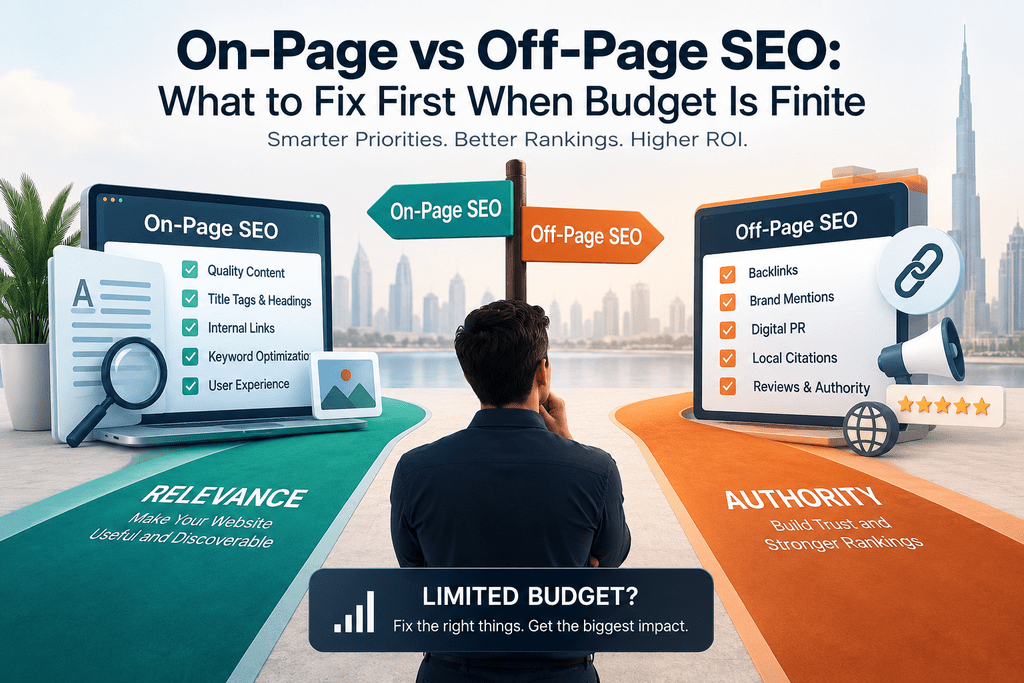
On-page SEO improves the relevance, clarity and usefulness of the pages on your website. Off-page SEO strengthens your reputation through backlinks, brand mentions, digital PR, local citations, reviews and other external signals. Technical SEO supports both by ensuring that search engines can access, crawl, render, understand and index your content correctly.
For most businesses working with a finite budget, the safest starting point is to fix the website foundation before spending heavily on external authority. A backlink may help a strong page compete, but it cannot fully compensate for a page that targets the wrong search intent, provides little useful information or cannot be indexed. The principle is simple: technical SEO makes your website accessible, on-page SEO makes it relevant and off-page SEO makes it more credible. Your budget should go first to the layer currently limiting performance.
On-Page vs Off-Page SEO
When the SEO budget is limited, fix critical technical and on-page issues before investing heavily in off-page SEO. Technical SEO ensures that search engines can crawl and index the website, while on-page SEO improves content relevance, search-intent alignment, internal linking and user experience. Once these foundations are strong, off-page SEO can help the website compete by building authority through relevant backlinks, digital PR, reviews, citations and brand mentions. The right priority depends on the main barrier to growth: fix accessibility problems with technical SEO, relevance problems with on-page SEO and authority gaps with off-page SEO.
What Is On-Page SEO?
On-page SEO refers to improvements made directly to a webpage or within the website that help search engines interpret its purpose and help visitors find a useful answer. It includes visible elements such as page copy, headings, images and internal links, along with title tags, meta descriptions and structured data.
Effective on-page SEO begins with search intent. A page should satisfy the reason behind a search, not merely repeat the words used in the query. Someone searching for “SEO audit services Dubai” is probably comparing providers or looking for professional help. A suitable service page should explain what the audit covers, which problems it identifies, what the client receives, how the process works and why the provider is qualified. A short definition of an SEO audit would not adequately serve that commercial intent.
Keyword targeting still matters, but modern optimization goes beyond placing one exact phrase in a title and several paragraphs. The page should cover the main topic and its relevant subtopics in natural language. Clear headings make information easier to scan, descriptive URLs provide context, useful images support understanding and internal links connect the page to related services or resources. The content should also demonstrate enough experience and specificity to give visitors confidence in the answer.
Good on-page SEO therefore improves both discoverability and conversion potential. A page that attracts impressions but does not clearly explain the product, service or next step may gain traffic without generating meaningful business value. The objective is to create a page that deserves to rank and helps the right visitor take an informed action.
What Is Off-Page SEO?
Off-page SEO covers signals and activities outside your website that influence how search engines and users perceive your brand’s authority, reputation and credibility. Backlinks are important, but they are only one part of a broader off-page strategy.
A link from a respected and relevant industry publication can indicate that another source considers your content worth referencing. An unlinked brand mention in a credible news article may strengthen awareness and lead to branded searches. For a local business, accurate directory listings, positive customer reviews and a well-maintained Google Business Profile can help establish legitimacy and local relevance. Partnerships, expert commentary, podcast appearances, original research and digital PR can also create external signals while introducing the business to a genuine audience.
The value of off-page activity depends heavily on quality and context. A single editorial link from a reputable website in your sector may be more useful than hundreds of links placed on unrelated or low-quality domains. Search engines evaluate patterns, relevance and trust, so building links purely to increase a reported backlink count can waste budget and create unnecessary risk.
A strong off-page strategy is designed to earn recognition rather than manufacture volume. It asks why a credible website, journalist, customer, association or partner would naturally mention the business. The answer may be expert knowledge, useful data, a distinctive tool, a strong customer experience or a resource that genuinely helps their audience.
On-Page SEO vs Off-Page SEO: What Is the Difference?
The difference is easiest to understand by considering what each discipline controls and what problem it solves.
| On-Page SEO | Off-Page SEO |
| Takes place on your website | Takes place outside your website |
| Improves topical relevance and usefulness | Builds authority, reputation and recognition |
| Includes content, titles, headings and internal links | Includes backlinks, PR, reviews and brand mentions |
| Is largely under your direct control | Often depends on third parties and relationships |
| Helps search engines understand what a page answers | Helps demonstrate why the source may be trusted |
| Can improve rankings and conversion experience | Can improve competitiveness, discovery and brand demand |
Neither discipline works well in isolation. A website with excellent content but almost no authority may struggle to outrank established competitors for highly competitive terms. Conversely, a website may attract many backlinks yet perform poorly because its content is outdated, its important pages are difficult to find or its targeting does not match what people want.
The strongest results normally come when on-page and off-page work reinforce each other. A useful research report can earn backlinks, while those backlinks help the report and related pages gain visibility. A well-optimized service page can convert visitors introduced through digital PR. The goal is not to choose one discipline permanently, but to apply each where it produces the greatest incremental return.
Where Does Technical SEO Fit In?
Technical SEO is sometimes grouped with on-page SEO, but it deserves separate attention because it affects whether search engines can process the website at all. It covers crawlability, indexability, site architecture, XML sitemaps, robots directives, canonical tags, redirects, mobile usability, page performance, structured data, HTTPS and JavaScript rendering.
Consider an e-commerce category page with helpful copy, strong products and several quality backlinks. If the page has a noindex directive, points its canonical tag to another URL or is accessible only after a search engine struggles with JavaScript, much of that investment may fail to produce the expected visibility. Similarly, a website migration with incomplete redirects can weaken rankings even if the new design and content are better.
Not every technical issue deserves immediate investment. A critical indexation problem affecting revenue-generating pages should take priority, while a minor validation warning with no effect on crawling, indexing, user experience or eligibility for a search feature may not. A technical audit should classify issues by business impact, affected page type and implementation effort instead of presenting every warning as equally urgent.
Technical SEO forms the operating foundation, but it is not a substitute for useful content or external authority. Once important pages can be crawled, indexed and understood, further technical work should compete for budget based on its likely impact, just like on-page and off-page activity.
What Should You Fix First When Your SEO Budget Is Limited?
There is no universal budget split that suits every website. A new local business, an established e-commerce store and a mature software company can face completely different constraints. The correct sequence should be based on evidence from analytics, Google Search Console, crawling data, ranking patterns, backlink comparisons and business priorities.
In most cases, begin by fixing technical problems that block crawling, indexing or the performance of important pages. Next, strengthen the pages connected most closely to revenue, qualified leads or another meaningful business outcome. Establish essential local and brand signals where relevant, then invest more heavily in external authority once the website offers something credible and competitive to promote.
This sequence does not mean all technical work must be completed before any content or off-page activity begins. SEO work can overlap. For example, a business can correct an indexation issue, rewrite its main service pages and clean up local listings during the same quarter. The main rule is to avoid committing a large share of the budget to promotion while serious problems remain on the destination pages.
Phase 1: Fix Technical and On-Page Foundations
Start by confirming that the pages most important to the business are accessible and indexed. Review whether robots.txt rules, noindex tags, canonical tags or redirect chains are preventing search engines from reaching the correct version of each page. Check the XML sitemap, broken internal links, mobile rendering, page templates and site architecture. For larger websites, pay particular attention to duplicate URLs, faceted navigation, pagination and orphan pages because these issues can waste crawl resources or leave valuable pages disconnected from the wider site.
Next, evaluate whether each priority page has a clear purpose. Its title, H1, headings, copy, imagery and internal links should support the same search intent. A category page should help shoppers compare an appropriate range of products, while a service page should explain the service and reduce uncertainty. An informational article should answer the main question early, develop the topic logically and guide readers to a relevant next step without forcing a sales message.
Internal linking is especially valuable when resources are tight because it uses assets the website already owns. Links from authoritative or frequently crawled pages can help search engines discover important content, understand relationships between topics and identify relative page importance. Descriptive anchor text is generally more useful than repeated generic phrases such as “click here,” but it should remain natural and helpful to the reader.
Foundation work should finish with prioritization, not an endless list of possible improvements. Focus first on high-value pages that already receive impressions, rank within striking distance, support core products or services, or have a clear role in the conversion journey. Improving ten commercially important pages often produces more value than making superficial edits across hundreds of low-priority URLs.
Why On-Page SEO Usually Comes Before Heavy Link Building
A backlink can strengthen authority, but it does not automatically make a weak page relevant or persuasive. Imagine two websites competing for the same commercial keyword. Website A directly answers the search intent, explains its offer clearly, provides evidence, loads properly on mobile and is supported by useful internal links. Website B contains thin copy, vague headings, poor navigation and an unclear next step. Even if Website B acquires new links, users and search engines still encounter a weaker destination.
On-page improvements often have another advantage for a limited budget: they are more controllable. A business can revise a title, improve a service explanation, consolidate overlapping pages or add internal links without waiting for an external publisher. These changes may also improve conversion rates, which means the same organic traffic can generate more enquiries or sales.
This does not mean links should always wait. A new brand can begin developing relationships and earning relevant mentions while it improves the site. However, large-scale outreach becomes more efficient when the website contains a genuinely valuable resource, expert contribution, tool, study or product experience worth discussing. Put simply, content gets a page into the race, while authority often helps determine who wins a close contest.
When Should You Start Investing More in Off-Page SEO?
Off-page SEO becomes a stronger priority when the technical foundation is stable, target pages satisfy search intent and competitors continue to outrank the website with comparable content. This pattern may indicate an authority gap rather than a relevance gap.
Look beyond domain-level metrics when assessing that gap. Compare the quality and relevance of links pointing to competing pages, the strength of the brands behind them, the frequency of credible mentions and their visibility across industry publications. A competitor may rank because it is a recognised entity with years of coverage, not simply because a tool reports a higher authority score.
You may also need off-page investment when launching into a market where the business has little recognition, promoting original research that deserves wider distribution or strengthening local prominence in a competitive city. Targeted digital PR, expert contributions, partnerships, association listings and local coverage can build both SEO value and referral demand.
Before spending, define what the campaign should achieve. The objective may be links to a specific commercial asset, broader brand visibility, local trust or coverage that generates qualified referral traffic. Clear objectives make it easier to select suitable publications and measure value beyond the number of links secured.
Quality Over Quantity in Link Building
A limited budget makes poor-quality link building particularly costly. Packages promising large numbers of links at a low price may rely on irrelevant sites, paid networks, recycled guest posts or pages created mainly to host outbound links. These links may provide little benefit, disappear later or expose the website to an unnatural link pattern.
A better opportunity combines topical relevance, editorial credibility, a real audience and a natural reason for the reference. For example, a financial planning guide cited by a respected business publication has a clearer relationship than a link from an unrelated entertainment blog. The location of the link, the surrounding discussion and the quality of the referring page all matter more than a headline number in a monthly report.
Useful link-worthy assets can include original data, industry benchmarks, calculators, detailed guides, expert commentary, case studies and genuinely distinctive products or initiatives. Promotion should focus on publishers and communities whose audiences benefit from that material. This approach may produce fewer links, but each placement has a stronger chance of supporting authority, referral visits and brand discovery.
Instead of asking, “How many backlinks can we buy?” ask, “Which credible sources would have a legitimate reason to reference our expertise or resource?” That question encourages sustainable authority building and directs money toward opportunities connected to real relevance.
What About Local SEO?
For local businesses, off-page signals may deserve attention earlier because search visibility depends partly on location, prominence and trust. A complete and accurate Google Business Profile, consistent business details, relevant directory listings, customer reviews and local mentions help search engines and potential customers verify that the business exists and serves the stated area.
Local optimization should still begin with a sound website. Each genuine location should have a useful page that explains its services, address, opening information and locally relevant details. Repeating the same generic copy across many city pages adds little value. Where appropriate, location pages can include transport or parking information, service coverage, branch-specific facilities and links to the relevant profile or contact route.
Reviews are particularly important because they influence both visibility and customer confidence. Businesses should create a consistent process for requesting honest feedback and responding professionally, rather than purchasing reviews or using incentives that breach platform policies. Local PR, association memberships, community partnerships and coverage from relevant regional publications can complement citations and strengthen real-world prominence.
For a Dubai business, accurate local information and credible UAE-based mentions can run alongside improvements to service pages and mobile experience. The correct sequence remains the same: ensure visitors arrive at a trustworthy, useful website, then strengthen the external signals that help them discover it.
How to Allocate a Finite SEO Budget
Budget percentages are most useful as starting points, not fixed rules. Before allocating money, separate one-time corrective work from ongoing activity. Technical repairs, template changes and major content improvements may require a heavier investment early in the programme. Content maintenance, digital PR, local profile management and performance monitoring then continue over time.
Small or Bare-Bones Budget
A small budget may initially place 70 to 90% on foundational SEO and 10 to 30% on off-page work. Foundational spending should focus on critical technical fixes, high-value page improvements, search-intent alignment, internal linking and basic measurement. The off-page portion can cover essential local listings, review processes, supplier or association links and a small number of highly relevant outreach opportunities.
The aim is not to optimize the entire website at once. Select the pages that have the clearest relationship to revenue and the strongest realistic ranking opportunity. If one service page already ranks near the first page, improving its content and links may deliver a faster return than publishing several new articles with no established demand.
Moderate Budget
A moderate budget might use an approximate 60% on-site and 40% authority-building split once critical issues have been resolved. The on-site portion can maintain content quality, improve category or service coverage, strengthen internal linking and monitor technical health. The authority portion can support digital PR, expert contributions, partnerships and promotion of useful assets.
The exact balance should change as evidence develops. If priority pages start ranking well but remain below stronger brands, increase authority investment. If coverage earns links but the landing pages show poor engagement or conversion, redirect effort toward page quality and user experience.
Highly Competitive Market
In a highly competitive sector, off-page investment may eventually exceed on-site spending, but only after the website is genuinely competitive. Legal, finance, travel, health, software and major e-commerce categories often contain established brands with strong editorial coverage and extensive link profiles. Minor wording changes are unlikely to close that authority gap on their own.
Even then, authority-building should be selective. Competitor backlink research can reveal the types of sources and assets that attract legitimate references, but the goal is not to copy every competitor link. Identify gaps where your business can contribute distinctive expertise, data or value. The governing principle is that budget allocation should follow the current constraint, not a fixed SEO formula.
A Simple SEO Priority Framework
If search engines cannot crawl or index important pages, technical SEO is the immediate priority. Fix blocking directives, broken redirects, incorrect canonicalization, inaccessible navigation and rendering problems before investing heavily elsewhere.
If pages are indexed but attract few impressions or rank for irrelevant queries, on-page SEO is likely the priority. Reassess search intent, page targeting, content depth, headings and internal links. Also check whether multiple pages compete for the same intent and should be consolidated or differentiated.
If content is useful, technically sound and already gaining impressions near the first page, compare it with the pages ranking above it. Where relevance and experience are similar but competitors have stronger recognition and better links, off-page authority may offer the best next return.
If organic traffic suddenly declines, diagnose the cause before approving new spending. Check whether the drop affects the entire site, one template, one country, branded searches or a particular device. Review recent releases, indexation, tracking, ranking changes, seasonality, demand and search-result changes. More content or more links will not correct an analytics fault or accidental noindex tag.
For a new website, technical structure and essential commercial pages normally come first, but basic brand profiles and legitimate citations can develop at the same time. For a page stuck just outside the first page, the correct action depends on the gap: stronger intent coverage, improved internal links, better user value or more authority may each be the decisive factor.
How On-Page and Off-Page SEO Work Together
The strongest SEO programmes treat technical, on-page and off-page work as connected parts of one system. Technical SEO allows search engines to discover and interpret the website. On-page SEO gives each page a clear purpose and a useful answer. Off-page SEO supplies independent signals that the business or resource has credibility beyond its own claims.
The relationship also works in both directions. A well-researched article can support outreach and earn coverage. That coverage can send referral visitors, increase branded searches and strengthen the article’s ability to rank. Internal links from the article can then guide authority and visitors toward a relevant product or service page. Measurement reveals which subjects, pages and publications produce meaningful results, informing the next content and promotion cycle.
The practical formula is accessibility + relevance + authority + measurement. Removing any one component weakens the overall programme. This is more useful than asking whether on-page or off-page SEO is universally better because it connects every activity to the condition required for organic performance.
Common Mistakes When Budget Is Limited
One common mistake is spending most of the budget on backlinks before fixing the website. External promotion may create attention, but that attention is wasted if visitors reach an unhelpful page or search engines cannot index it correctly. Another mistake is measuring success mainly by the number of links acquired. A large total can hide weak relevance, poor editorial standards and little referral value.
Publishing content without a defined search intent is equally inefficient. A high article count may look productive, but content that duplicates existing pages, targets no meaningful demand or offers no distinct value can increase maintenance costs without improving performance. Every planned page should have an audience, purpose and place within the site structure.
Internal linking is often neglected because it appears less impressive than a new content campaign or media placement. Yet weak internal navigation can leave commercial pages isolated and make relationships between topics unclear. Regularly reviewing links from strong, relevant pages is a relatively low-cost way to improve discovery and context.
Businesses also make the mistake of treating technical SEO as either a one-time project or an endless checklist. Technical health needs monitoring after migrations, redesigns, platform updates and template changes, but not every audit warning deserves immediate development time. Prioritize issues based on affected traffic, revenue pages and actual search impact.
Finally, avoid applying the same strategy to every website. A local clinic, international retailer, SaaS platform and specialist publisher have different search journeys, competitive environments and trust requirements. Finite budgets produce better results when the strategy reflects the business model and the website’s actual bottleneck.
The 80/20 Rule for SEO Budget Allocation
The 80/20 rule is useful as a prioritization mindset rather than a mandatory spending ratio. It encourages you to identify the small number of actions most likely to produce a large share of the result. In SEO, those actions often sit within a limited group of pages, templates or technical issues.
For one website, the greatest opportunity may be correcting an indexation problem, improving five high-value service pages, adding contextual internal links and resolving a slow mobile template. For another, the foundation may already be strong, making original research, relevant industry coverage, local authority and brand mentions more valuable.
Use available data to find these opportunities. Pages with high impressions but low click-through rates may need better titles or stronger alignment with the query. Pages ranking between positions 5 and 20 may benefit from content improvements, internal links or external authority. Pages receiving traffic but generating few conversions may require clearer information, stronger trust elements or a better next step.
The objective is to maximize business impact per unit of budget. That requires deciding not only what to do, but also what can wait. A focused programme with measurable priorities is usually more effective than distributing small amounts of effort across every possible SEO activity.
How to Decide What to Fix First
Begin by asking whether search engines can reliably access and index your priority pages. If the answer is no, technical corrections should lead the plan. Then check whether those pages match the intent behind their target searches and offer information equal to or better than the current results. If they do not, improve on-page relevance and usefulness.
Next, compare the website’s authority with realistic competitors. Review page-level links, brand recognition, topical coverage, local prominence and the quality of external mentions. If your content is competitive but the sites above it have substantially stronger authority, allocate more budget to relevant PR, partnerships and link earning.
Finally, connect every priority to a measurable business outcome. Useful indicators include the indexation of strategic pages, non-branded impressions, rankings across a keyword group, qualified organic sessions, leads, revenue, assisted conversions and referral traffic. Avoid judging work solely by deliverables such as the number of articles published or emails sent. Deliverables describe activity; outcomes show whether the constraint is actually being removed.
A practical quarterly review should ask three questions: What changed, what business result followed and what is now the largest remaining constraint? The answer should guide the next allocation rather than automatically repeating the previous month’s plan.
How to Measure Whether the Investment Is Working
Technical work can be evaluated through successful crawling, correct indexation, reduced errors and improved performance across affected page groups. On-page work should be measured using changes in relevant impressions, keyword coverage, click-through rate, rankings, engagement and conversions. Off-page work can be assessed through the quality of earned coverage, referral visits, new relevant referring domains, branded search demand and ranking movement for the supported pages.
Measurement needs enough time and context. SEO results rarely appear uniformly across an entire site, and external factors such as seasonality, promotions, algorithm changes and changes in demand can influence performance. Annotate major website releases and campaign dates so improvements or declines can be interpreted accurately.
Where possible, compare groups of optimized pages with similar pages that were not changed during the same period. This will not create a perfect experiment, but it can provide better evidence than looking only at total site traffic. Most importantly, report the relationship between SEO improvements and commercial outcomes. A smaller increase in highly qualified service enquiries may be more valuable than a large increase in informational visits with no connection to the business.
Conclusion
When your SEO budget is finite, you do not need to choose between on-page and off-page SEO forever. You need to identify what is preventing growth now and fund the work most likely to remove that constraint.
Start by making sure search engines can access and index your important pages. Build pages that match search intent, demonstrate genuine usefulness and connect logically through internal links. Establish essential local and brand signals, then invest more heavily in relevant external authority when the website is ready to compete.
The most effective sequence is technical SEO, on-page relevance, off-page authority, measurement and refinement. Some activities can overlap, but priorities should remain evidence-led. When the constraint changes, the budget allocation should change with it.
Frequently Asked Questions
Is on-page SEO more important than off-page SEO?
Neither is universally more important. On-page SEO creates relevance and gives visitors a useful destination, while off-page SEO helps establish credibility and competitive authority. If a website has serious technical or content weaknesses, fixing those issues will usually offer more value than immediately increasing link-building activity. If the foundation is already strong, authority may become the main factor separating the site from better-known competitors.
Should I do on-page or off-page SEO first?
Most websites with a limited budget should begin with critical technical fixes and their most important on-page improvements. Once priority pages are accessible, well structured and aligned with search intent, the business can increase investment in digital PR, partnerships, citations and relevant backlinks. Basic brand and local signals can still be built alongside foundation work when appropriate.
Can I rank without backlinks?
Yes, particularly for specific, local or less competitive searches where the page closely satisfies intent and the website has sufficient existing trust. However, backlinks and broader authority signals become more important as competition increases. The question is not whether every page needs a set number of links, but whether the page has enough relevance and authority to compete with the current search results.
How much of my SEO budget should go to backlinks?
There is no universal percentage. If priority pages have indexation, targeting or quality problems, most of the initial budget should address those issues. If the website is technically stable and its content is comparable with top-ranking competitors, a larger authority-building allocation may be justified. Review the split regularly based on ranking movement, competitor gaps and commercial results.
Is technical SEO part of on-page SEO?
Technical SEO is sometimes included within the wider definition of on-page SEO, but it is often treated separately because it concerns the website’s infrastructure and accessibility. It supports on-page performance by helping search engines crawl, render, understand and index the content. A technically healthy site still needs strong content, and strong content still needs a technically accessible platform.
How long does off-page SEO take to work?
Off-page authority normally develops over time. Results depend on the competitiveness of the query, the strength and relevance of the coverage, the existing authority of the website and the quality of the supported page. A valuable mention may generate referral traffic immediately, while its influence on rankings may take longer and cannot be isolated from other SEO changes with complete precision.
What is the most important SEO factor when the budget is small?
The most important factor is the one currently blocking the website’s ability to attract and convert relevant organic traffic. For many websites, this is a technical or on-page issue. For a well-optimized site in a competitive market, it may be authority. A short diagnostic review of indexing, priority pages, competitors and conversion performance should determine where the first investment goes.
Should local businesses invest in off-page SEO?
Yes. Local businesses can benefit from accurate citations, authentic reviews, Google Business Profile optimization, local media coverage, partnerships and relevant local links. These activities help demonstrate prominence and trust, but they should support a useful website with accurate location and service information rather than replace it.
Can on-page and off-page SEO be done at the same time?
Yes. In practice, the work often overlaps. A team may improve priority landing pages while preparing a digital PR asset and correcting local listings. The important issue is the proportion of budget and attention given to each area. Heavy promotion should not distract from critical problems that prevent the promoted pages from ranking or converting.
How often should the SEO budget allocation be reviewed?
Review the allocation at least quarterly and after major events such as a migration, redesign, algorithm change, market launch or significant ranking decline. Monthly performance checks can identify early movement, but strategic reallocations should consider enough data to distinguish a real trend from short-term volatility. Each review should identify the largest remaining constraint and adjust the next phase accordingly.