
Types of Search Intent in SEO: A Complete Guide to Better Rankings

Introduction
Every search begins with a purpose. Someone searching for “what is SEO” wants information, while another searching for “buy SEO software” is ready to take action. This underlying goal is called Search Intent—the reason behind every search query. Understanding search intent helps search engines deliver results that best match what users are actually looking for.
According to Google’s Search Quality Evaluator Guidelines, search systems aim to satisfy the user’s intent rather than simply matching keywords. The guidelines categorize queries into different intent types, such as informational, action-oriented, website-specific, and visit-in-person searches, emphasizing that successful content should fulfill the user’s primary goal.
For SEO professionals, businesses, and content creators, aligning content with Search Intent is essential for improving rankings, user engagement, and conversions. This guide explores the different types of search intent, explains how search engines interpret user behavior, and provides practical strategies for creating content that meets user expectations and ranks effectively.
What Is Search Intent?
Search Intent (also known as user intent, searcher intent, or keyword intent) refers to the primary goal a user wants to accomplish when entering a query into a search engine. Instead of focusing only on the words typed into the search bar, search engines analyze the meaning and context behind the query to deliver the most relevant results.An experienced seo content writing uses this understanding of search intent to create relevant, useful, and search-focused content that matches what users are looking for.
By aligning content with user intent, an seo content writing agency can help businesses develop content that answers searchers’ questions, supports organic visibility, and guides users toward meaningful actions.
For example, a user searching for “what is search intent” expects an informative guide, while someone searching for “best SEO tools” is likely comparing products before making a purchase. Although both queries relate to SEO, their objectives differ significantly. Recognizing these differences allows search engines to provide content that best satisfies user expectations.

Google’s Search Quality Evaluator Guidelines emphasize understanding the purpose of a query, categorizing searches into intent types such as Know (informational), Do (action-oriented), Website (navigational), and Visit-in-Person (local). This user-focused approach enables search engines to rank pages based on how effectively they fulfill the searcher’s needs rather than relying solely on keyword matching.
Why Search Intent Matters for SEO
Search intent is one of the most important factors in modern SEO because search engines prioritize content that best satisfies the user’s goal. A page may be well-written and optimized with the right keywords, but if it doesn’t match the intent behind the search query, it is unlikely to achieve strong rankings. Creating content that aligns with user expectations helps search engines understand its relevance and improves the overall user experience.
When content matches search intent, users are more likely to find the information they need, stay on the page longer, and take the desired action. This can lead to higher click-through rates (CTR), increased engagement, lower bounce rates, and better conversion rates. In contrast, content that targets the wrong intent often results in users quickly returning to the search results, signaling that the page did not satisfy their needs.
Google’s Search Quality Evaluator Guidelines emphasize that search results should be helpful, relevant, and satisfying for the user’s query. The guidelines encourage evaluating whether a page effectively fulfills the purpose of the search rather than simply containing matching keywords, making search intent a fundamental component of successful SEO.
Google’s Evolution Toward Intent-Based Search
In the early days of SEO, ranking often depended on keyword repetition and backlinks. Today, Google’s algorithms use semantic understanding, machine learning, and natural language processing to interpret the meaning behind search queries. This allows the search engine to deliver results that best match what users actually want, even when different keywords express the same intent.
Benefits of Optimizing for Search Intent
- Improves search engine rankings
- Increases organic traffic
- Enhances user engagement and dwell time
- Reduces bounce rates
- Boosts lead generation and conversions
- Strengthens topical authority and content relevance
- Creates a better overall user experience
The Four Main Types of Search Intent
Understanding the different types of Search Intent is essential for creating content that meets user expectations. Every search query reflects a specific goal, whether it’s to learn something new, visit a particular website, compare products, or complete a purchase. By identifying the intent behind a keyword, you can create content that aligns with what users—and search engines—expect to see.
Google’s Search Quality Evaluator Guidelines group user queries into several broad intent categories, including Know (informational), Do (action-oriented), Website (navigational), and Visit-in-Person (local). In SEO practice, these are commonly organized into four primary search intent types: Informational, Navigational, Commercial Investigation, and Transactional.
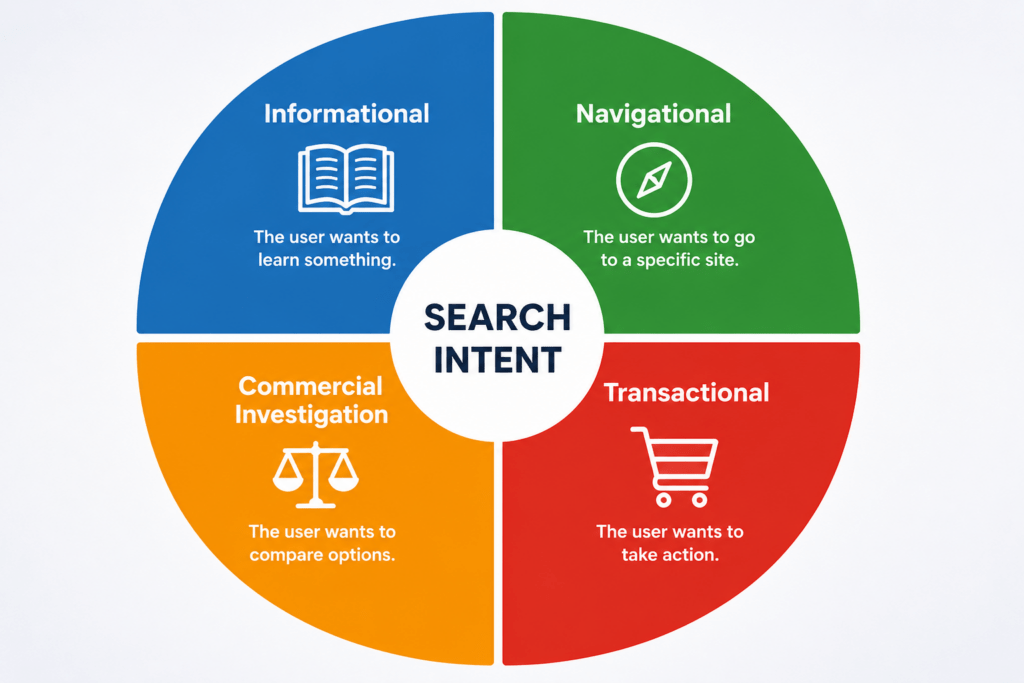
Let’s explore each type in detail.
1. Informational Intent
Users with informational intent want to learn, understand, or find answers to a question. They are looking for educational content rather than making an immediate purchase.
Examples
- What is Search Intent?
- How does SEO work?
- Beginner’s guide to content marketing
- What is keyword research?
The best content format includes:
- Comprehensive blog posts
- Step-by-step tutorials
- Guides
- FAQs
- Educational videos
2. Navigational Intent
A user with navigational intent already knows the website or brand they want to visit and uses a search engine as a shortcut.
Examples
- Google Search Console
- Ahrefs Login
- YouTube Studio
- HubSpot Blog
For these searches, users expect the official website or specific webpage to appear at the top of the search results.
3. Commercial Investigation Intent
Commercial investigation occurs when users are researching products or services before making a purchasing decision. They compare features, prices, reviews, and alternatives to identify the best option.
Examples
- Best SEO tools
- Ahrefs vs Semrush
- Top CRM software
- Best laptops for programming
The most effective content formats include:
- Comparison articles
- Product reviews
- Buying guides
- “Best of” lists
- Feature comparison tables
4. Transactional Intent
Users with transactional intent are ready to take action, such as purchasing a product, subscribing to a service, or downloading a resource.
Examples
- Buy SEO software
- Subscribe to ChatGPT
- Download SEO checklist
- Book SEO consultation
The best content for transactional searches includes:
- Product pages
- Landing pages
- Pricing pages
- Checkout pages
- Service pages with strong calls-to-action
Understanding Mixed Search Intent
Not every search query fits neatly into a single category. Many keywords have mixed search intent, meaning users searching for the same term may have different goals. Some users may be looking for information, while others are comparing options or preparing to make a purchase. To provide the best user experience, Google often displays a variety of content formats on the Search Engine Results Page (SERP) to satisfy these multiple intents.
For example, a search for “best SEO tools” may return comparison articles, product pages, review videos, and software websites on the same results page. This indicates that Google recognizes both commercial investigation and transactional intent behind the query. Instead of favoring a single content type, it ranks pages that collectively address the different needs of searchers.
Identifying mixed intent is crucial when planning content. Analyzing the top-ranking pages helps determine whether a keyword requires an educational guide, a comparison article, a landing page, or a combination of these formats. Creating content that addresses the dominant intents increases the likelihood of satisfying users and improving search visibility.
Common Examples of Mixed Search Intent
Informational + Commercial
Users first want to understand a topic before evaluating products or services.
Example Keywords
- Best SEO practices
- Email marketing software
- How to choose a CRM
Commercial + Transactional
Users are comparing options but are also close to making a purchase.
Example Keywords
- Ahrefs vs Semrush
- Best web hosting providers
- Buy project management software
Local + Transactional
Users are ready to take action at a nearby location.
Example Keywords
- SEO agency near me
- Dentist near me
- Coffee shop open now
Google often responds to these searches with Local Packs, maps, business profiles, reviews, and direct contact information to help users complete their desired action.
How Google Identifies Search Intent
Google’s primary goal is to deliver the most relevant results for every search query. Instead of relying solely on exact keyword matches, Google’s algorithms analyze the meaning, context, and purpose behind a search to understand what users are trying to accomplish. By combining semantic understanding, user behavior, and Search Engine Results Page (SERP) analysis, Google can identify the most appropriate content for different types of search intent.
According to the Google Search Quality Evaluator Guidelines, raters are instructed to understand the query meaning and user intent before evaluating search results. The guidelines classify searches into categories such as Know, Know Simple, Do, Website, Visit-in-Person, and queries with multiple user intents, highlighting that a single search may have more than one valid interpretation.
Although Google’s exact ranking algorithms remain proprietary, analyzing search results provides valuable insights into how the search engine interprets user intent.
Analyze the Search Engine Results Page (SERP)
One of the easiest ways to identify search intent is by examining the top-ranking results for a keyword. Google tailors the SERP layout based on what it believes users want to see.
For example:
- Featured Snippets usually indicate informational intent, where users seek quick answers.
- People Also Ask (PAA) boxes suggest users have related questions and need additional information.
- Product Listings (Shopping Results) often appear for transactional searches where users are ready to buy.
- Local Packs and Google Maps indicate visit-in-person or local intent.
- Videos commonly appear for tutorials, demonstrations, and how-to searches.
- Knowledge Panels provide quick facts for entities such as brands, people, or organizations.
By observing which SERP features dominate a keyword, you can determine the type of content Google expects to rank.
User Behavior Signals
Google also evaluates how users interact with search results to understand whether a page satisfies their intent. While Google has not publicly confirmed every behavioral signal used in ranking, factors such as user engagement help search engines assess content usefulness.
Some commonly observed indicators include:
- Click-through rate (CTR)
- Time spent on a page
- Return visits
- User engagement with the content
- Whether users continue searching for the same query after visiting a page
If users consistently find the information they need without returning to the search results, it suggests that the content successfully fulfills the intended search purpose.
How to Identify Search Intent Before Writing Content
Identifying search intent before creating content is one of the most important steps in any SEO strategy. Instead of relying solely on keyword search volume or difficulty, you should first understand what users expect to find when they search for a particular term. The easiest way to determine this is by analyzing Google’s existing search results. Since Google continuously refines its algorithms to satisfy user intent, the top-ranking pages provide valuable clues about the type of content that best matches a query.
By examining the Search Engine Results Page (SERP), content creators can identify the dominant intent, preferred content format, and common topics covered by competing pages. This research helps ensure that your content aligns with user expectations while increasing its chances of ranking well.
1. Analyze the Current SERPs
Start by searching your target keyword in Google and carefully review the first page of results. Pay attention to the types of pages ranking at the top.
Ask yourself:
- Are the results mostly blog posts or product pages?
- Does Google show comparison articles or buying guides?
- Are there videos, featured snippets, or local listings?
- What questions are answered on the page?
The highest-ranking pages usually indicate the dominant search intent for that keyword.
2. Examine Page Titles
Page titles reveal what users expect from a search query. Look for recurring patterns among the top-ranking results.
For example:
- What is… → Informational Intent
- Best… → Commercial Investigation
- Buy… → Transactional Intent
- Login… → Navigational Intent
If multiple pages use similar wording, it is often a strong signal that Google favors that content format.
3. Study Heading Structures
Review the H2 and H3 headings of top-ranking articles to understand the topics users expect to see.
Look for:
- Frequently repeated subtopics
- Definitions and explanations
- Step-by-step instructions
- Examples and case studies
- FAQs
This helps you create a more comprehensive article that addresses user needs.
4. Review the Content Format
Different search intents require different content formats. Matching the format is just as important as targeting the right keyword.
| Search Intent | Best Content Format |
| Informational | Blog posts, guides, tutorials |
| Navigational | Homepage, login page, brand page |
| Commercial Investigation | Comparison articles, reviews, buying guides |
| Transactional | Product pages, landing pages, pricing pages |
Choosing the correct format improves the likelihood that your content will satisfy both users and search engines.
Matching Content Types to Search Intent
Creating high-quality content is only part of a successful SEO strategy. Equally important is choosing the right content format for the user’s search intent. Even if your content is accurate and well-optimized, it may struggle to rank if it doesn’t match what users expect to see. Google consistently rewards pages that align with both the searcher’s intent and the preferred content format for a query.
| Intent | Best Content | CTA |
| Informational | Blog | Newsletter |
| Commercial | Comparison | Demo |
| Transactional | Landing Page | Buy |
| Navigational | Homepage | Login |
By understanding the relationship between search intent and content type, you can create pages that satisfy user expectations, improve engagement, and increase your chances of ranking higher in search results.
1. Blog Posts
Blog posts are the most effective format for informational intent because they educate, explain concepts, and answer user questions.
Best for keywords like
- What is Search Intent?
- SEO basics
- How to improve website rankings
Blog posts typically include definitions, examples, tutorials, and actionable tips that help users learn about a topic.
2. Landing Pages
Landing pages are designed for transactional intent, where users are ready to take a specific action such as signing up, requesting a demo, or purchasing a service.
Best for keywords like
- SEO services
- Free SEO audit
- Book a consultation
A successful landing page includes clear messaging, benefits, trust signals, and a strong call-to-action (CTA).
3. Product Pages
Product pages target users who have already decided to purchase and are looking for detailed product information.
Best for keywords like
- Buy SEO software
- CRM pricing
- Project management tool
Effective product pages should provide:
- Features and specifications
- Pricing details
- Customer reviews
- FAQs
- Clear purchase options
4. Comparison Articles
Comparison articles serve users with commercial investigation intent who are evaluating multiple options before making a decision.
Best for keywords like
- Ahrefs vs Semrush
- Best SEO tools
- WordPress vs Webflow
These articles should present unbiased comparisons, feature tables, pricing, pros and cons, and recommendations based on different user needs.
5. Tutorials and How-To Guides
Tutorials help users solve specific problems through step-by-step instructions, making them ideal for informational intent.
Best for keywords like
- How to optimize a website
- How to perform keyword research
- How to build backlinks
Including screenshots, examples, and practical tips improves readability and user satisfaction.
6. Category Pages
Category pages are commonly used on eCommerce websites to organize related products or services. They typically target commercial investigation and transactional intent by helping users browse available options.
Best for keywords like
- Running shoes
- SEO tools
- Web hosting providers
Well-optimized category pages include concise descriptions, filters, internal links, and easy navigation to individual product pages.
Choosing the Right Content Format
Before creating content, ask yourself:
- What is the user’s primary goal?
- What type of pages are currently ranking?
- Which content format dominates the SERP?
- Does my page match the expectations of the target audience?
Matching your content type to search intent ensures that users find exactly what they’re looking for, increasing both search visibility and user satisfaction.
Common Search Intent Mistakes
Understanding search intent is only half the battle—the real challenge is applying it correctly. Many websites fail to rank not because of poor content quality but because their content doesn’t align with what users expect. Even with strong keyword research and on-page SEO, targeting the wrong intent can reduce visibility, engagement, and conversions. Avoiding these common mistakes can significantly improve your SEO performance.
1. Targeting the Wrong Search Intent
One of the most common SEO mistakes is creating content that doesn’t match the user’s goal. For example, publishing a product page for a keyword that primarily returns educational blog posts is unlikely to perform well because Google recognizes that users are seeking information rather than making a purchase.
Example
- Keyword: “What is Search Intent?”
- Wrong Content: Product or service page
- Right Content: Comprehensive educational guide
Always analyze the dominant intent before creating content.
2. Ignoring the Search Engine Results Page (SERP)
The current SERP is one of the best indicators of search intent. Many content creators skip competitor analysis and create content based solely on keyword volume. As a result, their pages fail to match the format Google already considers most relevant.
Before writing, examine
- Top-ranking pages
- Featured snippets
- Videos
- People Also Ask (PAA)
- Local Packs
- Shopping results
These features reveal what users expect to find.
3. Focusing on Keywords Instead of User Needs
Keyword optimization remains important, but stuffing pages with keywords without addressing user questions creates a poor experience. Modern SEO prioritizes helpful, relevant, and user-focused content over excessive keyword usage.
Instead of asking:
“How many times should I use this keyword?”
Ask:
“Does this page completely answer the user’s question?”
Content that genuinely solves problems is more likely to rank and retain visitors.
4. Mixing Multiple Search Intents Without Structure
Some keywords naturally have mixed intent, but combining unrelated intents on the same page can confuse both users and search engines.
For example, an article that starts as a beginner’s guide but quickly shifts into a sales page without clear organization may fail to satisfy either informational or transactional users.
If a keyword serves multiple intents
- Organize content with clear headings.
- Address the primary intent first.
- Naturally guide users toward secondary actions where appropriate.
5. Failing to Update Content as Search Intent Changes
Search intent is not static. As user behavior, technology, and industry trends evolve, Google may begin ranking different types of content for the same keyword. A page that ranked well a year ago may lose visibility if it no longer aligns with current user expectations.
Regularly review your content by
- Monitoring ranking changes
- Reanalyzing the SERP
- Updating outdated information
- Adding new examples and FAQs
- Improving content depth and relevance
Keeping content aligned with evolving search intent helps maintain long-term rankings.
How to Avoid These Mistakes
Before publishing any content, ask yourself:
- Does this page match the dominant search intent?
- Is the content format consistent with the top-ranking results?
- Does it fully answer the user’s question?
- Is the information current and relevant?
- Will users leave the page feeling satisfied?
Answering these questions ensures your content is optimized not just for search engines but also for the people using them.
Search Intent Examples by Industry
| Industry | Informational | Commercial | Transactional |
| Ecommerce | Best Shoes | Nike vs Adidas | Buy Nike Shoes |
| SaaS | CRM Guide | HubSpot vs Salesforce | Buy CRM |
| Healthcare | What is Diabetes | Best Hospital | Book Appointment |
| Travel | Best Places | Hotel Reviews | Book Hotel |
| Finance | Best Credit Cards | Compare Cards | Apply Card |
Search Intent and the Customer Journey
Search intent and the customer journey are closely connected. As users move from discovering a problem to making a purchase, their search behavior changes. Understanding this relationship helps businesses create the right content for each stage of the buying process, ensuring users receive relevant information exactly when they need it. By aligning content with the customer journey, you can attract qualified traffic, build trust, and guide potential customers toward conversion.
Search Intent Mapping
1. Awareness Stage
At the awareness stage, users have identified a problem or want to learn more about a topic. Their searches are primarily informational, and they are looking for answers rather than products.
Example Searches
- What is Search Intent?
- How does SEO work?
- Why is keyword research important?
Best Content Types
- Blog posts
- Beginner guides
- Tutorials
- Educational videos
- FAQs
The goal at this stage is to educate users and establish your website as a trusted source of information.
2. Consideration Stage
During the consideration stage, users understand their problem and begin researching possible solutions. They compare products, services, tools, or approaches before making a decision. This stage reflects commercial investigation intent.
Example Searches
- Best SEO tools
- Ahrefs vs Semrush
- Top keyword research software
Best Content Types
- Comparison articles
- Product reviews
- Buying guides
- Case studies
- Expert recommendations
At this stage, provide balanced information, highlight key differences, and help users evaluate their options.
3. Decision Stage
In the decision stage, users are ready to take action. Their searches indicate transactional intent, meaning they want to purchase, subscribe, book, or contact a business.
Example Searches
- Buy SEO software
- Start free SEO trial
- Hire an SEO agency
Best Content Types
- Product pages
- Service pages
- Landing pages
- Pricing pages
- Demo or sign-up pages
Focus on clear value propositions, trust signals, customer testimonials, and compelling calls-to-action to encourage conversions.
4. Retention Stage
The customer journey doesn’t end after a purchase. Existing customers often return to search engines for support, updates, tutorials, or additional products. Creating content for the retention stage improves customer satisfaction and encourages long-term loyalty.
Example Searches
- How to use SEO software
- SEO software tutorials
- Upgrade subscription
- Customer support
Best Content Types
- Knowledge base articles
- Help center documentation
- Video tutorials
- Product updates
- Community forums
Providing ongoing support strengthens customer relationships and increases the likelihood of repeat business.
Mapping Search Intent to the Customer Journey
| Customer Journey Stage | Primary Search Intent | Best Content Format | |
| Awareness | Informational | Blog posts, guides, tutorials | |
| Consideration | Commercial Investigation | Comparisons, reviews, buying guides | |
| Decision | Transactional | Product pages, landing pages, pricing pages | |
| Retention | Informational / Navigational | Help articles, documentation, tutorials |
By creating content for every stage of the customer journey, businesses can attract users earlier in the buying process, nurture their interest, and support them long after the initial conversion. This holistic approach not only improves SEO performance but also builds trust and fosters lasting customer relationships.
Search Intent Optimization Checklist
Creating content that matches search intent requires more than choosing the right keyword. Every stage of content creation—from keyword research to post-publication updates—should focus on satisfying the user’s goal. Use the following checklist to ensure your content aligns with search intent and improves its chances of ranking in search results.
1. Identify the Primary Search Intent
Before writing, determine why users are searching for the keyword.
Ask yourself:
- Are users looking for information?
- Do they want to visit a specific website?
- Are they comparing products or services?
- Are they ready to make a purchase?
Understanding the dominant intent helps you choose the right content strategy from the beginning.
2. Analyze the Search Engine Results Page (SERP)
Study the top-ranking pages to understand what Google considers the best answer for the query.
Check for:
- Featured Snippets
- People Also Ask (PAA)
- Videos
- Shopping Results
- Local Packs
- Knowledge Panels
These SERP features reveal the type of content users expect.
3. Choose the Right Content Format
Match your content format to the dominant search intent.
| Search Intent | Recommended Content |
| Informational | Blog posts, guides, tutorials |
| Navigational | Homepage, login page, brand page |
| Commercial Investigation | Reviews, comparisons, buying guides |
| Transactional | Product pages, landing pages, pricing pages |
Selecting the correct format significantly improves user satisfaction.
4. Create Helpful and Comprehensive Content
Your content should answer the user’s question completely rather than simply mentioning the target keyword.
Ensure your page:
- Covers the topic in depth.
- Answers common questions.
- Includes practical examples.
- Uses clear headings and logical structure.
- Provides actionable information.
Helpful content is more likely to meet user expectations and perform well in search results.
5. Optimize for Readability and User Experience
Even high-quality information can underperform if it’s difficult to read.
Improve readability by:
- Using short paragraphs.
- Adding descriptive headings.
- Including bullet points and tables.
- Using visuals where appropriate.
- Ensuring the page is mobile-friendly.
A better user experience increases engagement and encourages visitors to stay longer.
6. Strengthen E-E-A-T Signals
Google values content that demonstrates Experience, Expertise, Authoritativeness, and Trustworthiness (E-E-A-T), especially for topics that influence important decisions.
Strengthen credibility by:
- Citing reputable sources.
- Including author information.
- Providing accurate and up-to-date content.
- Supporting claims with data and examples.
- Maintaining transparency and trust.
7. Review and Update Content Regularly
Search intent can evolve over time. Regularly review your content to ensure it continues to satisfy user expectations.
Update your content by
- Refreshing outdated information.
- Adding new examples.
- Improving clarity and structure.
- Expanding sections based on new search trends.
- Reanalyzing the current SERP.
Regular updates help maintain relevance and improve long-term rankings.
Search Intent Optimization Checklist
Use this quick checklist before publishing your content:
- ✅ Identify the primary search intent.
- ✅ Analyze the current SERP.
- ✅ Match the appropriate content format.
- ✅ Answer the user’s questions completely.
- ✅ Improve readability and user experience.
- ✅ Demonstrate E-E-A-T with credible information.
- ✅ Optimize headings and internal links.
- ✅ Review and update content periodically.
Following this checklist ensures your content aligns with both user expectations and search engine requirements, increasing the likelihood of higher rankings, better engagement, and improved conversions.
Future of Search Intent
Search intent continues to evolve as search engines become more intelligent and user expectations change. In the past, search engines relied heavily on exact keyword matching. Today, they use artificial intelligence, machine learning, and natural language processing to understand the context and purpose behind every query. As a result, content creators must focus less on keyword repetition and more on delivering accurate, relevant, and helpful information.
According to Google’s Search Quality Evaluator Guidelines, understanding query meaning and satisfying user needs remain central to evaluating search quality. The guidelines also recognize that many searches have multiple possible intents and that search engines should present results that best fulfill those expectations.
1. AI-Powered Search
Artificial intelligence is transforming how search engines interpret queries. AI systems can understand conversational language, recognize relationships between topics, and provide more personalized search results.
This means content should:
- Answer questions naturally.
- Cover topics comprehensively.
- Focus on solving user problems rather than targeting isolated keywords.
2. Conversational Search
With the growing use of voice assistants and AI chatbots, users are increasingly searching using complete questions instead of short keyword phrases.
Examples:
- “What is the best SEO tool for beginners?”
- “How can I improve my website rankings without backlinks?”
Creating content that directly answers conversational queries increases its chances of appearing in voice search and AI-generated responses.
3. Multimodal Search
Modern search engines now understand more than just text. Users can search using images, voice, videos, and even combinations of different input methods.
As multimodal search grows, content creators should include:
- High-quality images
- Descriptive image alt text
- Videos and infographics
- Structured data where appropriate
This improves accessibility and helps search engines better understand page content.
4. Personalized Search Experiences
Search results increasingly vary based on factors such as user location, language, search history, and device. Although the same keyword may produce different results for different users, the goal remains consistent—delivering content that best matches individual intent.
Businesses should focus on creating content that serves their target audience rather than attempting to optimize for every possible variation of a query.
Preparing for the Future
As search technology continues to evolve, one principle remains unchanged: the best-performing content is content that genuinely satisfies user intent.
To stay competitive
- Focus on solving real user problems.
- Create original, trustworthy, and comprehensive content.
- Regularly review search results to identify changes in intent.
- Keep content updated with new information and examples.
- Prioritize user experience over keyword density.
By adapting to emerging search trends while consistently meeting user expectations, businesses can build long-term visibility, authority, and sustainable organic traffic.
Frequently Asked Questions (FAQ)
1. What are the four main types of search intent?
The four primary types of search intent are
- Informational Intent – Users want to learn or find answers.
- Navigational Intent – Users want to visit a specific website or page.
- Commercial Investigation Intent – Users compare products or services before making a decision.
- Transactional Intent – Users are ready to purchase or complete an action.
Understanding these intent types helps create content that aligns with user expectations and improves SEO performance.
2. Why is search intent important for SEO?
Search intent is important because Google prioritizes content that best satisfies the user’s goal. When your content matches user intent, it is more likely to achieve higher rankings, improve engagement, reduce bounce rates, and increase conversions.
3. How can I identify search intent?
The easiest way is to analyze Google’s search results for your target keyword.
Look for:
- The types of pages ranking
- Featured Snippets
- People Also Ask boxes
- Videos
- Shopping results
- Local Packs
These SERP features reveal what Google believes users expect to find.
4. Can one keyword have multiple search intents?
Yes. Many keywords have mixed search intent. For example, “best SEO tools” may return comparison articles, reviews, product pages, and videos because users may be researching, comparing, or preparing to purchase.
In such cases, creating comprehensive content that addresses the dominant intents can improve search visibility.
5. How often should I review search intent?
Search intent should be reviewed regularly, especially when rankings decline or search results change. Reanalyzing the SERPs every few months helps ensure your content continues to match current user expectations and remains competitive.
Conclusion
Search intent has become the foundation of modern SEO. Rather than focusing solely on keywords, successful content strategies prioritize the purpose behind each search query and aim to deliver the most relevant, helpful, and satisfying experience for users. Whether someone wants to learn, compare options, visit a specific website, or make a purchase, understanding their intent allows you to create content that genuinely meets their needs.
By identifying the correct search intent, analyzing the SERP, selecting the appropriate content format, and regularly updating your pages, you can improve search rankings, attract qualified traffic, and build long-term authority. As search engines continue to evolve through AI and semantic understanding, businesses that consistently align their content with user intent will be best positioned to achieve sustainable SEO success.