
Modern Marketing Funnel Models for Online Businesses
Introduction
In boardrooms across Dubai’s fast-evolving digital economy, one question keeps resurfacing: Why does traffic keep increasing while conversions plateau? Dashboards show growth in impressions and clicks, yet revenue impact remains inconsistent. More often than not, the issue is not demand generation but outdated thinking around marketing funnel models that no longer reflect how customers actually buy.
For years, businesses treated funnels as linear pipelines—pour leads in at the top and hope customers drip out at the bottom. That logic no longer holds. Today’s online consumers move non-linearly, switch devices mid-journey, validate choices through reviews and peers, and expect relevance at every interaction. Modern growth is not driven by volume alone; it is driven by well-orchestrated customer journeys that reduce friction and build trust across touchpoints.
For a Dubai-based marketing agency working with regional and global brands, understanding and deploying modern marketing funnel models is no longer optional. It has become the foundation of scalable, defensible growth in a competitive digital landscape where intelligence, adaptability, and customer-centric design determine long-term success.
What Are Marketing Funnel Models?
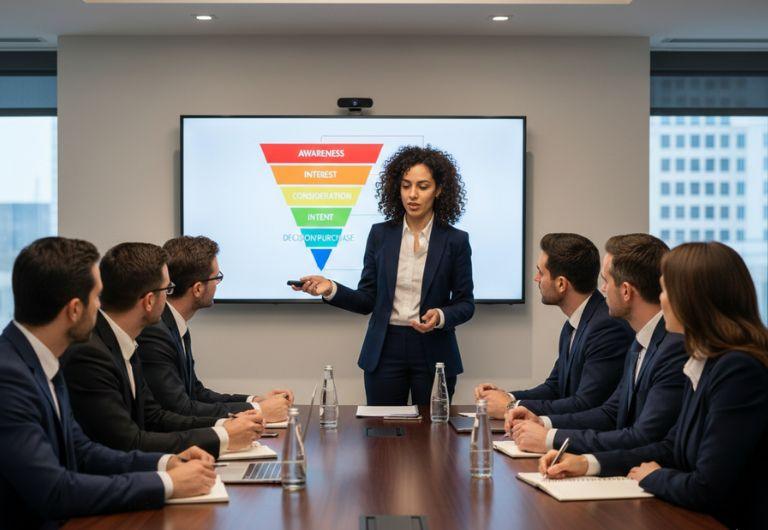
At their core, marketing funnel models are structured frameworks that explain how potential customers move from initial awareness to conversion—and, increasingly, to retention and advocacy. They provide a strategic lens for aligning messaging, channels, and metrics with customer intent at each stage.
Classic funnels assume predictability: awareness leads to interest, interest leads to desire, and desire leads to action. Modern funnels challenge that assumption. They recognize that buyers loop, stall, accelerate, and sometimes convert before they “officially” reach the bottom.
As McKinsey notes, “The consumer decision journey is now circular, not linear.” This insight fundamentally reshaped how digital marketing funnel models are designed today.

Why Modern Marketing Funnel Models Matter Today
The urgency around modern funnels is not theoretical; it is driven by measurable shifts in buyer behavior that have fundamentally altered how decisions are made. Digital customers no longer follow predictable paths, and traditional linear funnels fail to capture this reality. According to Google research, consumers interact with an average of 7–10 touchpoints before making a purchase decision, often spanning search engines, social platforms, email, review sites, and online marketplaces. In sectors such as SaaS and high-consideration eCommerce, that number is significantly higher, reflecting longer evaluation cycles and greater perceived risk.
For online businesses operating in highly competitive markets like the UAE, Saudi Arabia, and the wider MENA region, the implications are unmistakable. Fragmented funnels—where channels operate in isolation and messaging lacks continuity—create friction that erodes trust and delays conversion. A modern, integrated online business marketing funnel removes that friction by aligning touchpoints around intent, ensuring consistency across devices, channels, and moments of engagement.
Modern funnels matter because they:
- Reflect real customer behavior, not idealized paths
- Support omnichannel and cross-device journeys
- Enable personalization and automation at scale
- Tie marketing investment directly to revenue outcomes
In doing so, they transform marketing from a cost center focused on activity into a growth engine focused on impact, accountability, and long-term value creation.
The Evolution of Marketing Funnel Stages
To understand modern funnel design, it is useful to revisit the marketing funnel stages themselves. While terminology varies across industries and frameworks, most contemporary models still anchor around three macro phases: awareness, consideration, and conversion. What has fundamentally changed is not the existence of these stages, but the fluidity with which customers move between them.
The traditional awareness–consideration–conversion funnel assumed orderly progression. Today, that assumption no longer reflects reality. A prospect may discover a brand via social media, validate it through reviews or peer recommendations, abandon a cart, re-engage through retargeting, and ultimately convert weeks later after receiving a highly personalized email or offer. These journeys are fragmented, iterative, and influenced by context, timing, and trust.
As a result, linear funnel thinking has been replaced by more dynamic frameworks such as the customer journey funnel and buyer journey mapping. These approaches prioritize understanding intent signals over enforcing stage progression. The strategic objective is no longer to “push” users downward, but to identify moments of readiness and remove friction wherever intent appears. In modern funnels, relevance, timing, and experience matter more than sequence—turning adaptability into a competitive advantage.
Popular Marketing Funnel Models Explained
The AIDA Marketing Funnel (Reimagined)
The AIDA marketing funnel—Awareness, Interest, Desire, Action—remains relevant, but only when modernized. In digital contexts, desire is often built through social proof, content authority, and brand credibility rather than persuasive copy alone.
High-performing online brands adapt AIDA by integrating behavioral data, retargeting logic, and personalized messaging. Awareness becomes data-driven reach. Interest is measured through engagement depth. Desire is reinforced via trust signals. Action is optimized through UX and CRO.
TOFU–MOFU–BOFU as a Content Engine
The TOFU MOFU BOFU funnel has found renewed relevance in content-led growth strategies. Top-of-funnel content educates, middle-of-funnel assets build authority, and bottom-of-funnel content converts.
What distinguishes modern usage is intent alignment. TOFU content is no longer generic blogs; it is search-driven, problem-aware content. MOFU content addresses comparison and evaluation. BOFU content focuses on risk reduction—case studies, demos, guarantees.
For Dubai-based agencies working with B2B and SaaS brands, this framework remains one of the most effective marketing funnel models for lead generation when executed with precision.
Conversion Funnel Models for Performance Marketing
Conversion funnel models are central to paid media, CRO, and performance marketing. These funnels prioritize micro-conversions—clicks, scroll depth, form starts—over simplistic last-click attribution.
Modern performance teams analyze funnels as feedback systems, continuously optimizing messaging, landing pages, and offers based on behavioral signals. According to Bain & Company, companies that excel at analytics-driven funnel optimization are five times more likely to make faster decisions than competitors.
Full-Funnel Marketing Strategy Frameworks
A full-funnel marketing strategy integrates awareness, acquisition, conversion, retention, and advocacy into a single operating system. This approach is especially critical for subscription businesses and marketplaces.
Rather than allocating budgets by channel, full-funnel models allocate resources by customer intent stage, ensuring consistency across paid, owned, and earned media.
This shift explains why leading brands increasingly organize teams around lifecycle stages rather than marketing silos.
Sales Funnel vs Marketing Funnel: A Strategic Distinction
One persistent source of confusion is the debate around sales funnel vs marketing funnel. In modern organizations, the distinction matters less operationally but more strategically.
The marketing funnel focuses on demand creation and intent shaping. The sales funnel focuses on qualification, negotiation, and closure. In digital-first businesses, these funnels increasingly overlap, particularly in self-serve and product-led models.
High-performing organizations design integrated revenue funnels, where marketing owns early intent, sales engages when value is clear, and post-sale teams drive expansion and loyalty.
Marketing Funnel Models for Online Businesses
Modern marketing funnel models must adapt to the economic logic of each business type. While the core principles of awareness, consideration, conversion, and retention remain universal, the way value is created—and risk is perceived—differs sharply across eCommerce, SaaS, services, and startups. High-performing funnels are therefore designed as business-specific growth systems, not generic templates.
eCommerce Businesses
Awareness: High-Velocity Discovery at Scale
For marketing funnel models for ecommerce businesses, awareness is no longer a slow build. Discovery typically occurs on social platforms, influencer ecosystems, and marketplaces where consumers are exposed to products before actively searching for them. Speed matters more than depth at this stage. The objective is mental availability—ensuring the brand enters the consumer’s consideration set with minimal friction.
Consideration: Trust Compression Through Social Proof
Consideration is where most eCommerce funnels either scale or collapse. Reviews, user-generated content, comparison pages, and delivery assurances act as trust accelerators. Modern funnels recognize that buyers outsource judgment to peers. The role of the brand is not persuasion, but validation—making trust visible and easily verifiable.
Conversion: UX, Checkout Friction, and Operational Transparency
Conversion hinges less on emotional messaging and more on execution excellence. UX clarity, checkout speed, payment flexibility, and delivery transparency directly determine outcomes. In modern conversion funnel models, operational friction is the primary conversion killer, not price sensitivity.
Retention & Loyalty: Where Profit Is Actually Created
Leading eCommerce brands extend the online business marketing funnel beyond the first purchase into structured retention and loyalty systems. Post-purchase email, SMS, and personalization are not add-ons; they are core funnel stages.
A Shopify Plus study found that increasing repeat purchase rates by just 5% can increase profits by 25–95%, reinforcing a fundamental insight: modern eCommerce funnels are designed for lifetime value, not single transactions.
SaaS Companies
Awareness: Problem-Centric, Not Brand-Centric
Marketing funnel models for SaaS companies begin with education. Awareness is driven by problem recognition rather than product promotion. Prospects are searching for clarity around inefficiencies, costs, and missed opportunities. Content at this stage positions the brand as a guide, not a seller.
Consideration: Solution Validation and ROI Framing
During consideration, SaaS buyers evaluate depth—features, integrations, security, and scalability. Modern funnels use case studies, comparison content, and ROI frameworks to reduce uncertainty. The customer journey funnel here is analytical rather than emotional.
Conversion: Product-Led and Experience-Driven
Modern SaaS funnels increasingly rely on product-led growth. Free trials, freemium models, and demos are not conversion tactics; they are central funnel stages. Onboarding sequences, in-app nudges, and lifecycle emails blur the line between marketing and product, creating a unified marketing automation funnel.
Expansion: From Acquisition Funnel to Growth Engine
The most effective SaaS funnels evolve beyond acquisition into expansion engines. Upsells, renewals, and cross-sells are integrated into the same funnel logic that acquired the customer. Success is measured not in sign-ups, but in activation, retention, and revenue expansion—hallmarks of mature customer acquisition funnels.
Service-Based and Agency Businesses
Awareness: Authority Before Visibility
For marketing funnel models for service-based businesses, awareness is built through authority rather than reach. Thought leadership, strategic insights, and industry commentary outperform promotional messaging. The goal is not traffic, but relevance.
Consideration: Proof, Credibility, and Risk Reduction
Consideration hinges on evidence. Case studies, frameworks, testimonials, and demonstrated expertise reduce perceived risk. In high-value services, prospects are evaluating competence, not offers.
Conversion: Confidence Over Pressure
Dubai-based agencies often outperform competitors by avoiding aggressive sales mechanics. Conversion happens when confidence outweighs risk. The funnel becomes a credibility narrative—each interaction reinforcing expertise and strategic alignment.
In this model, the sales funnel vs marketing funnel distinction fades. Marketing does the heavy lifting by pre-qualifying trust before sales engagement even begins.
Startups and Digital Brands
Early-Stage Funnels: Speed, Learning, and Validation
Marketing funnel models for startups prioritize learning velocity over optimization. Simplified funnels allow rapid testing of messaging, pricing, and channels. Assumptions are validated through data, not opinion.
Scaling Funnels: Layering Automation and Precision
As traction grows, startups layer sophistication—automation, personalization, and segmentation—without losing agility. Funnels evolve from experimentation tools into repeatable systems.
Continuous Optimization: Agility as Strategic Advantage
For modern marketing funnel models for digital brands, agility is the differentiator. Funnels are continuously reconfigured based on performance insights rather than fixed annual plans. This approach enables data-driven funnel optimization, allowing smaller brands to outmaneuver larger competitors despite lower budgets.
Case Study: Full-Funnel Transformation in the GCC
A regional D2C brand operating across the UAE and Saudi Arabia faced stagnant growth despite rising ad spend. Traffic was increasing, but conversion rates remained flat, and repeat purchases were declining.
The issue was not demand—it was funnel fragmentation.
By redesigning the marketing funnel strategy for online business, the brand aligned paid media, content, and CRM around lifecycle stages. Awareness campaigns were decoupled from conversion KPIs. Retargeting was rebuilt around behavioral triggers. Post-purchase communication shifted from promotions to education.
Within six months, conversion rates improved by 28%, and customer lifetime value increased by 34%. The transformation did not rely on new channels but on modern funnel logic applied consistently.

How to Choose the Right Marketing Funnel Model
Context Over Theory
Choosing the right framework is far less about academic theory and far more about business context. The most effective marketing funnel models with examples are those deliberately adapted to the realities of a company’s business model, buying cycle length, and growth ambitions. A funnel designed for impulse-driven eCommerce will underperform in enterprise SaaS, just as a complex lifecycle funnel can slow down early-stage digital brands.
Strategic Evaluation Criteria for Executives
Executives should evaluate funnel models through a strategic, organization-wide lens rather than a campaign-level perspective. Several core factors determine whether a funnel will scale or stall:
- Sales cycle length and complexity, which influence how much education and trust-building are required
- Digital maturity and data availability, defining how effectively behavior can be tracked and optimized
- Customer acquisition costs relative to lifetime value (LTV), ensuring the funnel is economically sustainable
- Internal alignment between marketing, sales, and product, which determines execution efficiency and accountability
These variables shape not only funnel structure, but also how aggressively automation, personalization, and optimization can be applied.
Funnels as Growth Operating Systems
Ultimately, the most effective funnels are not static diagrams built for presentations or reporting. They function as operating systems for growth, continuously translating customer behavior into insight, insight into action, and action into measurable revenue impact. In modern organizations, the funnel becomes a decision-making framework—guiding investment priorities, aligning teams, and enabling consistent, scalable growth over time.
Benefits of Marketing Funnel Models
When designed and executed correctly, modern funnels deliver compounding advantages that extend far beyond short-term lead generation. They bring strategic clarity to decision-making by connecting customer behavior directly to business outcomes, enabling leadership teams to prioritize investments based on measurable impact rather than intuition. Marketing, sales, product, and customer success teams operate from a shared growth framework, reducing friction and eliminating siloed execution.
More importantly, modern marketing funnel models enable continuous, data-driven funnel optimization. Every interaction—clicks, dwell time, drop-offs, repeat purchases—becomes a signal for refinement. Funnels evolve in response to customer intent, not static assumptions, allowing businesses to reallocate budgets, adjust messaging, and redesign journeys in near real time.
In volatile digital markets, this adaptability is not merely operational efficiency; it is a strategic asset. Organizations that treat funnels as living systems consistently outperform those relying on rigid campaign structures. As McKinsey observes, “Companies that embed analytics into their operating models are more likely to lead their industries.” Modern funnels are the practical manifestation of that principle—turning data into decisive competitive advantage.
Ultimately, the value of a modern funnel is not in how many prospects it attracts, but in how intelligently it converts attention into trust, trust into revenue, and revenue into long-term growth.
Conclusion: From Funnels to Growth Systems
The era of simplistic funnels is over. Today, marketing funnel models must reflect complexity, adaptability, and deeply customer-centric design. For online businesses—and especially for Dubai-based agencies serving ambitious, growth-oriented brands—the funnel is no longer a static diagram used for reporting. It has evolved into a strategic growth system that connects customer insight, technology, and execution into a single operating model.
Organizations that treat funnels as living, data-informed frameworks gain a structural advantage. They respond faster to shifts in customer behavior, optimize investment with greater precision, and align teams around shared performance signals rather than disconnected KPIs. Funnels become decision engines—continuously learning, recalibrating, and improving.
In a market defined by abundance of choice and intensifying competition, success will not belong to those with the loudest messaging or the highest media spend. It will belong to brands that design the most intelligent journeys—journeys that respect customer intent, reduce friction at every touchpoint, and transform attention into trust, and trust into long-term value.
FAQs
1. What are marketing funnel models?
Marketing funnel models are structured frameworks that map how customers move from initial awareness to conversion and long-term engagement. They help businesses understand buyer intent at each stage of the journey and design relevant touchpoints accordingly. By doing so, marketing efforts become more focused, measurable, and aligned with revenue goals.
2. How do marketing funnel models work in practice?
In practice, marketing funnel models guide channel selection, messaging, and performance metrics across the customer journey. Each stage is optimized using behavioral data to reduce friction and improve progression. This systematic approach enables continuous refinement rather than one-time campaign execution.
3. Are modern marketing funnel models industry-specific?
Yes, modern marketing funnel models vary significantly by industry due to differences in buying cycles, trust requirements, and decision complexity. eCommerce, SaaS, startups, and service businesses each require tailored funnel designs. However, the underlying principles of intent alignment and optimization remain consistent.
4. How do marketing funnel models support business growth?
Marketing funnel models create a clear link between customer behavior and revenue outcomes. By structuring engagement across awareness, consideration, conversion, and retention, businesses can optimize resources, reduce inefficiencies, and scale growth predictably. This alignment enables smarter investment decisions and sustained performance improvement.
5. What makes modern marketing funnel models different from traditional funnels?
Modern marketing funnel models are dynamic, data-driven, and non-linear, reflecting how customers actually behave across channels and devices. Unlike traditional linear funnels, they adapt continuously based on real-time insights, allowing brands to respond faster to changing market conditions. This flexibility makes them more effective in competitive digital environments.