
From Awareness to Retention: Building a High-Performance Conversion Loop
Introduction: Why the Funnel Is No Longer Enough
For decades, marketing strategy has been dominated by the linear funnel: awareness at the top, conversion in the middle, and purchase at the bottom. While this model helped organizations visualize demand flow, it no longer reflects how modern customers behave—especially in competitive, high-consideration markets like the UAE.
Today’s buyers do not move neatly from exposure to purchase and disappear. They research, disengage, return, compare, convert, churn, and sometimes advocate. In this reality, growth is not driven by isolated campaigns but by systems—specifically, by a high-performance awareness → conversion → retention loop.
This loop reframes marketing as a continuous, compounding engine rather than a one-time acquisition effort. For Dubai-based businesses operating in saturated digital environments, rising media costs, and increasingly sophisticated B2B and B2C buyers, mastering this loop is no longer optional. It is the difference between sustainable growth and perpetual re-acquisition.
As McKinsey notes, “The most successful companies are shifting from linear funnels to cyclical growth models that prioritize lifetime value over single transactions.” This article explores how to design, measure, and optimize the awareness → conversion → retention loop with strategic depth, real-world applications, and a focus on long-term value creation.
What Is the Awareness → Conversion → Retention Loop?
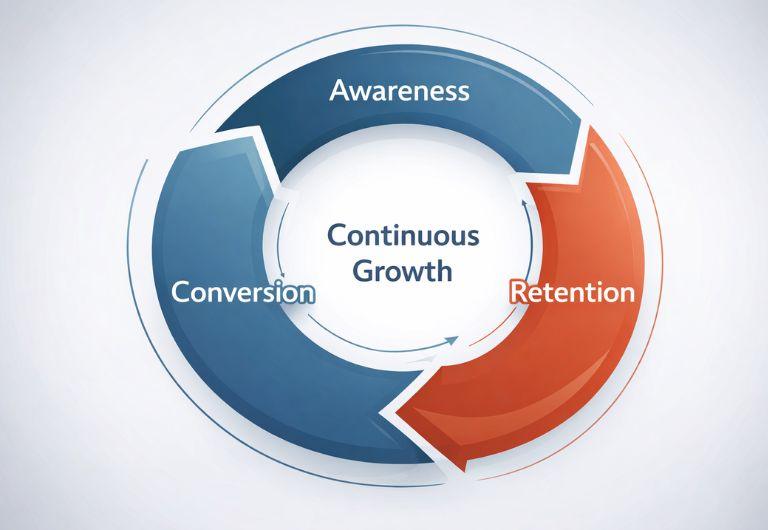
At its core, the awareness conversion retention loop is a full-funnel marketing framework that integrates acquisition, monetization, and loyalty into a single, self-reinforcing system.
Unlike the traditional funnel—which ends at conversion—the loop recognizes retention as both an outcome and an input. Retained customers generate repeat revenue, referrals, behavioral data, and brand signals that feed back into awareness, lowering acquisition costs and increasing conversion efficiency over time.
In practical terms, the loop consists of three interconnected stages:
- Awareness: How relevant audiences first discover and understand your brand
- Conversion: How effectively interest is translated into action and revenue
- Retention: How consistently customers return, engage, and advocate
What makes this framework powerful is not the stages themselves, but the feedback mechanisms between them. High-quality awareness attracts better-fit users. Better-fit users convert at higher rates. Higher conversion quality improves retention. Strong retention amplifies awareness through advocacy, content, and social proof.
This is why leading growth teams increasingly talk about a full-funnel marketing loop or customer lifecycle marketing loop rather than top-of-funnel tactics in isolation.

Why the Loop Matters More Than Ever in Dubai’s Market
Dubai is one of the most competitive marketing environments globally. Businesses operate in a multicultural, multilingual ecosystem where audiences are digitally mature and comparison-driven. Paid media costs are rising across Google, Meta, and LinkedIn, while trust thresholds remain high.
In this context, brands that focus purely on awareness or lead generation often face three structural problems:
- High CAC with low LTV, due to weak retention
- Unqualified conversions, driven by broad messaging
- Inconsistent growth, dependent on constant spend increases
A well-designed awareness → conversion → retention loop directly addresses these challenges. By aligning messaging, experience, and value delivery across the lifecycle, brands reduce waste and increase customer lifetime value (CLV).
According to Bain & Company, “Increasing customer retention rates by just 5% increases profits by 25% to 95%.” In markets like the UAE—where customer acquisition costs are among the highest in MENA—this leverage is significant.
Stage One: Awareness as Strategic Signal, Not Reach
Rethinking Awareness Beyond Impressions
In a high-performance conversion loop, awareness is not about maximum exposure. It is about precision relevance. The goal is not to reach everyone, but to reach the right audience with the right narrative at the right moment of problem recognition.
This shift reframes awareness from a branding exercise into a strategic filtering mechanism. Every awareness touchpoint sends a signal—to the market and to your own funnel—about who your brand is for and who it is not.
Effective awareness in this framework aligns tightly with:
- Customer journey mapping
- Intent levels (latent vs active demand)
- Market education gaps
For example, a B2B SaaS company in Dubai targeting enterprise procurement teams should not lead with product features. Instead, it should frame industry inefficiencies, regulatory complexity, or cost leakage—problems the audience already feels but may not have articulated clearly.
Awareness That Pre-Qualifies Conversion
High-quality awareness content does part of the conversion work upfront. Thought leadership articles, expert webinars, and insight-driven LinkedIn content help self-select audiences who resonate with your worldview.
This is why demand generation and capture must be strategically sequenced. Demand generation educates and shapes intent. Demand capture converts existing intent. When awareness is done correctly, conversion becomes a natural continuation rather than a hard sell.
Stage Two: Conversion as Experience, Not Persuasion
Why Conversion Fails Without Context
Most conversion optimization efforts focus narrowly on tactics: button colors, landing page layouts, or copy tweaks. While these matter, they rarely compensate for a deeper issue—misaligned intent.
In the awareness → conversion → retention loop, conversion is not about persuasion. It is about resolution. The user has a problem, has recognized it through awareness, and is now seeking a credible path forward.
This is where conversion rate optimization (CRO) must integrate with lifecycle understanding. A high-performing conversion experience reflects three principles:
- Continuity of narrative from awareness to action
- Clarity of value exchange (what the user gets vs gives)
- Reduction of cognitive friction, not pressure
Harvard Business Review highlights that “Customers are more likely to convert when they feel in control of the decision process rather than pushed through it.”
Conversion Quality Over Conversion Volume
In growth marketing loops, not all conversions are equal. A lead that churns within 30 days damages the system more than it helps. This is why advanced teams track conversion quality metrics, not just conversion rates.
Examples include:
- Time to first value
- Activation depth
- Early engagement metrics
By aligning conversion events with downstream retention indicators, marketers create a healthier conversion and retention loop—one where revenue compounds instead of leaking.
Stage Three: Retention as the Growth Multiplier
Retention Is Where the Loop Closes—and Reopens
Retention is often treated as a post-sale responsibility, delegated to customer success or CRM automation. In reality, it is the most underutilized growth lever in the entire awareness of retention marketing funnel.
Retention transforms customers into assets. Each retained user contributes:
- Repeat purchase behavior
- Lower marginal acquisition costs
- Social proof and referrals
- Behavioral data that improves targeting
In subscription-based and service-driven industries, retention directly determines CLV. In transactional businesses, it drives frequency and advocacy.
According to Adobe, “Returning customers account for 40% of revenue while representing only 8% of visitors.” This imbalance explains why retention-centric strategies outperform acquisition-heavy models over time.
Designing Retention Into the System
Retention does not begin after conversion; it begins before it. Expectations set during awareness and reinforced during conversion shape satisfaction, trust, and longevity.
Effective retention strategies integrate:
- Intent-matched onboarding processes
- Proactive lifecycle communication
- Value reinforcement through content and education
This is where lifecycle marketing automation becomes critical—not as a spam mechanism, but as a contextual engagement layer aligned with user maturity.
The Awareness → Conversion → Retention Loop vs the Traditional Funnel
The traditional funnel assumes linearity. The loop assumes continuity. This distinction has practical implications for strategy, measurement, and budgeting.
In funnel-based models, teams optimize stages independently. In loop-based models, optimization focuses on flow efficiency across stages.
For example, improving awareness relevance may reduce top-of-funnel volume but increase conversion efficiency and retention—resulting in higher overall ROI. This trade-off is invisible in siloed funnel metrics but obvious in loop-based analysis.
Leading organizations increasingly evaluate performance through system-wide KPIs, such as:
- Customer lifetime value (CLV)
- CAC-to-LTV ratio
- Retention-adjusted conversion rates
Building a High-Performance Conversion Loop
Building a high-performance conversion loop is less about executing isolated tactics and more about engineering alignment across the entire customer lifecycle. In mature growth organizations, the loop functions as an operating system—one that continuously refines who you attract, how you convert, and why customers stay.
The defining characteristic of a high-performance awareness → conversion → retention loop is intent continuity. Each stage must feel like a logical progression rather than a reset. Awareness establishes the problem narrative and value hypothesis. Conversion validates that hypothesis through experience. Retention confirms it through consistent delivery. When any one of these stages is misaligned, friction appears—not always immediately, but inevitably through churn, declining engagement, or rising acquisition costs.
From a strategic standpoint, high-performing loops are built on feedback, not assumptions. Behavioral data from retention—usage patterns, repeat purchase signals, engagement depth—should actively reshape both conversion design and awareness messaging. This is why leading growth teams treat retention data as upstream intelligence rather than downstream reporting. As Bain & Company notes, “The most valuable customer insights often come after the first purchase, not before it.”
Operationally, this requires tight collaboration between marketing, sales, product, and customer success. Conversion optimization without retention insight leads to superficial gains. Retention programs without awareness alignment struggle to scale. The loop only performs when ownership is shared and metrics are connected—when teams optimize for lifetime value rather than short-term wins.
Technology plays an enabling role, but it is not the differentiator. Marketing automation, CRM platforms, and analytics tools only amplify what the strategy already prioritizes. High-performance conversion loops are ultimately driven by clarity: clarity on who the ideal customer is, what problem truly matters to them, and what sustained value the brand commits to delivering.
In competitive markets like Dubai—where buyers are informed, skeptical, and comparison-driven—this clarity becomes a growth advantage. Brands that build conversion loops grounded in intent alignment and lifecycle thinking do not just convert customers; they create momentum. Each retained customer strengthens the next awareness cycle, lowering friction and increasing trust before the first click even happens.
Designing the Conversion Loop Around Customer Intent
High-performance conversion loops are not built around channels or campaigns; they are built around customer intent dynamics. Intent is not static—it evolves as customers move from problem recognition to solution validation and finally to value realization. The awareness → conversion → retention loop succeeds when each stage mirrors this evolution rather than forcing users through predefined marketing steps.
At the awareness stage, intent is often latent. Prospects may feel operational pain or inefficiency but lack clarity on its root cause. Effective awareness strategies surface these problems without prematurely prescribing solutions. This is why insight-led content consistently outperforms promotional messaging in early-stage engagement. By shaping how the problem is understood, brands influence how solutions are evaluated later.
As intent matures, conversion becomes less about persuasion and more about risk reduction. Buyers are no longer asking, “Is this interesting?” but “Is this credible, relevant, and safe to choose?” Conversion experiences that succeed at this stage provide evidence rather than urgency—case validation, transparent pricing logic, and clear next steps. This alignment between intent maturity and conversion design is what separates high-converting funnels from high-performing loops.
Retention, in turn, reflects fulfilled intent. When customers experience a gap between promised and delivered value, the loop breaks. When intent is honored—through onboarding, service delivery, and ongoing engagement—retention strengthens, feeding higher-quality behavioral signals back into future awareness. In this way, intent is not only the driver of the loop but also its diagnostic tool.
Optimizing the Loop for Scale, Efficiency, and Lifetime Value
Once the awareness → conversion → retention loop is structurally sound, the strategic challenge shifts from building to optimizing for scale. At this stage, growth is constrained not by traffic volume but by system efficiency. High-performing organizations focus less on acquiring more customers and more on extracting more value—economic and informational—from each customer relationship.
This is where customer lifetime value (CLV) becomes the dominant metric. CLV reframes decision-making across the loop, influencing media investment, conversion thresholds, and retention spend. For example, awareness channels that appear expensive on a cost-per-click basis may prove highly profitable when evaluated through retention-adjusted CLV. Similarly, lower-volume conversion paths may outperform high-volume ones when long-term engagement is factored in.
Optimization at scale also requires closing the loop analytically. Cohort analysis, lifecycle segmentation, and engagement modeling allow marketers to identify which awareness narratives produce the most durable customers—and which conversion experiences correlate with repeat purchase behavior or expansion revenue. According to McKinsey, “Companies that connect customer data across the lifecycle are 1.5 times more likely to achieve above-average growth.”
Crucially, loop optimization is not a one-time initiative. Markets shift, buyer expectations evolve, and competitive signals change. High-performance conversion loops remain adaptive by design, continuously recalibrated through retention insights and customer feedback. In this sense, the loop is not just a growth engine—it is a learning system, enabling brands to scale intelligently rather than aggressively.
Case Insight: Loop-Driven Growth in Practice
A Dubai-based B2B services firm restructured its marketing around a customer lifecycle loop rather than isolated campaigns. Instead of running broad awareness ads, it invested in industry-specific insights targeting CFOs and operations leaders.
This narrowed awareness pool but dramatically increased conversion relevance. Sales cycles shortened, onboarding improved due to aligned expectations, and retention increased through educational content tied to real operational milestones.
Within 12 months, the firm reduced CAC by over 30% while increasing average contract value—demonstrating how the awareness conversion retention framework drives compounding returns when executed holistically.
Conclusion: From Campaigns to Compounding Growth
The shift from funnels to loops represents a fundamental evolution in marketing thinking—one driven not by theory, but by the realities of modern customer behavior. The awareness → conversion → retention loop is not a tactic, framework, or passing trend; it is a strategic operating model designed for sustainable, defensible growth in complex markets. It reflects how customers actually discover, evaluate, adopt, and continue relationships with brands over time.
For Dubai-based organizations navigating intense competition, rising acquisition costs, and increasingly sophisticated buyers, this loop offers a clear path to efficiency, differentiation, and long-term value creation. By aligning awareness relevance, conversion experience, and retention strategy into a single, integrated system, brands move beyond transactional marketing and begin to build compounding advantage. Each retained customer strengthens future awareness, lowers friction in conversion, and improves decision-making across the entire lifecycle.
As Peter Drucker famously observed, “The purpose of business is to create and keep a customer.” In modern marketing, the loop is how that purpose is operationalized at scale. It forces organizations to measure success not by isolated campaign performance, but by customer longevity, value realization, and trust earned over time.
When awareness feeds conversion, conversion reinforces retention, and retention amplifies awareness, growth stops being linear—and starts becoming exponential. In this model, marketing is no longer a cost center or demand engine alone; it becomes a strategic system for learning, value creation, and sustained competitive advantage.
FAQ
1. What is the awareness → conversion → retention loop?
The awareness → conversion → retention loop is a continuous customer lifecycle model that shows how brands attract potential customers, convert them into buyers, and retain them through ongoing engagement. Unlike a linear funnel, it emphasizes long-term relationships and repeat value.
2. How does awareness contribute to the customer lifecycle?
Awareness introduces potential customers to your brand through channels like SEO, content marketing, social media, and paid ads. Strong awareness builds familiarity and trust, making prospects more likely to engage and move toward conversion.
3. What happens at the conversion stage?
Conversion is the stage where interested prospects take desired actions such as making a purchase, signing up, or requesting a demo. This stage relies on clear value propositions, optimized landing pages, strong calls to action, and trust signals to reduce friction.
4. Why is retention critical after conversion?
Retention focuses on keeping customers engaged after the first purchase. Retained customers are more likely to make repeat purchases, recommend the brand, and provide feedback. Retention strategies include personalized communication, loyalty programs, quality support, and continuous value delivery.
5. How can businesses optimize the full awareness-to-retention loop?
Businesses can optimize the loop by aligning messaging across channels, using data to personalize experiences, improving onboarding, engaging customers post-purchase, and measuring metrics such as customer lifetime value (CLV), retention rate, and Net Promoter Score (NPS).