
Push vs Pull Marketing Strategies: How Brands Drive Demand in Modern Markets
Introduction
In fast-moving, hypercompetitive markets like Dubai, demand is not discovered—it is engineered. Brands no longer succeed by simply having a good product or an attractive offer; they succeed by orchestrating how and when customers encounter value. This is where push vs pull marketing strategies become central to growth strategy rather than tactical execution.
While the concepts of push and pull marketing models are decades old, their application has fundamentally changed. Digital platforms, algorithm-driven discovery, shorter attention spans, and rising customer acquisition costs have blurred the boundaries between outbound persuasion and inbound attraction. For today’s brands—particularly those operating in retail, real estate, fintech, ecommerce, hospitality, and B2B services across the UAE—the question is no longer push or pull, but how to combine both intelligently to drive demand at scale.
This article provides a strategic, non-generic examination of push vs pull marketing strategies, grounded in frameworks, real-world applications, and measurable business outcomes. Rather than repeating textbook definitions, we explore when, why, and how brands use push and pull marketing models to influence consumer behavior, accelerate growth, and build long-term demand.
Understanding Push vs Pull Marketing Models in Strategic Terms
At a surface level, the difference between push and pull marketing appears straightforward. Push marketing focuses on proactively delivering messages to potential customers, while pull marketing attracts customers by aligning with their intent. However, this binary framing is insufficient for modern marketing strategy.
A more useful way to understand push vs pull marketing models is through the lens of demand maturity.
Push marketing strategies are demand-creating. They work by interrupting, stimulating awareness, or accelerating consideration before a customer actively seeks a solution. Pull marketing strategies are demand-capturing. They work by positioning the brand where intent already exists and removing friction from the buying journey.
In practice, every high-performing brand operates across both dimensions—but with different weightings depending on market conditions, product complexity, and customer awareness.
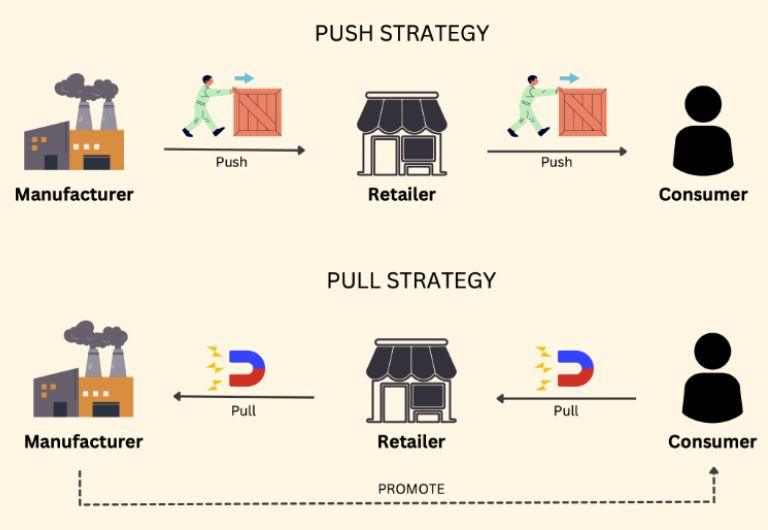
Push Marketing Strategy: Engineering Awareness and Acceleration
When Push Marketing Really Matters
Push marketing is most powerful in moments when customers are not actively looking for a solution. This usually happens when they do not yet recognize a problem, underestimate how urgent it is, or simply do not know that a solution exists at all. In these situations, waiting for organic demand to appear is not patience. It is a strategic mistake.
Push marketing steps in to create awareness before intent exists. It introduces the problem, frames its importance, and positions the brand as the obvious answer.
What Push Marketing Actually Includes
Push marketing is not one tactic. It is an entire category of proactive brand and demand creation. This includes paid advertising, outbound sales outreach, influencer seeding, promotions, display media, sponsorships, and large-scale brand campaigns designed to interrupt attention.
The difference between effective push marketing and background noise is not volume. It is relevance and timing. The best campaigns feel well placed, well targeted, and contextually appropriate rather than intrusive.
Push Marketing in Dubai’s Competitive Landscape
In Dubai’s crowded and high-visibility market, push marketing is not optional. Brands are competing across digital platforms, outdoor placements, experiential activations, and premium media environments, all at the same time.
Luxury real estate developers are a clear example. Their billboards, airport takeovers, and cinematic digital video campaigns are not responding to search demand. They are shaping aspiration, creating urgency, and defining category leadership before the buyer ever opens a browser. The goal is not clicks. It is perception.
Speed Is the Real Strategic Advantage
The true value of push marketing is speed. When a brand needs immediate market penetration, rapid awareness for a product launch, or faster pipeline creation, pull marketing alone cannot deliver results quickly enough.
Push marketing compresses time. It forces the brand into the customer’s field of vision and accelerates familiarity, recognition, and consideration in a way that organic channels simply cannot match on short timelines.
The Risks Brands Often Underestimate
Push marketing is powerful, but it is not forgiving. Costs scale linearly. Attention fatigue sets in fast. Performance drops sharply when targeting is broad or messaging is vague.
This is where many brands fail. They treat push marketing as exposure instead of precision. Modern push marketing must be data-driven, audience-segmented, and aligned tightly to funnel stages. Awareness messaging, consideration messaging, and conversion messaging should never look the same.
When push marketing is treated as a strategic system rather than a volume play, it becomes one of the fastest and most controllable growth levers a brand can use.
Pull Marketing Strategy: Capturing Intent and Building Trust
How Pull Marketing Really Works
Pull marketing is built on a very different assumption than push. It starts with the belief that the customer is already motivated. They know they have a problem, they are actively exploring options, and they are looking for answers they can trust.
In this model, the brand’s job is not to persuade or interrupt. It is to be visible at the right moment, credible when discovered, and easy to engage with once interest exists.
The Core Channels Behind Pull Marketing
Pull marketing shows up wherever customers go to educate themselves. This includes SEO, content marketing, thought leadership, community building, organic social media, email nurturing, and reputation management.
In digital ecosystems, pull strategies dominate high-intent environments like search engines, review platforms, and professional networks. These are not passive channels. They are decision environments where buyers are already comparing, validating, and narrowing choices.
Customer Agency Changes Everything
What truly separates pull marketing from push is agency. The customer initiates the interaction. That single shift changes conversion dynamics in a meaningful way.
Inbound leads generated through pull channels consistently convert at higher rates and tend to deliver stronger lifetime value than outbound leads. When people choose to engage, they arrive with intent, context, and readiness rather than resistance.
Why Pull Marketing Builds Credibility in Dubai
For Dubai-based brands targeting sophisticated and digitally fluent audiences, pull marketing is not optional. This includes B2B decision-makers, high-net-worth individuals, and experienced ecommerce buyers.
These audiences do not respond well to overt persuasion. They expect expertise. They look for third-party validation, proof, and signals of authority before engaging. Pull marketing allows brands to meet these expectations without feeling sales-driven or aggressive.
The Compounding Advantage of Pull Strategies
Pull marketing rewards consistency. Unlike paid campaigns that stop the moment budgets are paused, content assets, organic rankings, and brand authority continue to work long after they are created.
Each article, ranking page, case study, or community touchpoint adds to a growing foundation. Over time, this creates sustainable demand, stronger margins, and lower dependency on paid acquisition.
The Trade-Off Brands Must Accept
The cost of pull marketing is time. It requires patience, discipline, and long-term investment. Results rarely appear overnight, and momentum builds gradually rather than instantly.
For this reason, pull marketing is not a replacement for push in early-stage growth or time-sensitive launches. It is a strategic counterbalance. When used together, push creates speed and pull creates durability.
The Difference Between Push and Pull Marketing in the Digital Era
What Push Marketing Is Designed to Do
Push marketing is proactive. It assumes the customer is not yet thinking about the problem or solution, so the brand takes responsibility for initiating attention.
The goal is to introduce an idea, create urgency, or shape perception before demand exists. Push marketing puts the brand directly in front of the audience whether they are actively looking or not.
Common examples include paid advertising, outbound sales, display media, sponsorships, influencer seeding, and large-scale brand campaigns.
What Pull Marketing Is Designed to Do
Pull marketing is reactive by design. It assumes the customer already has intent and is actively seeking information, validation, or solutions.
Here, the brand’s role is to be discoverable, trustworthy, and helpful at the exact moment the customer goes looking. Pull marketing supports decision-making rather than forcing attention.
Typical pull channels include SEO, content marketing, thought leadership, organic social media, email nurturing, reviews, and reputation management.
Who Initiates the Interaction
This is the most fundamental difference.
In push marketing, the brand initiates the interaction. The customer did not ask to see the message.
In pull marketing, the customer initiates the interaction. They search, subscribe, follow, or explore on their own terms.
This shift in agency changes how messages are received and how easily trust is built.
How Intent Shapes Performance
Push marketing performs best at low intent levels. It introduces problems customers have not fully articulated and creates awareness where none existed.
Pull marketing performs best at high intent levels. Customers arrive with context, motivation, and readiness, which is why pull-driven leads typically convert at higher rates and deliver stronger lifetime value.
Neither replaces the other. They serve different psychological moments.
Speed Versus Sustainability
Push marketing is fast. It can generate awareness, traffic, and pipeline almost immediately. This makes it valuable for launches, promotions, and time-sensitive growth.
Pull marketing is slower but cumulative. Content, rankings, and authority compound over time, continuing to deliver value long after they are created.
Push buys speed. Pull builds durability.
Cost Structure and Risk
Push marketing costs scale linearly. When spending stops, results stop. Poor targeting or weak messaging quickly leads to fatigue and declining returns.
Pull marketing requires upfront investment in time and consistency, but marginal costs decrease as assets mature. Over time, it tends to improve efficiency and margins.
How the Best Brands Use Both
High-performing brands do not choose between push and pull. They sequence them.
Push marketing creates initial awareness and urgency. Pull marketing captures, educates, and converts demand as intent strengthens.
The real advantage comes from designing journeys where push introduces the story and pull closes the loop with credibility, depth, and trust.
Push and Pull Marketing Across the Funnel
One of the most effective frameworks for applying push vs pull marketing strategies is the funnel-based model.
At the top of the funnel, where awareness is limited and consumer buying behavior is exploratory, push marketing dominates. Brands use video, display, influencer partnerships, and broad-reach media to shape mental availability and category association.
In the middle of the funnel, where customers begin evaluating options, pull marketing becomes increasingly influential. Educational content, comparison guides, case studies, and social proof address objections and reduce uncertainty.
At the bottom of the funnel, where purchase intent is explicit, the distinction between push and pull narrows. Retargeting, email sequences, sales enablement content, and personalized offers work together to close demand efficiently.
This integrated view explains why brands that over-index on either push or pull often underperform. Push without pull creates short-term spikes but weak loyalty. Pull without push limits growth to existing demand ceilings.
Push vs Pull Marketing Strategies With Examples
Examining how brands apply push and pull marketing strategies in practice clarifies their complementary roles.
In ecommerce, push marketing is often used to stimulate demand during sales events, new product drops, or seasonal campaigns. Flash sales, paid social ads, and influencer launches generate urgency and volume. Pull marketing supports this by ensuring product pages rank well, reviews are visible, and brand credibility is established before traffic arrives.
In B2B services, push marketing typically takes the form of outbound sales, LinkedIn advertising, and account-based marketing. These tactics create entry points into target organizations. Pull marketing, meanwhile, nurtures decision-makers through whitepapers, webinars, and insight-driven content that positions the brand as a trusted advisor.
In hospitality and tourism—key sectors in Dubai—push marketing drives awareness through destination campaigns and limited-time offers, while pull marketing captures travelers researching experiences, hotels, and attractions weeks or months in advance.
These examples reinforce a central insight: push creates opportunity; pull converts opportunity into demand.
When to Use Push vs Pull Marketing
Knowing when to use push vs pull marketing is a strategic decision, not a channel choice. Several factors influence the optimal balance.
Market maturity is one. In emerging categories where customer awareness is low, push marketing is indispensable. In mature markets with established demand patterns, pull marketing delivers superior efficiency.
Product complexity also matters. High-involvement purchases—such as enterprise software, financial services, or luxury assets—require pull-based education and trust building. Low-involvement products can rely more heavily on push tactics.
Competitive intensity is another determinant. In saturated markets like Dubai, where multiple brands compete for the same demand, pull marketing becomes a differentiator by capturing intent more effectively than competitors.
Finally, the growth stage plays a role. Startups often rely on push marketing to gain visibility quickly, then transition toward pull marketing as brand equity and content assets accumulate.
Advantages and Disadvantages of Push vs Pull Marketing
From a strategic standpoint, push marketing offers control, speed, and predictability. Brands can scale exposure quickly and test messages in real time. The downside is cost sensitivity and diminishing returns.
Pull marketing offers efficiency, trust, and long-term value creation. It reduces dependency on paid media and strengthens brand authority. Its limitation lies in delayed impact and the need for sustained investment.
Understanding these trade-offs allows brands to design portfolios rather than binaries—allocating resources dynamically based on objectives and performance data.
How Brands Use Push and Pull Marketing Strategies Together
The most successful brands do not debate push versus pull; they orchestrate both.
A common integrated model involves using push marketing to amplify pull assets. Paid media drives traffic to high-value content. Influencer campaigns introduce audiences to owned platforms. Retargeting reinforces pull-generated intent.
Another approach uses pull insights to refine push execution. Search data, content engagement, and audience behavior inform messaging, creative, and targeting in paid campaigns.
This feedback loop transforms marketing from a linear process into a demand engine—one that continuously learns, adapts, and scales.

Push vs Pull Marketing for Business Growth in Dubai
For brands operating in Dubai, the strategic importance of balancing push and pull marketing is amplified by market conditions. The region combines high digital penetration with intense competition and culturally diverse audiences.
Push marketing is essential for visibility in crowded spaces, particularly in sectors like retail, real estate, and lifestyle. Pull marketing is critical for credibility, especially among expatriate and international audiences who rely heavily on online research.
Dubai-based marketing agencies that understand how to align push and pull strategies with local consumer behavior gain a structural advantage. They move beyond campaign execution to demand architecture—designing systems that attract, convert, and retain customers across cycles.
Conclusion: From Tactics to Demand Architecture
The debate around push vs pull marketing strategies often misses the point. The question is not which model is superior, but how brands can design systems that generate, capture, and compound demand.
Push marketing creates momentum. Pull marketing sustains it. Together, they form the backbone of modern demand generation strategies.
For brands seeking growth in competitive, digitally mature markets like Dubai, mastering push and pull marketing models is no longer optional. It is a strategic imperative—one that separates short-term visibility from long-term value creation.
A disciplined, insight-driven approach to push and pull marketing enables brands not just to reach audiences, but to shape markets.
FAQ
1. What is push marketing?
Push marketing is a promotional strategy where brands proactively push messages, offers, or products toward customers. Common examples include display ads, TV commercials, cold emails, SMS marketing, and in-store promotions. The goal is to create immediate awareness and stimulate quick responses.
2. What is pull marketing?
Pull marketing focuses on attracting customers by creating value-driven content and experiences that draw them toward the brand. Examples include SEO, content marketing, social media engagement, blogs, and organic search. Pull strategies rely on customer interest rather than interruption.
3. What is the key difference between push and pull marketing?
The primary difference lies in approach. Push marketing interrupts audiences with promotional messages, while pull marketing attracts audiences by addressing their needs and interests. Push drives short-term results, while pull builds long-term relationships and trust.
4. When should businesses use push marketing strategies?
Push marketing is effective for product launches, limited-time offers, brand awareness campaigns, and competitive markets where quick visibility is needed. It works well when immediate reach and fast results are business priorities.
5. How can push and pull marketing be combined effectively?
Combining both models creates balance. Push marketing generates quick attention and traffic, while pull marketing nurtures trust and long-term engagement. Together, they support the full customer journey—from awareness to conversion and retention.