
Using NPS to Track & Improve Brand Perception

Introduction
In an era where brand perception shifts by the minute shaped by fleeting social chatter, influencer trends, and instant digital feedback loops, the old ways of measuring brand equity no longer tell the full story. Metrics like unaided awareness, brand associations, or image scores still matter, but they’re snapshots in a constantly moving landscape.
To thrive today, brands need a real-time, customer-centered measure that links User & Market Branding Perception directly to advocacy and growth. That’s where the Brand Net Promoter Score (NPS) becomes indispensable.
Unlike static image studies, Brand NPS offers both a quantitative anchor, a clear, trackable metric on a −100 to +100 scale and a qualitative engine through open-text feedback that captures the why behind the numbers. But its true strength doesn’t lie in the score itself. It lies in how brands operationalize it, how they connect promoters, passives, and detractors to shape ongoing brand strategy, experience design, and organizational alignment. In essence, Brand NPS transforms perception from a passive metric into an active management system one that listens, adapts, and grows with the customer.
Understanding Brand NPS: Definition, Strengths & Caveats
Brand Net Promoter Score, or Brand NPS, is a simple yet powerful way to understand how people really feel about your brand, not just your product or service.
The concept was first popularized by Fred Reichheld in a 2003 Harvard Business Review article and has since become a cornerstone of customer experience programs. At its heart lies one straightforward question: “How likely are you to recommend our brand to a friend or colleague?”
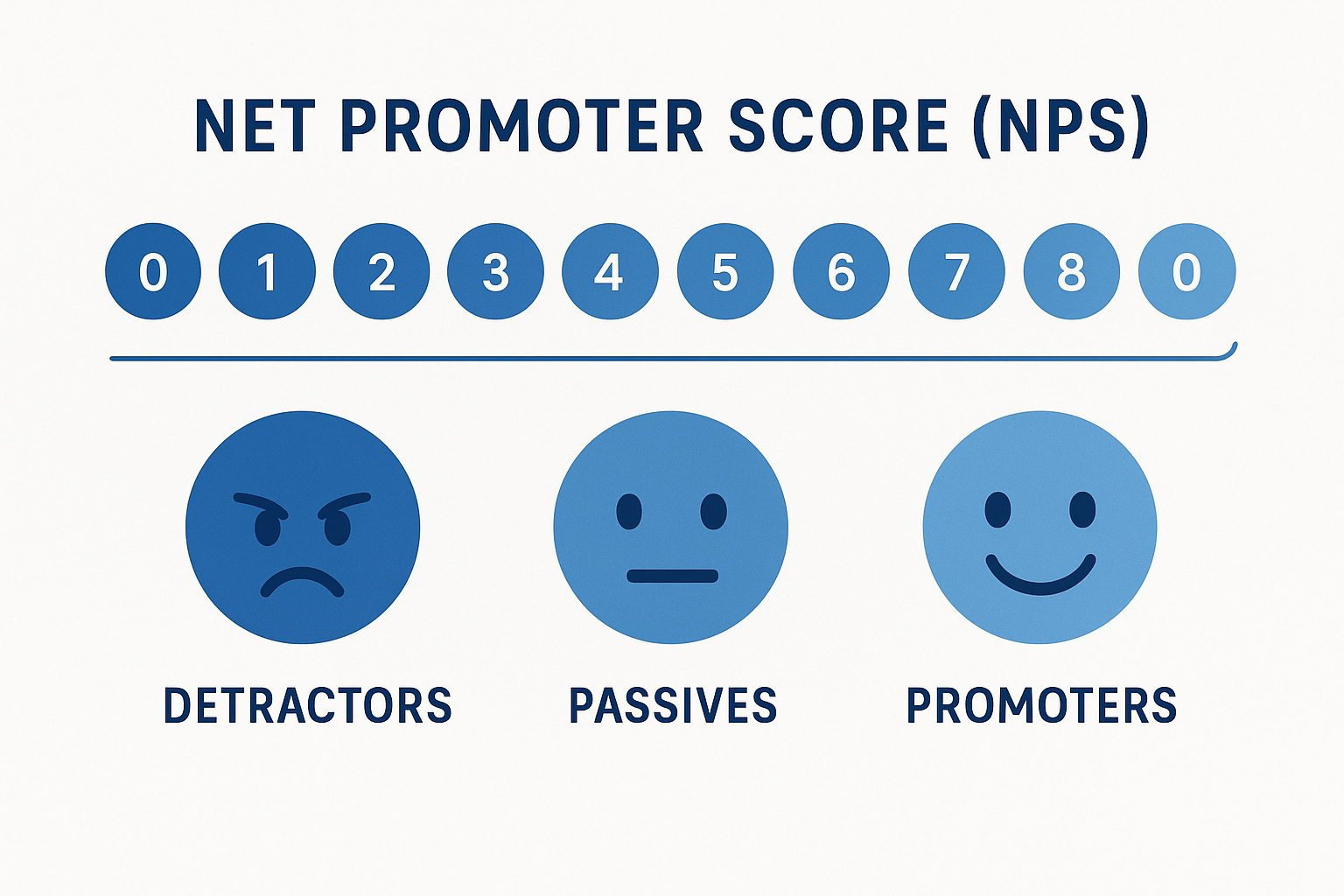
Respondents answer on a 0–10 scale, and their scores fall into three emotional groups:
- Promoters (9–10): Loyal fans who love your brand and actively spread the word.
- Passives (7–8): Generally satisfied, but not passionate they could easily switch brands.
- Detractors (0–6): Unhappy customers who might discourage others from choosing you.
The formula is refreshingly simple:
Brand NPS = % Promoters – % Detractors
The score ranges from −100 to +100. A positive score means you have more advocates than critics, while a score of +50 or higher often signals strong brand love and loyalty. Many top companies adopt NPS as their “one metric that matters” because of its direct link to customer advocacy and business growth.
Why NPS Belongs in a Brand Perception Framework
Unlike a typical customer service NPS that focuses on individual transactions, Brand NPS zooms out to capture the overall sentiment toward your brand.
In a brand or agency setting, it helps to:
- Anchor brand perception in real voices: It connects how people feel about your brand with their willingness to recommend it a true measure of trust and affinity.
- Benchmark over time: Instead of chasing vanity metrics like awareness, you can track whether advocacy for your brand is growing.
- Prioritize improvement efforts: Understanding what drives promoters or detractors helps pinpoint which touchpoints messaging, design, service, or product need attention.
- Unify teams: Because it’s easy to grasp and communicate, NPS can act as a shared KPI across marketing, customer experience, and leadership.
Key Caveats and Critiques
While NPS is simple, it’s not flawless. To apply it responsibly, it’s important to understand its limits:
- Classification bias: Passives (7–8) can be tricky; their sentiment may swing depending on context, industry, or culture.
- Not a growth guarantee: Some studies question whether NPS alone predicts revenue growth. It’s best used alongside financial and behavioral data.
- Survey fatigue: Overusing NPS surveys can reduce response rates and skew results toward extremes.
- Context sensitivity: A “good” NPS in one industry might be average in another; interpret your score relative to your market.
- Number obsession: Focusing on the metric without addressing the why behind the feedback can make NPS a vanity exercise rather than a learning tool.
A Three-Tier Framework for Embedding Brand NPS
To move Brand NPS from being a dashboard metric to becoming a true engine of brand transformation, agencies and brand leaders can use a three-tier approach: Align, Diagnose, and Activate.
Each tier blends both structural and cultural levers the systems, behaviors, and rituals that agencies can lead or co-create with their clients to make NPS meaningful
Tier 1: Align Make NPS Part of the Brand Architecture
Before launching any NPS program, start with alignment not just around the metric, but around what it means for the brand.
Executive buy-in & narrative
Leadership has to see NPS as more than a tactical score. It’s a brand health indicator, a pulse check on advocacy, trust, and emotional connection.
As Fred Reichheld’s research reminds us, loyalty is not a number but a story of relationships.
One client embedded this thinking literally: they installed live NPS dashboards in their boardroom so the leadership team couldn’t ignore customer sentiment. As Stefan Milev, CMO at Taylor & Hart, shared: “We have screens above everyone’s head … every department sees dashboards.” (Hotjar.com)
Define brand zones & focus areas
You can’t measure every interaction equally. Select 3–5 brand zones for instance:
- Digital experience
- Retail or in-store touchpoints
- Product lines
- Customer service moments
Then assign each a set of brand NPS drivers to focus analysis and improvement where it matters most.
Incentive alignment
Tie a portion of stakeholder incentives (across marketing, product, and operations) to NPS movement but keep it balanced with customer value and financial outcomes.
This ensures accountability without encouraging metric gaming or selective reporting.
Governance rituals
Make feedback a habit. Hold weekly or monthly NPS forums to review trends, discuss root causes, and prioritize initiatives. The goal isn’t just to report data, it’s to build a rhythm of listening and responding that reinforces customer-centric culture.
Tier 2: Diagnose Decompose, Segment & Sense-make
Once alignment is in place, the real work begins: turning NPS feedback into insight, and insight into transformation.
Transactional / Relationship Layering
Customer experiences are layered and so should your NPS strategy be.
- Relationship (Brand) NPS: Periodic surveys (quarterly or biannually) that ask about overall brand recommendation. This acts as your brand health anchor.
(CustomerGauge recommends beginning with relationship surveys before layering transactional ones.) - Transactional NPS: Surveys triggered after specific touchpoints like purchases, onboarding, support interactions, or delivery. These reveal which journeys drive or damage brand loyalty.
Together, these layers form a feedback ecosystem: when brand NPS dips, transactional data helps trace where the experience is breaking down.
Driver Analysis & Root Cause Mapping
After classifying respondents as promoters, passives, or detractors, go deeper with qualitative insight.
Ask open-ended questions such as:
“Why did you rate us at X?”
Include 2–3 short driver-rating questions for example:
- Brand trust
- Product quality
- Emotional connection
- Service consistency
Then, look for patterns by segment:
- High NPS but low “brand innovation” = loyal customers who don’t see your brand as forward-thinking.
- Low NPS but high “product quality” = a brand perception issue, not a product problem.
Framework for Root Cause Mapping
To uncover what’s really driving your Brand NPS, it helps to approach diagnosis through four levels of root cause mapping. Start at the brand zone level to identify which major domains of the brand are underperforming whether that’s your digital experience, customer service, or product quality. Tools like driver correlation, regression analysis, or impact/relevance matrices can help spotlight where the biggest loyalty gaps lie. Next, zoom into the segment level to understand which customer groups are struggling the most. Comparing segment NPS scores across regions, tenures, or value tiers often reveals hidden friction points. From there, shift to the journey level, where you can pinpoint the specific touchpoints that create friction using transactional NPS data and detailed journey mapping to visualize the customer experience. Finally, move into causal intervention, where insight turns into action. Through root cause workshops, the 5 Whys technique, and service design, teams can identify the operational levers that will meaningfully improve advocacy. Together, these layers transform NPS analysis from a spreadsheet exercise into a structured, story-driven process of brand improvement.
Tier 3: Trend & Benchmark Narrative
Don’t get lost in week-to-week swings. Focus on trends and meaning:
- Use rolling averages (e.g., three-month NPS) to filter out noise.
- Benchmark against industry peers, but tell a story data comes alive through narrative: “We gained +4 over baseline; detractors in GCC retail fell by 2pp; promoters in UAE digital rose 5pp.”
Real-world examples show what’s possible when feedback drives action:
- Manheim (Auto Remarketing): Transformed NPS insights into 110 business improvement initiatives in just 18 months. (Genroe)
- Zip Water UK: Lifted NPS from +2 to +73 in three years through disciplined, customer-centric reinvention. (Genroe)
Activate: From Insight to Brand Strengthening
Insights without action only breed frustration. The third tier Activate is where NPS intelligence becomes transformation. It’s about designing, testing, and executing initiatives that close the gap between what customers feel and what your brand stands for.
Rapid “Close-the-Loop” Recovery
Speed matters. One golden rule of NPS is to respond to detractors within 24–48 hours. Often, the simple act of reaching out can turn a critic into a loyal advocate. As SurveyVista’s studies highlight, brands like Apple and Manheim have made quick, compassionate responses a core part of their customer care DNA.
Agencies can play a crucial role in building this responsiveness by helping design:
- Triage logic: clear rules for which responses go to which teams.
- Automated workflows and SLAs: so no customer slips through the cracks.
- Contextual personalization: tailoring outreach using past interaction history or segment data.
- Feedback tracking and retests: measuring whether post-recovery actions truly move the NPS needle.
When customers see you listen and act fast, it doesn’t just resolve an issue it rebuilds trust.
Tailored Micro-Interventions by Brand Zone
Because earlier you aligned around key brand zones, you can now translate insights into focused micro-actions. Each zone calls for its own flavor of intervention:
- Digital & UX: Let NPS feedback guide UX priorities, fix friction points, clarify copy, personalize experiences. While NPS isn’t a pure usability metric, Nielsen Norman Group notes it closely tracks perceived ease and emotional satisfaction.
- Product & Innovation: Promoters are often full of ideas. Mine their feedback for “next feature” suggestions and focus on quick wins that delight.
- Communications & Messaging: If detractors feel misled or confused, adjust your storytelling and make promises you can consistently keep.
- Service & Support: Map repetitive complaints back to training gaps, knowledge base improvements, or escalation processes.
- Retail & Physical Experience: Look beyond the numbers are layout, ambiance, or staff behaviors driving friction?
To bring this to life, consider running “brand NPS sprints” short, two-to-four-week cycles where teams focus on one issue, fix it, measure impact, and iterate. These sprints build momentum and show that feedback isn’t just collected it’s acted upon.
Programmatic Advocacy & Ambassador Cultivation
Your promoters are more than just satisfied customers; they’re potential storytellers, creators, and ambassadors. Harnessing their energy can organically amplify your brand voice.
Use NPS data to:
- Identify top promoters and invite them into exclusive communities.
- Gather testimonials, case studies, and referrals straight from authentic voices.
- Co-create campaigns, “ambassador challenges,” or loyalty programs that celebrate their passion.
- Involve them early in beta testing or product development.
A standout example comes from Pranamat, the acupressure mat brand, where 32% of promoters became active affiliates through its ambassador program (Survicate). That’s NPS at work transforming satisfaction into advocacy.
Continuous Feedback Loops & Learning Cycles
A truly customer-centric brand treats NPS not as a quarterly ritual, but as a living, breathing loop of feedback and improvement.
To keep it alive:
- Integrate NPS into product launch cycles to compare pre- and post-launch perceptions.
- Build real-time dashboards accessible to every team.
- Host monthly “NPS retrospectives” in brand steering forums to discuss what’s changing and why.
- Run A/B tests with NPS as the outcome metric to measure emotional resonance.
- Track cohorts over time understanding how loyalty evolves with experience.
When used this way, NPS stops being a static score and becomes a navigation system helping the brand steer, adapt, and grow with its customers’ evolving expectations.
Case Study: Taylor & Hart NPS as Strategic Compass
To see how this framework works in action, let’s look at a few brands that have turned NPS from a score into a system one that drives culture, growth, and transformation.
Taylor & Hart: Turning Feedback into a Growth Engine
When Taylor & Hart, a UK-based bespoke jewelry brand, first set out to scale, they made a bold choice: NPS would be their “one metric that matters.” (Hotjar.com)
They identified two key customer milestones to measure and learn from:
- Service NPS captured shortly after an order is placed.
- Product NPS captured after the jewelry is delivered, roughly 40 days later.
By automating both surveys through their CRM, Zapier integrations, and real-time dashboards, they created a seamless feedback loop visible to everyone in the company. In fact, NPS scores were displayed across their offices, a constant reminder that customer sentiment was the heartbeat of the business. Weekly review meetings ensured those numbers turned into actions.
Then came the insight that changed everything: a consistent 10–15 point gap between service satisfaction and product satisfaction. Customers loved the buying experience but something in production or delivery was falling short.
Instead of brushing it off as a metric fluctuation, the team dug deeper. They traced the issue to manufacturing, delivery, and quality control and overhauled their entire operational process. This wasn’t a cosmetic fix; it was a cultural one.
The result? Taylor & Hart maintained an NPS above 80 and saw 70% revenue growth, which they attributed directly to their disciplined, data-driven, and customer-obsessed approach.
Key takeaways from their journey:
- Milestone-based NPS gives more granular, actionable insight.
- Visibility drives culture when NPS is literally on the wall, it becomes everyone’s responsibility.
- Don’t chase the number, chase the why behind it.
- Tie interventions to NPS drivers, not just to the survey itself.
Zip Water UK: Aligning an Entire Organization Around the Customer
At Zip Water UK, NPS wasn’t just a marketing tool it became a mirror reflecting the company’s customer experience. Over three years, they raised their NPS from +2 to +73 by rallying every department around customer sentiment data.
From leadership meetings to frontline teams, customer feedback guided daily decisions. That alignment turned NPS from a retrospective measure into a forward-looking management system, one that unified purpose and performance.
BPS World: Making NPS a Brand Differentiator
For BPS World, a global recruitment firm, NPS became more than an internal KPI it became a marketing advantage.
By openly publishing their NPS of 50, they signaled transparency and customer trust in an industry where reputation often hinges on credibility. This move positioned them as an employer and partner who listens, measures, and acts standing out in a crowded recruitment landscape.
The Big Picture
Across these diverse examples from luxury jewelry to water systems to recruitment one truth stands out: NPS creates lasting impact only when treated as a living system, not a quarterly checkbox.
When brands embed NPS into daily rituals, link it to real actions, and use it to fuel collaboration across teams, it evolves into something far greater than a score; it becomes a compass for culture, quality, and growth.
Regional & Contextual Considerations for Brands
Operating from Dubai or working with GCC-based brands brings a unique mix of complexity and opportunity when it comes to applying Brand NPS. The fundamentals remain the same, but local culture, language, and expectations shape how people respond, how data behaves, and how insight translates into action.
Here are some key nuances to keep in mind:
1. Cultural Calibration
A “9–10 promoter” score in London or New York doesn’t always mean the same thing in Riyadh or Dubai. Across GCC markets, people may be more conservative in their scoring, even when satisfied it’s a cultural expression of modesty or reservation rather than disengagement. To interpret results accurately, consider running pilot studies to calibrate thresholds and understand local response patterns before setting benchmarks.
2. Language and Framing
In a region as multilingual and diverse as the GCC, how you ask matters as much as what you ask. Offering surveys in English, Arabic, or other prevalent regional languages (like Hindi or Urdu, depending on audience) ensures inclusivity. Localization isn’t just about translation, it’s about phrasing questions in ways that feel natural, respectful, and emotionally clear to local audiences.
3. Luxury and Prestige Expectations
In premium or luxury segments, expectations are elevated and tolerance for lapses is low.
Customers paying for craftsmanship, exclusivity, or status expect flawless experiences. A Brand NPS in the +40s might be excellent in global terms, but in luxury categories, even small service missteps can have an outsized impact. In these markets, emotional resonance and personalized touchpoints often outweigh traditional satisfaction drivers.
4. Omnichannel Complexity
Many UAE and GCC brands operate in both physical flagship environments and digital ecosystems. To gain a complete view of customer advocacy, integrate transactional NPS across in-store, online, and after-sales journeys. The most valuable insights often come from contrasts where digital convenience shines but in-store experiences lag (or vice versa).
5. Rapid Reputation Amplification
In a hyper-connected region like MENA, reputation moves fast. A single negative experience can spread rapidly across social channels, often shaping broader brand perception within hours. That’s why rapid detractor recovery following up quickly, personally, and empathetically isn’t just a best practice here; it’s a strategic advantage.
6. Benchmark Scarcity
Unlike mature markets in Europe or North America, public NPS benchmarks in the GCC are still scarce. For agencies, this is both a challenge and an opportunity: by building proprietary benchmarking datasets across industries from retail and hospitality to fintech and luxury you position yourself as a regional authority on brand health.
Integrating Brand NPS into Branding Strategy & Positioning
To truly unlock the power of Brand NPS, agencies shouldn’t treat it as a post-campaign score; it should live at the heart of brand strategy. When embedded thoughtfully, NPS becomes both a compass and an accountability system for how customers feel about your brand over time. Here’s how agencies can weave NPS into the most critical moments of brand decision-making:
1. Brand Positioning and Messaging
Your customers’ voices hold the raw material for sharper positioning. Analyze promoter language the words your advocates naturally use when they describe what they love about your brand. Then, contrast that with detractor pain points. If detractors often mention “lack of trust,” that’s a signal to reshape your messaging around reliability, transparency, and credibility. In other words, let your customers teach you how to tell your own story better.
2. Brand Architecture Decisions
In a multi-brand portfolio, Brand NPS can reveal which sub-brands are earning true advocacy and which are dragging the portfolio down. By comparing NPS scores across brands, you can make more confident decisions about mergers, consolidations, or extensions. This shifts portfolio management from gut feel to customer-grounded strategy.
3. Creative Testing
NPS isn’t just a tracking metric; it can be a creative barometer. Test new campaign concepts or pre-launch ideas with customers and use NPS as an outcome metric alongside qualitative feedback. The goal isn’t to replace creative intuition, but to ensure the work inspires the kind of emotional connection that translates into advocacy.
4. Narrative and Storytelling
Every brand tells a story and NPS provides the data to make that story credible. Bring NPS insights into your brand reports, investor decks, and annual summaries. Instead of listing metrics in isolation, tell the story behind the movement: “In Year 1, we gained +8 NPS and reduced detractors in the GCC by 3 percentage points.” This kind of storytelling demonstrates momentum, not just measurement.
5. Brand Equity Modeling
Finally, integrate NPS directly into your brand equity models. Treat it as a leading indicator, a signal of future value and growth potential. Because when more customers advocate for you, it doesn’t just boost reputation it compounds into long-term equity and valuation.
Measurement of Impact & Business Outcomes
It’s the question every brand eventually asks: Does improving our Brand NPS actually move the needle on business performance? The short answer backed by both data and experience is yes, though there’s no universal formula or fixed multiplier. What matters is how consistently and intelligently the brand uses NPS insights to guide action.
Across industries, companies that take NPS seriously report clear links between customer advocacy and financial outcomes:
- Retention and churn: Customers in higher NPS cohorts almost always show lower attrition. When people feel emotionally connected to a brand, they simply stay longer.
- Revenue growth: Take Taylor & Hart, for example they attributed a 70% revenue increase directly to disciplined NPS execution and feedback-driven improvement.
- Advocacy lift: Promoters don’t just buy again they bring others with them. Each new advocate expands your brand’s reach organically through referrals and word of mouth.
- Operational efficiency: When fewer customers are dissatisfied, service teams spend less time resolving complaints, translating to lower recovery costs and higher morale.
- Brand equity: Over time, a rising NPS becomes a signal of deeper trust and stronger brand valuation; it builds the intangible equity that investors and customers alike can feel.
Empirical research backs this up too. As noted in SAGE Journals’ “From Research to Action”, Brand NPS operates as a non-financial KPI one that connects perception, emotion, and loyalty to measurable business performance.
The real power lies in linking NPS to your brand’s leading and lagging indicators metrics like retention rate, share of wallet, referral volume, and cross-sell success. Over time, you can tell a story that’s both human and analytical: “Every +5 point increase in NPS correlated with a x% rise in lifetime value, y% growth in referrals, and z% drop in churn.” That’s when NPS stops being just a survey question and becomes a strategic bridge connecting customer sentiment to business success.
Conclusion: From Metric to Brand Compass
For a Dubai-based branding agency aiming to lead in brand performance, the Brand Net Promoter Score (NPS) isn’t just another metric it’s a compass. It’s the single point where customer sentiment, advocacy, operational friction, and brand narrative intersect. When applied with rigor and empathy, Brand NPS turns User & Market Branding Perception from something abstract into something dynamic, a living, measurable, and improvable asset that reflects how people truly experience and talk about your brand.
But here’s the truth: the magic doesn’t live in the score itself. It lives in the system you build around it the alignment, diagnostics, activation, and cultural discipline that make those numbers meaningful. When your agency brings clients into that system embedding NPS into decision-making, creative ideation, and operational improvement you stop being just a service provider. You become a co-owner of brand vitality, a strategic partner who helps clients see what their customers feel and act on it.
If you adopt the three-tier framework of Align → Diagnose → Activate, integrate NPS into your governance rituals and storytelling, calibrate it thoughtfully for the GCC cultural landscape, and commit to closing feedback loops relentlessly, you’ll lead clients into a new era of brand growth and authenticity. In that future, your agency won’t just measure perception, it will shape it, improve it, and own it, sprint by sprint, month by month.
FAQ
1. What is NPS and how does it measure brand perception?
Net Promoter Score (NPS) is a customer loyalty metric that measures how likely customers are to recommend your brand to others. It helps businesses understand overall satisfaction and perception by categorizing customers as promoters, passives, or detractors based on their feedback.
2. How can NPS help improve brand perception?
NPS provides direct insight into how customers feel about your brand. By analyzing responses and identifying pain points, businesses can take targeted actions to improve products, services, and experiences—ultimately strengthening how the brand is viewed in the market.
3. How often should businesses conduct NPS surveys?
NPS surveys should be conducted regularly, such as quarterly or after key customer interactions. Frequent tracking allows brands to monitor trends over time and quickly address issues before they negatively impact overall perception.
4. What actions should be taken based on NPS results?
Businesses should engage with promoters to encourage advocacy, follow up with passives to improve their experience, and address concerns from detractors to resolve problems. Using NPS feedback to guide improvements helps build stronger customer relationships.
5. Is NPS enough to fully understand brand perception?
While NPS is a powerful indicator of customer loyalty, it works best when combined with other feedback tools like reviews, surveys, and sentiment analysis. Together, these insights provide a more complete picture of how customers truly perceive your brand.