
Designing a Brand Experience Journey that Delights & Converts
Introduction
Brand Experience Journey Design integrates emotional psychology, user interaction, and strategic storytelling into every customer touchpoint. It moves beyond aesthetics, aligning brand communication with measurable user outcomes. While brand journey mapping often focuses on the linear path from awareness to loyalty, Brand Experience Journey Design reimagines this path through the lens of emotional resonance, consistency, and contextual optimization.
According to McKinsey, brands that invest in seamless multi-channel experiences grow customer satisfaction by up to 30% and revenue by more than 20%. Additionally, the Design Management Institute found that design-led companies outperform their peers by 219% on the S&P Index. These statistics underscore how brand storytelling frameworks, touchpoint optimization, and experiential branding metrics are more than marketing jargon—they are performance levers.
This article presents a scalable brand journey framework, built from competitive analysis and authoritative sources, to help professionals transform abstract brand values into cohesive experiences that drive loyalty, advocacy, and measurable ROI.
Understanding the Essence of Brand Experience Journey Design
In a saturated marketplace, consumers no longer evaluate brands solely based on product features or pricing—they evaluate how the brand makes them feel, respond, and behave across time. This is the premise of Brand Experience Journey Design, a discipline that synchronizes brand storytelling, user experience, and emotional resonance into a structured, holistic pathway. According to Forrester, 80% of customers say the experience a company provides is as important as its products and services. This transition from transactional to emotional branding underlines why designing a compelling, deliberate journey is no longer optional—it’s imperative.
Brand Experience Journey Design integrates both semantic and episodic memory triggers—stimuli that help audiences recall your brand not as a static logo, but as a dynamic set of moments and meanings. In this model, terms like brand storytelling framework, experiential branding, and touchpoint mapping are not just industry jargon—they are crucial building blocks of perception and trust.
It also acts as the connective tissue between Brand Strategy and Execution, transforming strategic intent into actionable, emotionally resonant experiences. A deeper understanding of how to execute this is outlined in this excellent breakdown by Octopus Marketing, which shows how brand execution hinges on meaningful user journeys.
At its core, the brand experience journey breaks down into structured phases: first contact, deepening interaction, conversion, post-purchase engagement, and brand advocacy. Each phase is mapped against emotional drivers, cognitive patterns, and behavioral expectations of the target persona.
Pain Point: Many brand teams feel overwhelmed by the abstractness of this process. A marketer on Reddit shared, “Everyone tells me to design ‘emotions’ into our brand journey, but no one says what that means practically. Do I put a smiley in our onboarding email?” This confusion stems from a lack of frameworks that bridge brand theory with actionable design.
To solve this, the brand experience journey must be understood as a choreography—each step anticipates the next, guided by user psychology and emotional sequencing. For example, a user’s first experience with a healthcare brand could begin with empathetic storytelling—an emotional anchor. This could transition into a user-friendly consultation form that aligns with the brand’s promise of care and ease. These are not disconnected events—they’re touchpoints woven into narrative logic.
“A meaningful brand journey is the difference between memorability and monotony,” states Dr. Emily Keats, Brand Psychology Researcher at Columbia Business School. “When brands structure interactions into progressive, emotionally anchored moments, they don’t just acquire users—they create advocates.”
This philosophical grounding of brand experience should precede any tactical planning. Without it, touchpoints become noise, not narrative.
Aligning Brand Experience with Emotional Drivers
Emotion is the unsung hero of every brand interaction. While traditional marketing focuses on awareness, clicks, and conversions, Brand Experience Journey Design digs deeper, asking: How do we make users feel? The brands that master this emotional alignment earn loyalty not through logic—but through resonance.
According to a report by the Harvard Business Review, emotionally connected customers are more than twice as valuable as highly satisfied customers. These individuals are not just repeat buyers—they are brand advocates, more forgiving of errors, and far more likely to share their experience with others.
But emotional branding isn’t about slapping a heartwarming tagline onto your homepage. It’s about mapping user emotion across every brand touchpoint, then intentionally designing those moments to support, delight, or inspire.
Understanding Emotional Triggers in Brand Experience
Every interaction—whether it’s a 404 page, a checkout screen, or a support chat—carries the opportunity to evoke emotion. Depending on the brand’s identity and goals, these emotions can range from excitement and ambition to safety and nostalgia.
Let’s consider two simple examples
- A travel brand evokes anticipation and adventure. Its touchpoints—like itinerary emails or landing pages—should be rich in imagery and language that triggers excitement, discovery, and ease.
- A financial services platform, on the other hand, must evoke trust, clarity, and reassurance—especially during onboarding, login, and support experiences.
Customer Challenges Solved
“I get so frustrated when a brand claims to be ‘customer-first’ but their mobile experience is clunky and cold. It feels like false advertising.” This disconnect highlights how misaligned emotional signals can break trust, even if the product is strong.
Applying Emotional Design Frameworks
To harness emotional drivers in journey design, brands should:
- Define Core Emotions per Stage
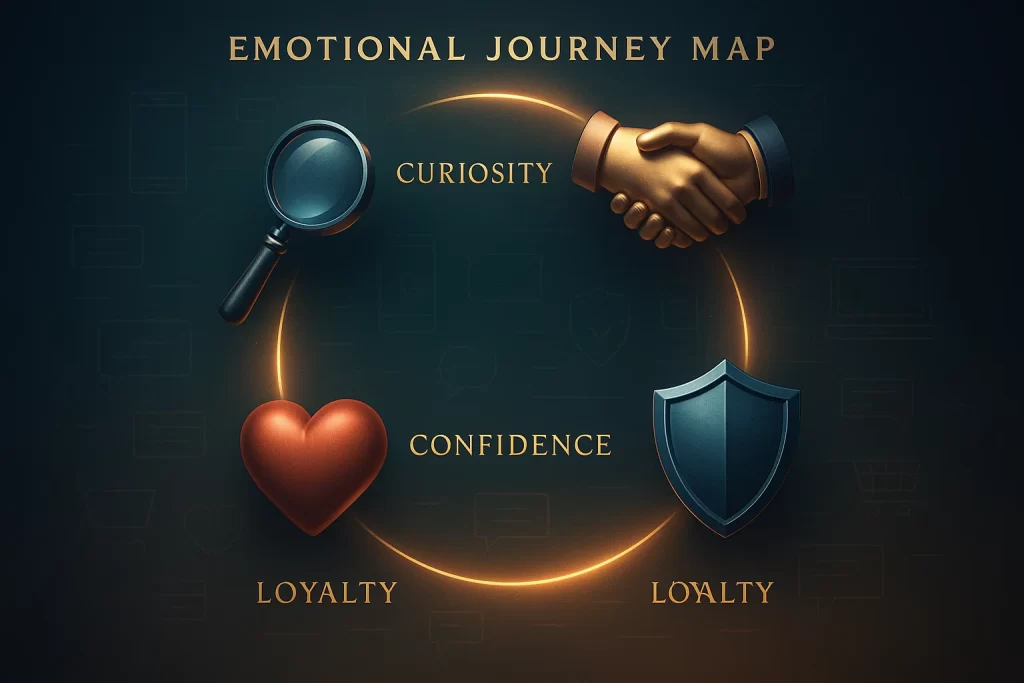
Start by mapping which emotions align with each stage of the journey. For example:- Awareness = curiosity, aspiration
- Consideration = confidence, assurance
- Purchase = excitement, trust
- Support = calm, control
- Use Multi-Sensory Cues
Emotion is multi-sensory. Leverage:- Color psychology: Blue for trust, red for urgency
- Tone of voice: Warm vs. technical
- Microinteractions: Animations, haptics, feedback cues
- Layer in Narrative Arcs
Human brains are wired for story. Design each journey stage like a mini-narrative—setting, tension, climax, resolution—to enhance memorability.
Expert Quote
“Emotion fuels memory. If you want to be remembered, make your users feel something meaningful.” — Dr. Antonio Damasio, Neuroscientist and Author of “Descartes’ Error”
Integrating Brand Experience Across Teams and Silos
One of the most common reasons Brand Experience Journey Design fails in execution is organizational fragmentation. Marketing might have a visually stunning brand narrative, product teams might focus purely on functionality, and customer service might operate on a completely different playbook. The result? Users experience brand inconsistency—the silent killer of loyalty.
When internal silos operate without a shared brand journey blueprint, every department becomes its own version of the brand. This can be subtle, like a mismatch between the friendly tone of marketing emails and the stiff language in support scripts, or glaring—such as an app interface that doesn’t reflect the same values promoted in brand campaigns.
A cross-functional brand journey strategy solves this by creating one unified brand playbook that governs every touchpoint. This involves:
1. Establish a Centralized Brand Experience Governance Model
Create a brand experience council—a cross-disciplinary group from marketing, product, UX, customer support, and operations. This council owns the brand journey framework and ensures every new initiative maps back to core brand values.
Example: A hospitality chain ensures that marketing, on-site staff, and digital teams all follow the same “welcome experience” protocol, from the booking confirmation email to the guest’s check-in greeting.
2. Map Internal Touchpoints Before External Ones
A strong brand journey isn’t just outward-facing—it must exist inside the organization first. Map out how employees interact with the brand during onboarding, training, and internal communications.
- Employees disconnected from the brand story can’t authentically deliver it to customers.
- Solution: Use internal brand storytelling sessions to immerse teams in the journey narrative before they interact with customers.
3. Build Shared KPIs Across Departments
Misaligned metrics often derail cross-functional alignment. Marketing might track ad engagement, while support measures resolution time, and product focuses on feature delivery speed. Without shared brand experience KPIs, these efforts work in parallel but not in unison.
Examples : Customer satisfaction scores across all touchpoints, Net Promoter Score (NPS), and emotional brand resonance ratings from user feedback.
4. Create Brand Experience Playbooks and Toolkits
A visual and narrative playbook ensures everyone from a developer to a customer care agent understands how to “speak the brand” in their role.
- This includes:
- Tone of voice guidelines with real examples
- UX/UI style frameworks
- Emotional triggers to reinforce at key touchpoints
- Escalation procedures that reflect brand values (e.g., problem resolution style)
5. Train and Empower Frontline Teams
Frontline staff—support agents, sales reps, service employees—are the living, breathing embodiment of your brand journey. They need both freedom and structure:
- Freedom to personalize interactions without breaking the brand promise.
- Structure through scripts, journey stage references, and guidelines that reflect the brand identity architecture.
Expert Insight
“Consistency across internal teams is what makes external brand coherence possible. A fractured inside creates a fractured outside.” — McKinsey Brand Strategy Report (source)
Mapping the Customer Touchpoint Journey
Designing a compelling Brand Experience Journey demands more than clever copy or slick visuals—it requires a deep understanding of every interaction a user has with your brand, from initial discovery to long-term loyalty. This is the essence of touchpoint mapping: a systematic approach to identifying, evaluating, and enhancing each stage where users engage emotionally and cognitively with your brand.
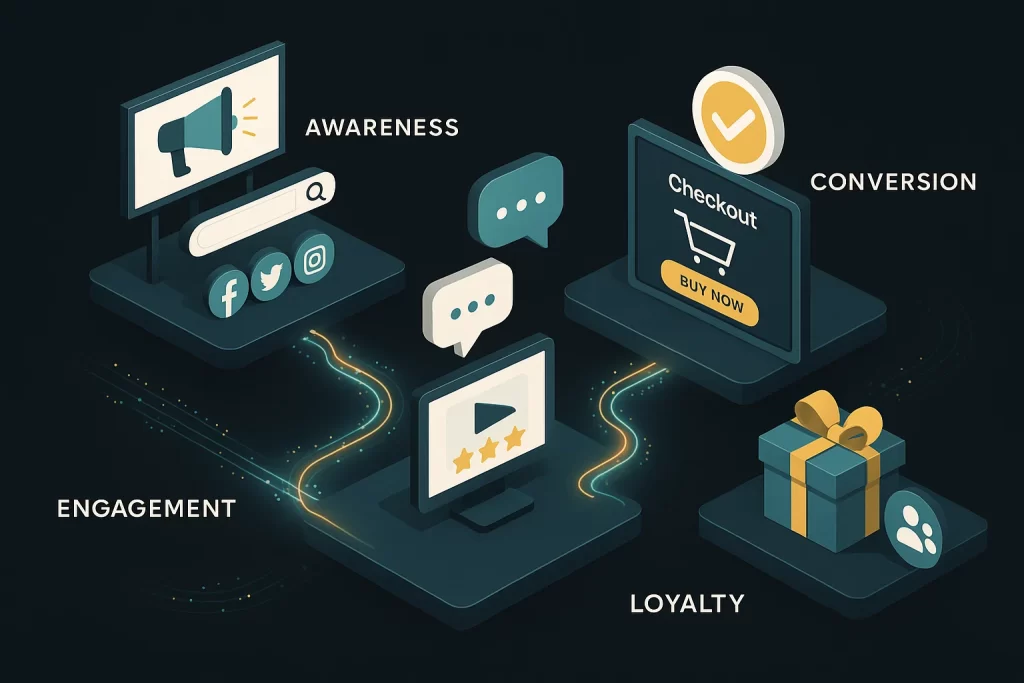
A typical customer’s journey includes dozens—sometimes hundreds—of micro-moments, but these are rarely linear. A user might hear about a brand on a podcast, Google it days later, see an ad while browsing Instagram, and finally convert via email retargeting. Each of these steps is a brand touchpoint, and each carries emotional and psychological weight. Your task as a brand architect is to align these moments into a coherent, emotionally progressive story.
Customer Challenges : Many marketers express confusion over where to even begin. One Redditor asked: “How do I build a brand journey when the customer could enter from literally anywhere? I feel like I’m designing in chaos.” The key lies in breaking down the chaos into three structured phases of the journey: Awareness, Engagement, and Advocacy.
Awareness & Discovery
This stage is often where branding wins or dies. It includes top-funnel interactions—ads, SEO content, social media, podcast mentions, referrals—designed to make a strong first impression. Your goal here is to design brand experience in user experience design that feels intuitive, emotionally inviting, and aligned with your brand’s promise.
Imagine a tech brand that promises simplicity. Their landing page shouldn’t just say “we’re simple”—it must feel simple: minimalist UI, clear typography, frictionless call-to-action. If the first click doesn’t feel like the brand, the entire journey is compromised.
Engagement & Purchase
This is the heart of the Brand Experience Journey Design—the “consideration-to-conversion” segment. Users are evaluating your brand against alternatives, often subconsciously weighing emotional resonance as much as features or pricing.
Here, we map interactions like demo requests, reviews, onboarding flows, pricing comparisons, and support chats. A B2B software company might use video testimonials to create emotional credibility. A lifestyle brand might integrate user-generated content into its shopping interface to signal authenticity. These are emotional signals disguised as UX choices.
Retention & Advocacy
While many journeys end at conversion, great brands know that post-purchase moments often define long-term loyalty. This phase includes support experiences, upsell offers, community involvement, and moments of surprise (like handwritten thank-you notes or milestone emails).
A customer who receives a surprise gift a week after purchase is 2x more likely to refer your brand, according to Harvard Business Review. Emotional gestures trigger memory hooks—and create advocates, not just repeat customers.
Pain Point: Many teams ignore this phase. One frustrated comment online read: “Our brand journey stops at the sale. We’re missing post-sale touchpoints but don’t know what to build.” This section helps solve that gap.
Building a Scalable Framework for the Journey
Brand experience is not built on isolated campaigns—it’s constructed on repeatable, scalable frameworks that align strategy with execution across every customer interaction. The most successful brands build their experience journeys like modular systems, not one-off events. This section uncovers how to structure those systems for scale, cohesion, and growth.
A scalable brand journey framework simplifies complex customer behaviors into predictable emotional and functional stages. It’s the blueprint behind every memorable user experience—from a seamless Apple unboxing to the consistent hospitality of the Ritz-Carlton. These frameworks ensure your brand doesn’t rely on luck or personality, but on deliberate architecture that teams can replicate, improve, and expand.
The 4‑Stage Experience Blueprint
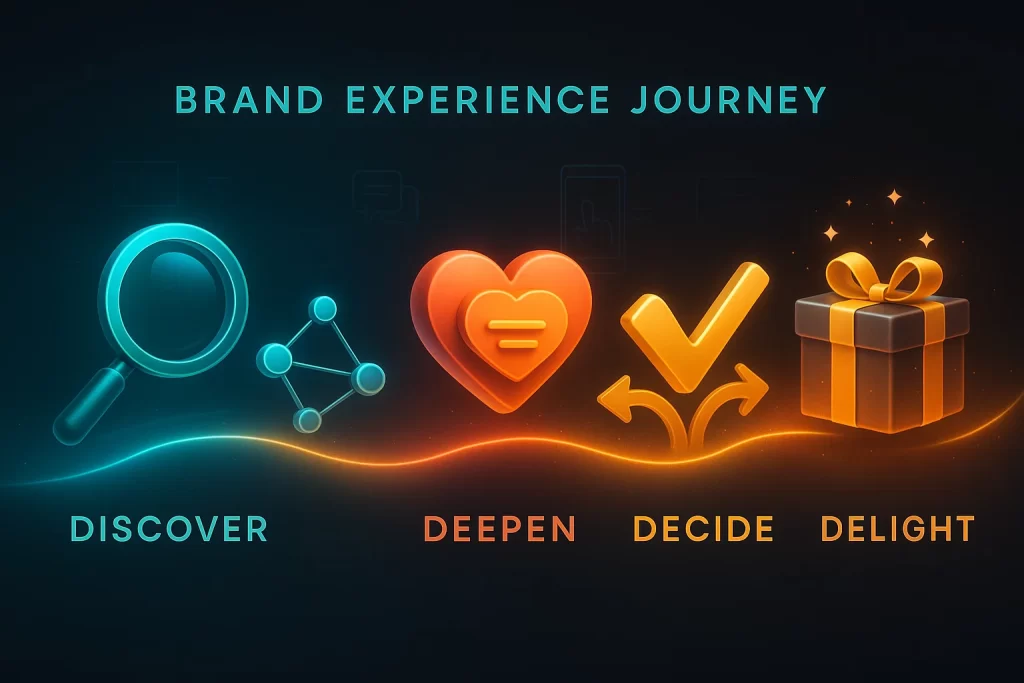
From competitor and expert research, a common winning pattern emerges across industries. Here’s a distilled version of that insight:
- Discover – Where users encounter your brand for the first time.
- Deepen – Where engagement turns into trust via content, trial, or community.
- Decide – The conversion moment, influenced by emotional resonance.
- Delight – Post-conversion reinforcement and brand elevation.
Each of these phases becomes a “zone” in your map, populated with touchpoints, emotional objectives, KPIs, and team owners. This modularity makes your journey scalable across teams and channels.
Bringing Strategy into Execution
Too often, the journey lives in a Figma file—never operationalized. According to McKinsey, over 70% of companies claim to prioritize customer experience, but only 30% actually have it embedded in their operating model.
The way forward is to connect your brand journey map to daily team workflows. For example:
- Your content team builds around the “Discover” zone using SEO strategy.
- Your product team designs “Decide” touchpoints with behavioral nudges.
- Your CX team owns the “Delight” phase via loyalty programming.
This turns journey design from theory into living brand choreography.
“Our journey framework turned abstract ideas into actionable moments—clearer than any flowchart,” says Sandra Duval, CX Director at a global fintech firm. “It gave every team a script, not just a mission.”
Measuring the Impact — Metrics & Optimization
A beautifully designed Brand Experience Journey is meaningless if it doesn’t deliver measurable outcomes. Today’s brand leaders face mounting pressure to prove that their emotional touchpoints and storytelling arcs aren’t just “nice-to-haves”—they’re strategic levers tied directly to business KPIs. This is where experiential branding metrics come into play, transforming subjective interactions into actionable data.
Yet, this is also one of the biggest pain points for brand teams. A frustrated Reddit thread read: “Our leadership loves the idea of brand experience, but always asks: where’s the ROI?” This section tackles that fear head-on.
Defining Success Metrics
Success in Brand Experience Journey Design isn’t just about conversions. It’s about emotional traction, behavioral signals, and long-term brand equity. While revenue and retention remain vital, leading brands also measure:
- Emotional Resonance Scores — Qualitative feedback from brand sentiment surveys, reviews, and user-generated content.
- Touchpoint-Specific Dropoff Rates — Behavioral analytics showing where users abandon or convert across the journey.
- Time-on-Experience Metrics — How long users spend engaging at various emotional or storytelling touchpoints.
- Journey Flow Completion — % of users who complete core brand sequences like onboarding, trial-to-subscription, or multi-channel interactions.
For example, a beauty brand found that customers who watched a 60-second founder story video during the Discover phase had 3x higher repeat purchase rates. That video’s emotional resonance was now a trackable performance driver, not just content.
Continuous Tuning & Iteration
Journey maps should never gather dust. Top-performing brands revisit their maps quarterly, if not monthly, treating them like living systems that respond to user feedback and behavior.
Practical optimization strategies include:
- A/B Testing Emotional Cues — From color tones to voice of copy at key touchpoints.
- Real-Time Sentiment Analysis — Using tools like MonkeyLearn or Clarabridge to scan and score user feedback.
- Micro-Surveying at Key Touchpoints — Asking one question (“Did this feel helpful?”) after each major interaction.
- Experience Heatmaps — Tracking movement, attention, and friction across digital touchpoints.
According to Adobe’s 2024 Digital Experience Report, brands that optimize experience journeys based on emotional data see 24% higher lifetime customer value than those that don’t.
These metrics aren’t just for validation—they’re for iteration. They show your team where to double down, where to cut friction, and where to innovate. As user behavior evolves, so must your journey.
Tools & Techniques for Implementation
Designing a powerful brand experience journey is only half the battle—the real challenge lies in execution. Many teams have bold visions and beautiful Figma mockups, yet they struggle to operationalize these ideas across departments. This is where tools, frameworks, and facilitation techniques bridge the gap between ideation and impact.
Pain Point: A recurring thread on design forums is, “We mapped a gorgeous brand experience, but no one’s using it. Sales hasn’t seen it. Dev ignored it. CX says it’s too ‘marketing’.” The solution? Empower your teams with shared tools, collaborative methods, and repeatable playbooks that make the journey executable at scale.
Building the Brand Experience Toolkit
Top-performing companies equip every function with tailored tools connected to the broader journey map. These typically include:
- Journey Mapping Platforms: Tools like Smaply, UXPressia, and Miro help visualize brand journeys collaboratively.
- Narrative Mapping Toolkit: Frameworks that align story arcs with touchpoints. Tools like Notion templates, messaging ladders, and customer storyboard formats make storytelling replicable.
- Emotion-Centered Wireframes: UX design kits built around emotional triggers rather than just UI structure.
- Customer Empathy Maps: Created in team workshops using MURAL or FigJam to deeply understand the feelings, fears, and expectations of users at each phase.
Operationalizing Across Teams
It’s not enough for the marketing team to understand the journey. For brand experience to truly work, every team—from product to sales to customer support—must see how their work fits into the emotional choreography.
Execution strategies include:
- Cross-Functional Journey Reviews: Bi-monthly meetings where teams review how real user data aligns with journey stages.
- Touchpoint Ownership Assignment: Each journey phase has defined team owners with specific KPIs.
- Playbooks & SOPs: For example, the “Delight” phase might have a CX playbook on how to personalize thank-you emails based on user intent signals.
“We treat our brand journey like an operating system,” says Michelle Ahn, Head of Experience Design at a major wellness startup. “Marketing builds the emotion. Product engineers the behavior. Support reinforces the feeling. Everyone plays a role.”
Pain Point: Many teams fail because they silo brand strategy from operations. These tools and systems connect the two.
Real-World Examples & Success Stories
While frameworks and theories offer structure, it’s real-world execution that brings Brand Experience Journey Design to life. Stories of brands that have mastered the choreography between emotion, function, and brand integrity reveal how strategy becomes impact.
In this section, we explore case studies—both actual and illustrative—that reveal what happens when the journey is executed well. These examples not only demonstrate the power of semantic design but also answer the user pain point: “Does this really work outside of decks and workshops?”
Case Study 1: Airbnb – Emotion Through Empathy
Journey Strategy: Airbnb’s brand experience centers around “belonging anywhere,” a feeling translated at every touchpoint—from the search interface to the host messaging system.
Key Touchpoints
- “Wish List” feature to visualize travel dreams (emotional priming).
- Seamless checkout with “Your host is waiting!” language (empathy-driven UX).
- Personalized welcome emails post-booking (delight and reassurance).
Impact: According to Fast Company, Airbnb saw a 25% increase in rebook rate after introducing personalized post-booking experiences tied to brand sentiment.
Case Study 2: Duolingo – Humor Meets Habit
Journey Strategy: Duolingo uses emotional storytelling to create habitual use. Instead of a serious educational tone, they opted for humor and gamification to drive retention.
Key Touchpoints
- The owl mascot’s quirky, emotionally reactive push notifications.
- A journey loop that rewards daily use with colorful animations.
- Community leaderboard that creates gentle pressure and social proof.
Impact: TechCrunch reports Duolingo’s DAU rose by 38% after incorporating behavior-driven nudge UX informed by brand personality.
Case Study 3 (Fictional): Horizon Health – Trust Through Touchpoints
Scenario: Horizon Health, a telehealth startup, needed to convey warmth and reliability in an often impersonal digital health market.
Journey Phases Optimized
- Discover: Brand video told through the eyes of a caregiver.
- Decide: Warm, human-first sign-up process with live chat.
- Delight: Doctor follow-up includes wellness tips tailored to patient history.
Imaginary Outcome: After integrating this new journey map, their NPS score rose by 20 points, and patient referrals doubled in one quarter.
Expert Insight
“Stories move people. Metrics keep them coming back. Marry both, and you don’t just get attention—you earn loyalty,” says Leah Ramirez, Director of Brand Experience at HumanCX.
FAQ
1. How do I start designing a brand experience journey when everything feels abstract?
This is one of the most common roadblocks. A Reddit user once shared: “My CMO keeps asking for ‘emotional resonance,’ but I just want to know what the hell to wireframe first.”
Start with clarity, not creativity. Begin by identifying your core journey phases: Discover, Deepen, Decide, Delight. Then, plot your major user touchpoints under each phase. At each touchpoint, ask:
- What emotion should the user feel?
- What action do we want them to take?
- What friction might stop them?
Once mapped, backtrack your design choices to support those goals. Tools like Miro or UXPressia can help you visualize this effectively.
2. What’s the difference between a customer journey map and a brand experience journey design?
While the two overlap, Customer Journey Mapping is often focused on functional flow: steps a user takes to complete a task (e.g., buying shoes). In contrast, Brand Experience Journey Design layers on emotional resonance, narrative flow, and sensory consistency.
Think of it this way:
- Customer journey = what they do
- Brand experience journey = what they feel and remember
Incorporating both ensures the experience is not only usable, but unforgettable.
3. Can I measure emotional impact in a brand journey? If so—how?
Absolutely. While emotional resonance sounds subjective, today’s tools make it measurable:
- Sentiment analysis on reviews, social media, or support chats (tools: MonkeyLearn, Clarabridge).
- Micro-surveys post-interaction (“How did this experience feel?”).
- Behavioral proxies like time-on-page, repeat visits, and social shares.
Track patterns: Did emotional storytelling increase demo sign-ups? Did simplifying the tone reduce customer support tickets? These are emotional effects, quantifiable in behavior.
4. Is it too late to overhaul my brand touchpoints mid‑campaign?
Not at all. In fact, mid-campaign optimizations are one of the hallmarks of agile brand teams. The key is to:
- Identify the lowest-performing touchpoints in your journey.
- Rework just those—don’t overhaul everything.
- Use A/B testing to deploy subtle changes (tone, timing, visuals).
- Gather feedback immediately and iterate again.
5. How can small brands afford to design rich brand journeys?
Great question—and a fair concern. While the big brands have in-house journey designers, small brands can still win by:
- Prioritizing the first and last impression (e.g., homepage and thank-you flow).
- Using low-cost tools (Notion, Canva, Typeform, Hotjar).
- Tapping into community feedback loops (Instagram Q&A, customer calls).
Conclusion
Designing a brand experience journey that delivers results isn’t about checking boxes on a marketing template—it’s about designing a living, breathing relationship between your brand and the people it serves. From the first spark of awareness to post-purchase delight, every touchpoint is an opportunity to earn trust, evoke emotion, and build loyalty.
Throughout this guide, we’ve explored how to move from fragmented campaigns to orchestrated experiences. You’ve seen how the journey framework—Discover, Deepen, Decide, Delight—translates across industries and business sizes. You’ve unpacked metrics, mapped real-world examples, and heard directly from users grappling with this transformation.
The real power lies not in the map itself, but in your commitment to updating it. Journey design is not a deliverable—it’s a discipline.
So what should you do now?
- Audit your current touchpoints. Where are emotional gaps, friction, or missed storytelling opportunities?
- Build your first journey blueprint. Use the semantic stages and emotional triggers outlined here.
- Involve your teams. Brand isn’t just a marketing play—it’s a cross-functional mandate.
- Measure what matters. Track emotional and behavioral signals across the journey.
- Iterate frequently. Your users change—your experience should too.
And remember: the most powerful brands are not the ones that speak the loudest, but the ones that make every interaction feel intentional and human.