
Building a Brand Demand Generation Strategy: From Awareness to Action
Introduction
The modern buyer’s journey is fragmented, self-directed, and increasingly skeptical of traditional lead capture tactics. As a result, businesses that continue to prioritize bottom-funnel conversions over holistic branding are leaving massive growth opportunities untapped. This is where a Brand Demand Generation Strategy becomes indispensable—not just as a buzzword, but as a repeatable, measurable system for driving full-funnel revenue impact.
While lead generation focuses on capturing existing demand, demand generation is about creating demand where none existed yet. And yet, too often, marketers confuse these two distinct stages. The result? Campaigns that generate short-term MQLs, but fail to nurture lasting buyer intent or brand affinity.
According to a 2024 Forrester study, only 38% of B2B marketing leaders consider their demand generation programs truly brand-led. The rest invest disproportionately in paid search, gated content, and remarketing—often to diminishing returns. Without a foundation in brand-building, these tactics risk becoming performance silos.
Scientific evidence supports this. A meta-analysis published in the Journal of Marketing Science concluded that organizations that invest consistently in brand awareness and early-stage content are 2.3x more likely to convert late-stage opportunities into revenue. This isn’t magic—it’s behavioral economics. Buyers don’t just purchase based on need; they respond to familiarity, trust, and perceived expertise—all built at the brand level.
Even more critical is how this intersects with today’s privacy-first marketing landscape. As third-party data becomes scarcer, and buyers spend more time researching anonymously, the only scalable asset marketers control is the strength of their brand narrative. And that narrative must begin early in the buyer journey—long before intent signals surface.
This is why it’s no longer enough to just have messaging alignment. You need to invest in Brand Strategy and execution—building a full-funnel ecosystem where planning, creative, media, and measurement are tied together by a clear brand thesis. Without this, demand generation efforts remain reactive and fragmented.
“Demand generation starts before buyers realize they have a problem,” says Brent Adamson, co-author of The Challenger Sale. “Branding is what makes that signal visible.”
“We hit our MQL goals every quarter, but the sales team says the leads have no clue who we are. That’s not real demand.”
This anecdote reflects a systemic pain point: performance without brand equals noise. A flashy ad might generate a click, but it rarely builds trust—especially in complex B2B environments where deals involve multiple stakeholders and long sales cycles.
This article breaks down the full picture. You’ll learn how to:
- Design a brand demand generation strategy that works from awareness to conversion
- Avoid common missteps (like skipping the pre-funnel phase)
- Blend semantic SEO, content, paid media, and sales enablement into one cohesive system
- Use metrics that reflect true demand, not just traffic or form-fills
Throughout this guide, we’ll integrate key like market demand strategy, b2b brand marketing, and intent-based branding, ensuring not just depth, but discoverability. We’ll cite authoritative research, quote industry experts, and spotlight real campaigns that moved the needle—not just for leads, but for long-term brand equity.
By the end, you’ll have a blueprint to turn your brand into a demand creation engine—one that drives action because it first inspired belief.
The Pre‑Funnel Phase: Where Awareness Meets Intent
Most marketing teams are laser-focused on what happens after a prospect enters the funnel. They optimize landing pages, lead magnets, and retargeting ads, chasing marginal gains in conversion rate. But what if the real opportunity lies not inside the funnel—but before it?
Welcome to the pre-funnel phase—the often-overlooked territory where awareness, curiosity, and problem recognition begin to form. This stage is the true starting line of a brand demand generation strategy, and mastering it is key to differentiating your brand in a crowded market.
Why “Brand” Comes Before “Lead”
Buyers don’t wake up and search your solution—they first become aware of a problem, idea, or desire. That’s where your brand needs to live: in the early moments when context is being shaped and preference is being formed.
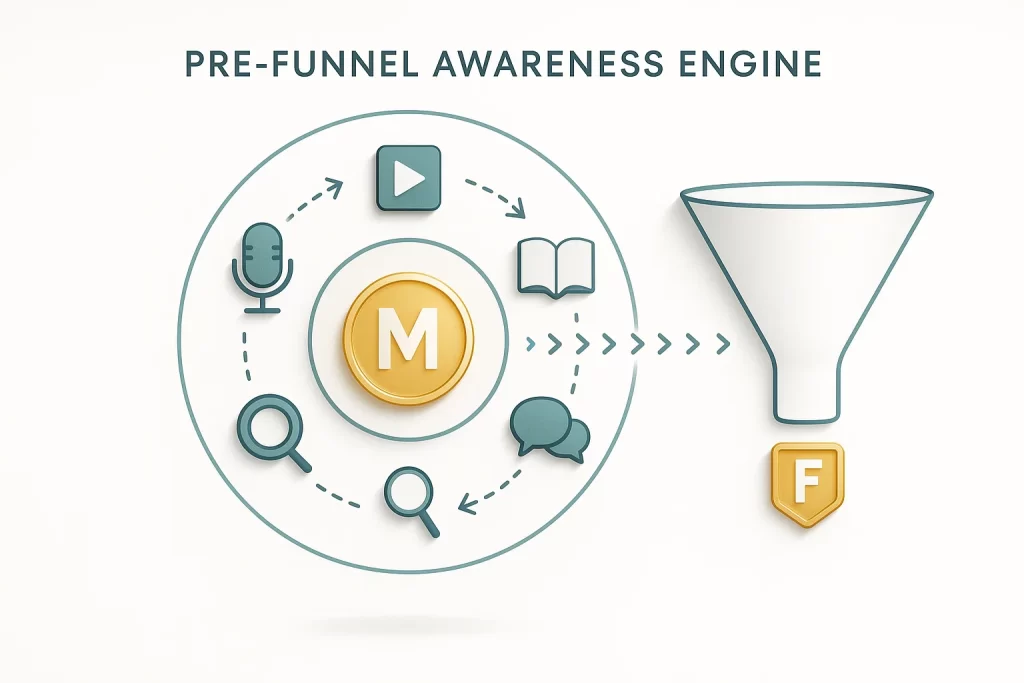
“Demand generation isn’t just about being present when buyers are ready—it’s about making sure you exist in their mental shortlist when the need arises,” explains Gartner in their B2B marketing insights report .
Think about the last time you made a significant purchase decision—like switching CRM platforms or choosing a new enterprise analytics tool. The vendors you considered weren’t just those who ran the best retargeting campaigns. They were the ones you’d heard about, read about, or seen consistently referenced by peers—often weeks or months before you started your active search.
That’s the power of brand-led demand activation: it creates familiarity before intent, which drastically lowers friction when it’s time to engage.
Diagnostic: Are You Skipping This Stage?
Most marketing orgs have blind spots in the pre-funnel stage. Here’s how to tell if your team might be skipping this critical layer:
- Your ads drive traffic, but not memory.
Prospects click, but can’t recall your brand later. - Leads convert but churn.
Sales closes deals, but brand value never sticks. - Sales says leads are unqualified.
Why? Because the buyer didn’t really know why you mattered in the first place.
These are all symptoms of skipping pre-funnel strategy—a phase that demands brand storytelling, thought leadership, and educational content before the sales pitch begins.
“Our webinars were great, but no one showed up because no one knew who we were. Lesson learned: awareness is oxygen.”
How to Reclaim Pre-Funnel Visibility
Here’s where strategic brand strategy and execution can change the game. Rather than pushing gated whitepapers, focus on high-reach, low-friction formats:
- Podcasts & guest appearances: Position leaders as authorities
- Strategic organic content: Answer early-stage questions (intent-based branding)
- Branded mini-campaigns: Spark conversation and recall before any CTA
Remember, buyers don’t just buy when they’re ready—they buy from brands they remember when readiness strikes. The best brand demand generation strategies optimize for memory before conversion.
Building the Framework: Awareness‑Centric Strategy That Drives Demand
If awareness is the ignition point, the brand demand generation framework is the engine that sustains momentum. It’s not just about getting seen—it’s about being remembered and understood across every stage of the buyer journey.
This section unpacks the key components of a structured, awareness-centric demand strategy—one that builds interest, intent, and action without skipping the crucial early steps.
Components of a Demand‑First Brand Engine
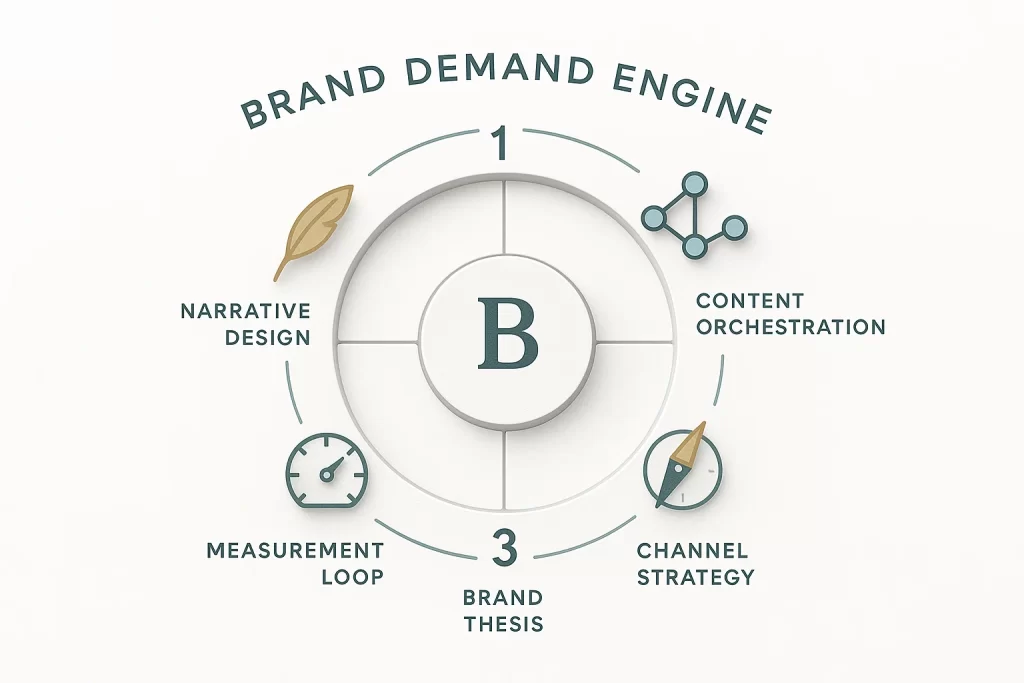
An effective brand demand generation strategy rests on four pillars:
- Narrative Design
Your brand must lead with a compelling narrative—rooted in pain points, solution clarity, and distinctive perspective. Forget generic taglines. What idea does your brand own in the market? - Content Orchestration
Strategic content is no longer a blog post here and a webinar there. It’s a web of assets—awareness-level thought leadership, mid-funnel case studies, and late-stage sales enablement—all mapped to buyer intent signals. - Channel Strategy
Instead of casting a wide net, adopt omnichannel demand strategy. This includes SEO, paid social, programmatic, partner co-marketing, and even community—each reinforcing the brand message across touchpoints. - Measurement Loop
Awareness doesn’t mean fluffy KPIs. Measure brand lift, direct traffic, search volume changes, and engagement rates on pre-funnel content. Add qualitative cues too—do prospects mention your brand unprompted?
“A healthy demand engine doesn’t just track conversions—it tracks how often buyers cite your brand before they become leads,” says Sangram Vajre, co-founder of Terminus.
Integrating Intent Signals Early
The gap between awareness and conversion can be shortened—if you embed buyer intent data into your strategy. That doesn’t mean waiting for form fills. Instead, use:
- Content engagement heatmaps: Which early articles drive repeat visits?
- Intent data platforms (e.g., Bombora, 6sense): Who’s researching your space but not raising their hand?
- Keyword trend shifts: Rising interest in terms like “market demand strategy” can signal a shift in awareness.
Combine this with smart nurture journeys—i.e., instead of blasting a whitepaper follow-up, offer a branded podcast clip or client story. This keeps the buyer in your ecosystem without forcing a hard ask.
Channel Mix & Messaging
Your channel mix should reflect both the message and the maturity of your market. A startup selling to CIOs will differ from a SaaS platform marketing to e-commerce managers.
Here’s a channel alignment matrix:
| Channel | Awareness Role | Demand Role |
| Organic SEO | Evergreen discovery, thought leadership | Capture late-stage searches |
| Paid Social | Attention bursts, brand recall | Retargeting + education |
| Webinars & Events | Mid-funnel engagement | Qualification + authority building |
| Podcasts/YouTube | Passive awareness | Repetition and retention |
Each channel should reinforce your core brand story, using language and visuals consistent with the broader brand strategy and execution plan.
“Marketing without a channel hierarchy is noise,” said one Reddit user. “We used to run ads everywhere. Now we focus on organic + branded video, and suddenly people remember us.”
Real‑World Examples: Brand Demand Strategies That Worked
While frameworks and strategy are essential, nothing reinforces belief like real-world brand demand success stories. These campaigns demonstrate how companies—especially in B2B—turned brand-led thinking into measurable demand impact.
Below are three standout examples that combine awareness, intent-based branding, and demand creation—not just lead capture.
Example 1: Gong – From “Sales Tech” to Category Leader
Challenge: Gong needed to break through a crowded sales tech space dominated by incumbents and demo-driven demand strategies.
Strategy: Instead of chasing leads with webinars and CTAs, Gong invested heavily in awareness-stage content—humorous LinkedIn posts, industry memes, and bold statements challenging the status quo of sales coaching.
Execution
- Branded their category as Revenue Intelligence
- Used paid social for high-reach non-gated content
- Created a “Gong Labs” data series to publish proprietary insights
Impact
- Achieved 3x brand recall in less than 12 months
- Drove a 240% increase in direct traffic—an early indicator of brand-led demand
“We measure brand lift like we measure pipeline. Memory creates revenue,” said Udi Ledergor, Gong’s CMO.
Example 2: HubSpot – Education as a Demand Generator
Challenge: Competing in a saturated CRM + marketing software space.
Strategy: HubSpot’s secret weapon wasn’t ads—it was education. They doubled down on free courses, certifications, and blogs to build trust and loyalty—before buyers were ready to purchase.
Execution
- Created HubSpot Academy (pre-funnel asset)
- Optimized for long-tail queries like “b2b demand generation strategy”, “how to do inbound marketing”
- Partnered with influencers in marketing and sales to extend reach
Impact
- Academy became a lead source AND brand trust engine
- Branded search increased 4.2x over 18 months
Example 3: Monday.com – Performance Marketing with Brand at the Core
Challenge: Scale a work operating system in a hyper-competitive category (Asana, Trello, Notion).
Strategy: Blend brand storytelling with conversion optimization across YouTube, social, and native content.
Execution
- Created humorous, bold YouTube ads focusing on team collaboration pain points
- Retargeted video viewers with actionable demand content
- Kept visual branding consistent across channels
Impact
- YouTube campaigns generated over 30M views
- Site traffic from branded keywords increased 210% YoY
- Awareness built trust-first, converting at 4x normal rates
Common Pitfalls & Misconceptions
Even experienced marketers fall into traps when executing a brand demand generation strategy. These pitfalls often stem from outdated beliefs, short-term pressures, or a lack of clarity around the role of brand in building demand. Let’s demystify the most common misconceptions—and show how to avoid them.
Pitfall 1: Confusing Demand Generation with Lead Generation
This is the most persistent misunderstanding.
- Lead generation captures existing demand—usually via gated content, forms, or outreach.
- Demand generation creates demand—by introducing your brand and shaping buyer perception before they enter the funnel.
“My CEO said, ‘Why aren’t leads up?’ but we just launched brand campaigns. I had to explain that brand doesn’t create leads tomorrow—it creates pipeline next quarter.”
The pressure to produce quick results can sabotage long-term brand investments. Educating stakeholders on the difference is crucial.
Pitfall 2: Launching Campaigns Without a Clear Brand Narrative
Without a unifying brand story, even well-funded campaigns will underperform.
Symptoms
- Disjointed messaging across channels
- Inconsistent creative tone
- Low recall despite high reach
Instead, anchor every campaign in your brand positioning for demand—what you solve, why it matters, and how your values align with your audience’s worldview.
Pro Tip: Use brand strategy and execution principles to map messaging tiers from awareness to decision stages.
Pitfall 3: Measuring the Wrong Metrics
Many teams obsess over vanity metrics like:
- Click-through rates (CTR)
- Cost per lead (CPL)
- Number of MQLs
But these don’t tell the full story of brand-driven demand. Instead, track:
- Direct traffic growth
- Branded search volume
- Engagement with awareness-stage content
- Brand recall surveys or post-demo attribution
“You can’t manage what you can’t measure—but don’t measure what doesn’t matter,” says B2B strategist Louis Grenier.
Pitfall 4: Over-Reliance on Paid Performance Channels
Paid ads are powerful, but not enough on their own. Without brand demand strategy as the foundation, performance campaigns often see diminishing returns.
Common signs:
- High initial conversions, low retention
- Lead quality drops over time
- CPA increases steadily
Solution: Pair performance marketing with a top-of-funnel awareness engine using organic, community, and thought leadership content.
Step‑by‑Step Roadmap: From Awareness to Action
Most demand generation frameworks start at the middle of the funnel—with lead scoring, nurture flows, and attribution. But a true brand demand generation strategy starts much earlier. This roadmap breaks down a complete funnel-wide approach—from zero awareness to sustained demand.
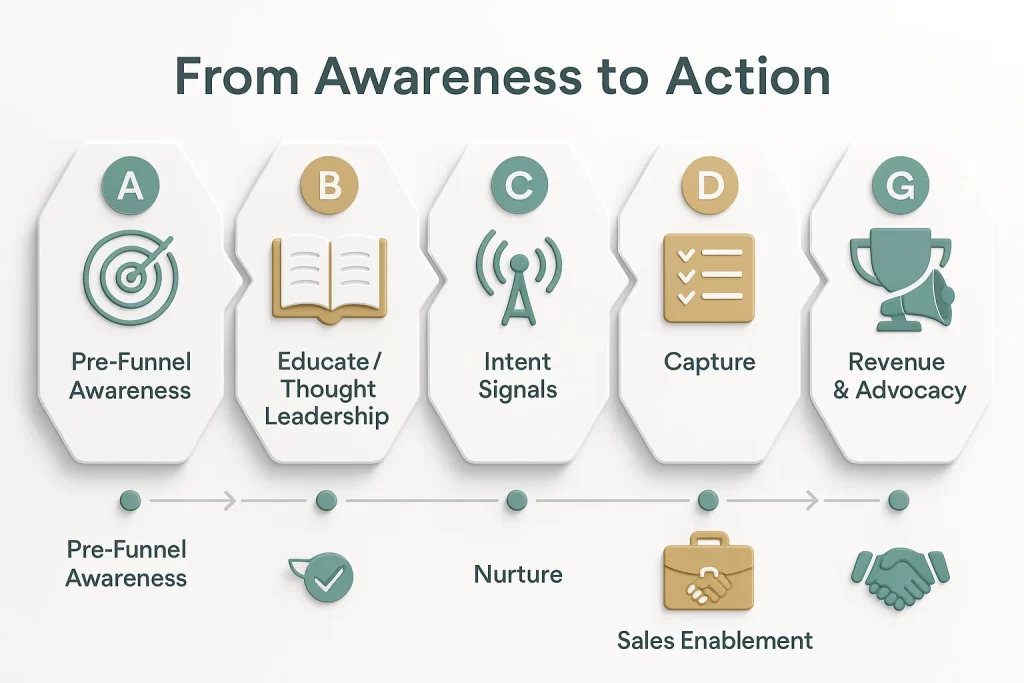
Each phase balances brand building with buyer intent, ensuring your audience isn’t just captured—but converted over time.
Step 1: Audit & Discovery
Before building anything, audit your current brand presence
- How often is your brand searched directly?
- What are buyers saying about you in forums or on social media?
- Is your narrative consistent across touchpoints?
Use tools like
- Google Search Console for branded queries
- SparkToro for audience research
- Reddit and Quora for qualitative sentiment
“We thought we were well-known, until we realized our own sales team couldn’t summarize our brand in a sentence.”
Step 2: Strategy Design
This is where brand strategy and execution converge. Define:
- Brand thesis: What do you believe that your competitors don’t?
- Audience segmentation: Not just firmographics, but psychographics and journey stages
- Core messaging pillars: Anchor everything from paid ads to case studies
Map long-tail search intent to stages
- TOFU: “What is a demand generation strategy?”
- MOFU: “b2b demand generation strategy for SaaS”
- BOFU: “top CRM tools for demand generation”
Step 3: Testing & Iteration
No strategy survives contact with reality. Use micro-campaigns to test:
- Narrative: Do people engage with your “why”?
- Channels: Are podcasts better than webinars?
- Creatives: Static vs. video vs. carousel ads
Use A/B testing across content formats and paid assets. Success here means signals—not sales. Early signals include:
- Increased direct traffic
- Higher time on site from TOFU pages
- Social shares/comments on thought leadership posts
Step 4: Scaling & Measurement
Once early signals validate your narrative, it’s time to scale:
- Expand into new channels (e.g., partner co-marketing, PR, audio)
- Repurpose winning content across the funnel
- Layer in sales enablement assets with brand voice
Measurement should include:
- Brand lift studies (via LinkedIn or Google Brand Lift)
- Engagement metrics on pre-funnel content
- Funnel velocity changes
“After we layered brand-led webinars into our nurture, our demo-to-close time dropped by 27%,” reported a VP of Marketing in a Demand Gen Report case study.
FAQ
1. How is demand generation different from brand marketing?
This confusion is common. The key difference is intent.
- Brand marketing builds recognition, trust, and memory. It’s often emotional and long-term.
- Demand generation uses that brand equity to drive interest, engagement, and eventually action.
But they must work together. Think of brand as the soil and demand gen as the crops. You can’t grow pipeline in poor soil.
2. I’ve run demand-gen for 6 months—why isn’t awareness improving?
Because most demand gen tactics (e.g., gated PDFs, LinkedIn ads) don’t build top-of-funnel visibility. If your audience only sees you after they’re searching, you’re not actually generating demand—you’re just competing for scraps.
To fix it:
- Launch pre-funnel content: YouTube, podcasts, ungated guides
- Start branded search campaigns and brand lift studies
- Inject brand storytelling into performance assets
3. Is demand generation only about generating leads?
No. That’s a narrow view that leads to lead obsession. True brand demand strategy focuses on:
- Creating new markets
- Educating unaware buyers
- Sparking curiosity before a solution is needed
Demand isn’t a form fill—it’s a buyer thinking, “I trust this brand to help me solve a problem I didn’t know I had.”
4. Can brand demand strategy work for B2B SaaS startups?
Absolutely—and arguably, it’s essential in early-stage SaaS. Without brand, your CAC stays high, your churn rises, and your pipeline becomes fragile.
B2B buyers often default to the brands they remember. In the absence of awareness, they go with known players—even if your product is better.
Startups can win with:
- Founder-led content
- Narrative-first landing pages
- Community building and partner podcasts
5. Should we prioritize SEO or paid media for brand-led demand gen?
Both—but in sequence. Use SEO for sustained awareness, especially around long-tail queries like:
- “How to build brand demand strategy”
- “Demand generation vs lead generation explained”
- “Best B2B examples of brand-led growth”
Conclusion
In an increasingly noisy, skeptical, and fragmented market, capturing attention is no longer enough. Brands must earn relevance long before buyers begin comparing vendors or scheduling demos. This is the power—and the necessity—of a well-executed brand demand generation strategy.
We’ve unpacked how awareness isn’t just the first step in the funnel—it’s the foundation of sustainable demand. From defining your brand narrative, to integrating intent signals, to balancing short-term performance with long-term memory—every stage of your strategy should reinforce who you are and why you matter.
Forget the outdated playbooks that treat demand generation as lead-hunting. The future belongs to brands that generate interest, trust, and authority before the sale even starts.
So whether you’re a startup trying to earn your place at the table or a global enterprise looking to rejuvenate stagnant pipeline growth, remember: brand is not fluff—it’s the multiplier. And demand doesn’t just appear—it’s built.