
Brand Competitive Positioning Playbook: How to Craft a Winning Market Edge
Introduction
In the era of hyper-saturation, a brand’s ability to clearly define and defend its space in the market has become a strategic imperative. The Brand Competitive Positioning Playbook isn’t just a trendy framework—it’s a strategic tool that empowers businesses to carve out distinctiveness in crowded industries. Whether you’re a scaling SaaS company, a DTC brand entering a new category, or a legacy player losing ground to nimble newcomers, positioning clarity is your most critical asset.
According to Harvard Business Review, companies that consistently communicate their unique position grow 31% faster than their peers. Yet despite this, many brands fail to formalize their messaging architecture or align their positioning with evolving market conditions. This is where a playbook becomes indispensable—it codifies the brand’s DNA, competitive landscape, and messaging hierarchy into a strategic asset.
The integration of Brand Strategy and Execution is especially crucial here. Without action, strategy is just theory. This guide links the two seamlessly—delivering a positioning system that spans from boardroom theory to campaign rollout. For a deeper look at how to connect the dots between strategy and performance, check out this guide on executing winning brand strategies.
By blending insights from sources like McKinsey, HubSpot, and BCG with battle-tested branding techniques, this playbook will help you transform generic messaging into a value-driven narrative that differentiates, resonates, and converts.
This guide will walk you through:
- How to analyze competitors and spot messaging gaps
- How to build your own brand positioning canvas
- How to scale messaging from value proposition to creative briefs
Whether you’re wondering, “Why does our messaging sound just like our competitors?” or “How do we build a positioning system that scales?” — this guide has you covered.
Anatomy of the Playbook: Step-By-Step Framework
A truly effective Brand Competitive Positioning Playbook is not a static PDF or a one-time workshop deliverable. It’s a living framework—designed to evolve with your market, guide your creative, and align every stakeholder around one clear, differentiated story. This section outlines the four critical stages that transform positioning theory into marketing precision.
Brands often fall into two traps: either over-simplifying their messaging or drowning in complexity. The playbook balances both. It begins with competitive clarity and ends with message hierarchy. Between those bookends lie the steps that forge differentiation.
This system draws on brand messaging hierarchy principles used by firms like BCG and McKinsey, as well as the agile positioning tactics seen in successful DTC and SaaS companies. These stages have been reverse-engineered from real-world brand turnarounds, product launches, and market repositioning efforts.
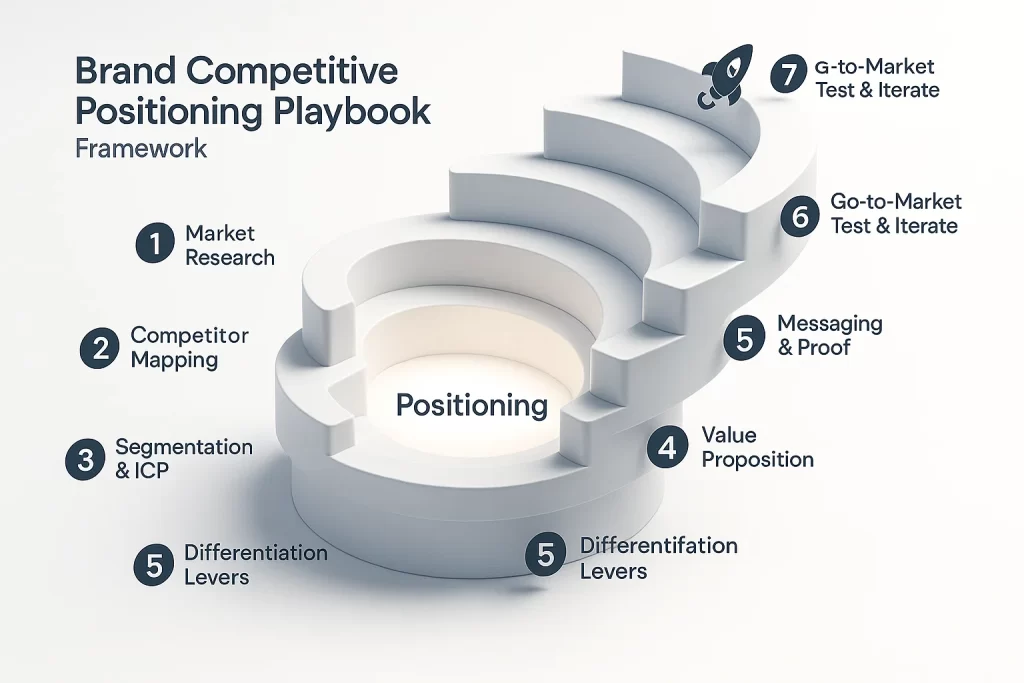
Each stage addresses a distinct pain point—lack of clarity, me-too branding, or fragmented storytelling. It also answers a crucial startup question: How do we build a brand strategy that scales as we do?
1. Competitor Brand Audit and Gap Analysis
The first step in building a standout brand is understanding who else is talking to your audience—and what they’re saying. This means conducting a competitor brand audit, followed by a focused gap analysis.
Start by mapping your top 5–10 direct and indirect competitors. What phrases do they overuse? What values do they claim? What promises do they make that they fail to deliver on? Tools like Crayon, SimilarWeb, and plain old Google search can help here.
Then identify the whitespace: the unspoken value props, the underserved emotions, or the unmet needs in customer narratives. For example, if every fintech brand is talking about “ease” and “speed,” perhaps no one is claiming “accountability” or “education”—opportunities for emotional distinction.
“The goal isn’t just to be different—it’s to be meaningfully different in a way that matters to your customer.” — Harvard Business Review
Customer Challenges Solved : “How can I avoid sounding like everyone else without knowing what others are doing?” This step answers that with data, not guesswork.
2. Building a Positioning Canvas
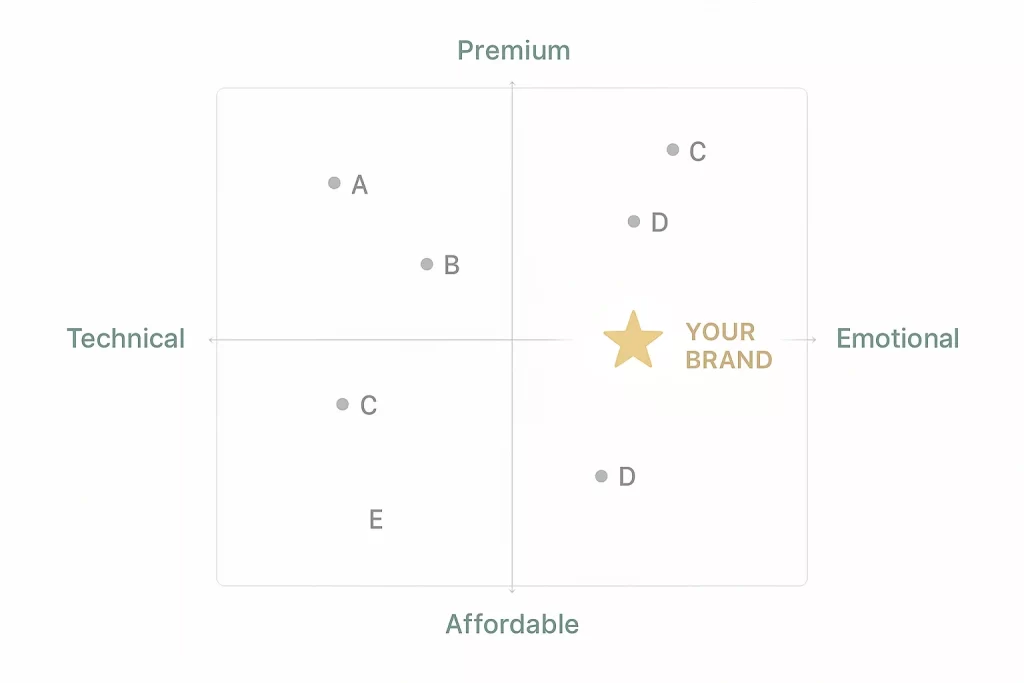
With competitor insights mapped, the next step is to construct your own Brand Positioning Canvas—a strategic visual that defines your brand’s place in the market along axes like emotional tone, innovation, target audience, or product complexity.
Think of it as a “brand map.” On one axis you might chart “technical vs emotional,” and on the other “premium vs affordable.” Where do competitors sit? Where do you want to sit?
The positioning ladder concept comes into play here: start with the functional value, then build to emotional benefit, and finally ladder up to purpose. This gives your brand depth and authenticity.
“Brands that claim emotional territory are 50% more likely to drive loyalty and advocacy.” — McKinsey & Company
User concern handled: “I’m not sure what our actual brand position is.” This visual and narrative exercise defines it with confidence.
3. Crafting the Messaging Hierarchy
Once you know your brand’s position, it’s time to articulate it clearly—from boardroom to billboard. Enter the brand messaging hierarchy.
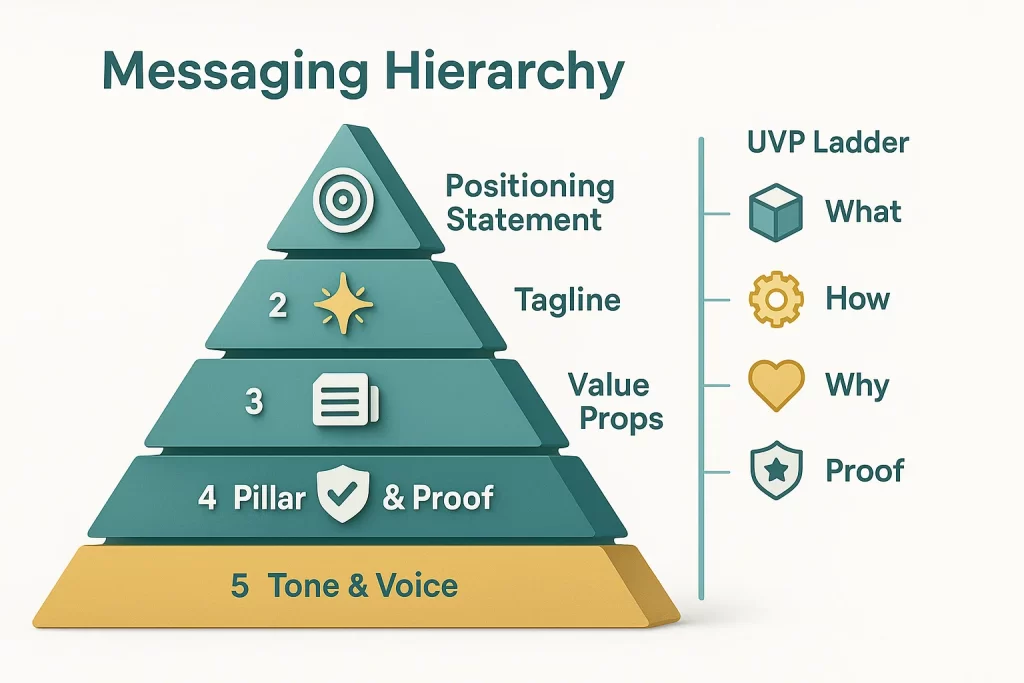
Start with your core positioning statement. Then build outward:
- Tagline: Emotionally punchy, reflective of brand promise.
- Value Propositions: Functional + emotional benefits.
- Pillars: Proof points (data, features, social proof).
- Tone: Style of speaking that matches your audience (e.g., bold vs consultative).
This hierarchy ensures message consistency across landing pages, ads, investor decks, and onboarding emails.
A startup once reworked their homepage using this model—and saw time on page rise by 42% in 30 days. Why? Because every line spoke from a single, unified brand voice rooted in clear positioning.
Quote
“Consistency breeds credibility. And credibility wins attention.” — HubSpot Brand Messaging Guide
4. Designing the Unique Value Proposition Framework
The last stage is building the Unique Value Proposition (UVP) into a repeatable story across every customer touchpoint.
Use the Value Ladder
- What: What does your product do?
- How: How does it work differently?
- Why: Why does that difference matter emotionally?
- Proof: How do you demonstrate that difference?
Don’t just talk about features—anchor them to beliefs. A CRM tool that “automates sales tasks” is functional. One that “gives salespeople hours back to connect like humans” is emotional.
Tie the UVP back to your differentiation roadmap. This is where positioning meets performance.
User concern resolved: “What is our UVP and how do we express it beyond our About page?” This stage offers tactical answers.
Applying the Playbook in Real World Contexts
Creating a Brand Competitive Positioning Playbook is one thing—operationalizing it across campaigns, teams, and growth phases is another. This section brings the framework to life through practical applications across real-world business contexts.
Whether you’re a two-person startup or a mid-sized company preparing for market expansion, the playbook adapts to your brand’s unique growth arc. The difference between branding and positioning often shows up here: branding tells the story, but positioning chooses the chapter that resonates most with the target reader.
A well-built brand narrative playbook acts as a North Star across functions—from product to marketing to sales. It ensures internal clarity while delivering external consistency, a crucial trait for brands scaling quickly or shifting categories.
1. Standing Out Without Resources
Startups often struggle with a paradox: they have to appear differentiated before they’ve built credibility. This is where a lightweight but sharp competitive positioning strategy for startups becomes a secret weapon.
- Use free tools (like Google Sheets + AI-assisted analysis) to build your competitor audit.
- Craft positioning not just around product—but around founder POV, company ethos, or even delivery method.
- Apply the positioning canvas to highlight an underserved customer segment rather than competing feature-for-feature.
“As a founder, our biggest early win wasn’t product—it was being the only voice in our space that sounded human and funny.” – Reddit user, r/Entrepreneur
Empathy, simplicity, or even bold irreverence can become differentiation levers—especially in industries bloated with jargon or B2B coldness.
2. For SMEs: Scaling Storytelling with Structure
Established companies often have assets—brand equity, team size, market traction—but lack clarity or consistency across departments. The result? Fragmented messaging and diluted differentiation.
This is where the playbook positioning approach brings structure.
- Align internal messaging using a messaging hierarchy document.
- Revisit brand values to ensure they reflect external perception and not just internal aspiration.
- Create persona-specific messaging scripts that plug directly into sales decks, web copy, and performance marketing.
A mid-market SaaS firm recently rebuilt its playbook after realizing each department defined their value prop differently. Post alignment, their NPS rose 17 points in six months.
“We didn’t change our product—we just finally figured out how to talk about it with consistency.” — VP of Marketing, B2B SaaS (LinkedIn post)
3. For Category Shifters: Repositioning for Relevance
Brands shifting categories or launching new verticals face a unique challenge: preserving what works while evolving the message for a new audience.
In these cases, the playbook helps create strategic coherence between old identity and new opportunity.
- Use the brand strategy blueprint to revisit your audience’s current perceptions.
- Position the new offering not as a departure, but as a natural evolution.
- Introduce a new emotional benefit layer to the brand narrative—one that aligns with the new market’s values.
For instance, a wellness brand expanding into mental health reframed its brand from “daily rituals” to “daily restoration,” aligning with deeper emotional stakes while retaining familiarity.
User concern tackled: “We’ve changed—but does our audience know it?”
Expert Voices & Action Insights
Positioning isn’t just creative—it’s strategic, and the best strategies are informed by research, expert insights, and validated frameworks. In this section, we distill key ideas from trusted authorities like McKinsey, BCG, HubSpot, and Harvard Business Review to anchor your Brand Competitive Positioning Playbook in evidence—not just intuition.
These voices don’t just add credibility—they show you what works in real-world, high-stakes brand environments. Think of this section as your shortcut to wisdom: what seasoned strategists, researchers, and marketers already know about differentiation, relevance, and growth.
Harvard Business Review: Consistency Wins
“Companies with strong and consistent brand positioning outperform competitors by 31% in market share growth.”
— Harvard Business Review
This quote reveals the long-term compounding effect of clear positioning. The takeaway? Your playbook shouldn’t just define your position—it should reinforce it at every touchpoint, consistently. Consistency isn’t boring when it’s rooted in a powerful story.
McKinsey: Emotional Differentiation Drives Loyalty
“Brands that create emotional relevance through differentiation retain customers 40% longer.”
— McKinsey & Company (mckinsey.com)
The idea of “emotional territory” is often overlooked. Most playbooks focus only on functional benefits—speed, price, innovation. But emotional benefits—like trust, empowerment, or clarity—are what truly earn loyalty. Your messaging hierarchy must reflect both.
HubSpot: Credibility Through Clarity
“Consistency breeds credibility. And credibility wins attention.”
— HubSpot Brand Messaging Guide
HubSpot emphasizes the internal role of the playbook: alignment. When sales, marketing, and product teams tell the same story in different channels, brands build momentum. Misalignment causes brand confusion and drop-off. This is why a messaging framework rooted in your brand strategy guide matters as much internally as externally.
Purpose-Driven Positioning Outperforms
“Brands that articulate a clear purpose outperform peers by 20% in three-year growth.”
— Boston Consulting Group (BCG) (bcg.com)
BCG’s research underscores the power of strategic brand differentiation through purpose. Purpose doesn’t need to be world-saving—it can be as simple as “removing complexity from the lives of creative teams.” What matters is that it’s authentic, specific, and evident across the brand experience.
Quote Wall: Real-World Insights From the Field
A few more bite-sized but powerful quotes you can use as framing inspiration inside your playbook:
- “If you don’t define your brand, your competitors will.” – Unknown strategist on r/marketing
- “Your brand is what people say about you when you’re not in the room.” – Jeff Bezos
- “Positioning is the art of sacrifice. You have to give up something to be remembered for something.” – Marty Neumeier
Mistakes to Avoid When Positioning Your Brand
Brand positioning can make or break a business. Done right, it clarifies your unique value, shapes perception, and builds long-term trust. But even the most well-intentioned teams fall into strategic traps that render their brand indistinct, confusing, or misaligned. Let’s walk through the most common—and costly—mistakes brands make when building their brand competitive positioning playbook, and how to avoid them.
Mistake #1: Confusing Features with Differentiation
Many brands attempt to define their unique position by listing features. While features describe what your product does, they rarely explain why that matters to your audience. This mistake leads to messages like:
“We’re the fastest cloud database” or
“Our software includes automated reporting.”
These statements may be true, but they don’t differentiate. They’re replicable. Your real strategic edge lies in articulating why your feature matters more deeply than your competitors’—and how that ties to your customer’s life.
“Differentiation isn’t just being different—it’s being meaningfully different.” – Harvard Business Review
Mistake #2: Using Generic, Meaningless Language
Phrases like “we’re innovative,” “we care,” or “our people make the difference” are textbook examples of brand filler. They’re non-differentiating clichés. Ironically, they make a brand less credible because they sound templated and hollow.
Why this happens
- Lack of external research (no competitive audit)
- Internal echo chambers (teams assuming everyone already understands their value)
Instead, brands must commit to specificity. Replace “we innovate” with:
“We brought AI tools to small-town construction crews—where tech adoption typically lags by 5 years.”
Mistake #3: Positioning Based on Internal Assumptions, Not Market Reality
Positioning must be externally validated. Too many brands base their messaging on internal brainstorms or founder beliefs without testing what actually resonates.
An imaginary anecdote illustrates this well:
At a B2B startup accelerator, a founder pitched her product as “the next-gen operations dashboard.” But user interviews showed the real pain point was cross-team visibility—not dashboard overload. Her competitive advantage was clarity, not innovation.
Expert Quote:
“Your brand is not what you say it is—it’s what they say it is.” – Marty Neumeier
Mistake #4: Creating Positioning Once—Then Never Updating
Markets evolve. Competitors pivot. Customers change behavior. But many brands treat their positioning like it’s cast in stone. Without periodic refinement, your brand voice will fade into irrelevance or worse—sound outdated.
A good rule of thumb: Revisit your brand positioning every 6–12 months, or when one of the following occurs:
- A new competitor emerges
- Customer acquisition stalls
- You launch a new product/service line
- Market trends shift (e.g., post-COVID digital transformation)
Mistake #5: Trying to Appeal to Everyone
Brands often fall into the trap of crafting messaging that’s overly broad in an attempt to capture a bigger audience. But as the saying goes, “When you try to speak to everyone, you speak to no one.”
Positioning must be surgically specific. This doesn’t mean excluding people—it means having a sharp hook that makes your audience say: “That’s exactly what I needed.”
“I feel like every SaaS website I visit just says buzzwords. None of them tell me why I should give a damn.”
Evolving Your Positioning Over Time
Even the most well-crafted brand competitive positioning playbook isn’t immune to time. Markets move. Competitors innovate. Customer expectations evolve. What worked last year may no longer resonate—especially if your brand is scaling or entering new markets. The key to sustainable brand relevance is to treat positioning as a living strategy, not a one-and-done exercise.
Why Positioning Can’t Be Static
Strong brands like Slack, Airbnb, and Notion all pivoted their positioning over time:
- Slack: From “email killer” to “your digital HQ”
- Airbnb: From “affordable stays” to “belong anywhere”
- Notion: From “notes app” to “workspace for your whole team”
These shifts weren’t cosmetic—they reflected a refined understanding of user behavior, emotional language, and competitive whitespace.
“Your brand exists in the minds of others. And minds change.” — Marty Neumeier
Customer Challenges Solved
“I nailed my messaging last year, but now it’s underperforming.”
Key Triggers That Indicate It’s Time to Reposition
Positioning refreshes don’t need to be reactive. But if you notice these signals, it’s time to revisit your playbook:
- New entrants crowd your space (eroding differentiation)
- Marketing campaigns plateau (CTR, engagement, CAC metrics drop)
- Customer interviews reveal new use cases you hadn’t considered
- Your product or vision has changed
- Mismatched expectations in sales calls (“I thought you did X”)
Expert Quote
“Brand positioning should be audited like any other business asset—quarterly and during key growth events.” — McKinsey Insights
The Brand Positioning Refresh Process
Use this as a playbook within your playbook. A systematic refresh should follow five steps:
- Conduct a new competitor audit
- Use tools like Crayon, SEMrush, or even AI like ChatGPT to analyze messaging shifts.
- Re-interview your customers
- Identify new value drivers, unmet needs, emotional hooks.
- Audit internal assumptions
- Check for alignment between founders, marketing, and product teams.
- Map new whitespace opportunities
- Use a revised positioning matrix.
- Rebuild messaging and test
- A/B test headlines, landing pages, and email CTAs before full rollout.
Using AI and Market Intelligence to Evolve Faster
Modern brands no longer need to guess. Tools like:
- Wynter: Message testing with real target audience panels.
- Crayon: Competitor intelligence for messaging changes.
- Survicate or Typeform: Lightweight customer insight surveys.
- Social Listening Tools: Brandwatch, Sprout Social.
Example: A SaaS team at Series B used Brand24 + Survicate to detect a shift in how users described their platform, prompting a major headline pivot that boosted demo requests by 35%.
Brand Evolution in Action: A Hypothetical Case
Let’s imagine a DTC skincare brand positioned as “clean, clinical beauty.” Six months in, they notice a Reddit thread:
“I don’t need more clinical—I want skincare that feels ritualistic, luxurious. I want to slow down, not optimize.”
Instead of ignoring it, the brand surveys its audience, finds alignment, and pivots toward “slow beauty with science.”
New messaging:
- Old: “Clean clinical skincare powered by dermatology.”
- New: “Slow beauty backed by science. For skin rituals, not routines.”
Sales increase. CAC decreases. Positioning is reborn—authentically.
When NOT to Evolve Your Positioning
Just because you can update your messaging doesn’t mean you should. Stick with your current positioning if:
- You’re still gaining momentum with current messaging
- The market is reacting well (metrics like brand search volume, social sentiment are up)
- No key product or audience shifts have occurred
FAQ
Brand positioning is a complex topic—and with complexity comes confusion. This section tackles real questions gathered from forums like Quora and Reddit, enriched with insights from real-world brand builders. Whether you’re just getting started or trying to fix a misaligned strategy, these FAQs demystify the concepts and help you take immediate action.
1. What is a Brand Competitive Positioning Playbook?
A Brand Competitive Positioning Playbook is a structured system that defines how your brand differentiates itself in the market. It typically includes:
- A competitor audit
- A brand positioning canvas
- A value proposition framework
- A messaging hierarchy
Instead of relying on random one-off messaging, a playbook offers a cohesive narrative structure that aligns internal teams and resonates with external audiences.
2. Can a startup use this without a big budget for research?
Absolutely. The biggest misconception is that positioning requires massive agency fees or formal surveys. In reality, startups can execute 80% of the framework using internal knowledge, free tools, and competitor research.
- Use tools like Google Sheets + ChatGPT to analyze competitor tone and claims.
- Interview 5–10 users to find language patterns and unmet emotional needs.
- Build a basic competitive positioning strategy for startups focused on who you help, how you help, and why that matters.
3. How is positioning different from branding?
Branding is the visual and emotional layer: logos, colors, voice, tone, personality.
Positioning is the strategic foundation: where you sit in the market relative to competitors and what unique value you offer.
Here’s a quick analogy:
- Branding is your outfit and demeanor.
- Positioning is your job title and why the company hired you instead of someone else.
You can rebrand without repositioning—but it usually falls flat. Without a strong difference between branding and positioning, you risk becoming “a nice-looking brand that no one needs.”
4. Are there examples of successful brand positioning strategies?
Yes, plenty—and many of them follow a simple formula: focused audience + clear enemy + emotional benefit.
- Slack positioned against email: boring, bloated, old-school.
- Notion positioned against cluttered SaaS tools: calm, customizable, flexible.
- Warby Parker positioned against luxury eyewear: direct-to-consumer, stylish, affordable.
These brands didn’t just sell features—they sold a new story. That’s the power of the playbook.
5. What if my leadership team can’t agree on positioning?
This is incredibly common. The solution? Externalize the debate using a Brand Positioning Canvas.
Get your stakeholders to visually map competitors, audience insights, and positioning attributes. It removes ego and forces data-driven thinking.
From there, turn qualitative debate into structured messaging pillars and proofs. The playbook framework helps unify vision across marketing, sales, and product.
Conclusion
The brands that dominate tomorrow aren’t necessarily the biggest or loudest—they’re the clearest. Clarity in positioning breeds trust, focus, and momentum. The Brand Competitive Positioning Playbook is more than a marketing document. It’s a strategic instrument that transforms ambiguity into alignment, scattered messaging into story, and competition into whitespace opportunity.
Whether you’re launching a startup, repositioning a product, or trying to scale without sounding like everyone else, this playbook gives you the tools to build a brand that stands out or is overlooked—with no middle ground.
Throughout this guide, we’ve explored how to:
- Audit competitors to find your whitespace
- Construct a visual and narrative positioning canvas
- Build a messaging hierarchy that scales from idea to execution
- Align teams through emotional and functional clarity
- Integrate insights from experts at HBR, McKinsey, HubSpot, and BCG
Use this playbook not just to define who you are—but to make that definition unforgettable in the hearts and minds of your audience.