
Executing Brand Storytelling Strategies for Memorable Narratives
Introduction
Brand storytelling execution is the process that transforms narrative strategy into tangible customer experiences. It moves storytelling from the realm of planning into practice, bridging the gap between brand identity and audience perception. When done effectively, execution synchronizes voice, visuals, and values across every channel, creating a coherent, emotionally resonant brand presence.
Scientific studies in consumer neuroscience show that stories trigger oxytocin release, which builds trust and empathy. “Oxytocin is the neurochemical responsible for empathy,” says neuroeconomist Paul Zak. “It’s what makes us human.” When a brand’s story is well-executed, it doesn’t just inform—it connects, influences, and embeds itself in memory. Zak’s research found that storytelling can increase the likelihood of a consumer taking action by 20–30% compared to factual messaging.
Yet most brands fail at execution—not because they lack strategy, but because they struggle with operationalizing narrative. This failure isn’t theoretical; it’s practical. A LinkedIn B2B Institute study revealed that while 92% of marketers believe storytelling is critical to brand building, only 41% say their organization executes storytelling consistently across channels.
This execution gap leads to fragmented messaging, lost engagement, and missed opportunities to build brand equity. What’s often missing is a repeatable, scalable storytelling framework—a blueprint that turns high-level concepts into day-to-day marketing activities.
Semantic Triples in Action
- Brand storytelling execution → builds → audience trust
- Narrative alignment → drives → campaign effectiveness
- Emotional storytelling → increases → customer retention
- Consistent brand voice → reinforces → identity clarity
As outlined in this guide to executing brand strategies from planning to performance, brand strategy and execution must work together in an integrated cycle. Strategy sets direction, but execution delivers the outcome—through every story, post, touchpoint, and interaction.
This article presents a practical roadmap to executing brand storytelling with impact. From defining narrative structure and emotional resonance to integrating brand voice across media, you’ll learn how to turn strategic storytelling into a measurable business asset.
We’ll dissect execution tactics from leading global brands, explore storytelling frameworks in action, and offer practical tools for measuring narrative performance. Along the way, you’ll gain insight into the pain points that derail execution—and how to solve them using cross-functional alignment, content governance, and feedback loops.
Ultimately, brand storytelling isn’t a one-time effort. It’s a system. And like any high-functioning system, it must be designed, operated, tested, and improved.
Core Components of a Storytelling Framework
A successful brand storytelling execution requires more than just a compelling message—it demands a structured narrative engine that aligns with your brand strategy and scales across every consumer touchpoint. This section breaks down the foundational components that make storytelling operationally effective and emotionally resonant.
Defined Brand Archetype and Voice
Every brand needs a personality—this is where archetypes come in. Whether your brand is the Hero, Caregiver, Explorer, or Rebel, choosing an archetype creates consistency in tone, imagery, and message delivery.
- Why it matters: Consumers subconsciously recognize and respond to archetypes. For instance, Harley-Davidson aligns with the Rebel, while Nike embodies the Hero.
- Execution tip: Once you define the archetype, ensure the brand voice aligns with it. A Rebel brand shouldn’t sound cautious or corporate.
“A defined brand voice not only builds familiarity—it reduces cognitive friction in storytelling,” notes branding expert Margaret Mark, co-author of The Hero and the Outlaw.
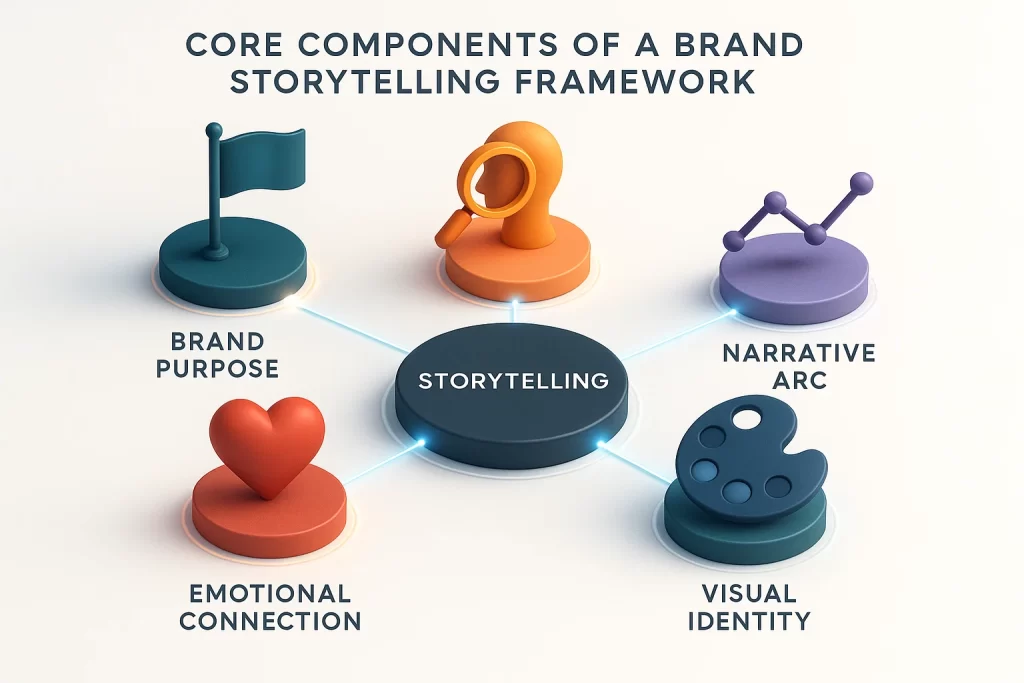
Narrative Structure and Story Arc
A story isn’t a slogan—it’s a sequence. Every compelling brand narrative follows a structure:
- Beginning (The Set-up): Introduce the customer’s world and pain point.
- Middle (The Conflict): Show the challenge or disruption your brand helps overcome.
- End (The Resolution): Reveal the transformation enabled by your product or purpose.
This structure mimics the monomyth or Hero’s Journey, used by legends like Disney and Apple.
Solving Key Challenges: Brands often get stuck in “features” and skip emotional conflict or transformation, making stories feel shallow.
Emotional Hook and Consumer Resonance
Emotion is not decoration—it’s the delivery system for memory and behavior.
- Science-backed insight: According to a Nielsen study, ads with above-average emotional response from consumers cause a 23% increase in sales compared to average ads.
- Execution example: Patagonia embeds emotion in its climate activism, while Dove sparks body image reflection. These emotions drive loyalty.
“People don’t buy what you do; they buy why you do it.” – Simon Sinek
Translating Framework into Execution
While storytelling frameworks define the what, execution determines the how, where, and when. This section walks through the tactical transformation of storytelling strategy into real-world marketing assets—integrated across teams, tools, and timelines.
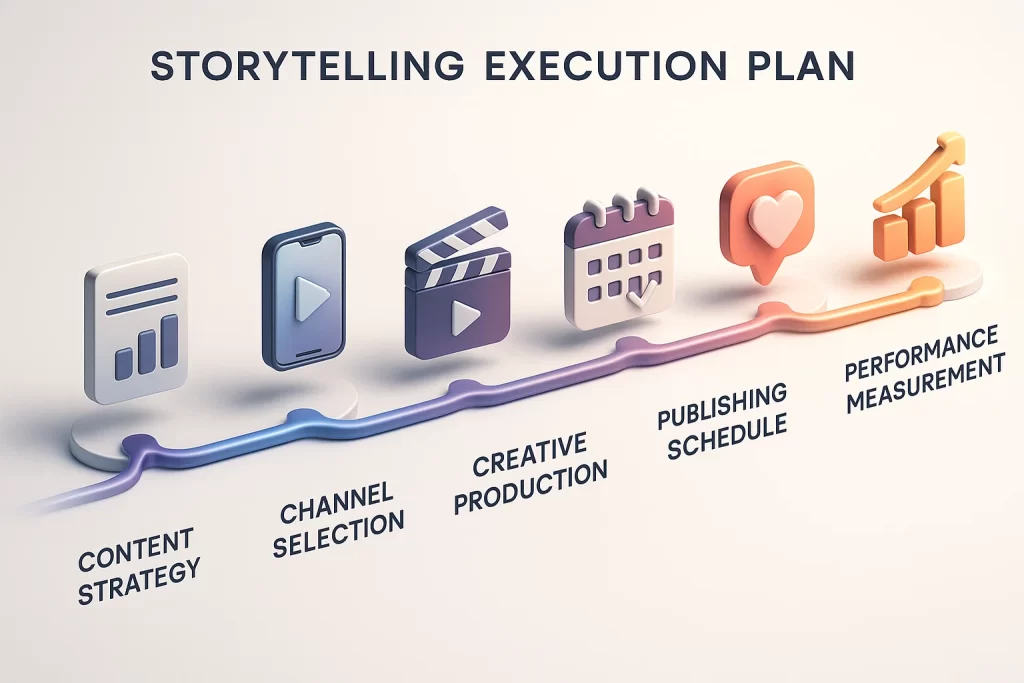
Operational Execution Plan
Execution starts with a documented, shared plan—often called a storytelling playbook. This document connects strategy to action by defining how stories are developed, reviewed, launched, and measured.
Key components of a storytelling execution plan
- Narrative Templates: Reusable structures (e.g., before-after-impact) that guide campaign storylines.
- Team Roles: Who owns the narrative (creative lead, copywriter, product marketer).
- Cadence & Timing: How often storytelling content is published and refreshed.
- Asset Types: Social media, email, product copy, landing pages, influencer collaborations.
Solving Key Challenges : Many teams produce “random acts of content” without centralized planning. This leads to diluted storytelling and inconsistent brand voice.
Expert Note
“Without operational governance, your storytelling will get hijacked by competing agendas or creative improvisation.”
— Content strategist Kristina Halvorson, author of Content Strategy for the Web
Cross-Channel Consistency (Digital, Social, Touchpoints)
Execution must be synchronized across all brand touchpoints—from your homepage to packaging, from TikTok to email sequences.
Best practices
- Use a centralized messaging matrix to define key messages by channel and audience.
- Train all content teams on brand voice and tone guidelines.
- Use AI-powered tools or DAM systems to maintain consistency in visuals and tone.
Example: Coca-Cola’s “Share a Coke” campaign told a story about personalization—but every execution (cans, billboards, digital ads, user-generated content) echoed the same core narrative.
Content Calendar & Campaign Structure
A storytelling content calendar maps the narrative across time and marketing objectives. Rather than publishing ad hoc, campaigns follow arcs:
- Phase 1 (Awareness): Introduce the story—problem, emotion, stakes.
- Phase 2 (Engagement): Develop tension—add conflict, proof, characters.
- Phase 3 (Conversion): Show resolution—outcome enabled by your brand.
Tactical Tip: Use thematic months or seasons to group storytelling campaigns. e.g., “March: Stories of Growth,” “July: Stories of Freedom”
“A campaign is a narrative sprint—its job is to land one chapter of the overall story.”
— HubSpot Academy
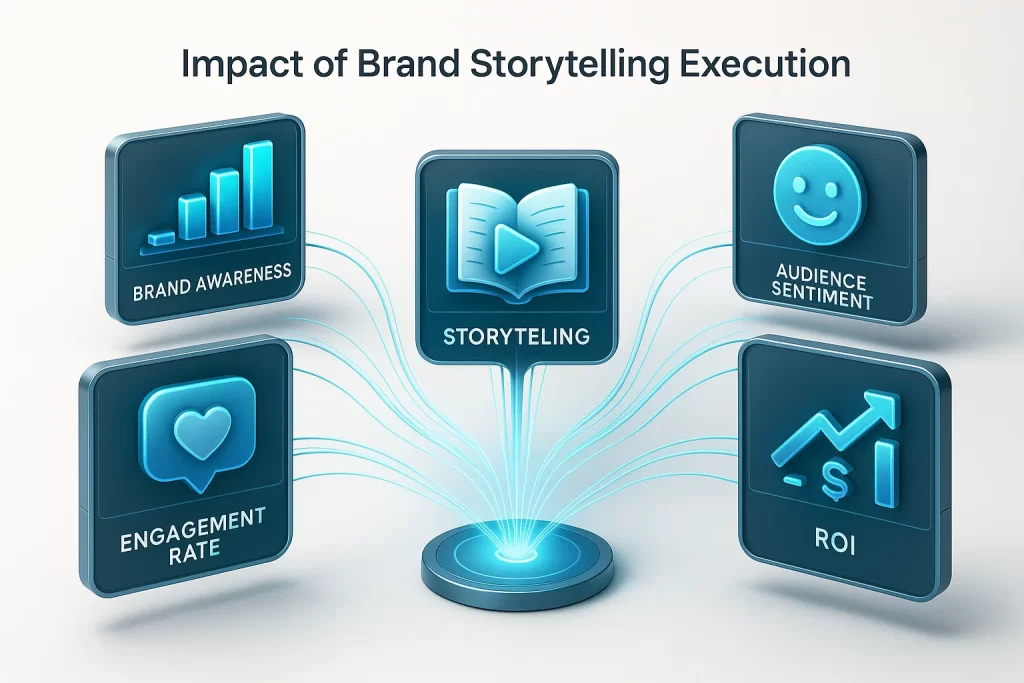
Measuring the Impact of Brand Storytelling Execution
Execution without measurement is performance without direction. To ensure storytelling drives results—not just engagement—brands must establish clear KPIs, track emotional resonance, and create a feedback loop to optimize storytelling in real time.
Key Metrics & KPIs
Not all success is measured in clicks. The right storytelling KPIs reflect both emotional engagement and behavioral outcomes.
Primary storytelling metrics
- Brand Recall: Surveys or awareness tests pre- and post-campaign.
- Engagement Rate: Shares, comments, time on page (vs. bounce rate).
- Brand Sentiment: Social listening tools (e.g., Brandwatch, Talkwalker).
- Narrative Reach: How far your story has traveled (earned media, UGC).
- Conversion from Story Exposure: Whether story-based content led to signups, purchases, etc.
Expert Insight
“You can’t manage what you don’t measure. Storytelling is no exception—it should be judged on emotional performance and business results.”
— Ann Handley, Chief Content Officer at MarketingProfs
Storytelling ROI and Analytics
Return on storytelling (RoS) isn’t just revenue—it’s impact over time. For example:
- A brand video might not convert immediately but lift brand affinity over months.
- A founder story shared on LinkedIn might boost recruitment quality—a different form of ROI.
Metrics to monitor
- Customer Lifetime Value (CLTV) changes after long-form story-driven content
- Churn reduction attributed to emotionally resonant onboarding
- Cost per acquisition (CPA) across storytelling vs. feature-based content
Feedback Loops for Iteration
Brands often assume the story ends once published—but in reality, it only begins.
Build a narrative feedback loop
- Monitor engagement signals. What do people feel, not just click?
- Use qualitative insights. Ask customers how stories made them feel in surveys or focus groups.
- Tweak the narrative in micro-campaigns. A/B test emotional tones, characters, conflict levels.
Real-World Case Example: Airbnb uses A/B testing to gauge which stories (hosts vs. guests) drive more listings or bookings in different regions.
Solving Key Challenges : Many teams keep using the same narrative without evaluating if it still resonates.
“We ran a story-driven series and engagement exploded. But our boss asked, ‘Did it sell?’—We had no idea how to answer.”
Real-World Case Studies & Examples
Theories are useful, but execution is proven in practice. In this section, we’ll analyze real-world storytelling campaigns from top global brands, uncover why they worked (or didn’t), and extract executional insights you can apply immediately.
Leading Brand Case Study 1: Nike’s “You Can’t Stop Us”
Overview
Nike’s “You Can’t Stop Us” video campaign masterfully interwove sports clips with a consistent narrative arc: adversity → perseverance → triumph. It used cinematic visual transitions and voiceovers to highlight unity and resilience.
Executional Brilliance
- Narrative Structure: The campaign had a clear beginning (athletes sidelined by crisis), middle (montage of struggle), and end (return and resolve).
- Emotional Hook: Evoked hope, inspiration, and shared humanity.
- Cross-Channel Consistency: The message was repurposed across social media, stores, packaging, and even Nike apps.
Results
- Over 58 million YouTube views in 2 weeks
- Brand favorability up 7% in post-campaign surveys
“Nike reminds us that great storytelling isn’t about product, but purpose.” – Marketing Dive
Leading Brand Case Study 2: Airbnb’s Host Stories
Overview
Airbnb launched a multi-part storytelling series featuring hosts from around the world. These weren’t just testimonials—they were personal stories of transformation.
Execution Tactics
- Localized Storytelling: Each story was shot and edited with regional cultural nuances.
- Emotional Core: Many stories focused on empowerment (e.g., single mothers becoming financially independent).
- Strategic Timing: Released alongside major travel seasons for emotional and practical relevance.
Impact
- 2.3x increase in listings in featured regions
- Boosted trust in Airbnb’s host community during a period of regulatory pressure
Solving Key Challenges : Most user stories are generic—Airbnb made theirs cinematic, human, and powerful.
Lessons from Execution Gaps: Pepsi’s Kendall Jenner Ad
Overview
Pepsi attempted to align with social justice narratives in a now-infamous ad featuring Kendall Jenner.
Why It Failed
- Lack of Authenticity: The brand co-opted a real, emotionally charged issue without prior equity or credibility in the space.
- No Narrative Arc: The ad lacked depth—conflict resolution was oversimplified and trivialized.
- Disconnected Execution: Execution felt more like an ad than a story.
Result: The ad was pulled within 48 hours after massive public backlash.
“It felt like Pepsi thought they could hijack a movement for likes. Instant disconnect.”
Common Challenges & How to Overcome Them
Even with a solid strategy and framework, brand storytelling execution can falter. From team silos to evolving narratives, this section explores the most common execution pitfalls—and how to fix them with systems, mindset shifts, and scalable processes.
Internal Misalignment Across Teams
Challenge
Marketing has the story. Sales has a pitch deck. Customer support follows a script. Each function often operates with its own voice, tone, and message hierarchy—creating brand fragmentation.
Why it hurts
Inconsistent execution confuses consumers and erodes trust. A strong story loses impact if told differently at every touchpoint.
Solutions
- Create a “Brand Narrative Guidebook” that includes tone, messaging pillars, proof points, and emotional language cues.
- Train cross-functional teams (sales, ops, CX) on the storytelling framework.
- Appoint a Story Steward (internal role) to audit and align all storytelling content.
Expert Quote
“Storytelling isn’t a marketing function—it’s a business function.” — Bernadette Jiwa, brand strategist and author of Story Driven
Keeping the Story Fresh Without Losing Cohesion
Challenge
Brands evolve. So do customer expectations. But refreshing the story too often—or too radically—can confuse your audience or break emotional continuity.
Why it happens
- Leadership turnover changes tone.
- Creative teams push for novelty over coherence.
- Seasonal campaigns stray from core narrative.
Solutions
- Develop story arcs that evolve over time without changing core themes. e.g., Spotify’s “Wrapped” series evolves each year but centers on personalization and user celebration.
- Use a “rolling refresh” model—adapt characters, visuals, or conflict while retaining purpose and voice.
Solving Key Challenges : Avoiding message dilution while scaling over time.
Resource Constraints and Scaling Execution
Challenge
Smaller brands or startups often lack the bandwidth or budget to produce high-volume storytelling content.
Result: Strategy exists, but execution lags or relies too heavily on templated, impersonal messaging.
Solutions
- Repurpose and atomize: Turn one customer story into a blog post, short-form video, email drip, and carousel ad.
- Use generative AI to draft content within the narrative guardrails—then humanize it before publishing.
- Build a narrative system—a library of hooks, arcs, and metaphors—to reduce creative cycles.
“We have one marketer doing everything. We need to tell better stories but we’re strapped for time.”
FAQ
1. How do I keep our brand story consistent across channels like email, social media, and packaging?
Consistency starts with codification. Your brand story must live in a shared document—often called a narrative framework—which includes your origin, mission, values, character voice, and tone. This framework should be referenced across:
- Social content calendars
- Email copy templates
- Product descriptions
- Internal briefs for freelancers and agencies
Use brand storytelling execution tools like a content matrix or digital asset management (DAM) system to track versions and approvals.
“We use Trello for storytelling approval flows. It saved us from five people rewriting the same post in different voices.” – r/marketingops
2. Why do storytelling campaigns sometimes feel forced or inauthentic?
This happens when the story doesn’t reflect real experiences or emotions. It often comes from:
- Using fictional stories that feel artificial
- Over-scripting influencer or user-generated content
- Jumping on social trends without internal alignment
The solution? Root your narrative in truth. Real customer stories. Real founder struggles. Real cultural insights. Then elevate with emotion, not fiction.
3. What’s a simple storytelling framework I can apply right away?
A practical beginner framework is “Before-After-Bridge”:
- Before: The customer’s world before your product/service
- After: Their life after using your solution
- Bridge: How your brand made the difference
This model works across emails, landing pages, videos, and presentations.
Example:
Before: Booking travel was stressful
After: Our app makes it joyful
Bridge: Here’s how we redesigned the entire experience around ease and emotion
4. How do I measure if my brand story is actually working?
Key indicators of effective storytelling include:
- Higher brand recall in surveys
- Positive sentiment in social listening
- Increased UGC (user-generated content) that echoes your narrative
- Decreased bounce rate on story-led pages
- Higher engagement time on narrative emails or blog posts
If customers are retelling your story in their own words—you’ve won.
“We tracked which email stories got the most replies. Turns out one personal founder story drove 80% of responses that quarter.” – r/emailmarketing
5. Can I still use storytelling in B2B or technical industries?
Absolutely. In fact, storytelling builds trust in high-stakes, complex industries. The key is to translate features into narratives:
- Use case stories
- Founder “aha moments”
- Customer success narratives
- Problem → Process → Solution journeys
Technical audiences crave clarity—but they also connect through emotion and narrative flow.
Conclusion
Brand storytelling execution isn’t just a creative flourish—it’s a competitive advantage. Brands that operationalize their story across platforms, teams, and time build deeper emotional connections, higher loyalty, and stronger market presence. From crafting clear narrative frameworks to measuring emotional performance, this article has broken down the systems and strategies required to turn abstract storytelling into real business impact.
You’ve learned:
- Why execution is as vital as strategy
- How to build and structure a brand storytelling framework
- Tactics for aligning cross-functional teams
- Real-world case studies of successful (and failed) storytelling
- Metrics and methods to measure ROI and iterate
Whether you’re a startup with one marketer or a global brand scaling across continents, the core principle remains: stories drive behavior—but only if they’re executed with clarity, consistency, and emotional intent.
The journey from narrative strategy to campaign success is long—but with the right execution, your story can move hearts, change minds, and grow your brand.