
Tapping into Brand Emotional Hooks to Drive Deeper Connections
Introduction
Emotional branding is not a new trend—it is the foundational mechanism by which brands embed themselves into the hearts and minds of their audiences. While traditional marketing often emphasizes product features or logical benefits, behavioral science and consumer psychology suggest that brand loyalty is rarely forged in the rational mind. Instead, it is the emotional brain—fast, intuitive, and feeling-driven—that anchors us to certain brands over others.
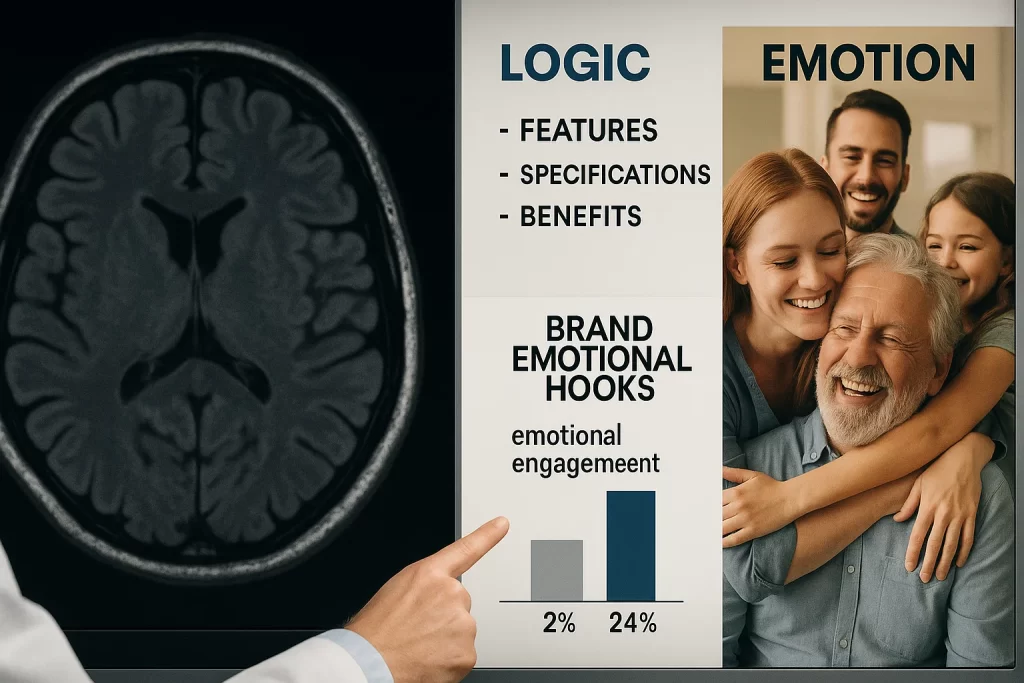
A groundbreaking study by Harvard Business School found that 95% of purchasing decisions happen in the subconscious mind, which is governed largely by emotion. When consumers are asked why they bought a product, they often rationalize with logic—but the real decision was already made by the limbic system, the brain’s emotional core. This aligns with Daniel Kahneman’s dual-system theory from Thinking, Fast and Slow, which distinguishes between System 1 (emotional, instinctive) and System 2 (rational, deliberate). Emotional branding appeals directly to System 1.
This science isn’t theoretical anymore. Nielsen’s neuroscience division has consistently found that ads with above-average emotional response from consumers cause a 23% lift in sales. Emotional resonance isn’t soft—it’s measurable, profitable, and deeply strategic.
Any effective brand strategy must recognize the primacy of emotion—not just in messaging but across every consumer touchpoint. When emotional insight is embedded into brand execution, it transforms a logo into a movement and a tagline into a belief system. Emotional branding is not just about feelings; it’s about deliberate, evidence-backed execution that elevates brands above commodity status.
This article will unpack the psychological frameworks and real-world techniques top brands use to cultivate emotional connections. From Apple’s aura of innovation and simplicity, to Nike’s archetypal storytelling of human triumph, emotional branding is the engine that drives enduring brand preference.
We’ll break down the mechanisms behind this phenomenon: the emotional triggers, the storytelling blueprints, the neurological patterns, and most importantly, how you can apply them without appearing manipulative or disingenuous—a major fear among modern marketers. Whether you’re a startup trying to stand out or an established company battling to stay relevant, understanding the science of brand emotion is no longer optional—it’s essential.
The Psychology Behind Emotional Branding
To understand emotional branding, marketers must first grasp how the human brain processes decisions—and more importantly, how it processes feelings. At its core, emotional branding connects products and services to feelings, memories, and subconscious values rather than features or logic. It’s this emotional resonance that builds long-lasting brand trust and advocacy.
Psychologist Daniel Kahneman, in his Nobel-winning work Thinking, Fast and Slow, explains that humans operate under two systems of thinking:
- System 1: fast, intuitive, emotional
- System 2: slow, logical, effortful
Most branding operates in System 1. A consumer walking down a grocery aisle doesn’t pause to evaluate every brand rationally. Instead, the brain makes snap judgments based on emotional associations built over time. This is why brand storytelling matters—it implants emotions that the brain can instantly retrieve in micro-moments of decision.
Scientific Proofs of Emotional Influence
A Harvard study found that people rely on emotion over logic when making brand choices, especially in saturated markets. When emotional engagement is high, brand recall improves by 3×, and purchase intent increases by 2×. This is not merely persuasive copywriting—it’s cognitive bias in action.
According to a Nielsen neuroscience study, content that evokes emotion generates a 23% lift in sales, outperforming purely rational messaging. In short: brands that make people feel, win.
Emotional Responses Shape Brand Perception
Our brains are hardwired to seek emotional significance in experiences. From early childhood, we attach feelings to stories, colors, sounds, and faces. When brands emulate this—through emotional triggers like nostalgia, surprise, or belonging—they are stored not just in memory but in identity.
When a brand evokes an emotional response:
- It increases attention and encoding (we remember it more vividly).
- It creates emotional associations that shape brand perception.
- It shortens the time to decision, which is crucial in high-speed digital environments.
This psychological blueprint is the hidden lever of great brand strategy. Without emotional alignment, even the best product fails to stick. Effective brand execution weaves emotional consistency into every consumer touchpoint—website, ads, packaging, in-store experiences, and customer service.
“But Isn’t That Manipulative?”
This is a common fear among marketers—particularly those in purpose-driven or ethical sectors. But emotional branding isn’t about trickery. It’s about understanding how humans actually make decisions and delivering messages that align with their deeper needs and values.
When done right, it cultivates brand empathy—an emotional connection based on mutual understanding, not exploitation. Emotion is not the enemy of ethics; it’s the path to deeper, more human brand communication.
Core Emotional Triggers Brands Use
Every successful brand taps into a small set of core emotional triggers—psychological levers that shape how we respond, engage, and ultimately decide. These aren’t random feelings; they’re predictable, repeatable patterns rooted in consumer psychology and affective neuroscience.
In emotional branding, the most commonly used emotional triggers include:
1. Belonging
Humans are social animals. Brands like Apple and Harley-Davidson don’t just sell tech or bikes—they sell identity. Owning their products places customers within a tribe, a lifestyle, a culture.
“I didn’t just buy a Mac. I joined a club that gets it.” — Reddit user
2. Aspiration & Pride
Nike excels here. Its “Just Do It” mantra evokes not just athleticism, but a sense of inner greatness. It activates self-worth and achievement. Pride, when authentically triggered, can build intense brand loyalty.
3. Nostalgia
This emotional shortcut connects people with childhood, family, or “simpler times.” Brands like Coca‑Cola and Disney use nostalgia to build trust and comfort.
Visuals—vintage packaging, retro jingles, or family holiday scenes—cue emotional memory instantly.
4. Fear & Security
Used carefully, fear can be powerful. Think life insurance ads, home security systems, or anti-smoking campaigns. But fear must always be paired with a path to safety—this is where brand trust becomes essential.
5. Happiness & Joy
Universally appealing and shareable, joy fuels viral success. Brands like M&M’s or Old Spice use absurd humor, while others like Airbnb use sentimental joy rooted in family and travel. Joy is effective in industries from FMCG to tech when it’s authentic and contextually relevant.
6. Surprise
Surprise creates memorability. A twist in storytelling, a humorous visual, or a shock moment in a video ad sparks emotional reaction. Brands like Dollar Shave Club and Snickers often use humor to trigger this.
Why Emotional Triggers Work: The Neurological Mechanism
When an ad or brand message activates an emotional trigger:
- The amygdala (emotion center) fires up
- Emotional memory encoding becomes stronger
- Dopamine (pleasure) or cortisol (fear) floods the system
- The message moves from short-term processing to long-term brand attachment
These reactions explain why brands with emotional resonance outperform those relying on features or price. Emotions create stickiness—logical selling points rarely do.
Strategic Tip: Choose Your Primary Emotional Trigger
Marketers often scatter emotional cues across campaigns. This weakens their impact. Instead:
- Identify your brand’s dominant emotion (e.g., joy, confidence, belonging)
- Audit your content, visuals, and copy for alignment
- Repeat that emotional tone across touchpoints (ads, UX, packaging, social)
For instance, Dove’s “Real Beauty” campaign focuses relentlessly on self-esteem and authenticity. Every ad, story, and visual reinforces that emotional cue.
“Which Trigger Should I Use?”
It’s not one-size-fits-all. The right emotional trigger depends on:
- Your audience’s unmet emotional need
- Your brand purpose
- Your product category
- Your cultural context
Example: A fintech app targeting Gen Z might activate freedom + trust, while a luxury skincare brand might lead with aspiration + self-worth.
Use qualitative research, social listening, and A/B testing to validate your chosen trigger.
Frameworks for Emotional Storytelling
While emotion may feel intuitive, the most compelling brand storytelling follows deliberate, psychology-backed frameworks. These aren’t just “nice narratives”—they’re engineered systems that align emotion with action. Without structure, even the most emotive messaging becomes noise. Effective brand strategy integrates these storytelling models into everything from advertising to UX copy.
Let’s explore the most impactful emotional storytelling frameworks used by iconic brands and backed by behavioral science.
1. Marc Gobé’s Emotional Branding Framework
In his seminal book Emotional Branding, Marc Gobé introduced a five-dimensional model that redefines how brands create emotional resonance:
| Dimension | Emotional Objective |
| Relationship | From product → to person |
| Experience | From function → to feel |
| Imagination | From information → to story |
| Sensation | From identity → to sensory cues |
| Vision | From honesty → to trust |
This framework elevates branding from communication to connection. When executed well, it transforms a product into a living emotional experience.
Example: Apple doesn’t just market devices—it crafts an identity. Sleek design, minimal packaging, clean stores, empowering ads—they all align under Gobé’s emotional vision.
2. Brand Archetypes: The Psychology of Myth
First introduced by Carl Jung and adapted for branding by Margaret Mark & Carol S. Pearson in The Hero and the Outlaw, the 12 brand archetypes represent recurring personalities in human storytelling. These archetypes unlock instant emotional recognition.
Here are a few of the most commonly used:
| Archetype | Emotion Activated | Brand Examples |
| Hero | Aspiration, courage | Nike, FedEx |
| Caregiver | Compassion, trust | Dove, Johnson & Johnson |
| Explorer | Freedom, self-discovery | Jeep, REI |
| Innocent | Simplicity, joy | Coca-Cola, McDonald’s |
| Rebel | Liberation, empowerment | Harley-Davidson, Diesel |
A well-chosen archetype gives your brand an emotional blueprint. It informs voice, visuals, tone, and storytelling across all campaigns. More importantly, it shapes how audiences emotionally relate to your brand.
3. The Hero’s Journey (Campbell’s Monomyth)
Derived from Joseph Campbell’s myth structure, the Hero’s Journey has 12 stages but often condensed into 3 key acts for brand storytelling:
- Challenge Introduced
(Customer faces a problem—e.g., self-doubt, injustice, obstacles) - Transformation Begins
(Brand offers the tool, belief, or transformation to overcome it) - Resolution Achieved
(Customer becomes the hero—not the brand)
Example: Always’ “Like a Girl” campaign reframes a derogatory phrase, guiding young women from shame to empowerment. The viewer, not the brand, is the hero.
The Science Behind Storytelling
Stories activate neural coupling, syncing the storyteller’s and listener’s brain. Research shows stories:
- Boost memory retention by 22x
- Increase empathy and engagement
- Trigger oxytocin, the “trust hormone”
This is why emotional storytelling outperforms product-led content in nearly every category—emotions are encoded deeper than facts.
“How Do I Choose the Right Framework?”
Here’s a guide based on brand maturity and emotional goals:
| If you want to… | Use this framework |
| Build a lifestyle brand | Brand Archetypes |
| Shift from product to experience | Marc Gobé Model |
| Launch a viral, cinematic ad | Hero’s Journey |
| Define emotional voice across channels | Archetypes + Gobé blend |
And remember: Your brand execution must reflect the framework at every level—tone, visuals, UX, and even customer support.

Case Studies: Emotional Advertising That Worked
To understand the brand strategy behind emotional resonance, one must examine the real-world executions of emotional branding at scale. The most impactful campaigns don’t just sell products—they sell belonging, inspiration, pride, or trust. Below are iconic case studies where emotional storytelling transformed brands into emotional experiences.
1. Apple: Belonging Through Simplicity and Identity
Apple’s legendary “Think Different” campaign didn’t tout specs—it celebrated misfits, rebels, and visionaries. This campaign built emotional connection through:
- Belonging: It told customers, “You’re not just using a computer—you’re part of a creative movement.”
- Aesthetic emotion: Sleek, minimalist visuals evoked clarity, simplicity, and power.
- Archetype: Apple embodies the Explorer and Creator, tapping into emotions of innovation and individualism.
Apple’s success lies in embedding emotional cues across all touchpoints—packaging, store design, product UI, and tone of voice. The brand isn’t just bought; it’s felt.
2. Nike: The Hero’s Journey in Athletic Form
Nike’s “Find Your Greatness” and “You Can’t Stop Us” campaigns exemplify the Hero’s Journey structure:
- Challenge: Facing limits, societal barriers, personal doubts.
- Transformation: Nike isn’t the hero—it’s the guide.
- Resolution: The consumer overcomes, prevails, evolves.
By consistently evoking aspiration, grit, and pride, Nike transforms performance gear into emotional armor. It activates a deep-seated identity: “I’m a fighter. I push through. I am more than enough.”
Nielsen found that Nike’s emotionally driven ads generated a 28% higher engagement rate than competitor performance-led ads.
3. Dove: Empowerment Through the Caregiver Archetype
Dove’s “Real Beauty” campaign is a masterclass in emotional branding rooted in:
- Authenticity and compassion
- Visual vulnerability: Everyday women, minimal makeup, raw emotion
- Emotional triggers: Self-esteem, societal pressure, acceptance
Using the Caregiver archetype, Dove created emotional safety and advocacy for women. This sparked:
- 700% increase in positive brand sentiment
- +20% brand trust increase in global markets
Emotional branding here wasn’t just creative—it redefined industry standards.
4. Google: Emotion Through Moments, Not Features
Google’s “Parisian Love” ad told the story of a romance via search queries. There was no product demo, no narration—just search inputs and emotional inference.
What worked:
- Nostalgia and yearning were layered into simple UX.
- The emotional narrative was universal, despite no faces or dialogue.
- Viewers reported crying at a search engine ad. That’s emotional resonance in its purest form.
5. Airbnb: Belonging is the Product
Airbnb’s brand isn’t travel—it’s human connection. Their emotional hook: “You belong anywhere.” In campaigns like “Don’t Go There. Live There,” the company emphasized:
- Cultural immersion over tourism
- Local empathy over amenities
- A visual tone that evoked warmth, intimacy, and spontaneity
This created an emotional identity for the brand: less hotel, more soulful host.
Strategic Insight: Emotional Consistency Wins
Across all five brands, successful emotional branding shared these traits:
- Clear emotional focus (not scattershot)
- Consistent storytelling across platforms
- Alignment between emotional hook and product experience
Without consistency, emotional branding appears manipulative. But when emotion flows from brand purpose to execution, it becomes powerful.
“We’re a Small Brand. Can We Do This?”
Absolutely. You don’t need a Super Bowl budget to tell emotional stories:
- Use customer testimonials with emotional arcs
- Show behind-the-scenes brand moments
- Celebrate community, not just product
A small vegan bakery that shares a video of a family birthday cake creating tears of joy? That’s emotional branding at work.
How to Develop Your Brand’s Emotional Hook
Emotional branding isn’t reserved for billion-dollar companies—it’s a repeatable brand strategy any business can master. Developing your own emotional hook is about aligning authentic human emotion with your brand’s core values and purpose. It requires structured brand execution, psychological insight, and storytelling discipline.
Here’s a step-by-step method to build an emotional branding system that actually resonates.
Step 1: Audit Your Brand’s Emotional DNA
Before launching campaigns, you must uncover the emotional subtext already embedded in your brand. Ask:
- What emotions do people feel when they encounter your brand today?
- What feelings do you want them to feel?
- Where are the emotional disconnects?
Tools to use:
- Brand sentiment analysis (social listening)
- Qualitative interviews
- NPS and open-ended survey responses
Example: A tech startup might intend to evoke empowerment, but customers perceive complexity and frustration. That gap must be addressed before scaling emotional storytelling.
Step 2: Identify Your Audience’s Emotional Needs
Consumers buy products, but they stay for emotions. Use empathy mapping to explore:
- What does your audience fear?
- What do they aspire to?
- What stories do they tell themselves?
Use tools like:
- Jobs to Be Done (JTBD) interviews
- Buyer persona workshops
- Emotion-based segmentation
Step 3: Define Your Primary Emotional Trigger
From the earlier section, choose ONE dominant emotional trigger aligned with your brand archetype. For example:
- Belonging (community-focused SaaS)
- Aspiration (premium fitness apparel)
- Security (legal or fintech brand)
- Nostalgia (DTC toys or foods)
This emotional trigger becomes your guiding light across campaigns.
Step 4: Build an Emotional Storytelling Brief
Create a brand storytelling template centered around emotion. Include:
- Your brand archetype
- Emotional trigger
- Brand voice (e.g., inspiring, nurturing, rebellious)
- Key story elements (e.g., conflict, transformation, reward)
Example for a brand selling ergonomic chairs:
- Archetype: Caregiver
- Trigger: Relief, Safety
- Voice: Warm, expert
- Story Hook: “You take care of others all day. Let us take care of your back.”
Step 5: Execute Emotionally Across Touchpoints
Your emotional hook must cascade through every consumer-facing interaction:
- Website copy: Use sensory language and emotion-first CTAs
- Visual design: Use color theory (e.g., blue for trust, yellow for happiness)
- Product packaging: Tell a micro-story the second they touch it
- Customer service scripts: Reflect your emotional voice
This is where many brands fail—misalignment between emotional strategy and brand execution leads to confusion or distrust.
Step 6: Test and Iterate
Use both qualitative and quantitative metrics:
- Emotion-based A/B testing in ads (e.g., joy vs. nostalgia)
- Emotional feedback surveys (“How did this make you feel?”)
- Heatmaps and user recordings to gauge emotional reactions
Tools like Nielsen’s consumer neuroscience platform, or Realeyes emotion tracking can give deeper biometric insights—especially for video.
“How Do I Stay Authentic and Not Manipulative?”
Great question. Emotional branding can backfire if it feels exploitative or fake. Here’s how to stay grounded:
- Anchor all emotional messaging in real consumer insights
- Be transparent—don’t fake stories or data
- Prioritize empathy over persuasion

Metrics and Measuring Emotional Branding ROI
Measuring the effectiveness of emotional branding is both an art and a science. While emotions are inherently subjective, advancements in consumer psychology, neuroscience, and analytics now allow marketers to track emotional resonance with surprising precision. ROI is no longer just about clicks or conversions—it’s about brand attachment, emotional memory, and long-term loyalty.
A successful brand strategy doesn’t just ask: “Did people buy?”—it asks: “Did people feel?”
Quantitative Metrics: Making Emotions Measurable
Here are key performance indicators (KPIs) that align with emotional branding success:
1. Emotional Engagement Rate
- Captures how emotionally charged your content is via shares, comments, dwell time, and reaction buttons
- Nielsen reports show content with high emotional resonance drives 23% higher sales lift on average.
2. Brand Recall & Recognition
- Emotion strengthens memory encoding.
- Surveys conducted a week after campaign exposure can measure unaided brand recall (critical for long-term success).
3. Net Promoter Score (NPS) with an Emotional Layer
- Instead of just asking “How likely are you to recommend?”, ask:
- “How did [brand] make you feel?”
- “What emotion comes to mind when you think of [brand]?”
4. Customer Lifetime Value (CLV)
- Emotionally connected customers are twice as valuable as highly satisfied ones, according to the Harvard Business Review.
- Use CLV to assess how emotional loyalty affects repurchase rates, referrals, and retention.
Qualitative Tools: Understanding the “Why”
Quant metrics tell you what’s happening; qualitative methods tell you why. Here are essential tools for decoding brand emotion:
1. Open-ended Feedback Analysis
- Use natural language processing (NLP) or manual review to analyze emotional tone in reviews, support chats, and exit surveys.
2. Emotion-First Focus Groups
- Prompt with “How did that make you feel?” not “What did you think?”
- Great for assessing packaging, storytelling, and UX flows.
3. Facial Coding & Eye Tracking
- Tools like Affectiva and Realeyes analyze micro-expressions and pupil dilation during ad exposure.
- Reveals true reactions beyond self-reporting.
4. Biometric Testing (Advanced)
- EEG headsets and galvanic skin response measure subconscious emotional activity.
- Mostly used in large-scale brand execution testing (TV ads, video, VR experiences).
Visualizing Emotional ROI
Combine data from both approaches to create an Emotional Impact Dashboard
| Metric | Description | Target |
| Emotional Engagement Rate | Shares, reactions, dwell time | 15–25% above baseline |
| Emotion-Word Density | Frequency of emotional language in feedback | Track shifts over time |
| CLV Delta | Difference between emotionally connected and average customer | 1.5x–2x lift |
This dashboard helps CMOs justify emotional branding efforts to stakeholders who demand numbers—not just narratives.
“How Do I Prove This to Skeptical Execs?”
Executives often ask for performance data before approving emotional campaigns. Here’s how to build your case:
- Run A/B tests comparing emotion-driven content with feature-driven content
- Show NPS lifts, longer dwell time, or higher shares
- Use case studies from earlier section (Nike, Dove, Google) to show precedent
Common Missteps & Ethical Concerns
While emotional branding can unlock unmatched connection and brand loyalty, it walks a fine ethical line. Brands that misuse emotional tactics risk alienating audiences, damaging trust, or being seen as manipulative—a core fear among marketers.
Understanding the common pitfalls—and how to avoid them—is essential to building a brand rooted in empathy, not exploitation.
1. Overusing Negative Emotions (Fear, Sadness, Guilt)
While emotions like fear can drive urgency, over-reliance on them creates fatigue or discomfort. Campaigns drenched in negativity may provoke momentary reactions—but not sustained trust.
Example Gone Wrong: Some insurance brands use fear-heavy visuals (car crashes, illness, crime) that cause anxiety rather than action.
Fix: Pair negative triggers with empowering solutions. Fear should always be followed by hope, clarity, or control.
2. Inauthentic Emotional Storytelling
Today’s consumers are savvier than ever. They can spot forced emotion or token representation in a heartbeat. Brands that insert emotional tropes without sincerity risk backlash.
Example: A fashion brand promoting body positivity but failing to reflect diverse sizing in its product line is a classic disconnect between message and brand execution.
Fix: Align emotional messaging with internal operations, culture, and customer experience. Live your values beyond the ad.
3. Cultural Blind Spots in Emotional Messaging
Emotion is universal, but its expression is cultural. A campaign that evokes joy in one country might evoke discomfort or offense in another.
Example: A U.S. campaign using bold self-praise may feel empowering—but could feel arrogant in more collectivist cultures like Japan.
Fix: Localize emotional triggers. Use regional research and local storytellers to craft messages that resonate respectfully.
4. Emotion Without Substance
Emotion grabs attention—but without value delivery, it fizzles. A tearjerker ad might go viral but drive no business if it’s disconnected from your actual offer.
Example: A tech company runs a beautiful cinematic brand film—but the product UX is clunky and uninspiring. Emotional disconnect = broken trust.
Fix: Emotional hooks must flow into product experience, UX, and service. Emotions spark the journey—value cements it.
5. Forgetting the Follow-Through
One viral emotional campaign is not a strategy. Emotional branding requires consistent execution over time. A powerful story followed by months of silence resets emotional memory.
Fix: Sustain your emotional voice across:
- Email journeys
- Social content
- Packaging
- Support touchpoints
This is the difference between a campaign and a brand identity.
“How Do We Avoid Being Manipulative?”
Here’s how to stay grounded:
- Use emotion as a bridge, not a trap.
- Be transparent—don’t overpromise emotionally what you can’t deliver functionally.
- If you stir emotions, create pathways for support, action, or transformation.
Emotional branding isn’t about hijacking feelings—it’s about reflecting them back in meaningful ways.
Crafting the Long-Term Emotional Brand Strategy
Short-term emotional campaigns can capture attention. But long-term emotional branding builds movements. It transforms customers into loyalists and brands into belief systems. For marketers, this requires embedding emotional intelligence into the foundation of your brand strategy—from identity and voice to brand execution, community-building, and culture.
Here’s how to future-proof your emotional brand presence.
1. Integrate Emotion into Your Brand Identity
Your emotional hook should influence not just your campaigns, but your core brand DNA:
- Logo and design language: Color psychology matters (e.g., blue = trust, red = urgency, purple = premium).
- Voice and tone: A caregiver brand might sound nurturing, while a rebel brand should sound bold and provocative.
- Taglines and slogans: Should reinforce the dominant emotion (e.g., Airbnb’s “Belong Anywhere”).
Example: Patagonia’s identity oozes environmental compassion and activist energy. Every visual, word, and product choice is rooted in that emotional stance.
2. Create Emotional Consistency Across Channels
Customers don’t interact with your brand in silos—they see you on Instagram, email, packaging, and customer service. Each of these must reflect the same emotional tone.
Consistency builds emotional memory and brand perception.
Checklist for Channel Alignment:
- Does your customer service reflect your emotional tone?
- Is your social content triggering the same feeling as your ads?
- Is your UX aligned with your emotional values (e.g., calm, energetic, empowering)?
3. Foster Community Through Emotional Themes
Today’s strongest brands create emotional ecosystems, not just audiences. Community activates feelings of belonging, meaning, and advocacy.
Strategies:
- Feature user-generated content that tells emotional stories
- Host emotionally resonant events (e.g., community cleanup for a sustainability brand)
- Use emotional rituals (e.g., welcome videos, anniversary notes, thank-you cards)
Example: Lululemon creates belonging not just through gear, but yoga classes, reflective campaigns, and local ambassador programs.
4. Internalize Emotional Branding Into Company Culture
Your team must live the emotional values you market. Otherwise, dissonance will show up in every customer interaction.
- Train staff on emotional communication
- Hire based on emotional intelligence (EQ)
- Create rituals that reinforce emotional purpose
Example: Zappos bakes “delivering happiness” into internal team rewards, onboarding, and customer support scripts—translating into legendary service.
5. Evolve Your Emotional Story Over Time
Just as consumers grow, so must your emotional story. Don’t cling to a fixed emotional narrative for too long. Brands that evolve stay relevant.
Tips:
- Refresh emotional tone based on cultural context (e.g., more empathy during global crises)
- Introduce secondary emotional triggers to deepen the story
- Let your audience shape the evolution through feedback and co-creation
FAQ
1. What is emotional branding? How does it differ from rational branding?
Emotional branding is the practice of building brand loyalty by connecting with consumers on a deep emotional level, rather than relying solely on logic, features, or price. While rational branding focuses on specifications—“Our battery lasts 12 hours”—emotional branding says, “With our phone, you’ll never miss your kid’s first words.”
According to Harvard research, 95% of purchase decisions happen subconsciously. Emotions are faster, stickier, and more persuasive than facts alone.
2. How can small brands compete using emotional branding?
You don’t need Super Bowl budgets to win with emotional branding. In fact, small brands often win because they can connect more intimately with their audience. Start by:
- Identifying one core emotional trigger (e.g., belonging, pride, nostalgia)
- Using real customer stories in your content
- Embedding emotional language in emails, packaging, and social media
3. What emotional triggers are most effective for brand loyalty?
The most effective emotional triggers depend on your audience, category, and brand strategy, but some consistently drive loyalty:
- Belonging: Community-focused brands (e.g., Lululemon)
- Nostalgia: Heritage brands (e.g., Coca-Cola)
- Pride: Achievement-oriented brands (e.g., Nike)
- Security: Financial or health brands (e.g., Allstate, Calm)
Loyalty forms when customers see your brand as an extension of their identity—not just a service provider.
4. Is emotional branding manipulative? How do we stay ethical?
Emotional branding is only manipulative when it’s inauthentic or misused. Ethical emotional branding:
- Reflects actual customer needs and values
- Is consistent across product, service, and message
- Never exploits fear, trauma, or pain without offering support or resolution
5. How do I measure emotional connection with my brand?
Measure both qualitative and quantitative signals:
- Track emotional language in reviews and surveys
- Use tools like Realeyes or Affectiva for facial/emotion analysis
- Run A/B tests between emotional and rational campaigns
- Monitor long-term loyalty metrics like NPS and Customer Lifetime Value
Platforms like Nielsen and Harvard Business Review offer insights into tracking emotional ROI.
Conclusion
In a world saturated with choice, emotional branding is what separates brands that are seen from those that are felt. Logic may capture attention, but emotion earns loyalty, advocacy, and love. From Marc Gobé’s emotional branding framework to Jungian brand archetypes and Nielsen-backed neuroscience, the evidence is overwhelming: humans are wired to remember—and reward—the brands that move them.
The brands that endure—Nike, Apple, Dove, Airbnb—don’t just tell stories. They awaken feelings. They don’t just sell products. They offer identity, belonging, aspiration, and hope.
But emotional branding isn’t a one-off campaign. It’s a long-term brand strategy and execution—anchored in empathy, consistency, and cultural relevance. It demands that you understand your audience better than they understand themselves, and that you reflect their values, struggles, and aspirations in every detail—from your product and packaging to your customer service and storytelling.