
Conducting a Brandscape Analysis: Competitive & Market Insights
Introduction
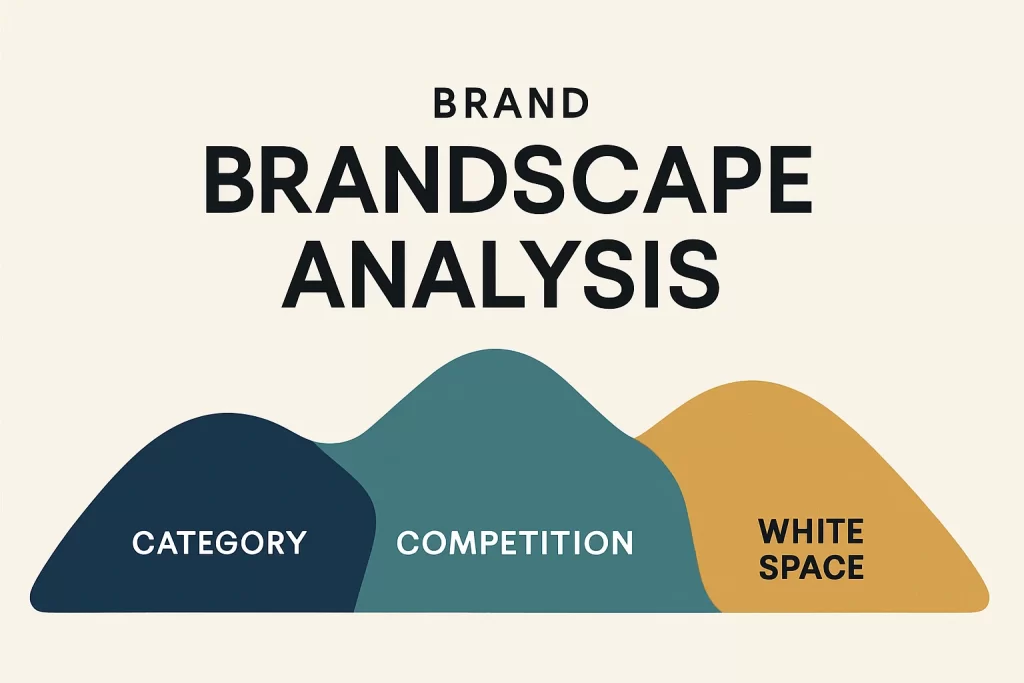
Brandscape analysis is evolving from a design-based curiosity into a strategic imperative. As markets become more saturated and consumer expectations more nuanced, brand leaders are recognizing the power of a well-constructed brandscape — not just as a visual collection of competitor logos, but as a diagnostic tool that reveals market gaps, positioning clarity, and messaging misalignments.
At its core, a brandscape analysis is a mapping of how different brands within a category are perceived, how they communicate, and how they position themselves emotionally and functionally. Unlike a basic visual brand audit, which might compare logos, colors, and fonts, a modern brandscape strategy goes deeper. It examines consumer perception, competitive whitespace, brand narrative, and strategic differentiation — all of which are critical for effective brand strategy and execution.
Recent studies by McKinsey show that companies aligning brand strategy with customer experience have a 20% higher revenue growth rate than their competitors. Meanwhile, insights from Harvard Business Review suggest that brand clutter has led to an increasing number of indistinguishable brand identities, especially in the tech and DTC space. These findings reinforce the importance of not just “standing out,” but standing for something — clearly, consistently, and credibly.
From startups unsure where they fit in, to large enterprises looking to reposition, the problem is often the same:
They don’t know where their brand stands in the competitive landscape.
A brandscape analysis answers that question by:
- Identifying how your brand positioning compares to competitors.
- Mapping your brand’s functional and emotional territory.
- Highlighting white space opportunities where your brand can thrive.
This article walks you through how to conduct a strategic brandscape analysis — from identifying competitors and collecting data, to visualizing emotional positioning and turning insights into strategy. You’ll discover frameworks, tools, and real-world examples that go far beyond “design inspiration,” helping you position your brand where it truly belongs.
Understanding the Brandscape: Beyond Logos and Color Palettes
When most marketers hear the term brandscape, they often picture a Pinterest board of logos, typography, and packaging — a curated visual collage of competing brands. While this kind of visual brand audit may serve a purpose in design discussions, it barely scratches the surface of what a true brandscape analysis should be.
In strategic terms, a brandscape is a cognitive map that illustrates how consumers perceive and categorize brands within a specific market. It includes not just aesthetics, but also messaging tone, functional value, emotional pull, and brand archetypes. The most successful brands occupy clear, defensible space in this perceptual ecosystem — and they do it on purpose.
Why Logos Aren’t Enough
As Harvard Business Review notes, the proliferation of minimalist logos and “blanding” in sectors like fintech and DTC has led to a sea of sameness. Brands like Casper, Away, and Glossier all adopt similar visual languages — soft hues, sans-serif fonts, clean packaging — making it difficult for consumers to differentiate unless they go deeper.
The problem isn’t aesthetic fatigue alone — it’s strategic blindness. When companies focus solely on how they look rather than how they fit into their market’s psychological and functional hierarchy, they risk blending into irrelevance.
The Four Layers of a Brandscape
A complete brandscape analysis includes:
- Visual Layer – Logos, colors, design language
(Often the only layer many audits cover) - Verbal Layer – Taglines, tone of voice, brand messaging
- Emotional Layer – Brand archetypes, associations, psychological triggers
(E.g., Nike as “The Hero”; Dove as “The Caregiver”) - Functional Layer – Core product benefits, performance, pricing model, innovation
Each of these layers influences how the consumer mentally categorizes your brand — and whether they remember it when making a decision.
Real-World Example
Let’s look at the tech productivity space:
- Notion leans into the “customizable workspace for thinkers” — minimal visuals, but deep messaging around modularity and control.
- Evernote projects stability and longevity, using more traditional branding.
- ClickUp positions itself as the “one app to replace them all,” visually aggressive with strong contrast and bold claims.
Each of these brands occupies a different strategic position in the same functional space — something that would be invisible if we were just comparing logos.
“Your brand isn’t your logo. It’s the space you hold in your customer’s mind,” says brand consultant Marty Neumeier in his book Zag.
Customer Challenges & Frustrations
This deeper understanding directly addresses a common fear:
“I feel like our branding is clean, but it’s not connecting. We look good, but sound like everyone else.”
Many small businesses and startups pour thousands into branding visuals — only to discover later that they lack emotional resonance or a unique position in the competitive field.
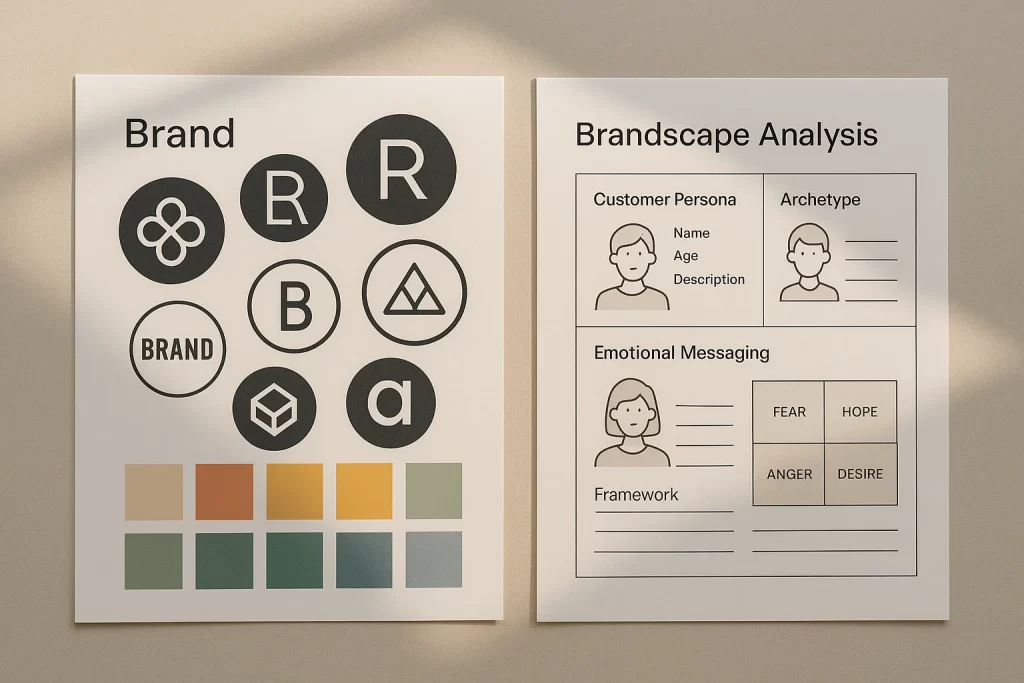
Understanding your brandscape means understanding where you live in the market’s mind, not just on its retina.
The Strategic Power of Brandscape Analysis
A well-executed brandscape analysis isn’t just a visual exercise — it’s a competitive strategy tool. While traditional marketing focuses on defining what a brand is, brandscape thinking centers on defining where a brand lives — in the hearts, minds, and habits of consumers, in relation to everything else.
In competitive markets, brands don’t exist in isolation. Every purchase decision a consumer makes is contextual. They compare — consciously or subconsciously — features, feelings, functional benefits, and emotional triggers across the ecosystem of available choices. Your brandscape is the map they navigate.
Seeing Your Brand in Context, Not Isolation
Too many teams approach brand strategy internally: “What do we want to say? What do we look like?” But without market context, these decisions are made in a vacuum. That’s where brandscape analysis comes in.
“Customers compare. And comparison is how preference is built,” notes Ana Andjelic, brand strategist and author of The Business of Aspiration.
By visualizing where your brand sits relative to your competitors — not just in design, but in messaging, tone, promises, and personality — you can uncover whether you:
- Are crowding in a red ocean of sameness
- Own a white space others have missed
- Are misunderstood in your category
- Are aligned or misaligned with consumer expectations
The “Brandscape Matrix” Advantage
One effective tool for strategic analysis is the brandscape matrix — a two-dimensional map that plots competitors on axes like:
- Price vs. Innovation
- Trust vs. Disruption
- Functional Value vs. Emotional Connection
This matrix exposes not only who occupies what space, but what’s vacant. If every brand in your market clusters around “affordable + functional,” but no one owns “premium + emotional,” that’s an opening for brand repositioning.
McKinsey’s Strategic Insight
A 2023 McKinsey report titled “The Brand-Driven Company” found that:
“Companies that align brand strategy with customer experience outperform competitors by 20% in revenue growth and customer loyalty”
The key word here is alignment — between what the brand promises and what the market wants. Brandscape analysis bridges that gap by showing not just what your competitors promise — but where they may be overpromising or underdelivering.
Branding in the Age of Clutter
Consumers today are bombarded with brand signals. According to research by Harvard Business Review, the average consumer sees 5,000+ brand impressions per day — across social, digital, OOH, and packaging. That’s more than double what it was a decade ago.
In this environment, being “clear” beats being “creative.” A good brandscape analysis helps clarify:
- What core benefit your brand claims
- What archetype it plays
- What positioning it owns (or lacks)
- Where confusion, overlap, or inconsistency may be costing conversions
Audience Concerns Resolved
This section helps users confronting an existential brand question:
“We’re doing a lot — content, ads, partnerships — but we’re not breaking through. Do people even understand what we stand for?”
The answer often lies not in brand weakness, but in brand sameness.
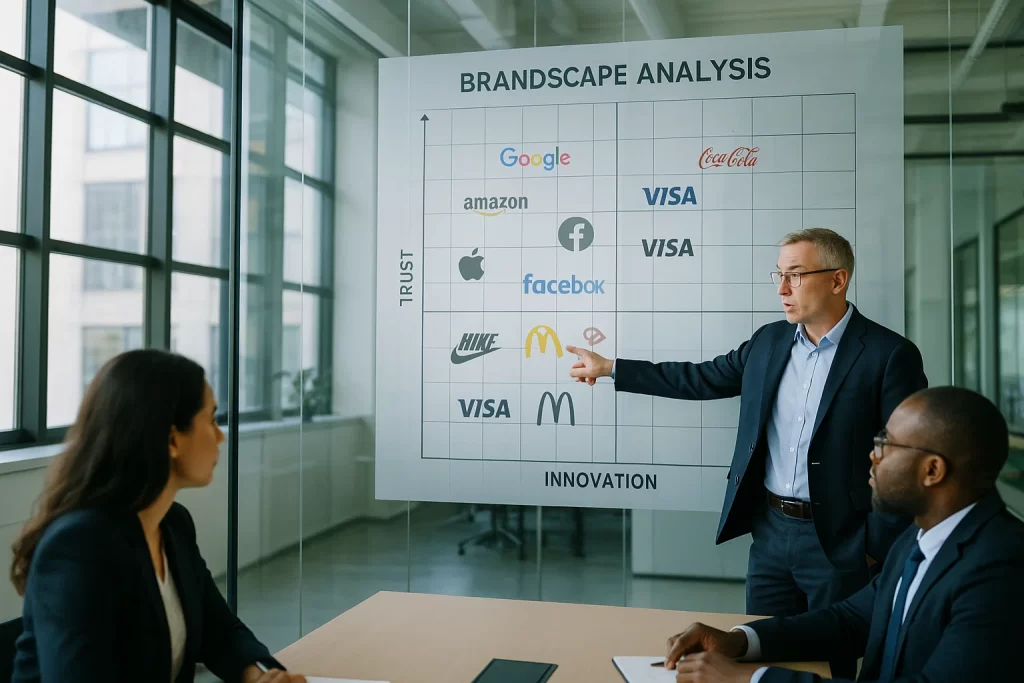
This is the power of brandscape thinking: it surfaces clarity through comparison, giving you the strategic sightlines to stand out with intention.
How to Conduct a Brandscape Analysis: A Step-by-Step Framework
A brandscape analysis is more than a research exercise — it’s a strategic methodology. Done well, it gives you an X-ray view of how brands in your market communicate, differentiate, and compete. Here’s a practical framework that moves beyond design aesthetics to extract meaningful, actionable brand insights.
Step 1: Define the Competitive Set
Before you can map the landscape, you need to understand who’s in it. That means looking beyond just your known competitors to include:
- Direct competitors: Brands offering the same product/service in your niche
- Indirect competitors: Brands competing for the same attention or wallet share
- Aspirational peers: Brands that share values or archetypes, even in other categories
For example, a boutique coffee brand might list Starbucks (direct), Red Bull (indirect – for energy), and Patagonia (aspirational – for sustainability narrative).
“Understanding who you’re really competing with — not just who you’re aware of — is often the biggest unlock in brand strategy,” says strategist Nick Sayers of Interbrand.
Step 2: Audit the Brand Signals
Once you’ve identified your competitive set, the next step is to collect and assess brand signals. This involves analyzing:
- Visual Identity: Logos, typography, color schemes, imagery
- Messaging: Taglines, headlines, mission statements, tone of voice
- UX/UI cues: Website experience, microcopy, onboarding language
- Content Style: Social media presence, campaign voice, design cohesion
You can organize this in a brand audit spreadsheet or a visual brandscape board.
Customer Challenge Resolution : “We have a polished brand — but it feels generic. We don’t know how we actually compare.”
Step 3: Map the Emotional and Functional Positioning
This is the most strategic layer of the analysis.
Here, you categorize brands based on their:
- Emotional Archetypes: Hero, Sage, Creator, Caregiver, etc.
- Functional Benefits: Speed, durability, savings, exclusivity, innovation
- Emotional Benefits: Belonging, freedom, identity, confidence
Using this, you can create a Brandscape Matrix — a 2×2 diagram that plots each competitor on dimensions like:
- Emotional connection vs. Functional performance
- Trust vs. Disruption
- Mass appeal vs. Niche depth
“A brand lives in both the heart and the head. Mapping both is essential,” says Denise Lee Yohn, author of What Great Brands Do.
Step 4: Synthesize Patterns and Gaps
Once mapped, patterns emerge:
- Are competitors clustering in the same quadrant?
- Is there a quadrant no one owns? (White space)
- Do some brands contradict their intended position?
- Is your brand stuck in the middle?
Look for:
- Overlaps that signal competitive saturation
- Gaps that reveal untapped opportunity
- Mismatches between brand intent and market perception
Real-World Mini Case
A startup in the pet food space did this exercise and found that while every competitor focused on “natural ingredients,” no one owned the emotional territory of “joyful mealtime moments.” That insight shifted their messaging from “clean kibble” to “joyful rituals” — and CTRs on their ads rose by 41%.
This framework becomes your strategic GPS — helping your brand navigate with precision, not guesswork.
Case Studies: Effective Brandscape Analyses in Action
To illustrate how brandscape analysis works in the real world, let’s break down several notable brandscape mappings that led to strategic breakthroughs. These case studies highlight how companies use this diagnostic tool not only to visualize where they stand — but to define where they should move next.
Case Study 1: Airbnb vs. Traditional Hotel Chains
When Airbnb launched, its visual identity was clean but unremarkable — soft colors, a stylized “A,” and modern sans-serif fonts. But what set it apart wasn’t visual — it was emotional positioning.
Most hotel brands at the time (Hilton, Marriott, Holiday Inn) positioned themselves as:
- Functional providers of rest, cleanliness, and convenience
- Focused on rewards programs and consistency
Airbnb used a radically different emotional narrative:
“Belong anywhere.”
In a brandscape map of the hospitality sector:
- Hotel chains clustered in the “Functional + Predictable” quadrant
- Airbnb staked out the “Emotional + Experiential” white space
This insight drove the company’s marketing and brand strategy. Their campaigns showcased belonging, host stories, and local immersion, not just beds and rates.
“We realized people weren’t buying beds — they were buying belonging,” said Airbnb co-founder Brian Chesky in an HBR interview.
Case Study 2: Apple vs. Samsung in the Tech Landscape
While both Apple and Samsung make smartphones, their brandscape positioning couldn’t be more distinct.
Samsung
- Functional messaging: battery life, camera specs, durability
- Innovation-heavy visuals with futuristic imagery
Apple
- Emotional messaging: simplicity, creativity, individuality
- Rarely mentions specs — emphasizes user empowerment
On a 2×2 matrix of Innovation vs. Identity:
- Samsung sits firmly in the “Innovative + Functional” quadrant
- Apple dominates “Innovative + Emotional”
Apple’s brandscape dominance stems from aligning its entire ecosystem — from store layout to product launches — around emotional storytelling, not product details.
Case Study 3: DTC Skincare Brand Finds Its Voice
A small DTC skincare brand analyzed its market and discovered most competitors (Glossier, The Ordinary, Drunk Elephant) clustered around:
- Minimalist aesthetics
- Clinical claims
- Empowerment narratives (clean beauty, accessible science)
Their insight? No one owned playfulness and self-expression.
They repositioned as the “art-school rebel” of skincare — colorful packaging, cheeky messaging, and campaign visuals inspired by Y2K nostalgia.
Result? A 3x increase in social engagement, and major press from Vogue for “breaking the skincare mold.”
“We didn’t need another beige bottle with a molecule name,” their CMO joked. “We needed a personality.”
Common Pitfalls: What Most “Visual Audits” Get Wrong
Many marketers begin their brandscape journey by assembling logos, fonts, and color palettes into a visual moodboard. While this is a useful design step, stopping there leads to the most common and costly mistake in branding:
Confusing design differentiation with strategic differentiation.
Without strategic depth, a visual audit becomes a shallow exercise in aesthetics — one that misses the real levers of perception, positioning, and purpose.
Pitfall 1: Mistaking Visual Variety for Brand Distinctiveness
Just because logos look different doesn’t mean the brands feel different. Take the fintech space, for example:
- Many neobanks like Chime, Revolut, and Monzo use pastel colors, sans-serif fonts, and app-friendly icons.
- Visually, they differ. Strategically, they cluster around the same “simplicity + control” narrative.
According to Harvard Business Review, over 60% of new DTC brands in wellness, finance, and fashion use nearly identical visual systems.
“The same fonts. The same colors. The same minimalist packaging. It’s the ‘blanding’ epidemic,” wrote HBR contributor Mark Wilson.
Pitfall 2: Ignoring Messaging and Tone
Branding isn’t what you look like — it’s what you sound like, too. Yet visual audits often exclude the critical layer of verbal identity
- Taglines
- Headlines
- Product descriptions
- Tone of voice
Two brands may look distinct but speak with the same voice, which confuses consumers.
Example: A brand positions itself as rebellious visually but speaks in corporate jargon. That disconnect creates distrust, and the audience subconsciously tunes out.
Pitfall 3: Missing the Emotional Layer Entirely
Consumers don’t buy features — they buy feelings. Yet most visual audits omit
- Brand archetypes
- Psychological triggers
- Identity signals (tribes, status, aspiration)
When you skip the emotional mapping in your brandscape, you’re only seeing the tip of the iceberg. The real value lies beneath — in how the brand is perceived, not just how it’s presented.
“If your visual audit doesn’t include how your brand feels, then you’re not auditing your brand — you’re auditing your Photoshop file,” joked strategist Blair Enns.
Pitfall 4: Overloading the Moodboard
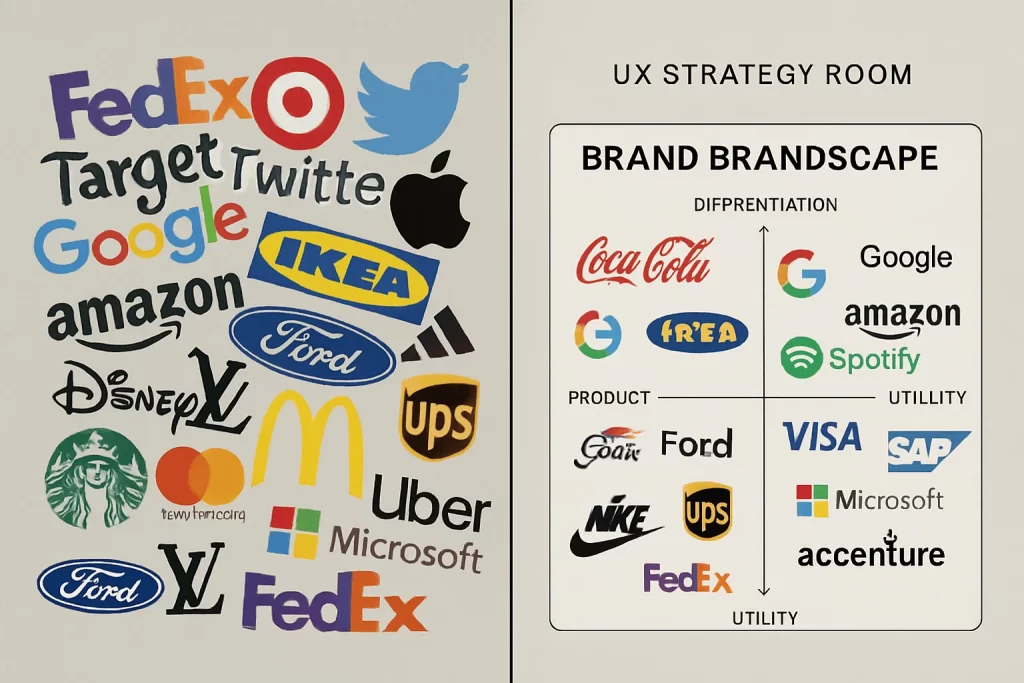
Marketers often assemble dozens of brand elements into one chaotic board — hoping to “see” a pattern. The result is visual noise without insight.
This leads to a critical user fear:
“I did a brand audit and it left me more confused. I saw what others were doing, but not what I should do.”
That’s because data without structure is distraction.
Brandscape analysis, on the other hand, applies structure:
- Matrices
- Axes
- Emotional territories
- Comparative tone grids
It’s not about collecting more — it’s about seeing clearly.
From Analysis to Action: Turning Insights into Strategy
A brandscape analysis only creates value when it moves from insight to implementation. Once you’ve mapped competitors, assessed emotional and functional positions, and identified white space opportunities — the next step is transformation.
The insights you’ve gathered can (and should) guide strategic shifts across your brand — from messaging and positioning to campaigns and customer experience.
Step 1: Revisit or Redefine Brand Positioning
If your brandscape reveals overlap with competitors or a misunderstood market role, it may be time to reposition.
This doesn’t necessarily mean a full rebrand. Sometimes, small shifts in how you frame benefits or tell your story can yield dramatic results.
Example:
A mental health app discovered through brandscape mapping that nearly every competitor was focusing on calm and relaxation. They chose to pivot toward resilience and energy, tapping into a more empowered emotional space — and reached a new segment of Gen Z users.
Step 2: Translate Emotional & Functional Gaps into Messaging
Messaging should directly reflect where you want your brand to live in the market’s mind. Based on your brandscape analysis, consider:
- Updating taglines to reflect unique emotional territory
- Revising your homepage copy to clarify differentiators
- Aligning CTAs and benefits language with your positioning quadrant
“Strategic messaging is not about saying what others aren’t — it’s about saying what your customers need to hear, in a way no one else can,” says April Dunford, author of Obviously Awesome.
Step 3: Refresh Visual Identity
If your visual brand signals no longer reflect your strategic intent — and your brandscape analysis shows overlap or confusion — then a design refresh might be necessary.
Ask:
- Is our visual tone aligned with our brand archetype?
- Are we visually crowding an already-saturated quadrant?
- Could we simplify or clarify our UI/UX to reinforce our message?
But beware:
Don’t redesign just to “stand out.” Redesign to stand for something.
Step 4: Build the Brand Experience Around the New Position
Brand isn’t just what you say — it’s what customers experience. Once your strategy is clear:
- Align customer support tone with your brand archetype
- Update onboarding flows and product naming
- Reinforce new positioning through partnerships, content, and campaigns
Step 5: Measure the Strategic Impact
Use these KPIs to evaluate the effectiveness of your brandscape-driven shifts:
- Message Recall: How well do customers remember your core benefit?
- Brand Perception: Are you associated with your desired archetype?
- NPS & Reviews: Do emotional keywords appear in user feedback?
- Ad Performance: Are new campaigns outperforming the old ones?
Strategy Rollout Timeline
| Phase | Action | Timeframe |
| Audit | Brandscape analysis complete | Week 1-2 |
| Alignment | Executive strategy review | Week 3 |
| Messaging | Update core brand copy | Week 4 |
| Design | Refresh visual identity | Week 5-6 |
| Execution | Launch new campaign | Week 7-8 |
| Evaluation | Run post-launch perception survey | Week 9-10 |
By closing the loop between brandscape and brand execution, you turn theoretical insights into market-moving outcomes.
Tools & Templates for Building Your Brandscape
You don’t need an agency or a six-figure budget to conduct a professional-grade brandscape analysis. With the right tools and a structured approach, any brand strategist, founder, or marketer can map a competitive landscape with clarity and purpose.
This section highlights tools, templates, and frameworks that help you visualize, share, and act on your brandscape insights.
1. Figma – The Ultimate Brand Mapping Canvas
Figma is a favorite among designers and strategists for good reason:
- Collaborative interface allows teams to contribute in real time
- Easy drag-and-drop lets you build brand grids, quadrant maps, and moodboards
- Reusable components for logos, labels, and sticky notes
You can create a brandscape quadrant by:
- Drawing a 2×2 grid
- Adding axes labels (e.g., Price vs. Innovation)
- Dropping competitor logos in their perceived quadrant
- Annotating with insights or quotes
“We used Figma to run a live brandscape workshop across three departments — design, marketing, and product. It changed how we think about positioning,”
2. Miro – For Live Brainstorming and Sticky-Note Strategy
Miro is perfect for early-stage brandscape thinking
- Mimics the feel of a real whiteboard
- Ideal for mapping brand tone, emotion, and narrative before visual elements
- Supports embedded links and videos (great for research boards)
Use Miro to run brand archetype mapping, compare tone-of-voice grids, or group brand personality traits across competitors.
3. Excel or Google Sheets – For Competitive Data Grids
Sometimes the best brandscape work starts in a spreadsheet:
- List all competitors
- Add columns for: Brand Promise, Emotional Hook, Archetype, CTA, Pricing Strategy, Color Palette, Fonts, Channels
- Use filters and conditional formatting to identify overlaps and white space
This method is highly structured and useful for presenting data to stakeholders who prefer clarity over creativity.
Tip: Export this grid into Figma or Miro later to make it visual.
4. Canva – Quick Visual Boards for Stakeholders
Canva is a great tool for quickly:
- Compiling visual brand comparisons
- Creating easy-to-understand before/after boards
- Building simple quadrant-style maps for pitch decks
Its templates and drag-and-drop UX are ideal for non-designers.
5. Templates to Download or Build
If you’re looking to get started fast, here are templates to consider:
- Brandscape Matrix Template (build in Figma or Miro)
- Competitor Messaging Spreadsheet
- Emotional Archetype Worksheet
- White Space Opportunity Map
FAQ
1. What is a brandscape analysis?
A brandscape analysis is a strategic mapping of brands within a specific category or market to understand their relative positioning, emotional tone, messaging, and visual identity. Unlike a basic brand audit, which looks internally, a brandscape examines how your brand fits into the broader ecosystem of competitors and substitutes.
Think of it as your brand’s GPS system — showing not only where you are, but where your competitors are, and where you could go.
2. How do you analyze a brandscape effectively?
Start with these steps:
- Identify direct, indirect, and aspirational competitors
- Collect brand signals — visuals, tone, messaging, and UX
- Categorize by emotional/functional benefits and brand archetypes
- Map on a 2×2 matrix to uncover overlap and whitespace
- Translate findings into brand strategy and positioning shifts
3. Are there free tools to create a brandscape?
Yes! You can build an effective brandscape using:
- Figma: for visual quadrant maps and workshop boards
- Miro: for live sticky-note-based archetype or tone grids
- Canva: to visualize branding comparisons quickly
- Google Sheets: for structured brand audits
Templates are often available on Notion, Pinterest, and community forums like Reddit and Indie Hackers.
4. Can small businesses benefit from brandscape analysis?
Absolutely. Small brands often have more to gain — and fewer internal politics to navigate. A brandscape:
- Reveals market gaps that a nimble brand can own
- Guides early messaging and campaign focus
- Prevents expensive design or positioning mistakes
“Wish we had done a brandscape before our first launch. Could’ve saved $20k in design that looked just like our competitors,” shared one founder on IndieHackers.
Conclusion
In an era of overwhelming brand noise, superficial differentiation is no longer enough. A clear, strategic brandscape analysis empowers companies to rise above aesthetic mimicry and surface-level branding — and to define their unique space in the market with purpose.
By mapping not only how your brand looks, but how it feels, speaks, and resonates, you uncover more than competitor gaps — you uncover strategic clarity. You gain the confidence to shift your positioning, refresh your messaging, and align your brand with a value proposition no one else owns.
Whether you’re a startup seeking relevance or an enterprise rethinking identity, the brandscape isn’t just a visual exercise — it’s a strategic lens into your next phase of growth.