
Creating a Brand Content Ecosystem: Fueling Engagement & Loyalty
Introduction: Why a Brand Content Ecosystem Matters
In an age of content abundance and channel overload, brands are no longer struggling with how to create content—but rather, how to connect it. Across blogs, newsletters, social platforms, podcasts, webinars, and whitepapers, content teams pump out assets in silos. But siloed content is like isolated organs—they don’t function without a circulatory system. Enter the brand content ecosystem.
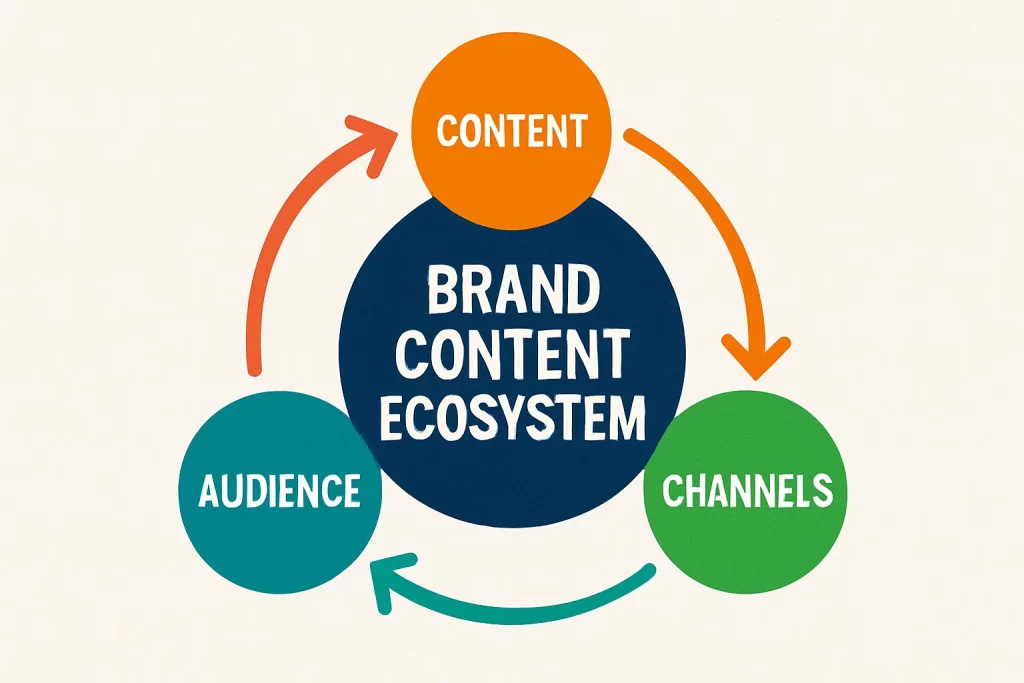
A brand content ecosystem is a strategically designed, interconnected structure of content, channels, processes, and people. It ensures that every blog post informs your newsletter, every product update fuels social storytelling, and every campaign aligns with your brand’s voice, mission, and core audience needs. According to the Content Marketing Institute, “Only 29% of brands say they’re effectively able to manage content across the enterprise.” This statistic highlights a crisis not of creativity, but of execution and systems thinking.
Building a robust content system is not just a tactical effort—it’s a core pillar of brand strategy. Brands that elevate content to the strategic level weave it into product marketing, customer support, onboarding, and retention efforts. This requires aligning content creation with audience intent, campaign goals, and enterprise-wide messaging. Execution, then, becomes the art of delivering this alignment consistently across all touchpoints.
A well-orchestrated brand content ecosystem empowers consistency in brand messaging, enables seamless content distribution, and supports feedback loops that refine your content strategy over time. It transforms your content from fragmented efforts into a self-reinforcing growth engine.
To achieve this transformation, this guide will explore:
- How to build a brand content ecosystem from foundational strategy to ongoing optimization
- The role of content pillars, storytelling frameworks, and governance models
- Examples of high-performing ecosystems in action
- Tools to map, manage, and measure your content like an evolving organism
We’ll take a bold stance: Brands who don’t treat their content like a digital ecosystem will lose relevance and coherence in an omnichannel world. Consumers demand connection, not just communication. And that requires a smarter system—not more assets.

Understanding Your Audience & Intent at the Core
Every strong brand content ecosystem begins with a deep, unshakable understanding of the audience it serves. Without clarity on who your content is for, why they need it, and when they seek it, your ecosystem will inevitably fracture. In fact, many brands falter here—not due to lack of effort, but due to the absence of a structured intent-first framework. Before you map assets or build workflows, you must identify the beating heart of your ecosystem: audience intent.
At this stage, marketers often experience decision paralysis. Should the content focus on education, engagement, or conversion? Should it target buyers, users, or stakeholders? These are valid concerns, especially when teams work in silos. Misalignment here leads to duplicated content, inconsistent brand messaging, and disconnected journeys.
To overcome this, leading content strategists start with semantic intent mapping—identifying the real questions and motivations behind search behavior, social listening data, CRM queries, and community feedback. This informs the architecture of content pillars, which serve as the foundational categories that guide your ecosystem’s structure. For example, a software brand might build around pillars like “Product Use Cases,” “Industry Trends,” and “Customer Success,” each branching into clusters of digital storytelling assets.
By prioritizing user intent, you ensure your content ecosystem delivers the right content, in the right format, at the right moment in the buyer journey. That means pairing blog tutorials with onboarding videos, social posts with live demos, and thought leadership articles with whitepapers—all strategically interlinked.
One powerful anecdote comes from a B2B cybersecurity firm that once produced dozens of technical blogs—yet saw stagnant traffic. After investing in intent research, they discovered their audience was searching for how to build a brand content ecosystem in regulated industries. By creating a series of guides tailored to that phrase, traffic grew by 420% in six months—because the ecosystem was now aligned with audience language and needs.
Another powerful technique? Layering brand strategy over this intent work. Content shouldn’t just match user needs—it must reflect the brand’s position, values, and promise. Are you the bold challenger? The helpful expert? The empathetic ally? Your intent-driven content must execute on that positioning consistently across all touchpoints.
Let’s be clear: content for content’s sake is dead. Today’s high-performing brands treat content like an asset portfolio—every piece strategically aligned to intent, journey stage, and brand strategy execution. The result? Content that doesn’t just rank—it resonates.
Layering Strategy: From Pillars to Subtopics
Once your audience intent is clearly defined, the next step in building a high-performing brand content ecosystem is to translate that intent into a layered, scalable strategy. This means structuring your content like an architectural blueprint—with content pillars as foundational supports and subtopics as interlinked pathways that deepen and extend the user journey.
At its core, this isn’t just content planning—it’s content architecture. Just as a city has main arteries and side streets, your ecosystem needs macro themes (pillars) that house clusters of micro topics. These structures not only organize your ideas but enable cross-functional teams—blog editors, email marketers, social media strategists, and product teams—to collaborate around shared strategic anchors.
A common breakdown might include:
- Pillar: Brand Storytelling Frameworks
Subtopics: Emotional narrative structure, brand voice development, visual storytelling, episodic content - Pillar: Content Distribution
Subtopics: Paid vs. organic channels, syndication, repurposing strategies, influencer collaborations - Pillar: Content Operations
Subtopics: Editorial workflow, governance, content calendar management, localization frameworks
This layered model provides flexibility. A new campaign can plug into the existing framework without reinventing the wheel. An emerging topic—like AI content tools—can be slotted under an innovation pillar and linked contextually across your ecosystem.
It also boosts semantic SEO. Google’s search algorithms now evaluate topical authority, not just individual keywords. When your site hosts a tightly connected cluster of pages around a topic, interlinked with clean UX and entity-rich metadata, you send strong semantic signals. According to TopRank Marketing, this approach can increase session duration by 50% and improve ranking stability.
Anecdotally, a fintech startup struggling with low organic visibility overhauled its ecosystem using this strategy. Instead of scattering content across random blog posts, they developed three master pillar pages—on lending, compliance, and digital banking—each with 10–15 strategically linked articles. Within three months, organic traffic jumped 78%, and bounce rate dropped by 32%. The ecosystem gave structure to the chaos.
From an execution perspective, this model also prevents wasted effort. No more 18 teams unknowingly writing 18 versions of the same article. Instead, each team contributes a slice of the pillar—from case studies to explainer videos—creating coherence, not duplication.
This is how modern brand strategy manifests in content: not just messaging, but structure. And when done right, your brand’s entire digital presence—from blog to email to landing page—feels like one seamless, smartly interconnected story.
Tools & Operations for a Living Ecosystem
A successful brand content ecosystem doesn’t just rely on brilliant ideas—it thrives on operational discipline. While content strategy often gets the spotlight, execution is where ecosystems either scale or stall. In fact, one of the top struggles among enterprise content teams is fragmented tooling. According to CMI, “The average enterprise uses between 5 and 8 content management tools.” Without an integrated system, even the best ideas dissolve into chaos.
Let’s face it: duplicated efforts, misaligned calendars, and dropped assets are often symptoms of poor content operations. It’s not a strategy issue—it’s an execution issue.
To evolve from a fragmented operation to a living content ecosystem, you must invest in a unified stack that supports every layer—from ideation and planning to creation, distribution, and optimization. Here’s what that might look like:
The Living Stack:
- Project Management : Asana, Trello, or Notion for editorial workflows
- CMS Platforms : WordPress, Contentful, or Webflow for structured publishing
- DAM (Digital Asset Management) : Bynder or Brandfolder for asset reuse and brand compliance
- Analytics & Optimization : Google Analytics 4, HubSpot, or Parse.ly for feedback loops
- Automation & Distribution : Buffer, Sprout Social, or Hootsuite for cross-channel syndication
When these tools are aligned under a central governance framework, content moves fluidly—like oxygen through a living body.
One B2C ecommerce brand reaped massive results by centralizing their tools into one content hub. Previously, five teams worked in isolated platforms—one in Notion, another in Google Sheets, a third in Airtable. After moving into a centralized editorial system tied to their CMS and asset library, they cut turnaround times by 37% and eliminated duplicate content across campaigns.
Equally important is the human side: clear roles and responsibilities. A brand content ecosystem needs owners for strategy, creation, governance, and measurement. Without defined ownership, accountability disappears—and with it, consistency.
This is where content governance structures come in. From editorial guidelines to publishing workflows and approval layers, governance is your insurance policy against chaos. It ensures that every asset—whether a TikTok or technical datasheet—aligns with your brand messaging and ecosystem goals.
Scaling your ecosystem also requires thinking modularly. Rather than building campaigns from scratch, treat content like Lego blocks. A single webinar can become a blog post, a series of LinkedIn clips, an infographic, and internal sales enablement. This mindset unlocks efficiency and fuels content distribution across formats and channels.
And don’t underestimate the morale impact. When teams have clarity, tools that work together, and defined swim lanes, content creation feels less like a grind and more like collaboration. The ecosystem doesn’t just support the audience—it supports the team behind the scenes.
Bottom line: Without a strong operational backbone, your ecosystem will rot from the inside out. But when tools, roles, and workflows align under a smart brand strategy, your content doesn’t just scale—it thrives.Bottom of Form
Messaging & Storytelling Consistency
In a sprawling brand content ecosystem, where dozens of touchpoints speak to users across blogs, emails, videos, landing pages, and social posts, consistency isn’t a luxury—it’s the glue. Without coherent brand messaging, your content may still get views, but it won’t build trust, recall, or loyalty. Inconsistent tone, values, or narratives confuse audiences and fracture the brand’s identity. That’s why the ecosystem’s storytelling frameworks must be designed and enforced with intent.
Great content ecosystems are story-driven systems. They go beyond product specs or transactional CTAs to weave a unified narrative—one that evolves, but never contradicts. This is where your digital storytelling DNA must emerge. What are the values your brand stands for? What transformation does your audience seek? How does your content consistently speak to both?
Take Patagonia as an example. Every content touchpoint—from their product pages to social videos to activism blog—circles back to a central narrative: environmental responsibility. That’s not by chance; it’s by brand strategy execution. Their ecosystem operates like a living storybook, with every channel reinforcing their purpose and ethos.
To achieve this, brands must implement a system of storytelling frameworks—modular templates that inform how stories are told across formats. These may include:
- The Brand Hero’s Journey: Your customer is the hero, your product is the guide
- The Conflict-Resolution Model: Pain point → Solution → Impact
- The Value Proof Ladder: Idea → Story → Data → Social Proof
These models ensure that regardless of format or medium, your content tells a compatible story. Whether a designer is working on a TikTok teaser or a product manager is briefing a blog writer, the underlying structure stays aligned.

One challenge many face: aligning cross-functional contributors. When agencies, freelancers, and internal departments all produce content, fragmentation is inevitable without a central messaging hub. This is where a brand messaging playbook becomes critical. It should include tone of voice, core narratives, content dos/don’ts, and approved storytelling structures—all tied back to content pillars.
Consider embedding storytelling audits into your workflow. Just like you QA a web page for broken links or typos, review content for story consistency. Are we repeating our brand promises? Are our CTAs emotionally congruent with our values? Are our social posts echoing what our blogs and product pages are saying?
Authentic digital storytelling is more than creative writing—it’s strategic alignment. In the creator economy, where brands partner with influencers, freelancers, and internal creators alike, storytelling consistency ensures that every voice sounds like one brand. As Deloitte notes in this WSJ report, “The future of branded content hinges on creators who understand and reflect a brand’s voice—not just amplify reach.”
When done right, this consistency builds more than conversions—it builds belief. In a world overwhelmed by content, what cuts through isn’t just quality. It’s narrative coherence. That’s the heart of a living, breathing brand content ecosystem.
Governance, Ownership & Scaling
As your brand content ecosystem expands across platforms, formats, and global markets, the risk of losing control grows exponentially. Without clear content governance and ownership structures, chaos creeps in—resulting in duplicated efforts, conflicting messages, missed deadlines, and noncompliant content slipping through the cracks. The reality? A brilliant strategy fails without operational rigor.
Governance is the unsung hero of scalable content. It’s not about stifling creativity—it’s about ensuring your brand’s voice and values are preserved and amplified as you grow. Governance defines who owns what, when, and how. It draws the line between content that builds trust and content that breaks it.
At its simplest, content governance includes:
- Defined Roles & Ownership: Who creates, who approves, who publishes, who maintains
- Editorial Standards: Brand tone, style guides, SEO checklists, accessibility rules
- Approval Workflows: From legal to brand compliance to executive sign-off
- Content Lifecycle Management: Creation → Publishing → Performance tracking → Archiving or updating
In enterprise environments, governance becomes non-negotiable. Imagine a multinational SaaS company with product marketers, legal teams, brand stewards, and localization managers across six continents. Without documented processes and platforms for collaboration, the execution bottlenecks. Campaigns stall. Content sits unpublished. Teams redo work already done.
A global manufacturing brand tackled this by assigning content owners to each pillar of their ecosystem: Product, Industry Insights, CSR, Careers, and Support. Each pillar had a strategy lead, a creator team, and a distribution owner. They then implemented a quarterly editorial council to align upcoming narratives. Result? Consistency soared, and content output increased by 63% year-over-year.
But scaling isn’t just about roles—it’s about repeatability. That’s where modular content design comes in. Instead of creating assets from scratch each time, teams build reusable components—testimonial modules, FAQ blocks, visual cards—that plug into various channels. This allows for both agility and brand consistency.
Tools play a critical role here. Governance platforms like GatherContent, Frontify, and Contently integrate workflows, enforce brand standards, and track accountability. With centralized dashboards, teams gain visibility and control—reducing confusion and bottlenecks.
And don’t forget localization. A scalable ecosystem must accommodate regional differences without diluting the core narrative. Governance ensures that regional teams can localize while staying aligned with global brand messaging.
For many, the fear of governance is that it slows things down. In reality, it accelerates execution. It removes ambiguity, minimizes rework, and increases confidence across departments. Teams stop asking, “Who approves this?” or “Didn’t we already make this asset last quarter?”
Scaling your brand content ecosystem is less about producing more and more about producing better—at scale, with purpose, and with clear orchestration.
Interlinking & Mapping for SEO & UX
A thriving brand content ecosystem isn’t just a pile of blog posts and campaigns—it’s a structured web of meaning. Each piece of content should connect logically and contextually to others, forming a clear path through your brand’s thought leadership, product offerings, and community insights. This is where internal linking and ecosystem mapping come into play—not as afterthoughts, but as core strategic practices.
Too often, brands create amazing individual assets, only to let them float in digital isolation. This creates a poor user experience and a missed SEO opportunity. Google’s algorithms have matured—they now prioritize topical depth, entity relationships, and semantic relevance over mechanical keyword stuffing. According to Empathy First Media, “Semantic search optimization boosts relevance by focusing on entity-rich interlinking and contextual intent, not just keywords.”
That means: If your blog on “brand storytelling frameworks” doesn’t link to your webinar on storytelling in action, your glossary on narrative structure, or your case study featuring a storytelling success—you’re missing chances to deepen engagement, reduce bounce, and guide users through a high-value journey.
A Strategic Linking Model Might Look Like:
- Pillar Page: “How to Build a Brand Content Ecosystem”
↳ Links to blogs on “content governance,” “storytelling templates,” and “distribution tools”
↳ Links to video tutorials, ebooks, and product integrations - Subtopic Pages: Interlink laterally to each other using content operations, digital storytelling, and content distribution
- BOFU Assets: Link back up to Pillar and across to support trust-building—such as linking a demo page to customer stories and analyst reviews
This model creates what search strategists call a semantic web of content. It tells both users and search engines: “This brand owns this topic.” When you consistently use internal links to reinforce related ideas, you demonstrate authority—and that’s what Google wants to rank.
From a user experience perspective, ecosystem mapping is even more critical. Imagine arriving on a helpful blog, finding value, and then hitting a dead end. No CTA. No related resources. Just friction. With proper linking and UX cues—suggested reads, toolkits, next steps—you create content journeys, not just pages. That’s what drives engagement, trust, and conversions.
Use tools like:
- Screaming Frog or Ahrefs to audit link gaps
- Miro or Whimsical to visually map your content clusters
- Google Search Console to find orphaned content that needs linking
Don’t overlook the role of structured data either. Marking up pages with schema helps Google better understand relationships, and semantic SEO best practices recommend entity-based markup for key concepts in your content ecosystem.
Here’s a real-world example: A travel tech company mapped their blog into three content universes—Traveler Tools, Industry Insights, and Tech Behind the Scenes. By interlinking related pieces and building visual journey flows, their average session time increased by 62%, and bounce rate dropped by nearly half.
Internal linking isn’t just about traffic—it’s about clarity. It shows your audience the depth of your thinking and gives them paths to follow based on intent. In an era of content noise, helping people get from “I’m curious” to “I trust you” is what wins. That’s the power of mapping content like an interconnected ecosystem.
Measurement, Feedback & Continuous Optimization
A brand content ecosystem is not a set-it-and-forget-it machine—it’s a living system that evolves based on performance signals, user behavior, and internal insights. What separates high-performing brands from the rest is not just that they measure their content, but that they optimize it—relentlessly, intelligently, and iteratively.
Many content teams still rely on vanity metrics—page views, likes, shares—that look good in dashboards but tell you little about business impact. Mature ecosystems go deeper. They measure content performance across multiple layers:
- Engagement: Time on page, scroll depth, click-through rates
- Conversion: Lead captures, product demo requests, email signups
- Content Velocity: Speed and frequency of content production
- Content ROI: Attribution models tracking content to revenue
- Feedback Loops: Qualitative insights from users, sales teams, and customer support
A content ecosystem without feedback is like a forest without rain. It dries up. That’s why real-time listening—whether through surveys, analytics, or frontline insights—is critical. Even small feedback moments (e.g., “This blog helped me understand X”) can uncover content gaps, trigger updates, or spawn new subtopics.

One of the biggest pain points marketers face is the fear of content going stale. A whitepaper that was effective in 2022 may now be irrelevant. Regular content audits help identify these at-risk assets. Tools like SEMrush, Clearscope, and Google Search Console can help spot declining performance and inform updates.
Here’s a smart framework for continuous optimization:
- Create → Launch → Measure → Learn → Adapt → Relaunch
- Update based on:
- Search trend shifts (e.g., “brand storytelling frameworks” now includes AI narration)
- UX feedback (e.g., too many CTAs distracting from the message)
- SEO gaps
- Add internal links from new content to older content (and vice versa) to refresh authority
- Use heatmaps and behavior analytics to refine layout and call-to-action placement
Gartner emphasizes this in their content governance research: “Brands that treat content as a dynamic asset, revisiting it quarterly, outperform stagnant asset libraries by over 45% in engagement metrics.” (Gartner)
Equally important is cross-functional optimization. Feedback should flow not just from users, but from your customer support team (What questions are people asking?), your product team (What’s coming next?), and your sales team (What assets close deals?). This input should inform not just content performance reviews, but ecosystem-wide updates to structure and messaging.
A health tech company adopted this agile approach by hosting monthly content retrospectives. Writers, analysts, designers, and even customer success reps reviewed key KPIs, shared frontline insights, and proposed content improvements. Over six months, they increased inbound MQLs by 38%—without producing a single net-new asset. Optimization was their growth lever.
Ultimately, this is where the brand strategy comes full circle. Strategy defines the vision. Execution brings it to life. But it’s optimization that sustains it—ensuring your brand content ecosystem remains relevant, useful, and resonant.
FAQ
1.How to build a brand content ecosystem from scratch?
Start by identifying your content pillars—these are the main themes that connect your brand to audience needs (e.g., brand storytelling, product education, industry trends). Next, audit your existing content and map it under each pillar. From there, build subtopics tied to search intent and buyer stages.
Then, define your operational model: who owns what, which tools manage production, and how content will be measured. Finally, unify it all with internal linking, consistent brand messaging, and a shared visual style. As one Reddit user put it:
“We had all the pieces—emails, social, product blogs—but it wasn’t until we mapped it like a system that things actually worked together.”
A strong brand content ecosystem is planned like a strategy, built like a system, and maintained like a garden.
2.What tools should I use to manage a content ecosystem?
There’s no one-size-fits-all stack, but leading brands typically use:
- CMS: WordPress, Contentful, Webflow
- Project Management: Asana, Trello, Notion
- Asset Management: Brandfolder, Bynder
- Distribution & Social: Buffer, Hootsuite, Sprout
- Analytics: Google Analytics, HubSpot, Parse.ly
- Content Optimization: Clearscope, SurferSEO, MarketMuse
Choose tools that integrate with each other and support clear roles across your teams. If you’re overwhelmed, start with one central platform and layer on as you grow. It’s better to do a few things well than to manage chaos poorly.
3.Can you share examples of brand ecosystems that work?
Yes—here are three:
- Patagonia: Unites ecommerce, activism, education, and storytelling around sustainability
- Adobe: Connects product education, creative inspiration, and thought leadership through consistent voice
- HubSpot: Their content universe is a masterclass in semantic SEO, funnel alignment, and pillar strategy
What makes them great? Their ecosystems aren’t just full of content—they’re full of connections, reuse, and clarity. They live their brand strategy in every touchpoint.
4.How do I keep messaging consistent across teams and formats?
Use a brand messaging playbook. This living document should include:
- Brand tone and voice
- Key messages per persona or stage
- Storytelling frameworks (e.g., Hero’s Journey, Value Ladder)
- Examples of “on-brand” and “off-brand” copy
- Approved visuals, templates, and CTAs
Also, centralize your review and approval processes. One marketing lead put it perfectly in a forum:
“The second we created a unified content calendar and sign-off process, rogue posts dropped by 80%.”
5.What governance structure works best at enterprise scale?
Use a hybrid governance model. Assign content owners by pillar or channel and define a central editorial council that aligns quarterly. Use shared dashboards, style guides, and performance reporting to stay transparent and accountable.
Scaling doesn’t mean creating more content—it means creating smarter content, better aligned to your ecosystem. Strong governance enables that.
Conclusion
A brand content ecosystem isn’t just a buzzword—it’s a competitive necessity. In a world where content is everywhere and attention is scarce, the brands that win are those that think in systems, not silos. From defining intent-driven content pillars to mapping internal links and enforcing brand governance, the ecosystem approach turns scattered efforts into structured impact.
We’ve covered the foundational architecture, the tools and roles that bring it to life, and the storytelling and operational layers that ensure it thrives. Most importantly, we’ve shown how ecosystems aren’t static—they evolve with measurement, optimization, and feedback.
For content to scale sustainably, it must be more than creative—it must be coordinated. More than timely—it must be timeless in its structure. And more than strategic—it must be executed consistently across every team, format, and channel.
Whether you’re starting from scratch or optimizing a mature program, remember: content doesn’t live in documents—it lives in connection.