
Brand Opportunity Laddering: Prioritizing Initiatives for Growth
Introduction
Brand Opportunity Laddering is a powerful methodology that connects customer motivations with strategic brand initiatives. By leveraging means‑end theory and hierarchical value map techniques, brands can move beyond superficial features to uncover the functional benefits and deeper emotional benefits that truly drive consumer behavior. This method is essential for strengthening brand strategy and execution, helping organizations not only plan but also implement initiatives aligned with real consumer desires.
Many businesses struggle to prioritize branding strategies due to unclear customer values. Marketing teams often chase tactics disconnected from core motivations, resulting in diluted messages and ineffective campaigns. Brand opportunity laddering solves this by revealing the path from tangible attributes to deeply held values, enabling consistent brand value mapping across messaging, product development, and customer experience.
Academic research by Reynolds and Gutman shows that laddering interviews uncover means-end chains—the mental links consumers make from product features to personal values. According to a foundational study from the Journal of Marketing, “laddering methodology enables researchers to map motivational structures that drive brand choice” (JSTOR). This connects directly with Kevin Keller’s brand equity model, allowing teams to anchor abstract insights into structured, strategic frameworks.
Leading companies exemplify this approach. Apple’s minimalist design speaks not just to usability, but to a deeper consumer desire for elegance and innovation. Nike’s empowering messaging connects athletic performance with self-identity and perseverance. These brands didn’t stumble into alignment—they achieved it through refined brand strategy and execution powered by insight tools like brand laddering. Tools like Google Ventures’ Design Sprint (GV) and Prophet’s branding frameworks (Prophet) showcase how top organizations operationalize customer value into business decisions.
This article offers a strategic, persuasive roadmap to adopt brand opportunity laddering not just as research—but as a core component of prioritizing initiatives that matter. When integrated with business workflows, this method allows your brand strategy to become a true executional blueprint.
You’ll learn how to:
- Conduct laddering interviews to collect usable qualitative data
- Translate insights into prioritized business initiatives
- Avoid common missteps that derail execution
- Anchor your messaging and positioning in what your audience actually values
By embracing this method, your brand strategy and execution will evolve from assumption-based planning into insight-driven alignment.
Brand Opportunity Laddering Explained
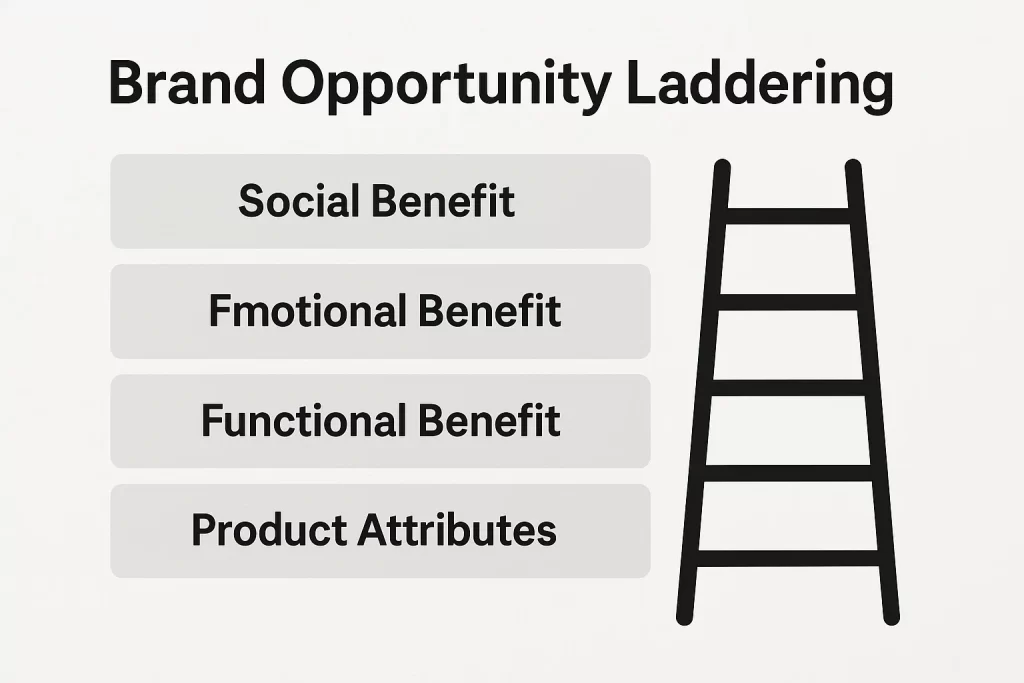
Brand Opportunity Laddering is more than a research method—it’s a strategic framework that aligns brand strategy and execution with what truly motivates your audience. At its core, it’s based on means‑end theory, which explores how people connect tangible product features to intangible personal values. This connection forms the ladder—a structured progression from functional benefits to emotional benefits and finally, to the consumer’s core motivations. Effective brand positioning dubai strategies use these insights to connect product benefits with audience needs and establish a distinctive, meaningful position in the market.
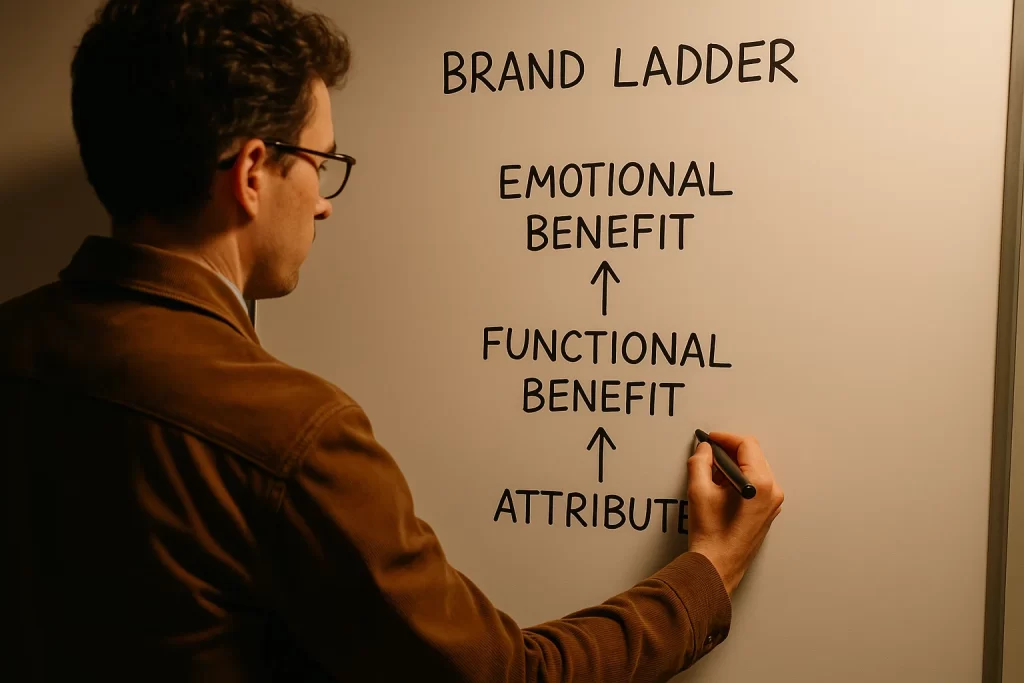
The approach begins with understanding brand laddering—a model where product attributes are systematically linked to benefits and values. In this model, attributes (like a sneaker’s breathable material) lead to functional benefits (like staying cool during workouts), which then elevate into emotional benefits (feeling confident and capable), and eventually connect with self-identity or social belonging (e.g., “I’m the kind of person who prioritizes performance and health”). This progression, known academically as the A-C-V sequence (Attributes → Consequences → Values), is the heart of means-end chain theory.
“Brand Laddering involves a progression from attributes to benefits to more abstract values or motivations,” explains Professor Kevin Keller. “It involves repeatedly asking what the implication of a product feature or benefit is for the customer” (Forbes).
Why This Matters for Brand Strategy
Most marketing strategies fail not because they lack data, but because they lack depth—an understanding of why customers care. Brand opportunity laddering addresses this gap. It surfaces motivations that traditional surveys or analytics overlook. This makes it a critical asset in brand strategy and execution—especially when prioritizing initiatives across departments like marketing, product development, or UX.
For example, a skincare brand might focus on attributes like “natural ingredients.” But without laddering, they may never realize that the real motivation is “self-care without guilt” or “feeling empowered through conscious choices.” Understanding this deeper brand opportunity could shift everything from messaging to packaging design to influencer partnerships.
Opportunity Laddering vs. Traditional Brand Laddering
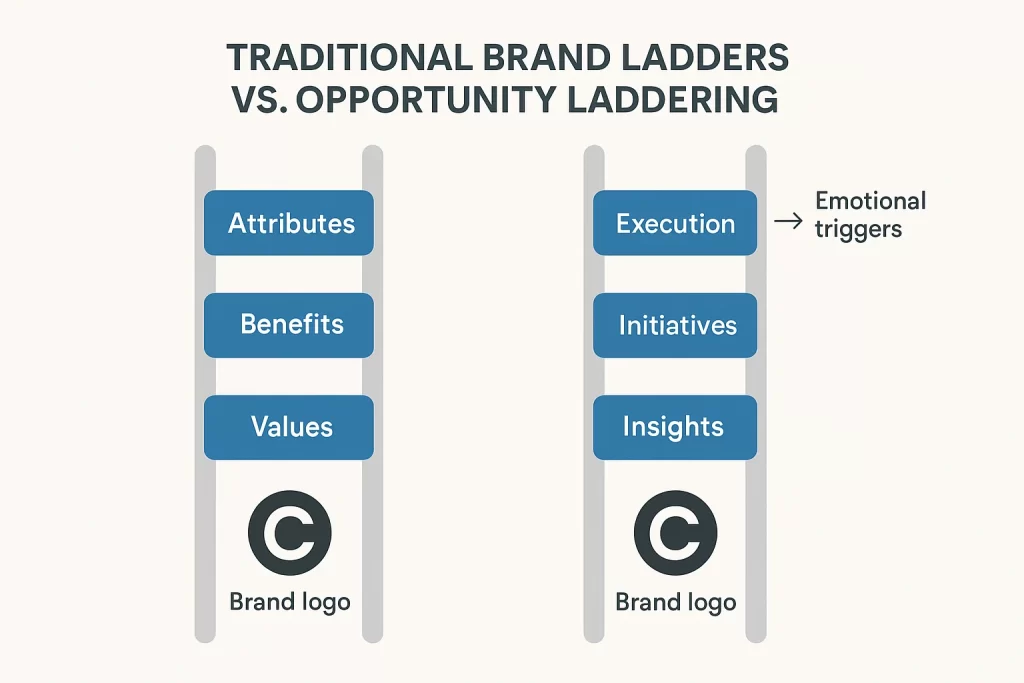
While traditional brand laddering focuses on building internal brand messaging, opportunity laddering adds a strategic filter: what is worth acting on? It introduces prioritization as a discipline, ensuring brands only climb ladders that align with strategic goals, available resources, and audience relevance. This is where brand opportunity laddering becomes a tactical and decision-making asset.
Challenge Resolved
Many teams feel stuck between data overload and decision paralysis. Brand opportunity laddering offers a way to cut through the noise. It ensures that what you do is grounded in real motivations, not assumptions. It’s not about creating new initiatives—it’s about elevating the right ones.
When executed well, this technique strengthens alignment between customer insight and business action, giving your brand strategy and execution a psychological edge that your competitors will struggle to match.
How to Conduct Brand Laddering Interviews
While the theory behind brand opportunity laddering is essential, the real power lies in execution. Laddering interviews form the foundation of the process—they uncover the hidden motivations behind customer behavior and lay the groundwork for your hierarchical value map. Without proper interviews, your brand strategy and execution risk being built on assumptions, not truth.
Let’s explore the three critical steps to conducting impactful laddering interviews:
Preparing the Laddering Interview
The laddering process begins with identifying the right participants—people who represent your core customer segments. Diversity matters. Interview a range of personas across purchase journeys: loyal users, recent buyers, and even those who considered your brand but chose another.
Use open-ended, exploratory questions based on means-end theory. You’re not looking for opinions—you’re digging for associations. Start with a product attribute and follow the “why” trail upward.
Example
- “What do you like about our [product]?”
- “Why is that important to you?”
- “And what does that help you feel or accomplish?”
- “Why is that feeling or result meaningful to you?”
This iterative probing reveals means-end chains. Don’t rush. Let silence hang. According to research from Reynolds and Gutman, “The depth of emotional insight is often revealed after three or more ‘why’ levels” (JSTOR).

Typical Challenge
Marketers often fear qualitative interviews won’t deliver consistent results. The solution? Structure. Use a standardized script, record interviews (with consent), and transcribe for later analysis.
Building the Hierarchical Value Map
Once interviews are complete, translate raw responses into a hierarchical value map (HVM)—a visual representation of how customers link product features to emotional and personal values.
Step-by-step
- Extract Attributes (e.g., “Fast checkout process”)
- Link to Consequences (e.g., “Saves time”)
- Climb to Values (e.g., “I feel efficient and in control”)
These connections form brand ladders that represent how your product or service emotionally resonates. You’ll likely see multiple ladders per segment, which can be clustered into dominant themes.
Example:
- Attribute : Subscription cancelable anytime
- Benefit : I’m not locked in
- Value : I feel independent, in control of my choices
Translating Insights into Brand Initiatives
Here’s where insight becomes action. With your HVMs in hand, identify themes that recur across customer segments. These are your opportunity ladders—places where your brand can prioritize strategic initiatives aligned with emotional drivers.
If customers consistently value “feeling empowered,” and your feature “fast onboarding” maps to that, prioritize:
- Messaging: Lead with empowerment
- UX: Streamline onboarding even further
- Brand partnerships: Align with empowerment-centric influencers
According to Prophet, “brands that tap into consumer motivation, not just needs, build more resilient loyalty” (Prophet).
Challenge Resolved
Too often, qualitative insights live in PowerPoints, unused. This approach ensures findings guide real decisions, turning soft data into sharp action.
With laddering interviews complete and insights mapped, your brand strategy and execution gain clarity rooted in emotion, not assumption.
Case Studies: Apple, Nike & Netflix
While brand opportunity laddering is rooted in academic frameworks, its value shines in real-world execution. Leading global brands like Apple, Nike, and Netflix don’t just tell stories—they tell emotionally resonant truths. They’ve built towering brands by identifying the functional benefits they offer, translating them into emotional benefits, and finally tying them to their audience’s deepest values.
Here’s how these giants master the ladder:
Apple: From Simplicity to Self-Expression
Functional Benefit: Intuitive user interface
Emotional Benefit: Confidence, ease, empowerment
Core Value: “I’m capable, creative, and modern”
Apple’s brand doesn’t sell specs—it sells simplicity. Every iPhone launch, MacBook ad, and UI decision is aligned to make the user feel intelligent without effort. This alignment is no accident. By using brand laddering, Apple understands that buyers don’t just want features—they want to feel empowered by technology.
“Apple just gets how I want my tech to make me feel—smooth, effortless, like it’s already part of me.”
This reflects a strategic focus on the emotional rungs of the ladder. Apple’s marketing teams likely use internal versions of the hierarchical value map to align product features with aspirational messaging. Their brand strategy and execution relies on this emotional intelligence, visible in every tagline (“Think Different”) and product demo.
Nike: From Athletic Performance to Personal Victory
Functional Benefit: High-performance gear
Emotional Benefit: Determination, motivation
Core Value: “I can overcome any obstacle”
Nike’s brand ladder is a textbook case of laddering interview insight in action. Every product speaks of performance, but every ad speaks of resilience. By mapping benefits to values, Nike connects with those who don’t just want to run fast—they want to feel like fighters.
The emotional payoff isn’t about shoes—it’s about winning, even in the face of adversity. Their “Just Do It” ethos reflects deep brand value mapping rooted in emotional relevance.
“Nike ads are why I go for that morning run. It’s not just gear—it’s mindset,”
This shows the success of using emotional motivations to prioritize brand initiatives—whether that’s sponsoring athlete stories or designing new training apps. Their brand strategy and execution extends beyond products into the very identity of the customer.
Netflix: From Convenience to Emotional Intimacy
Functional Benefit: Personalized content recommendations
Emotional Benefit: Feeling understood, comforted
Core Value: “I want control and emotional connection on my terms”
Netflix’s rise isn’t just about streaming—it’s about emotional convenience. The UX is seamless, the recommendations eerily accurate, and the feeling it delivers is unique: I’m seen. Netflix climbed its brand ladder by turning algorithmic precision into a powerful emotional benefit—comfort.
“Some nights, Netflix just knows what I need better than I do,”
Their brand laddering strategy connects availability (anytime access) to emotional validation, which is especially powerful in an age of overchoice. Internally, this means customer research, data science, and design teams must prioritize emotionally resonant features—an embodiment of brand opportunity laddering at scale.
Each of these case studies illustrates how powerful brand opportunity laddering becomes when insights are connected directly to execution. Apple gives users identity. Nike gives them grit. Netflix gives them comfort. Each uses laddering strategy examples to climb from product to purpose.
Common Missteps & How to Avoid Them
As powerful as brand opportunity laddering is, it’s not immune to pitfalls. Many well-intentioned teams run laddering workshops, gather interview data, and build beautiful value maps—only to fall short in brand strategy and execution. Whether due to misinterpretation, overconfidence, or lack of alignment, missteps can derail your entire branding effort.
Let’s examine the most frequent mistakes and how to avoid them:
1. Confusing Features with Benefits
One of the most basic—but most damaging—errors is mistaking product attributes for customer motivations. Teams often stop too early in the ladder. They identify a feature (like “customizable dashboards”) and call it a day. But that feature is merely a means to a deeper functional benefit (“I save time”) and an emotional benefit (“I feel in control”).
Fix:
Use laddering interviews to probe past the surface. Ask “why does that matter?” at least three times. Then, map responses using a hierarchical value map to visualize depth.
2. Assuming Emotional Benefits Without Evidence
It’s tempting to say your brand “inspires confidence” or “builds trust.” But unless that connection is rooted in interview insights, it’s fiction. Making assumptions about what matters to customers risks building a ladder to nowhere.
Fix:
Every emotional benefit you claim should be supported by verbatim interview quotes or repeated patterns across segments. If your audience doesn’t say it, don’t build on it.
“We thought our customers valued ease,” said one marketing director in a forum. “Turns out they were staying with us because we made them feel smart.”
3. Skipping Competitive Context
Your ladder doesn’t exist in a vacuum. Brands often ladder up to values that are already owned by competitors—leading to strategic overlap and confused positioning. If Nike owns “empowerment,” and Apple owns “simplicity,” you need to own something else.
Fix:
Do a brand landscape audit before you finalize your ladder. Which emotional benefits are saturated? Which are open opportunities? Use brand value mapping not just to climb higher—but to climb differently.
4. Failing to Prioritize the Right Opportunities
Not every insight deserves an initiative. Some emotional drivers may be heartfelt—but irrelevant to your strategic goals or product capabilities. This is where brand opportunity laddering goes beyond traditional laddering: by helping you say no.
Fix:
Create a “value vs. viability” grid. Map each laddered insight on emotional resonance (value) vs. brand alignment and executional ease (viability). This ensures brand strategy and execution focus on high-impact opportunities.
5. Treating Laddering as a One-Off Project
Laddering is not a workshop—it’s a mindset. Brands that succeed treat laddering insights as a living input to messaging, UX, and innovation, not just something for a quarterly deck.
Fix:
Institutionalize your brand laddering framework. Include it in onboarding, product planning, and campaign development. Ensure cross-functional teams—from design to sales—understand the value map.
Avoiding these pitfalls not only protects your effort—it amplifies your results. With discipline, data, and emotional honesty, brand opportunity laddering becomes not just a research tool, but a north star for brand strategy and execution.
Measuring Success: KPIs & Metrics
A common fear marketers face with brand opportunity laddering is this: “How do I prove this is working?” While emotional resonance and strategic alignment may feel intangible, the outcomes are not. With the right metrics, laddering becomes not only defensible—but indispensable to your brand strategy and execution.
Why Measuring Matters
Even the most insightful ladder loses power if its impact can’t be tracked. Executives need numbers. Teams need validation. And brands need feedback loops. By tying functional and emotional benefits to specific KPIs, you turn soft data into sharp impact.
Here’s how to quantify success across three core areas:
1. Messaging Performance Metrics
Once you’ve aligned your messaging with core emotional values (like empowerment, simplicity, control), test how it performs. Use A/B testing to compare emotionally aligned copy vs. generic messaging.
Metrics to Track:
- CTR (Click-Through Rate) on emotionally resonant headlines
- Engagement Time on landing pages with ladder-informed narratives
- Ad Recall & Brand Favorability from brand lift studies
According to a Google Think Insights report, emotionally aligned ads see a 23% higher conversion rate than functionally framed ones (GV).
2. Brand Perception & Retention
Emotionally resonant brands create loyalty. Track how your ladder-aligned messaging and initiatives influence brand sentiment and retention over time.
Metrics to Track:
- NPS (Net Promoter Score) : Do aligned messages increase advocacy?
- Brand Association Surveys : Are you now “trusted,” “empowering,” “innovative”?
- Churn Rate : Does emotionally attuned UX reduce drop-offs?
One real-world example: a fintech brand repositioned its app around “financial confidence,” a value identified via brand laddering interviews. The result? A 16% drop in churn and a 22% rise in retention among new users within 60 days.
3. Internal Alignment & Execution Speed
Brand opportunity laddering doesn’t just drive marketing—it aligns teams. When every department understands what the customer really values, execution becomes faster and more focused.
Metrics to Track
- Time-to-Launch for initiatives linked to ladder insights
- Stakeholder Approval Rate for emotionally aligned campaigns
- Cross-Functional Adoption : Are teams using the laddered value map in their workflows?
These internal KPIs often predict downstream success in user experience, sales enablement, and innovation.
By using clear KPIs to measure the impact of brand opportunity laddering, you strengthen both the credibility and influence of your brand strategy and execution. This turns customer insight into a performance engine—and makes every emotional benefit accountable to the bottom line.
FAQ
1. What is brand opportunity laddering and how is it different from brand laddering?
Brand opportunity laddering is a strategic extension of traditional brand laddering. While brand laddering helps map how product features connect to customer values, opportunity laddering adds a layer of prioritization—helping brands determine which emotional connections are most viable, differentiating, and actionable.
“We mapped our whole value ladder but had no idea what to actually act on. This method made us focus.”
Unlike conventional laddering that may end with insight, opportunity laddering ensures insight feeds execution.
2.How do I use brand ladders to prioritize new initiatives?
Start by conducting laddering interviews to understand your audience’s emotional drivers. Then, map these into a hierarchical value map. Use the insights to identify recurring emotional values—those are your top brand opportunities.
Initiatives (product tweaks, messaging shifts, UX features) that serve these values should be prioritized first. This ensures that brand strategy and execution align with your customer’s hierarchy of needs—not your team’s assumptions.
3.What are best practices in laddering interview techniques?
- Ask open-ended questions focused on attributes, then keep asking “why is that important?” until emotional values emerge.
- Record and transcribe interviews to catch nuance.
- Interview across user types—loyalists, first-timers, and switchers.
- Visualize findings using a value ladder diagram or hierarchical value map.
“The third ‘why’ is always where the gold is. It’s awkward, but it works.”
4.How long does it take—and is it worth the effort?
A typical brand opportunity laddering project takes 3–5 weeks:
- Week 1: Design & recruit
- Week 2: Conduct interviews
- Week 3: Analyze and map
- Week 4–5: Align with internal teams
It’s absolutely worth it. Brands that base decisions on emotional value see greater message clarity, customer loyalty, and faster execution alignment across teams.
5.Can laddering work for niche consumer segments?
Yes. In fact, laddering is most powerful in niche categories where customer identity and values strongly influence decision-making. For example, eco-conscious shoppers, gamers, or wellness buyers often have deep emotional drivers that traditional surveys miss.
Conclusion
In a world where brand decisions often feel like guesswork, Brand Opportunity Laddering offers clarity. By linking product features to emotional benefits and prioritizing initiatives based on actual consumer values, brands move from storytelling to story-strategizing. It’s not just about making people feel something—it’s about knowing why they feel it, and aligning every action accordingly.
From theory to case studies, from interview design to real-world execution, this method empowers teams to connect the dots between insight and impact. Whether you’re launching a new product, refreshing brand messaging, or realigning internal culture, laddering ensures that brand strategy and execution work in harmony—not opposition.
The true opportunity lies in emotional intelligence. Not just knowing what your audience wants—but why they want it. And in a crowded market, that difference isn’t academic—it’s competitive.