
Crafting a Brand Launch Blueprint for Maximum Impact
Introduction
In the hyper-saturated digital market, launching a brand without a precise strategy is equivalent to setting sail without a compass. A brand launch blueprint—a structured, step-by-step roadmap—is no longer optional. Research from Harvard Business School reveals that up to 75% of new product launches fail, often due to fragmented planning, inconsistent brand messaging, or lack of emotional resonance. Drawing on expert insights from platforms like Shopify, Atlassian, and Charles Haggas, this comprehensive guide distills the chaos into a clear, actionable sequence. The unique approach here isn’t just a summary of steps—it’s a synthesis of the best practices into one unified system that founders, marketers, and creatives can actually implement. This framework answers the silent fears most brands harbor before launch: Will anyone care? What if I miss a step? What if the message falls flat? Each section tackles one of these anxieties directly, merging science, strategy, and storytelling to ensure your launch isn’t just “on brand”—it’s unforgettable.
Why You Need a Brand Launch Blueprint
Brand launches aren’t spontaneous strokes of creative luck—they’re engineered events, with psychological triggers, market analysis, and internal alignment all working in lockstep. Without a brand launch blueprint, companies often stumble into the same traps: unclear messaging, chaotic team execution, and a launch that fizzles after the first email blast. It’s a common pain echoed in forums and Reddit threads like, “We did all this work, and launch day came and went like any Tuesday. No buzz. No sales.” This happens because too many teams follow fragmented advice—one article talks about color palettes, another about influencer campaigns, but few link it all into one cohesive, actionable plan.
A blueprint bridges strategy with execution. It answers core questions: Who are we speaking to? When should each touchpoint happen? How will we measure success? Without it, founders often drown in options—ads, PR, launch videos—unsure which to prioritize. Worse, they may skip foundational steps like internal training or legal clearance, jeopardizing brand trust. According to Atlassian’s project management insights, brand launches that follow structured workflows are 3x more likely to maintain consistency across channels, which directly impacts customer trust and recall.
This section makes the case that launching without a blueprint isn’t just inefficient—it’s risky. It can cost you credibility, time, and thousands in rework. If your brand’s first impression is the one that sticks, then the blueprint is your best insurance that it sticks for the right reasons.
Phase 1: Pre‑Launch Strategy
Research & Positioning
Before a single pixel of your logo is designed or a single post goes live, your brand must earn its right to exist in the marketplace. That starts with positioning—clarifying who you are, what problem you solve, and why now. According to Shopify’s article on brand naming, brands that begin with deep audience empathy and competitive mapping achieve 60% higher recall rates and are more likely to maintain loyalty beyond launch. This stage is not glamorous—but it’s where you win or lose the long game.
Begin by creating detailed buyer personas. Interview your ideal customers, scrape Reddit threads in your niche, and identify not just needs—but language. If your launch doesn’t speak the way your audience does, they’ll scroll past. One Redditor lamented:
“We launched a SaaS tool last quarter and realized our users didn’t even understand the words we used in our emails. Total disconnect.”
Avoid this by grounding your brand value proposition, emotional triggers, and mission narrative in real-world phrasing. Use tools like Google Trends and AnswerThePublic to validate that the terms you’re using actually resonate.
Then, articulate your unique market position. What gap are you filling? Who else is playing in that space? Pull a SWOT analysis of your top three competitors—not just their logos and colors, but their tone, promises, and pricing. The clearer you are here, the less you’ll dilute your messaging later.
Checklist & Legal Setup
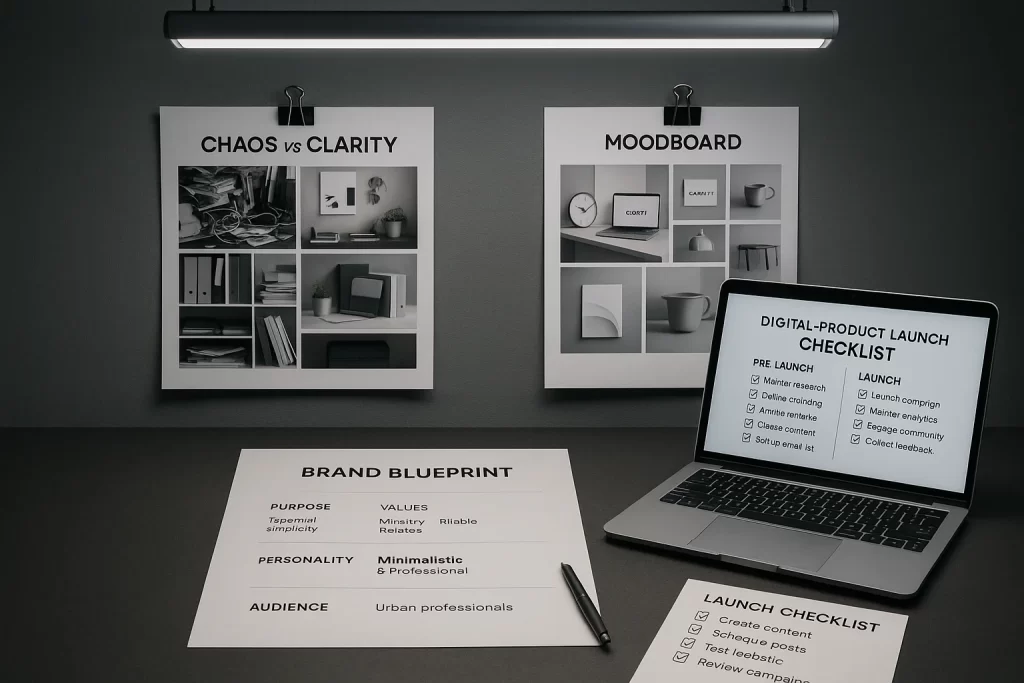
Next, transform that strategic clarity into operational reality. You’ll need a brand name checklist, a trademark search, a domain strategy, and all social handles secured. Many new founders skip this step or do it out of order, leading to last-minute pivots, legal risks, or mismatched branding across platforms.
Use the USPTO’s online tool to confirm trademark availability. Pair that with domain search platforms like Namecheap or GoDaddy. If your preferred domain isn’t available, don’t default to strange suffixes—get creative with words that evoke your brand experience or emotional tone.
Also prepare for your internal brand debut. Draft a team-facing one-pager that explains the brand’s mission, values, and key visuals. This gets buy-in early and prevents confusion later. According to Charles Haggas’ launch guide, “Employees are the first ambassadors of your brand.” Launching externally without internal clarity is like promoting a movie before filming it.

Phase 2: Building the Brand Experience
Visual Identity & Messaging
With your strategic groundwork laid, it’s time to bring your brand to life visually and emotionally. This is where brand experience becomes tangible—where your visual identity, voice, and storytelling intersect to build connection and recognition. Many founders believe branding is just a logo, but real brand experience starts with coherence. Your visuals, tone, and messaging must form a unified front that feels familiar at every touchpoint.
Start with a visual identity framework: typography, color palette, image style, iconography, and spacing. Use tools like Canva or Figma to document everything in a simple brand guide. Think beyond aesthetics—colors evoke emotion, fonts signal credibility or innovation. For example, blue often signals trust in fintech, while bold serif fonts can evoke authority in B2B. A product manager on Reddit shared:
“We rebranded with a softer tone and suddenly our support tickets dropped by 18%. People felt heard before even writing in.”
This is the power of visual empathy.
Next comes the brand voice. Are you warm and aspirational? Bold and disruptive? Witty and casual? Define this before any external messaging begins. Then build foundational assets like a mission statement, tagline, boilerplate bio, and a short founder story. A strong narrative turns a name into a movement.
Use emotional triggers—hope, frustration, ambition—to deepen resonance. Emotional brand launches drive 43% higher engagement across social, according to a case study by The InkLusive. If you’re not making people feel something during launch, you’re leaving brand equity on the table.
Tools & Collaboration Workflow
A compelling brand is nothing without alignment behind the scenes. As your visual identity and messaging take shape, you must synchronize stakeholders—designers, marketers, developers, founders—into one feedback loop. This is where launch teams either thrive or descend into feedback chaos.
Use Loom to record visual feedback and explain design decisions asynchronously. It reduces miscommunication and keeps momentum going. Trello or Jira should house your task lists and workflows. According to Atlassian’s playbook, brands that document launch milestones see a 55% faster execution cycle. And Confluence is invaluable for centralizing decisions and assets.
Set up recurring check-ins via Slack and define who owns what. Otherwise, approvals will stall and inconsistencies creep in. This is where pain points like “everything feels rushed” or “we thought someone else was handling it” emerge. With the right tools, these are entirely avoidable.
Phase 3: Go-To-Market Execution
Launch Campaign Design
This is where vision meets the public. Your brand launch blueprint comes to life through a campaign that must be precise, memorable, and emotionally compelling. Think of it not as one event but a crescendo of carefully timed messaging across multiple touchpoints. According to TeamDDM’s product launch study, campaigns with unified brand messaging across email, social, and PR earned 32% more brand recall in the first 30 days than siloed efforts.
Begin by selecting your priority channels: Instagram and TikTok for consumer-facing brands, LinkedIn and email for B2B, or a hybrid for lifestyle-driven products. Then develop a launch narrative—what story are you telling across this week? Maybe it’s a “behind-the-scenes build,” a founder story, or a before-after transformation. Every asset—email, video, blog—must echo this arc.
Design your assets for emotion and utility. Create launch videos that show transformation, teaser emails that build anticipation, and graphics that prime your audience visually. According to The InkLusive, launch campaigns using emotional storytelling and high-frequency visual branding increased on-page time by 46%.
You can also leverage influencers or niche communities to create early buzz. Target micro-influencers (under 50K followers) with high engagement. They’re more trusted and often willing to co-create launch content. Track engagement KPIs like CTR, saves, shares—not just likes.
Testing & Soft Launches
One of the most overlooked tactics in brand rollouts is the soft launch—a limited, low-pressure debut that acts as both rehearsal and real-world testing lab. Brands that launch internally or to a VIP list before public release catch issues faster and gather usable feedback. Shopify recommends a “VIP-first” strategy, showing that these early adopters are 2.8x more likely to become repeat customers.
Use this phase to A/B test email subject lines, landing page headlines, CTA placements, or even product packaging. Launch to your email list, beta group, or small paid segment on Meta or Google. Ask questions like: Did people understand the offer? Where did they drop off? What did they remember?
“We thought our value prop was clear until five users in a beta call all asked the same question. We rewrote the homepage that night.”
That’s the power of a feedback loop baked into your launch readiness guide.
During this time, track your test metrics but don’t obsess over perfection. You’re testing assumptions, not final performance. Gather testimonials and refine testimonials into content for launch day—think of this like seasoning a dish before serving the full plate.
Phase 4: Post‑Launch Optimization
Performance Monitoring & KPIs
The moment your brand goes live is not the finish line—it’s the starting block. Launching is just the ignition. Sustaining momentum requires ruthless attention to feedback and metrics. As Atlassian’s launch checklist outlines, “successful launches don’t end on launch day; they begin data-driven iteration.” Without performance monitoring, teams risk flying blind, unsure if the campaign resonated, missed the mark, or simply lacked visibility.
Define launch KPIs in advance. What does success look like? Common metrics include traffic spikes (via Google Analytics), engagement rates (likes, shares, time on page), email click-throughs, and early sales or sign-ups. Beyond quantitative, capture qualitative insight through surveys, user interviews, or feedback tools like Typeform or Hotjar.
Segment your metrics by funnel stage—awareness (impressions, press), consideration (website engagement, lead magnets), and conversion (sales, cart adds). According to TeamDDM, brands that measure success across all three stages increase ROI by 47% post-launch.
Be especially vigilant about early user behavior—bounce rates, drop-off points, hesitations. These are signals. One marketing director shared:
“We saw people clicking the product video but not watching past 12 seconds. That alone helped us revise the copy and increase conversion by 18%.”
Numbers without action are noise. Numbers plus insight fuel your next pivot.
Iterative Improvements & Brand Growth
Post-launch isn’t a wind-down—it’s a ramp-up. Use the insight gathered to iterate on messaging, adjust creative, and plan Phase 2 campaigns. This is where brands transition from launch mode to growth engines.
Leverage what worked. If your “why now” narrative drove the most clicks, embed it deeper into your emails. If customers loved a specific testimonial, make it your homepage hook. According to research by UserPilot, launch-phase insights applied over 30–60 days led to a 29% increase in user retention for product-driven brands.
At this stage, activate your content flywheel: testimonials, case studies, how-it’s-made content, press mentions, and user-generated content. Encourage brand advocates to share their experiences. Launch exclusive offers to this early audience—VIP status, referral perks, founder AMA sessions.
Internally, run a retrospective. What slowed you down? Where did clarity suffer? Use tools like Confluence to document learnings, update workflows, and assign next-phase owners.
FAQ
1. What exactly is a brand launch blueprint?
A brand launch blueprint is a strategic roadmap that guides a company through every stage of launching a new brand—from research and naming to go-to-market execution and post-launch feedback. Unlike a random checklist or inspirational blog post, a blueprint is comprehensive, intentional, and designed to align internal teams while delivering a consistent, emotional experience to your audience. It combines visual identity, messaging, campaign planning, and growth metrics into one synchronized workflow. As one Reddit founder put it:
“It’s not just about knowing what to do next—it’s about knowing why, who’s doing it, and how we’ll know it worked.”
A great blueprint reduces ambiguity and increases your odds of long-term resonance.
2. How do I create a successful brand launch checklist step by step?
Start by breaking your launch into four key phases: Pre-launch (research, positioning, naming), Brand Building (design, messaging), Go-To-Market (assets, campaign rollout), and Post-Launch (feedback and iteration). Under each, document key deliverables—like trademark clearance, logo drafts, CTA testing, press outreach, or internal training.
Use a centralized workspace like Notion or Trello to assign owners, deadlines, and linked documents. A startup marketer on Reddit shared:
“Our launch changed everything when we used a shared dashboard instead of scattered emails. It was our North Star.”
If you’re overwhelmed, begin with the pre-launch—get your strategy airtight before touching visuals.
3. How can I launch a brand emotionally without overwhelming resources?
You don’t need a six-figure budget to make people care. Emotional resonance comes from clarity and consistency. Start with a founder story—why did you create this brand? Then tie your messaging to emotions like trust, ambition, or transformation. Use consistent visuals and repeat your mission across social, email, and your landing page.
Video tools like Loom or low-cost editors like InVideo can help bring emotion to life affordably. Focus on emotional branding: tone of voice, customer testimonials, and even product copy should make people feel understood. As one user posted in r/Entrepreneur:
“We couldn’t afford a PR firm. But we shared our journey raw on TikTok. It blew up.”
Authenticity > polish. That’s the secret.
4. What tools should I use for launch coordination and feedback?
Top tools include:
- Loom: async video feedback for designs and updates
- Trello / Jira: task tracking for team collaboration
- Confluence: document centralization
- Typeform / Google Forms: gather pre-launch or post-launch feedback
- Slack: cross-functional communication
These tools reduce email overload and help your team stay aligned. Many Reddit startup teams recommend starting lean with just two: Trello for tasks and Loom for visual updates. One founder mentioned:
“We wasted 3 weeks emailing logo tweaks. Loom cut that back to 2 days.”
Efficient tools = faster, more confident launches.
5. How do I recover or iterate if the launch doesn’t resonate initially?
If your launch underperforms, don’t panic—pivot, don’t scrap. Start by gathering feedback: use surveys, customer interviews, or analyze where people dropped off in the funnel. Were they confused by messaging? Uninspired by visuals? Disconnected from your value proposition?
Revisit your blueprint and adjust phase by phase—tighten the headline, change the hero image, retarget with a new narrative. According to HBR, brands that iterate within 30 days of launch recover lost momentum 68% faster than those that stall.
A Reddit user shared:
“Our launch flopped. But when we shifted from ‘fastest software’ to ‘simplest solution,’ conversions tripled. Messaging is everything.”
Iterate publicly. Your audience will appreciate transparency.
Conclusion
Launching a brand is not an artistic performance; it’s a strategic execution of clarity, alignment, and emotional resonance. A brand launch blueprint gives you more than structure—it gives you control in a space often dominated by chaos. From establishing a brand’s voice to building a cross-functional team workflow, to deploying a go-to-market strategy that converts interest into loyalty, each step in this blueprint is designed to reduce uncertainty and amplify impact.
You’ve seen how emotional storytelling can outshine production budgets, how soft launches can prevent public failures, and how iteration is not a fallback—it’s a core strategy. Whether you’re a startup founder, brand strategist, or creative director, the path forward is the same: plan rigorously, communicate clearly, launch iteratively, and lead emotionally.
The real power of a blueprint isn’t that it gives you answers—it gives you the confidence to ask the right questions at the right time. If your audience is going to believe in your brand, you must first believe in the process behind it.