
Exploring Brand Growth Pathways: Strategies for Sustainable Expansion
Introduction
In today’s saturated digital economy, the term “brand growth” no longer implies mere visibility or aggressive marketing campaigns. Rather, brand growth pathways describe the structured strategies a business adopts to expand sustainably, authentically, and profitably. With over 90% of brand-first companies outperforming their competitors in customer loyalty and retention, modern brands must shift from traditional sales-centric tactics to customer-centric brand experiences rooted in emotional engagement, trust, and long-term value creation.
These pathways are grounded in brand identity, not just sales figures. They center on frameworks that embrace emotional storytelling, sustainable positioning, and agile growth mechanisms. From startups to multinationals, the shift towards values-driven growth reflects a global transformation in how brands earn and retain loyalty. This article dissects the science, stories, strategies, and signals that define modern brand growth pathways, drawing from leading authorities such as GreenHouseUVU, AGN.org, ProductSchool, and more.
Understanding Brand Growth Pathways
Brand growth pathways are not mere marketing tricks or growth hacks; they represent a deliberate roadmap for how a brand scales its influence, trust, and value over time. Unlike random promotions or one-off campaigns, growth pathways provide strategic direction. They define the who, what, how, and why behind brand decisions—from launching a new product to entering a new market. At their core, these pathways ensure that every move a brand makes aligns with its long-term vision and core values. Instead of aiming for viral visibility, they focus on sustainable resonance.
One of the most established tools to frame growth strategy is the Ansoff Matrix. This model lays out four major paths: market penetration, market development, product development, and diversification. For example, a brand might use penetration tactics (like discount campaigns or influencer partnerships) to grow within existing markets, or it might pursue diversification by launching new products in new verticals. However, brand growth pathways go a step further—they filter these tactics through brand identity. That means ensuring expansion doesn’t dilute the brand’s core messaging or customer perception.
Today, leading brands such as Airbnb and Glossier have shown how growth pathways can be both methodical and human-centric. These companies scaled by deeply understanding their audience and building narratives that stayed authentic even as they entered global markets. They didn’t grow through brute force; they grew through strategic empathy and coherent storytelling. In contrast, companies that chase growth without this grounding often end up with fractured messaging, mismatched product-market fit, or brand fatigue.
“Growth does not ‘droppeth from heaven’ — it requires strategic action.” – AGN.org
This quote reflects a common pain point—many entrepreneurs assume growth will naturally follow once their product is “good enough.” But in reality, brands grow when their strategy is rooted in structured, values-driven planning. Without a clear pathway, even the best ideas can falter in crowded markets.

The Science Behind Sustainable Brand Growth
Sustainable brand growth is no longer a luxury—it’s a strategic imperative in an era where brand trust, social alignment, and long-term value creation define business success. The concept of “growth at all costs” has been replaced by measured, mission-aligned expansion that factors in social responsibility, customer well-being, and operational agility. Brands that thrive today understand that fast growth without a foundational strategy leads to instability. Instead, the science of sustainable brand growth hinges on balancing short-term performance with long-term resilience, all while maintaining consistent brand integrity.
One of the most telling metrics of this shift comes from McKinsey, which reports that the average life span of public companies has plummeted from 90 years in the 1930s to just 15–18 years today. The root cause? Fragile growth models and lack of strategic adaptability. Companies that fail to integrate resilience, customer relevance, and innovation cadence into their branding find themselves overtaken by more agile, values-driven competitors. To survive, brands must build durability into every layer of their strategy—from product development and messaging to internal culture and customer experience.
That’s where frameworks like AGN.org’s “Genius of the AND” come into play. This model challenges the traditional trade-off mentality (e.g., “Do we grow fast or grow sustainably?”) and instead advocates for integrative thinking—growing fast and sustainably, being creative and data-driven, pushing innovation and preserving trust. The most successful brands are no longer those that dominate through scale alone, but those that evolve with purpose and resilience at their core.
Another overlooked component of sustainability is emotional durability. Brands that build emotional resonance with customers—through shared values, meaningful narratives, and ethical action—create long-term affinity that outlives trends and channels. This is why brands like Patagonia or LEGO aren’t just known for their products—they’re trusted for what they stand for. They have engineered growth models that are as human as they are strategic.
Solving Customer Challenges : Many founders mistakenly equate sustainability with slowness or softness. But in truth, sustainability is the engine of longevity, not its brake.
Building Brand Equity Through Authenticity
At the heart of every thriving brand is a reservoir of brand equity—the intangible value built through perception, trust, and emotional connection. But in today’s saturated market, this equity can’t be faked or bought with ad spend. It must be earned through authenticity. A brand is no longer defined by its logo, tagline, or color palette. It’s defined by how it behaves, how consistently it delivers on its promises, and how deeply it resonates with its audience across every touchpoint. Authenticity is the engine behind loyalty, advocacy, and premium positioning.
One of the key pillars of authentic branding is storytelling. Brands like Patagonia and Warby Parker don’t just sell jackets or glasses—they sell values. They narrate who they are, why they exist, and how their actions reflect their beliefs. This emotional clarity creates a gravitational pull that performance marketing alone can’t match. When a customer feels that a brand understands their needs or shares their worldview, the relationship transcends transactions. It becomes a partnership.
GreenHouseUVU says it best: “Your brand isn’t simply your logo, colors, or tagline—it’s the complete experience you deliver and the perception you create.” This experience includes tone of voice, packaging, social media interactions, employee culture, and even post-sale support. When these pieces align consistently, customers begin to associate the brand with reliability, relevance, and relatability—core ingredients of brand equity.
The trap many startups fall into is chasing visibility without first defining their brand essence. This leads to inconsistency, brand confusion, and customer distrust. For instance, if your Instagram is playful but your customer service emails are formal and stiff, you’re sending mixed signals. Authentic branding eliminates this misalignment by anchoring all decisions in a unified identity.
Solving Customer Challenges : Founders often believe branding starts with a logo, but true brand equity is built from the inside out—through mission, actions, and experience consistency.
Brand Growth Strategies for Digital-First Businesses
For digital-first businesses, the brand growth playbook is fundamentally different from traditional models. These companies operate in ecosystems where speed, visibility, and adaptability are key—but without sacrificing clarity or connection. The strategies that power growth in this space are rooted in value-driven content, product experience, and community ecosystems, rather than paid impressions or splashy one-time campaigns.
One of the most powerful digital growth models today is Product-Led Growth (PLG). In this framework, the product itself is the main vehicle for acquiring, activating, and retaining customers. Tools like Slack, Notion, and Figma grew largely through user love and word-of-mouth—not massive ad budgets. By delivering exceptional value from the very first interaction, these brands build organic adoption loops. According to OpenView, PLG companies grow faster and more efficiently because they minimize friction and let the product sell itself.
Complementing PLG is content-led SEO strategy, where brands produce educational, search-optimized content that addresses user pain points and positions them as thought leaders. Webflow, for example, has mastered this model by offering tutorials, templates, and branding insights that help creators—not just sell them a CMS. This builds trust and search visibility while aligning with the brand’s mission of empowering designers.
Social-led growth is another pathway. Brands like Glossier and Duolingo have built tribes through transparent, humorous, and interactive social presence. Their content feels less like advertising and more like community-building. By leveraging user-generated content, polls, behind-the-scenes videos, and creator partnerships, these brands cultivate a sense of belonging—which translates into long-term loyalty.
What unites all these strategies is a commitment to value-first interactions. Instead of pushing messages, they pull users in through authenticity and utility. The brand becomes a helpful presence, not an intrusive ad.

Strategic Partnerships and Ecosystem Expansion
In the realm of modern brand growth, going it alone is no longer the smartest path forward. Strategic partnerships offer an exponential way to grow—faster, wider, and more credibly—by tapping into the existing trust, audiences, and infrastructures of aligned brands. These aren’t just co-marketing gimmicks; when done right, they are ecosystem-expanding collaborations that create mutual value and long-term equity.
Take the example of Apple and Nike—a collaboration that fused hardware, software, and lifestyle branding into a singular value proposition. Or Shopify and TikTok, which integrated e-commerce with creator-driven marketing. These partnerships work because they serve a shared audience, reinforce complementary strengths, and amplify each brand’s core mission. Strategic alliances like these help brands enter new markets, improve credibility, and even co-innovate on products or experiences.
The key to successful partnerships lies in brand alignment. It’s not about teaming up with the biggest player—it’s about finding the right cultural and strategic fit. A shared audience base, similar brand values, and mutual benefit must be evident from the start. When the alignment is genuine, the result is not just growth in numbers, but a stronger brand narrative.
Startups can benefit just as much as large enterprises. Whether it’s a SaaS company integrating with a complementary tool, a DTC brand partnering with a values-aligned influencer, or a sustainability brand co-launching with a nonprofit—smart partnerships can unlock new growth dimensions that solo efforts rarely achieve.
“Strategic partnerships accelerate brand growth and credibility.”
Solving Customer Challenges : Many brands try to scale solo and burn out quickly. This section reveals how leveraging network effects and shared trust can be a smarter, faster path.
Brand Metrics that Matter: Measuring Growth
Growth without measurement is just guesswork. For any brand to scale meaningfully, it must track the right metrics—those that not only indicate success but also guide smart decision-making. While vanity metrics like pageviews or likes can be encouraging, they often don’t reflect real brand health. What matters more are KPIs that capture engagement, trust, sentiment, and customer retention.
A few core metrics should anchor every brand growth strategy. First, Customer Lifetime Value (CLTV) reveals how much revenue a brand can expect from a single customer over time. This metric not only reflects profitability but also how well a brand retains and deepens customer relationships. Second, Net Promoter Score (NPS) is a gold standard for loyalty—how likely customers are to recommend your brand. A high NPS typically signals strong emotional connection and service excellence.
Another essential but often overlooked metric is brand sentiment. Using tools like Sprout Social or Hotjar, businesses can gauge how audiences feel about the brand across platforms—positive, neutral, or negative. When brand sentiment trends downward, even amidst traffic growth, it’s a warning sign that perception may be misaligned with experience. Meanwhile, organic share of voice—how much your brand is mentioned in non-paid spaces relative to competitors—can give you an edge in positioning.
Effective brands don’t just track metrics—they act on them. They use data to iterate on messaging, redesign customer journeys, and refine tone of voice. Metrics become a feedback loop, not just a scoreboard. For example, if CLTV is dropping but traffic is high, it might suggest that while the brand is attracting interest, it’s failing to retain or upsell. In that case, efforts might shift toward improving onboarding, user education, or product quality.
Solving Customer Challenges : Many marketers track surface-level data but struggle to align it with brand goals. This section helps clarify what to watch—and why.
Overcoming Growth Obstacles and Scaling with Resilience
Every growth journey eventually hits a wall. Whether it’s innovation fatigue, leadership burnout, cultural misalignment, or operational overload, obstacles are inevitable. But how a brand responds to these moments determines whether it merely scales or scales with resilience. Building a brand that endures means preparing for friction and creating systems that adapt, recover, and evolve.
One common challenge brands face is misalignment between rapid growth and internal culture. As teams expand and goals diversify, it’s easy for the original mission to get diluted. Employees may feel disconnected from the brand’s purpose, and customers may detect a shift in tone or service. This is where internal brand alignment becomes critical—ensuring that everyone, from leadership to customer service, is guided by the same core values.
Another roadblock is message dilution. As brands grow into new channels, geographies, or product lines, their voice can become inconsistent or generic. To maintain clarity, leaders must document and enforce brand guidelines, tone standards, and customer experience principles. Brands that scale successfully maintain coherence across scale—every new customer touchpoint reinforces the same promise.
From a leadership perspective, growth can trigger complexity overwhelm. More customers, more platforms, more metrics. Without clear delegation systems or feedback loops, leadership teams can burn out trying to micromanage expansion. This is where agile systems and decision autonomy play a key role. Empower teams to own decisions while maintaining strategic guardrails.
The AGN.org framework emphasizes what it calls the “Genius of the AND”—a mindset that challenges false trade-offs. It’s not about choosing between structure or speed, vision or execution, creativity or process. Brands that scale with resilience learn to hold both. They develop a muscle for strategic duality.
“The most successful organizations don’t settle for false dichotomies but pursue visionary and pragmatic goals simultaneously.” – AGN.org
Unified Brand Growth Checklist
After navigating the complexities of brand strategy, storytelling, partnerships, and measurement, brands often ask: “Where do we start?” That’s where a unified growth checklist becomes invaluable. It distills strategy into execution, ensuring that every brand action is both intentional and aligned with long-term goals. Think of it as a diagnostic tool—a compass for navigating growth without veering off-brand.
- Define Brand Essence and Values
Before scaling, articulate what your brand stands for. What core values drive decision-making? What emotional impression should every interaction leave on the customer? This forms the DNA of your brand growth pathway. - Build a Customer-Centric Narrative
Successful brands don’t make themselves the hero—the customer is the protagonist. Craft a story that centers on customer pain points, aspirations, and transformation, with your brand acting as the guide. - Ensure Clarity and Consistency Across Platforms
From Instagram to invoices, every touchpoint should feel unmistakably “you.” Voice, visuals, and values must sync. A clear brand builds trust. An inconsistent one breeds confusion. - Integrate ESG and Sustainability Values
Especially for next-gen consumers, environmental and social ethics are not optional. Aligning your brand with purposeful action—whether it’s sustainable packaging or inclusive hiring—can be a major growth differentiator. - Set Strategic KPIs and Goals
Don’t just measure what’s easy. Define what success looks like and which metrics will guide your journey. Whether it’s Net Promoter Score, CLTV, or brand sentiment, clarity in metrics leads to clarity in action. - Foster Resilience and Agility
Market dynamics change fast. Build systems that allow you to pivot without panic. That means cross-training teams, adopting agile project frameworks, and de-risking through scenario planning. - Develop Strategic Partnerships
Map your ecosystem. Who shares your audience but doesn’t compete? How can you collaborate to multiply impact? Partnerships accelerate growth—when guided by mutual value and trust. - Embrace Continuous Learning and Iteration
No brand is ever “done.” Collect feedback, test messaging, run retrospectives. Growth is a loop, not a ladder. The best brands are always evolving, because their customers are too.
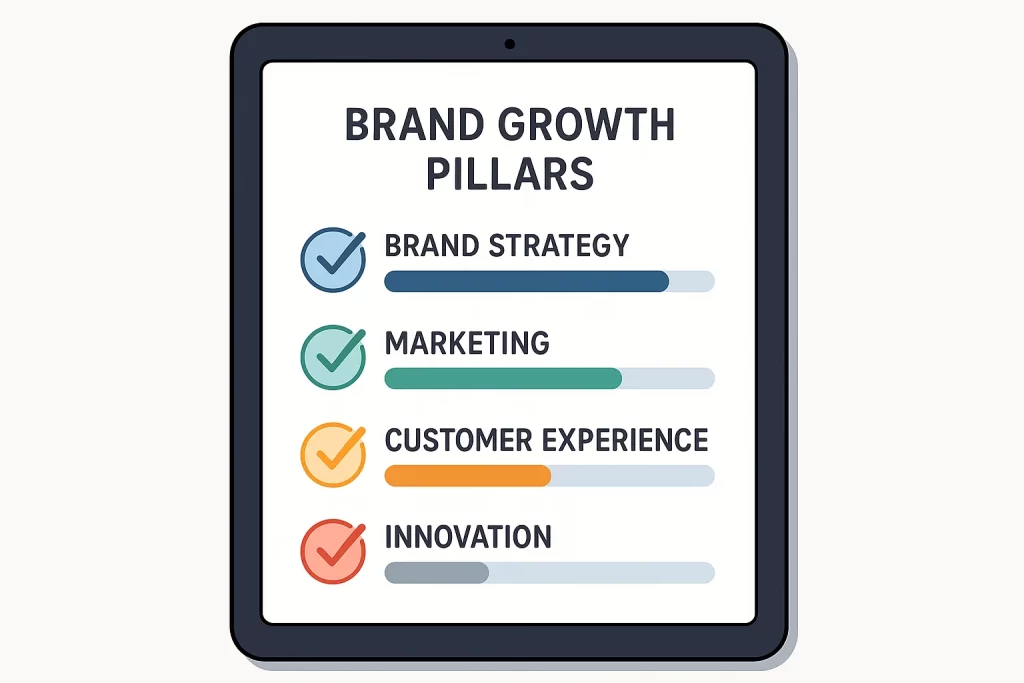
By checking these eight pillars regularly, a brand ensures that it’s not just growing in size—but also in strength, clarity, and loyalty. Growth becomes not just a goal, but a reflection of deeper alignment.
FAQ
1. What is brand growth and why does it matter?
Brand growth refers to the strategic process of expanding a brand’s influence, loyalty, reach, and value in the minds of its audience. It’s more than just increasing sales—it’s about deepening emotional connection, building brand equity, and becoming a trusted presence in a crowded marketplace. As one Reddit user put it on /r/startups: “Feels like without it, our team is just floating in chaos…” Without a structured approach to brand growth, companies often drift, change direction too frequently, or fail to create a consistent experience that builds long-term customer loyalty.
2. How do growth pathways differ from marketing strategies?
Marketing strategies focus on specific campaigns or tactics—like running Facebook ads or optimizing for SEO. Growth pathways, on the other hand, are higher-level blueprints. They guide where the brand is heading, how it evolves, and what principles it must uphold throughout expansion. Think of it this way: if marketing strategies are tools, growth pathways are the architectural plans. They consider audience alignment, narrative direction, and ecosystem positioning to ensure all tactics are cohesive and intentional.
3. How do I scale my brand without losing its soul?
Start by protecting your brand essence—your values, tone, and mission—as you expand. Whether you’re launching new products, entering new markets, or hiring quickly, every decision should align with that core. Brands like Webflow and Mailchimp have scaled while keeping their human, creative identity intact by using tone guidelines, community engagement, and consistent storytelling. Scaling isn’t about diluting your brand—it’s about amplifying what already works, at a larger scale.
4. What’s the best way to measure if my brand is growing?
Track both quantitative metrics (like CLTV, NPS, and organic engagement) and qualitative signals (like customer feedback, brand sentiment, and word-of-mouth referrals). Tools like Sprout Social or Hotjar can help analyze perception. If you’re seeing growth in revenue but a decline in sentiment or retention, that’s a sign your brand might be misaligned with customer expectations. True growth is balanced across reach, reputation, and relevance.
5. Can a startup use these strategies or are they only for big brands?
Absolutely—perhaps even more effectively. Many of these strategies are low-cost but high-impact, especially for startups focused on community, niche authority, or product excellence. For instance, a small SaaS startup used PLG tactics and founder-led storytelling to double its monthly recurring revenue in under six months—without a paid ad. Brand growth doesn’t require a massive budget; it requires clarity, consistency, and courage.
Conclusion
In a world where attention spans are fleeting and digital noise is louder than ever, brand growth isn’t just a business objective—it’s a strategic necessity for long-term survival. But true growth isn’t accidental, nor is it simply a function of ad budgets or product launches. It’s the result of deliberate, values-driven, and customer-centric decisions made consistently over time. From understanding your unique brand growth pathway to building emotional equity, leveraging partnerships, and measuring what truly matters, each step reinforces a brand’s ability to not just scale—but to scale with substance.
The most enduring brands—those we trust, advocate for, and return to—are not the ones that scream the loudest, but the ones that stay true to their mission, even while evolving. They grow by aligning every action with a core identity, adapting to customer needs, and staying relevant in a rapidly shifting landscape. Whether you’re a scrappy startup or an established business, sustainable brand growth is within reach—if you’re willing to do the foundational work.
As you’ve now seen, brand growth pathways offer more than strategies—they provide clarity in chaos, direction amid distraction, and purpose in the pursuit of scale. The challenge isn’t just to grow—it’s to grow wisely, authentically, and intentionally.