
Brand Opportunity Mapping: How to Find and Fill Gaps in Your Market
Most brands fail to scale not because their product is flawed or their marketing isn’t working, but because they’re playing in an already saturated sandbox. This is where Brand Opportunity Mapping becomes an indispensable strategic tool. A 2023 Gartner report noted that 73% of marketing leaders admit their growth efforts stall due to a failure to uncover untapped segments. Rather than guess at what customers might want or mimic competitors, brands that use opportunity mapping base their moves on identified whitespace—needs, desires, and use cases that remain under-addressed.
Brand Opportunity Mapping is not just for enterprise giants. Whether you’re an emerging DTC brand, a mid-market SaaS, or a service-based startup, this approach helps align strategy with unmet demand.
This article will guide you through what brand opportunity mapping is, why it matters, how to identify gaps, and how to translate those insights into growth strategies. You’ll also learn how to measure the success of your mapping, avoid common pitfalls, and explore tools that can help.
What Is Brand Opportunity Mapping?
Definition & Scope
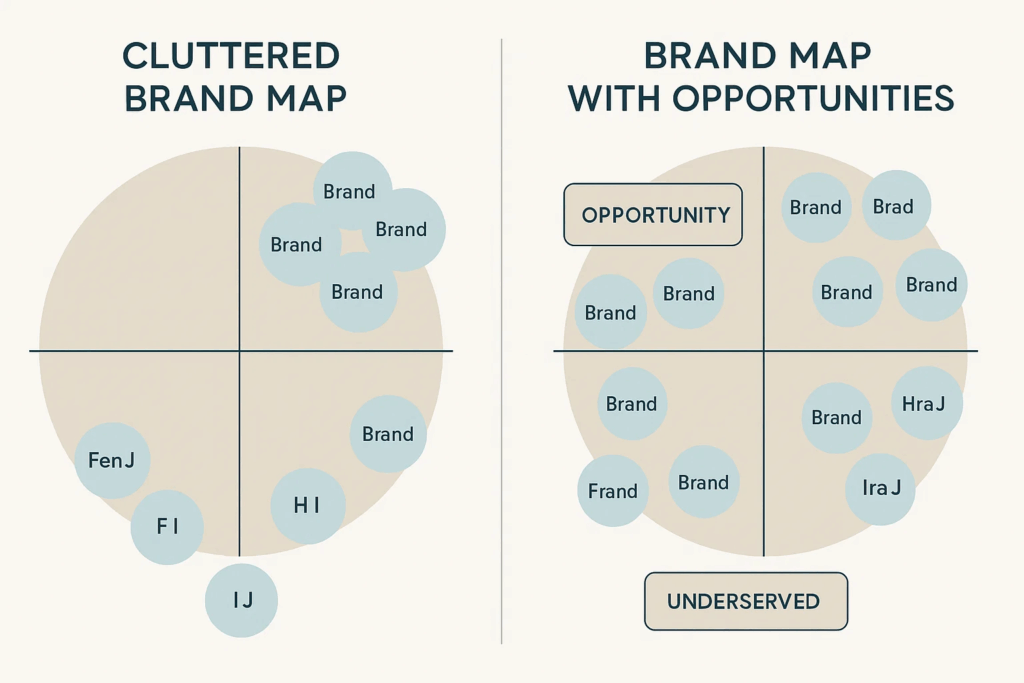
Brand Opportunity Mapping is the strategic process of identifying unmet needs, underserved market segments, and unclaimed territory within your industry. It leverages customer insights, market trends, and competitor weaknesses to map out where new value can be created.
Unlike traditional market research, which often validates known problems, opportunity mapping seeks to expose blind spots and emerging needs that haven’t been properly addressed.
“Opportunity mapping reveals the gaps you didn’t know existed—and that your competitors still don’t see.” — Ana Ferris, Brand Strategist at Futureproof Labs.
This process uses tools like customer interviews, competitive audits, survey data, and even keyword trend analysis to locate this whitespace.
Why Mapping Whitespace Matters
Failing to identify whitespace often leads to pricing wars, low differentiation, and stale positioning. Brands risk plateauing because their audience has no new reason to stay engaged. For startups, the risk is existential—if you’re not solving a unique problem, you’re a commodity.
A 2022 Forrester study found that brands using opportunity mapping frameworks were 3.5x more likely to successfully launch new products and retain market leadership.
The Hidden Costs of Market Blind Spots
Pain of Missing Whitespace
Blind spots are expensive. When brands rely solely on historic data, intuition, or what competitors are doing, they end up fighting for the same share. This creates brand fatigue—both internally and for customers.
Common blind spot indicators:
- Conversion rates drop despite ad budget increases
- New feature launches don’t move the needle
- Product-market fit feels elusive despite traction
These symptoms indicate the brand is addressing needs already well-served—or misreading evolving consumer sentiment. Without brand opportunity mapping, teams often misallocate resources chasing incremental gains rather than transformative whitespace.
“The most dangerous phrase in business is ‘we’ve always done it this way.’” — Grace Hopper
Real-World Failure Examples
Consider the case of Kodak. Despite inventing the first digital camera, they failed to capitalize on digital photography’s whitespace, choosing instead to protect their film business. By the time they acknowledged the gap, others had captured the market.
Another example is Yahoo!, which passed on buying Google and Facebook. Their missed insight wasn’t just financial—it was a failure to map where digital behavior was heading.

How to Identify Market Gaps (Step‑by‑Step)
Step 1: Conduct a Competitive Landscape Audit
Begin by visually mapping out the positioning, pricing, and feature sets of your top five to ten competitors. Use frameworks like perceptual maps, Blue Ocean Strategy grids, or even simple SWOT comparisons to pinpoint overlap zones and highlight potential white space segments.
Ask:
- Who is everyone targeting?
- What unique customer segments are underrepresented?
- What key value propositions are repeated across the board?
A brand opportunity mapping tool for SaaS startups might reveal, for example, that all competitors emphasize AI-based automation—but none offer concierge-style onboarding or emphasize ethical AI design.
Step 2: Discover Underserved Customer Needs
Use customer interviews, sentiment analysis tools, and public forums to identify recurring unmet needs. Tools like AnswerThePublic, Quora, and Reddit surface real-time frustrations, phrased in the language your audience already uses.
Look for:
- Emotional signals (“I hate when apps assume I’m tech-savvy.”)
- Long-tail phrases like “budget CRM with human onboarding”
- Needs ignored in mainstream messaging
These insights often highlight psychographic gaps that demographics don’t reveal.
Step 3: Use Surveys and Data to Validate the Gaps
Once hypotheses emerge, validate them through quantitative data. Surveys, heatmaps, and user behavior analytics will show whether the gap is real, growing, and valuable.
Design a quick validation loop:
- Draft 5–7 “gap hypotheses” based on step 1 & 2
- Create customer survey questions or A/B tests around them
- Analyze which gaps score highest on urgency + willingness to pay
If 60% of customers say they’d pay for a feature no competitor currently offers, you’ve struck gold.
Mapping Insights to Brand Strategy
Translate Gaps into Strategic Positioning
Finding a market gap is only half the equation. The real value comes from translating whitespace into brand action. This is where insight becomes impact.
To transform a validated gap into strategy, consider these layers:
- Positioning : Define your brand around the newly uncovered gap. What makes your solution uniquely relevant to this under-served segment?
- Messaging : Reflect the emotional and functional needs discovered in your research. Use the customer’s own language to show understanding.
- Product Offering : Can you tweak or redesign your offer to match the whitespace? Even small changes—like adjusting pricing tiers or packaging—can deliver major differentiation.
“When your product lines up perfectly with an unspoken customer need, you don’t sell—you resonate,” says Sam Horn, author of POP!
Example: A fintech startup uncovers that Gen Z users feel overwhelmed by traditional budgeting tools. Instead of launching another dashboard-heavy app, they reframe their product as a “financial wellness coach for overwhelmed creators,” speaking directly to the whitespace.
Prioritize the Right Opportunities
Not all gaps are created equal. You need a system to filter opportunities based on ROI, fit, and feasibility. This prevents wasted resources on flashy but impractical ideas.
Use a decision matrix based on three core criteria:
- Market Attractiveness: Is there enough demand and urgency?
- Strategic Fit: Does this align with your brand’s mission and capabilities?
- Ease of Execution: Can you bring it to life with your current resources?
Plot these on a simple 2×2 chart (High Value/Low Feasibility vs High Feasibility/Low Value) and highlight the sweet spot: quick wins with high resonance.
“Chasing every white space is a trap. Focus on the one where you can lead, not just compete.” — April Dunford, positioning consultant
Measuring Success & Iteration
Define Metrics for Opportunity Mapping
Once your brand has activated a whitespace opportunity, it’s critical to measure impact. Unlike traditional KPIs that focus solely on sales or traffic, opportunity mapping requires strategic KPIs that measure relevance, resonance, and retention.
Key metrics include:
- Share of Voice (SOV) in whitespace-related search queries
- Lead Quality from new segments (conversion rates, time to close)
- NPS or Customer Sentiment before vs after positioning shift
- Ad Engagement on whitespace messaging vs legacy campaigns
Use tools like Google Search Console, Brandwatch, Hotjar, and customer surveys to gather mixed-method insights.
Example: A skincare brand shifting to serve hormonal acne in midlife women saw a 2.3x increase in email CTRs when campaigns used new, empathetic whitespace language. Their NPS climbed by 11 points post-launch.
Build a Feedback Loop
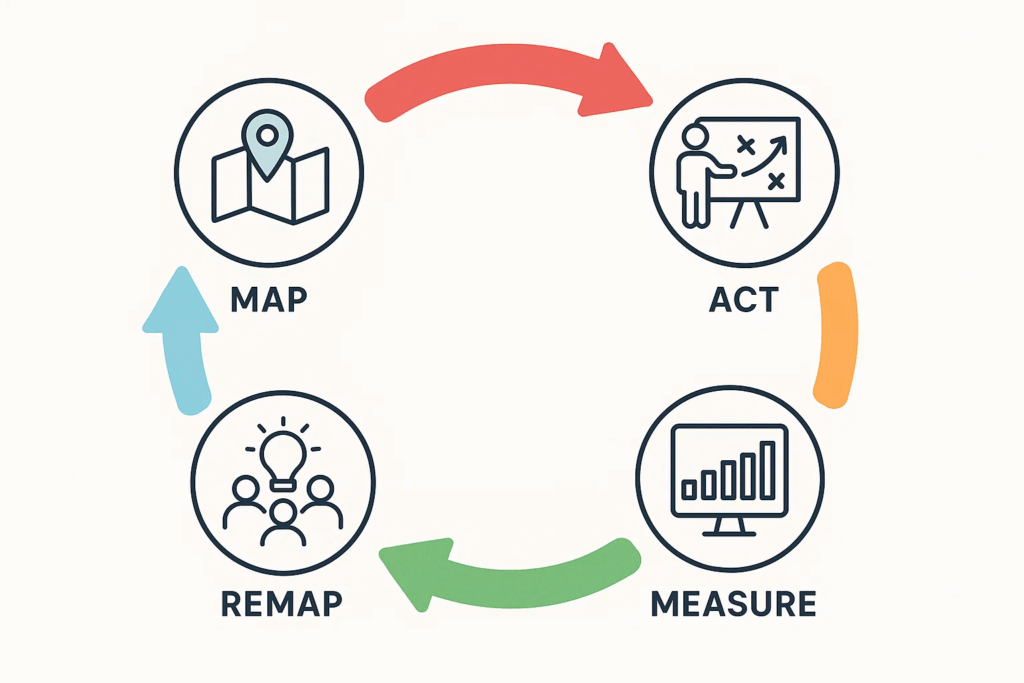
Markets shift fast. A mapped opportunity today could become tomorrow’s red ocean. To stay relevant, institutionalize a mapping habit by baking it into your strategic calendar.
Best practices:
- Conduct mapping sprints quarterly or post-major campaign
- Set up automated alerts for emerging trends or pain point phrases
- Rotate in fresh voices (CX, sales, support) to avoid echo chambers
“Opportunity mapping isn’t a one-time strategy. It’s a lens through which to continuously view your business,” says Lindsay Pedersen, author of Forging an Ironclad Brand.
The strongest brands aren’t just responsive—they’re preemptive. By using feedback loops, they become fluent in market evolution.
FAQ
1.How long does brand opportunity mapping take?
The initial mapping process typically takes 3–5 weeks, depending on your market size and available data. With pre-built templates and focused sprint teams, agile brands can compress this into a 2-week cycle.
2.Can brand opportunity mapping help small businesses?
Absolutely. In fact, small businesses are uniquely positioned to act on whitespace quickly because they aren’t bound by legacy systems. Many micro-brands scale by owning niche gaps larger players overlook.
“We built a six-figure Etsy store by targeting people who wanted wedding decor that felt less ‘Pinterest perfect’ and more ‘real.’” — r/entrepreneur
3. Should I hire a consultant or do it in-house?
If your team lacks research or strategy capabilities, a consultant can speed up and deepen the process. But many small brands find success starting with DIY mapping using customer feedback, SEO tools, and competitor audits.
4. How often should we revisit the map?
At minimum: quarterly. If your industry evolves rapidly (tech, wellness, e-commerce), aim for monthly signal scans. Whitespace closes quickly, so timing is key.
5. Is it worth the effort if I already know my customer?
Yes—because even the most loyal customer segments evolve. You may know your current buyer, but whitespace mapping helps you understand your future buyer or new use cases that extend lifetime value.
Conclusion
Brand Opportunity Mapping is more than a tactic—it’s a lens through which to see your brand’s future. By shifting focus from what competitors are doing to what your ideal customer still needs, you stop chasing trends and start creating territory.
In this guide, we uncovered:
- How to audit your competitive landscape to find overlap
- Techniques to uncover emotional, functional, and cultural whitespace
- Methods to validate and translate gaps into brand strategy
- Metrics and loops to make mapping a continuous advantage
Remember, the brands that lead tomorrow are mapping today. They aren’t waiting for the market to tell them what to do—they’re listening for whispers, watching for signals, and acting before the rest of the category even notices.
Start your opportunity map now. Your next leap forward is likely hiding in plain sight.