
Mapping the Brand Value Chain: From Creation to Consumer Impact
Introduction: Why the Brand Value Chain Matters Now More Than Ever
Let’s face it: branding today is a whole different ball game. It’s no longer just about slick logos or catchy taglines. In this hyper-connected, consumer-powered world, brand success comes down to something much deeper—how every part of your business delivers value that customers can feel, stakeholders can measure, and competitors can’t ignore. That’s where the Brand Value Chain (BVC) becomes a game-changer.
Originally introduced by Kevin Lane Keller and Donald R. Lehmann, the BVC isn’t just a theoretical framework—it’s a practical roadmap. It shows how your brand-building efforts, from creative campaigns to customer service and even supply chain operations, ripple outward to shape how people perceive you and how your business performs financially. In a time when CMOs are under the microscope to prove the ROI of every branding dollar, the BVC helps connect the dots between creative energy and cold, hard results.
If your leadership team still sees branding as a “nice-to-have” rather than a growth driver, you’ll want to keep reading. We’ll break down each stage of the BVC, share real-world examples from both legacy icons and bold disruptors, and offer tools you can use to diagnose weak spots and amplify what’s working.
In today’s climate—where markets are crowded, investors are watching closely, and consumers expect authenticity—the ability to tie brand actions to real financial outcomes isn’t just a smart strategy. It’s survival. So, let’s unpack how the Brand Value Chain can help your brand not just survive, but thrive.
Here’s a humanized version of that paragraph, with a warm and conversational tone while keeping the original depth and detail:
Stage 1: Marketing Program Investment – The Genesis of Brand Value
Brand value doesn’t magically materialize—it’s the outcome of deliberate, thoughtful investment. At the very first stage of the Brand Value Chain, everything begins with marketing program investments. This is where your strategy gets real—where ideas turn into experiences that shape how people see and feel about your brand. From eye-catching ads to product design, employee onboarding to social media campaigns, every touchpoint is a chance to make your brand resonate. And when done right, these investments build more than visibility—they build trust and loyalty.
Take Apple, for instance. Its global influence wasn’t built on flashy ads alone. It was earned through a steady, cohesive commitment to design, storytelling, customer experience, and even internal culture. Every ad, every store visit, every product unboxing speaks the same elegant, emotionally resonant brand language. That kind of alignment doesn’t just happen—it’s built, piece by piece, through smart marketing investments that work in harmony.
But spending money isn’t enough. To drive real brand equity, your investments need to be aligned, intentional, and measurable. That’s why savvy organizations turn to tools like marketing mix modeling to figure out what’s really moving the needle—whether it’s a boost in media spend, a packaging refresh, or a surge in influencer engagement. According to McKinsey, brands that invest consistently and strategically can grow up to 23% faster over five years. That’s not just a stat—it’s a wake-up call for marketers still stuck in reactive mode.
Not all marketing tactics are created equal, though. The impact depends on how well each element fits the bigger picture. A beautiful campaign can fall flat if the in-store experience doesn’t match the promise. And an inspiring message can ring hollow if employees aren’t trained to deliver on it. As EdrawMax puts it, “A good investment program will positively influence the next stages.” But that influence only sticks when every piece of the puzzle speaks the same brand truth.
To make it work, brand leaders should categorize their efforts—think product innovation, promotion, channel strategy, and internal branding—and connect them to tangible outcomes. A smart dashboard tracking metrics like brand awareness, trial rates, or social engagement can turn spending into strategy. Because at the end of the day, this first stage isn’t just about making noise. It’s about making meaning—and laying the groundwork for lasting brand value.
Stage 2: Customer Mindset – Turning Exposure Into Emotion
Once you’ve introduced your brand through thoughtful investments, the real magic begins—not in your media reports, but in the minds and hearts of your customers. This stage, known as Customer Mindset, is where branding starts to take root. It’s not enough for people to see your logo or hear your tagline. They need to feel something. They need to recognize your values, see themselves in your story, and form meaningful connections that go beyond the product.
At its core, customer mindset is made up of five key elements: awareness, association, attitude, attachment, and activity. These steps build on each other, moving a person from “I’ve heard of them” to “I love what they stand for” to “I tell my friends about them.” Maybe someone sees your brand online (awareness), starts to associate you with creativity or trust (association), feels good about your products (attitude), becomes emotionally invested (attachment), and ultimately recommends or keeps buying from you (activity). When all five click, you’ve moved from being seen to being significant in their lives.
Of course, you can’t build this kind of emotional equity by guessing. Today’s best brands go far beyond focus groups. They track the customer mindset using tools like brand recall surveys, NPS, and association maps, but they also tap into the real-time pulse of the internet. Social listening, sentiment analysis, and monitoring what people are actually saying on TikTok, Reddit, or Quora gives a raw, unfiltered view of how you’re really doing. Are people praising your ethics—or dragging you for greenwashing? These moments are goldmines of insight.
Take Reddit, for instance. If your brand keeps popping up in threads about great customer service, that’s a signal you’re on the right track. But if you’re getting called out for inconsistent values or tone-deaf messaging, that’s an early warning sign you can’t afford to ignore. The good news? These conversations give you a chance to fix problems before they affect your bottom line.
And this matters even more if you’re trying to win over Gen Z. According to McKinsey, 82% of Gen Z consumers check a brand’s social values before buying. They’re not just buying stuff—they’re buying what you stand for. If your branding doesn’t reflect their beliefs, they’ll move on—and they won’t look back.
So, ask the hard questions: Do people think of us when it counts? Are the values we’re projecting actually showing up in how we’re perceived? Is there real emotional stickiness behind our message? Because as branding expert Kevin Lane Keller puts it, these aren’t “nice-to-haves”—they’re the foundation of lasting brand equity.
Ultimately, a strong customer mindset is what transforms campaigns into connections and one-time buyers into lifelong fans. In a world overloaded with choices, the brands that win aren’t the loudest—they’re the ones that know how to turn exposure into emotion, and awareness into advocacy.
Stage 3: Market Performance – Translating Mindset Into Metrics
Once your brand has found a place in people’s hearts and minds, it’s time to answer the big question: is it actually moving the needle? This third stage—Market Performance—is where the emotional groundwork starts to show up in the numbers. It’s where branding meets business impact, and where CMOs can start tying brand equity to bottom-line results.
When a brand has earned trust and built loyalty, the payoff isn’t just fuzzy sentiment—it’s real, measurable advantages. Think pricing power, faster growth, stronger customer lifetime value (CLTV), or even the ability to stretch into new categories. Luxury players like Louis Vuitton or disruptors like Tesla aren’t just selling bags or cars—they’re selling identity, aspiration, and belief. That emotional capital lets them charge more and grow faster—because people aren’t just buying the product, they’re buying what it represents.
This is the stage where branding stops being a “nice story” and starts being hard evidence. When you see higher repeat purchases, increased share of voice, or customers sticking around longer, you’re witnessing brand equity in action. And that’s what every marketer ultimately needs to show: that the storytelling, design, and experience-building work of the last two stages is translating into results stakeholders care about.
Of course, proving that link is easier said than done. One of the toughest challenges here is attribution—figuring out how much of your revenue growth is really due to branding versus a new product feature or a big promo push. And then there’s the time lag: customers might love your refreshed brand now, but it could take months before that love shows up in the numbers.
That’s where tools like marketing mix modeling (MMM) and multi-touch attribution come in. These approaches help you slice through the complexity of the customer journey and identify which brand moments are actually driving sales and loyalty. Say your CLTV goes up after a major rebrand—MMM can help you figure out if that’s because your message is resonating more deeply or if something else (like pricing tweaks or improved UX) played a bigger role.
Market performance is also your window into growth opportunities. With predictive analytics and heatmaps, you can see which customer groups or regions are catching on fastest—and double down where momentum is strongest. Whether you’re exploring new geographies or considering brand extensions, this stage gives you the data to plan smarter.
At the end of the day, strong market performance means your brand isn’t just loved—it’s working. It’s delivering value that can be seen on a dashboard, discussed in a boardroom, and reinvested into future growth. When you turn emotional connection into commercial impact, you’re not just measuring success—you’re building a self-sustaining loop of value, trust, and strategic advantage.
Stage 4: Shareholder Value – Capturing the Financial Impact
At the end of the day, all branding roads should lead to one destination: financial value. This final stage of the Brand Value Chain zooms out to see the big picture—how all your brand-building work translates into real returns for investors, leadership, and the market. While earlier stages focused on creating emotional bonds and shifting customer behavior, this stage is about turning equity into economic advantage.
Strong brands don’t just make people feel something—they make companies more valuable. They drive higher market valuations, inspire investor confidence, and help businesses bounce back faster during tough times. Think about Coca-Cola, Apple, or Google—these are more than household names. Their brands act like armor, helping them hold onto customers, maintain pricing power, and ride out market fluctuations with resilience. That kind of consistency is exactly what investors love.
For public companies, the connection between brand strength and shareholder value is especially clear. Analysts pay close attention to P/E ratios, stock volatility, and brand health indexes when evaluating a company’s future. A brand that’s trusted, respected, and culturally relevant can push those numbers in the right direction. That’s why CFOs and investor relations teams are increasingly teaming up with marketers—because brand perception is no longer just a “soft” metric. It’s a strategic asset that belongs in boardroom conversations.
Data backs this up. According to BrandZ, the Top 100 global brands have outperformed the S&P 500 by nearly 200% over the past decade. That’s a massive gap—and a clear signal that branding isn’t just about storytelling. It’s about creating real business value, improving funding access, and de-risking investment decisions. During IPOs or funding rounds, strong brand perception can be the extra push that seals the deal.
Leading companies don’t just talk about brand value—they measure it. They include brand KPIs in earnings reports, use brand audits during mergers or due diligence, and link perception shifts to financial metrics. And as ESG (Environmental, Social, and Governance) criteria grow in importance, brands aligned with sustainability and ethical leadership are seeing stronger stock performance and deeper trust from institutional investors. The message is clear: doing the right thing—and being known for it—pays off.
Multipliers – The Catalysts That Amplify or Erode Value
Now, here’s where the Brand Value Chain gets even more interesting. It’s not just a one-way street. The model includes multipliers—influential factors that either accelerate or drag down your progress from one stage to the next. Think of them as your brand engine’s gears. If one slips, the whole machine stutters.
The first multiplier, Program Quality, is all about execution. A brilliant strategy means nothing if your campaign is confusing, poorly targeted, or off-brand. Mixed messages or clunky experiences can damage your brand faster than you built it—so consistency across every touchpoint is critical.
Next is Marketplace Conditions. You might have the perfect pitch, but are you entering a crowded space with razor-thin margins or a fast-moving category with room to shine? Channel access, competitor moves, and even consumer trends shape how well your branding translates into performance.
Then there’s Investor Sentiment—a powerful force at the end of the value chain. Even if your brand is killing it with consumers, if investors lose faith (due to scandals, poor forecasts, or regulatory pressure), the financial benefits can evaporate fast. It’s a reminder that brand equity is fragile, and trust—once broken—takes time to rebuild.
Some critics argue the BVC feels too linear for today’s fast-moving, data-driven world. And they’re right in some ways. That’s why forward-thinking brands are building in agile feedback loops. By using real-time analytics and predictive tools, they’re not just measuring—they’re adapting in the moment. That agility keeps the value chain relevant, reactive, and ready for anything.
To stay sharp, many companies are now using diagnostic dashboards to monitor their multipliers. These tools help flag weak spots—like declining sentiment or inconsistent messaging—before they spiral into bigger issues. It’s not about perfection; it’s about being proactive.
From Theory to Application: Brand Value Chain Diagramming
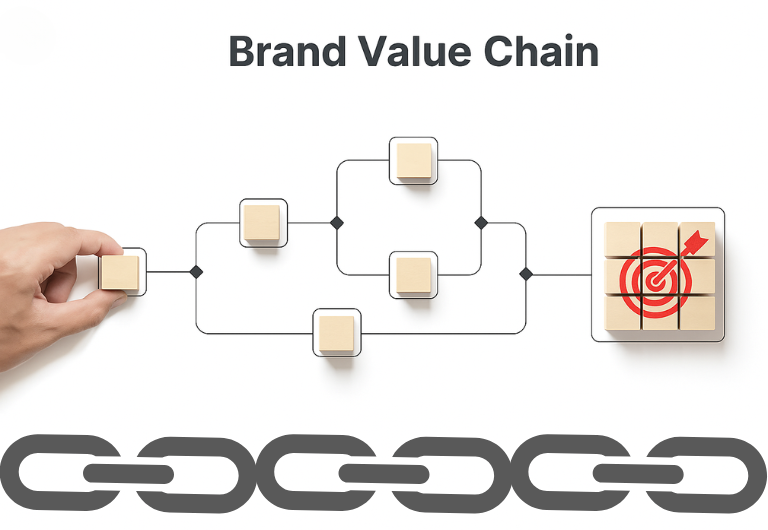
Understanding the BVC is one thing—seeing it is another. That’s why turning it into a visual framework is so powerful. Whether you’re presenting to execs, aligning cross-functional teams, or planning next quarter’s strategy, a well-crafted Brand Value Chain diagram makes your branding story crystal clear.
Tools like EdrawMax, Lucidchart, and Miro are perfect for this. Your diagram should map out:
- The four core stages (Marketing Program Investment → Customer Mindset → Market Performance → Shareholder Value).
- Feedback loops that show how insights and outcomes flow back to inform future actions.
- Highlighted multipliers, color-coded for clarity (green = strong, yellow = at risk, red = needs attention).
- Key performance indicators like NPS, CLTV, stock volatility, or ESG scores at each stage.
Want to go a step further? Overlay your customer journey data to get a fuller picture of how people interact with your brand—and how those interactions connect to business outcomes. The result? A 360° view that links creativity, consumer behavior, and financial impact in one unified map.
When done right, this diagram transforms the BVC from a theory into a living, breathing blueprint. It becomes a shared language across departments and a strategic north star for brand-building decisions. In a world where attention is scarce and trust is priceless, mastering this chain—and mapping it well—could be your brand’s smartest move.
Here’s a humanized version of your “Evolution Over Time” and “Final Takeaway” sections—keeping the insight while making it feel more conversational, motivating, and grounded:
Evolution Over Time: Iteration and Flexibility
Let’s be honest—branding isn’t something you set and forget. In a world where consumer preferences change overnight and new technologies constantly shake things up, the Brand Value Chain has to stay flexible. It’s not a rigid model—it’s a living, breathing system that evolves with your brand and your market.
The best brands don’t treat the BVC as a one-time strategic exercise. They treat it like a regular check-up—a way to catch what’s working, fix what’s not, and spot new opportunities before the competition does. That means revisiting each stage—marketing investments, customer mindset, performance metrics, and shareholder value—on a consistent basis. A quarterly rhythm is a great place to start. Use that time to review customer sentiment, run brand health surveys, scan the market for competitive shifts, and keep an eye on key financial markers like market share and revenue velocity.
And if something’s not clicking? That’s not failure—it’s feedback. The key is to build feedback loops into every stage of the chain. Maybe a campaign didn’t lift brand awareness the way you hoped. Rather than shrugging it off, use that signal to investigate, learn, and adapt. The smartest teams don’t just track—they tweak, so every investment gets smarter over time.
One way to bring this to life is by setting OKRs (Objectives and Key Results) tied directly to your brand’s value chain. Let’s say your goal this quarter is to boost unaided recall. Your key results might track ad reach, engagement, and sentiment. That’s not just good marketing—that’s precision steering. It turns the BVC from a theoretical model into a real-time performance system that keeps your brand moving forward, even when the market shifts beneath your feet.
Final Takeaway: The Brand Value Chain Is Your Strategic Compass
When you truly get it, the Brand Value Chain becomes more than just a diagram—it becomes your strategic compass. It helps you connect the dots between creativity and cash flow, between storytelling and shareholder value. It empowers CMOs and brand leaders to speak the language of finance without losing the soul of the brand.
This framework is your playbook for turning brand-building into measurable business growth. It shows you where your efforts are paying off, where friction is slowing you down, and where the next big opportunity might be hiding. It helps branding earn—and keep—a seat at the leadership table by proving that great marketing doesn’t just build buzz. It builds equity. It builds momentum. It builds trust.
But here’s the real magic: the BVC doesn’t just measure the brand—it matures it. The brands that win today aren’t just louder or flashier. They’re adaptive, intentional, and transparent. They know how to listen, learn, and level up. They don’t treat equity like a finish line—they treat it like a relationship that’s nurtured over time.
So if you take one thing away, let it be this: great brands don’t just market well—they measure well. Master the Brand Value Chain, and you’ll do more than build a strong brand—you’ll build one that earns loyalty, commands respect, and creates lasting value for everyone it touches. That’s not just smart branding. That’s smart business.
FAQ
1. What is a brand value chain?
The brand value chain is a structured model that explains how brand value is created and transferred across different stages of business activity. It tracks the process from marketing investment to customer mindset and ultimately to shareholder value. This framework helps brands understand how various actions impact brand equity. It’s widely used for strategic brand management and performance evaluation.
2. What are the four stages of a brand value chain model?
The brand value chain model includes four key stages: marketing program investment, customer mindset, brand performance, and shareholder value. Each stage reflects how value flows from internal activities to external impact. These stages are connected through value stages and influenced by key moderators. Together, they reveal the pathway from branding activities to business outcomes.
3. How do I create a brand value chain diagram?
To create a brand value chain diagram, start by mapping out the four stages: marketing investment, customer mindset, brand performance, and financial impact. Then, add connecting arrows and insert moderating factors like market conditions or customer profiles between stages. Use simple visuals or software like PowerPoint or Canva to structure it clearly. Make sure to align it with your specific brand touchpoints and KPIs.
4. What are the moderating factors that influence the creation of brand value?
Moderating factors include program quality, market conditions, customer characteristics, and competitive activity. These elements can accelerate or hinder the flow of value across the chain. For example, a strong media strategy may enhance customer mindset, while economic downturns could reduce financial returns. Recognizing these factors helps optimize each stage of the brand value chain.
5. How can I use the value chain concept to improve my customer’s experience?
You can use the value chain concept to identify which internal activities directly affect customer perceptions and satisfaction. By optimizing marketing programs, service delivery, and feedback loops, you enhance the customer mindset stage. Aligning every touchpoint to deliver consistent value strengthens brand trust. Ultimately, it leads to better experiences and increased loyalty.
6. What are the benefits of performing a value chain analysis?
Performing a value chain analysis helps identify which activities add the most value to your brand and which need improvement. It clarifies internal processes and how they affect customer outcomes and financial performance. This insight enables better resource allocation, cost efficiency, and strategic focus. It’s a powerful tool for both brand growth and operational excellence.