
How CAC and LTV Determine Your Business Profitability
Introduction
In today’s highly competitive business environment, companies are constantly searching for ways to grow while maintaining profitability. Many businesses focus heavily on increasing sales, launching new marketing campaigns, and acquiring more customers. However, sustainable business growth depends on understanding the economics behind customer acquisition and long-term value.
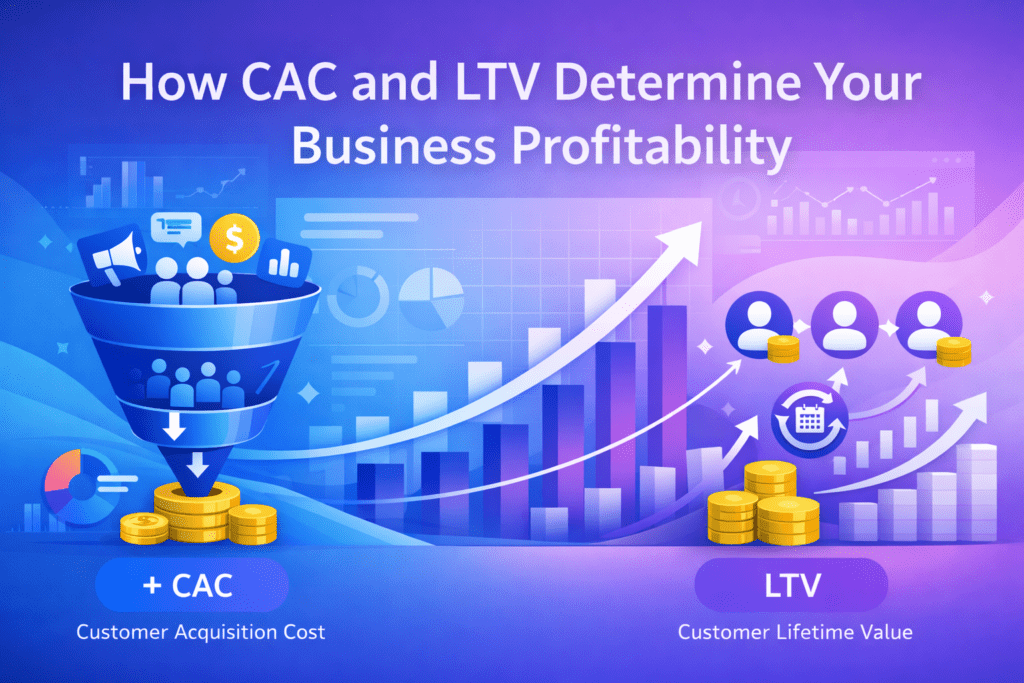
Two of the most important metrics that determine a company’s financial health are Customer Acquisition Cost (CAC) and Customer Lifetime Value (LTV). These metrics help businesses evaluate whether their marketing and sales investments are producing profitable outcomes.
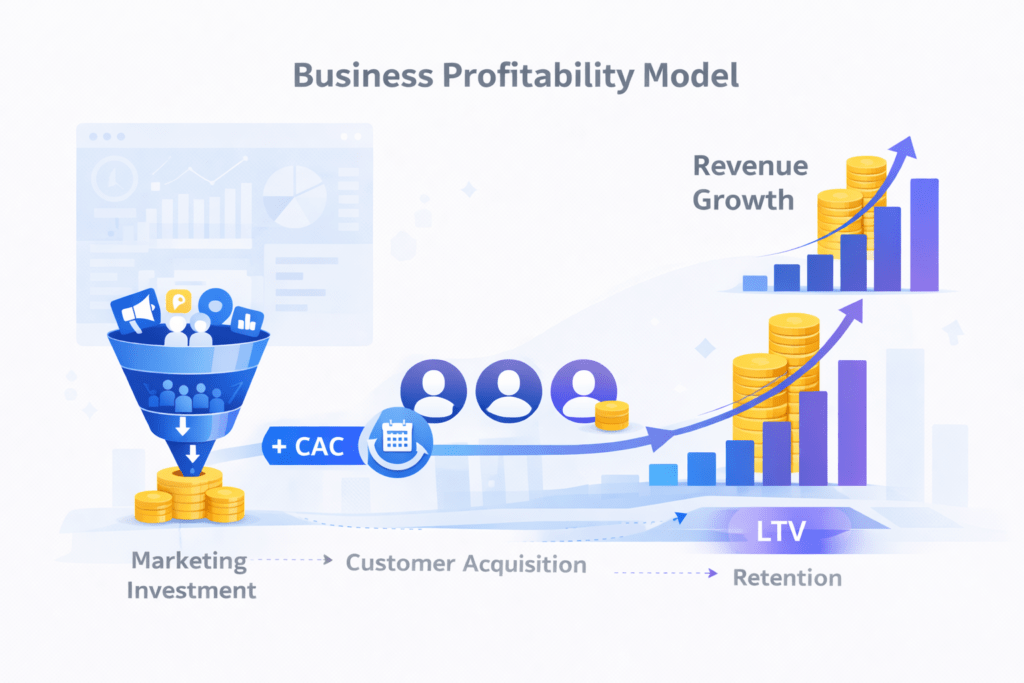
Customer Acquisition Cost tells you how much money your company spends to acquire a new customer, while Customer Lifetime Value measures how much revenue that customer generates over the course of their relationship with your brand. When analyzed together, CAC and LTV provide a powerful framework for understanding profitability, scalability, and long-term business sustainability.
For startups, SaaS companies, ecommerce brands, and service businesses, mastering the relationship between CAC and LTV is essential for building a successful growth strategy. If the cost of acquiring customers is too high relative to the value they bring, the business will eventually struggle to maintain profitability. On the other hand, if the lifetime value of customers significantly exceeds acquisition costs, the company can scale confidently and invest more aggressively in marketing.
This guide will explain what CAC and LTV are, how to calculate them, why they matter, and how businesses can optimize these metrics to achieve sustainable profitability.
What is Customer Acquisition Cost (CAC)?
Customer Acquisition Cost, commonly known as CAC, refers to the total amount of money a company spends to acquire a new customer. It includes all marketing and sales expenses associated with attracting and converting prospects into paying customers.
Understanding CAC is crucial because it helps businesses determine the efficiency of their marketing strategies. If a company spends too much money acquiring customers, profitability can quickly decline even if sales are increasing.
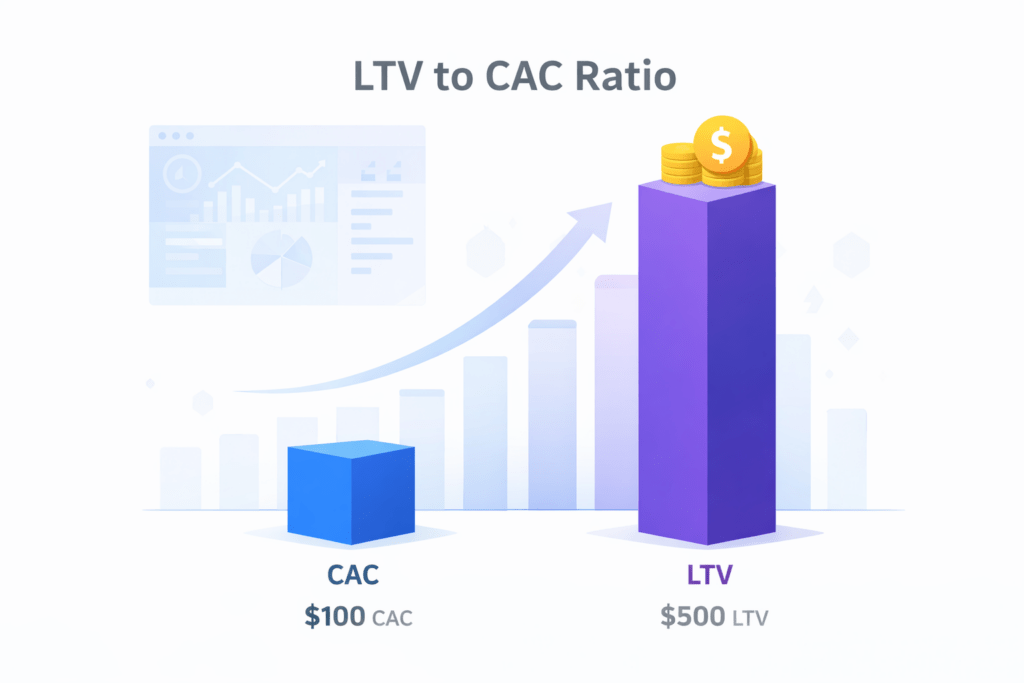
For example, if a company spends $10,000 on marketing and sales in a month and acquires 100 new customers during that period, the CAC would be $100 per customer.
Businesses must carefully monitor CAC because it directly impacts profitability. A high CAC means the company is spending too much to acquire customers, while a lower CAC indicates more efficient marketing and sales operations.
CAC is particularly important for startups and growth-stage companies. Investors often evaluate CAC to understand whether a business has a scalable growth model.
Customer Acquisition Cost Formula
The formula for calculating CAC is relatively simple.
Customer Acquisition Cost = Total Sales and Marketing Expenses ÷ Number of New Customers Acquired
Sales and marketing expenses typically include:
Advertising costs
Marketing campaign expenses
Sales team salaries
Marketing software tools
Content marketing costs
Agency fees
Promotional activities
For instance, if a business spends $50,000 on marketing and sales and acquires 500 customers, the CAC would be $100 per customer.
Tracking CAC over time helps businesses identify trends and optimize their marketing strategies to improve efficiency.
What is Customer Lifetime Value (LTV)?
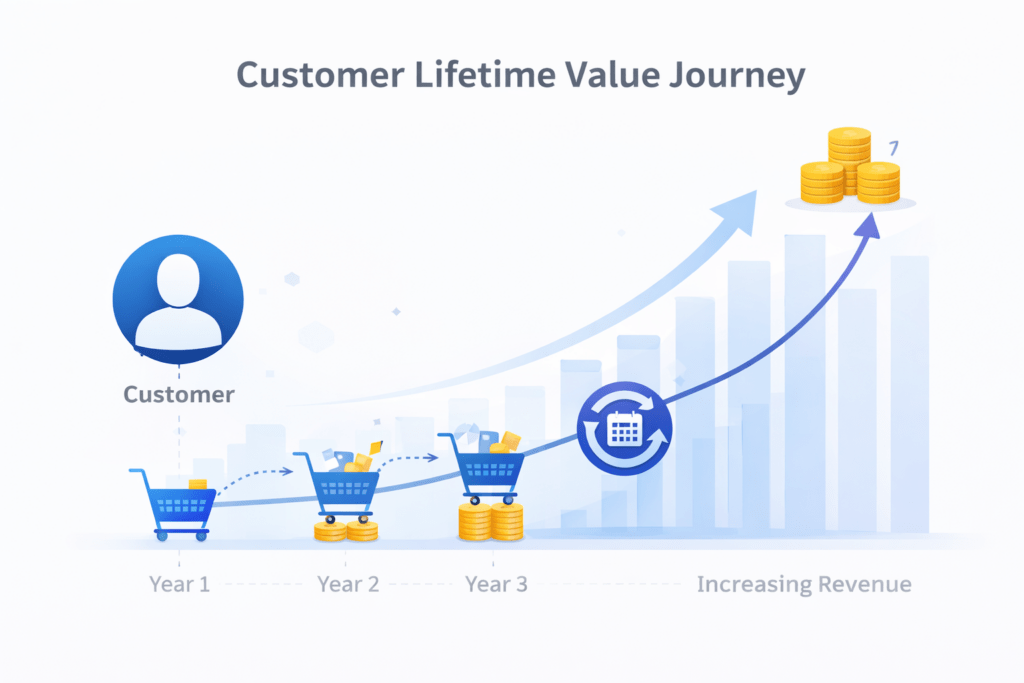
Customer Lifetime Value, or LTV, represents the total revenue a business expects to earn from a customer during the entire duration of their relationship with the company.
Unlike CAC, which focuses on acquisition costs, LTV measures long-term customer value. It helps businesses understand how much a customer contributes to revenue over time.
For example, if a customer purchases products worth $200 each year and remains a customer for five years, their lifetime value would be $1,000.
Businesses with higher LTV (Customer Lifetime Value) can afford to invest more in customer acquisition because each customer generates more revenue over time.
LTV is particularly important for subscription-based businesses, SaaS companies, e-commerce brands, and service providers that rely on repeat purchases.
Customer Lifetime Value Formula
There are several ways to calculate LTV depending on the business model. A common formula used by many businesses is:
LTV = Average Purchase Value × Purchase Frequency × Customer Lifespan
Average Purchase Value refers to how much a customer spends per transaction.
Purchase Frequency refers to how often customers make purchases within a specific time period.
Customer Lifespan refers to the average length of time a customer continues purchasing from the company.
For example:
Average purchase value = $50
Purchase frequency = 6 purchases per year
Customer lifespan = 4 years
LTV = 50 × 6 × 4 = $1,200
This means each customer generates approximately $1,200 in revenue over their lifetime.
Understanding the CAC vs LTV Relationship
The true power of these metrics comes from analyzing the relationship between CAC and LTV. Businesses use the LTV to CAC ratio to determine whether their customer acquisition strategy is profitable.
The LTV:CAC ratio measures how much value a customer generates compared to the cost required to acquire them.
If the lifetime value of a customer is significantly higher than the acquisition cost, the business is operating profitably.
Ideal LTV to CAC Ratio
Many industry experts recommend maintaining an LTV to CAC ratio of approximately 3:1.
This means the revenue generated from a customer should be at least three times the cost required to acquire them.
A ratio lower than 1:1 indicates the business is losing money on each customer.
A ratio of 3:1 suggests a healthy and sustainable growth model.
A ratio higher than 5:1 may indicate that the company is underinvesting in marketing and could grow faster by acquiring more customers.
Maintaining the right balance between CAC and LTV ensures that businesses can grow while remaining profitable.
Why CAC and LTV Are Critical for Business Profitability
Understanding CAC and LTV provides valuable insights into the financial health of a business. These metrics influence several aspects of business strategy and decision-making.
Marketing Efficiency
CAC, or Customer Acquisition Cost, allows companies to evaluate the performance of their marketing campaigns by measuring the cost associated with acquiring a new customer. Businesses can compare different marketing channels to determine which ones generate customers at the lowest cost.
For example, a company might discover that organic search traffic generates customers at a significantly lower cost than paid advertising.
By focusing on high-performing channels, businesses can reduce acquisition costs and improve profitability.
Sustainable Growth
Companies that maintain a healthy LTV to CAC ratio can scale their marketing efforts without sacrificing profitability.
When businesses know that each new customer generates long-term value, they can confidently invest in marketing campaigns to accelerate growth.
This is why many successful startups prioritize optimizing CAC and LTV early in their growth journey.
Better Financial Planning
CAC and LTV help businesses forecast revenue and plan budgets more effectively.
Knowing how much revenue each customer generates allows companies to estimate future income based on projected customer acquisition rates.
This information is essential for strategic planning and financial stability.
Investor Confidence
Investors frequently evaluate CAC and LTV when assessing startup opportunities.
A business with strong unit economics, meaning a healthy relationship between CAC and LTV, is more attractive to investors because it demonstrates sustainable profitability.
Strategies to Reduce Customer Acquisition Cost
Reducing CAC is one of the most effective ways to improve business profitability. Businesses can implement several strategies to lower acquisition costs while maintaining strong growth.
Improve Marketing Targeting
One of the primary reasons for high CAC is inefficient marketing targeting.
By focusing on the right audience segments, businesses can increase conversion rates and reduce wasted advertising spend.
Advanced targeting techniques such as customer personas, behavioral data, and demographic analysis help businesses attract high-quality leads.
Invest in Content Marketing and SEO
Organic traffic is one of the most cost-effective customer acquisition channels.
Content marketing strategies such as blogging, search engine optimization, and educational resources attract potential customers without ongoing advertising costs.
Over time, a strong SEO (search engine optimization) strategy can significantly reduce CAC (customer acquisition cost).
Optimize Conversion Rates
Conversion rate optimization involves improving website design, landing pages, and user experience to increase the percentage of visitors who become customers.
Even small improvements in conversion rates can dramatically reduce acquisition costs.
Businesses can conduct A/B testing to determine which messaging, layouts, and offers produce the best results.
Use Referral Programs
Referral programs encourage existing customers to recommend products or services to friends and colleagues.
Referred customers typically have higher trust and lower acquisition costs compared to traditional marketing channels.
Many successful companies have scaled their growth through referral marketing strategies.
Strategies to Increase Customer Lifetime Value
Increasing LTV allows businesses to generate more revenue from each customer relationship. This significantly improves profitability.
Focus on Customer Retention
Retaining existing customers is often more profitable than acquiring new ones.
Businesses can improve retention by providing excellent customer service, consistent communication, and high-quality products.
Loyal customers are more likely to make repeat purchases and recommend the brand to others.
Upselling and Cross-Selling
Upselling encourages customers to purchase higher-value products, while cross-selling promotes complementary products or services.
These strategies increase the average purchase value and contribute to higher lifetime value.
For example, ecommerce businesses often recommend related products during checkout.
Subscription Models
Subscription-based business models are particularly effective at increasing customer lifetime value.
By offering recurring services or memberships, companies can generate predictable revenue streams while building long-term customer relationships.
Many SaaS companies rely heavily on subscription models to maximize LTV.
Improve Customer Experience
Positive customer experiences lead to stronger brand loyalty and repeat purchases.
Businesses that prioritize customer satisfaction through personalized experiences, responsive support, and high-quality products often achieve higher LTV.
CAC and LTV in SaaS and Startup Business Models
SaaS companies and startups rely heavily on CAC and LTV metrics to measure growth potential and financial sustainability.
Subscription-based businesses invest significantly in customer acquisition because they expect to recover those costs through long-term recurring revenue.
However, if customer churn is high or LTV is too low, the business may struggle to achieve profitability.
This is why SaaS companies closely monitor additional metrics such as:
Customer retention rate
Churn rate
CAC payback period
Monthly recurring revenue
These metrics offer more information about the relationship between acquisition costs and long-term value.
Common Mistakes When Measuring CAC and LTV
Despite their importance, many businesses miscalculate CAC and LTV due to incomplete data or incorrect assumptions.
Ignoring Hidden Costs
Some companies only include advertising expenses in CAC calculations and ignore other costs such as salaries, tools, and overhead.
This can lead to inaccurate results and misleading conclusions.
Overestimating Customer Lifetime
Businesses sometimes assume customers will remain active for longer than they actually do.
This results in inflated LTV estimates and unrealistic profitability projections.
Focusing Only on Acquisition
While acquiring new customers is important, businesses must also invest in retention strategies.
Ignoring customer retention can lead to high churn rates and reduced lifetime value.
Real-World Example of CAC and LTV
Consider an e-commerce business that spends $20,000 per month on marketing and acquires 400 new customers.
CAC = $20,000 ÷ 400 = $50
If the average customer spends $80 per purchase and makes four purchases per year for three years:
LTV = 80 × 4 × 3 = $960
LTV to CAC ratio = 960 ÷ 50 = 19.2
This extremely high ratio indicates that the business has a highly profitable acquisition strategy.
Such a company could potentially increase marketing investment to accelerate growth while maintaining strong profitability.
The Future of Data-Driven Profitability Models
As businesses become more data-driven, metrics like CAC and LTV will continue to play a central role in decision-making.
Advancements in analytics, artificial intelligence, and customer data platforms allow companies to track customer behavior more accurately than ever before.
These technologies help businesses optimize marketing strategies, personalize customer experiences, and improve profitability.
Companies that leverage data effectively will gain a significant competitive advantage in the modern digital economy.
Conclusion
Customer Acquisition Cost and Customer Lifetime Value is one of the most powerful metrics for evaluating business profitability. CAC measures the investment required to acquire customers, while LTV represents the long-term revenue those customers generate. When analyzed together, these metrics offer helpful details about marketing efficiency, growth potential, and financial sustainability. Businesses that maintain a healthy LTV to CAC ratio can confidently invest in growth strategies, knowing that each new customer contributes to long-term profitability.
By reducing acquisition costs, improving customer retention, and increasing lifetime value, companies can build scalable and sustainable business models. In an increasingly competitive marketplace, mastering CAC and LTV is not just an advantage—it is a necessity for long-term business success.
Frequently Asked Questions (FAQs)
What is Customer Acquisition Cost (CAC)?
Customer Acquisition Cost (CAC) is the total amount a business spends to acquire a new customer. This includes marketing expenses, advertising costs, sales team salaries, and other promotional activities used to attract and convert customers.
What is Customer Lifetime Value (LTV)?
Customer Lifetime Value (LTV) is the total revenue a business expects to earn from a customer throughout their entire relationship with the company. It helps businesses understand how valuable each customer is over time.
Why is the CAC to LTV ratio important?
The CAC to LTV ratio is important because it helps businesses measure profitability and sustainability. If the lifetime value of customers is significantly higher than the cost to acquire them, the business model is considered healthy.
What is the ideal LTV to CAC ratio?
The ideal LTV to CAC ratio is generally 3:1. This means the value generated from a customer during their lifetime should be at least three times the cost required to acquire them.
How can businesses reduce Customer Acquisition Cost?
Businesses can reduce CAC by optimizing marketing campaigns, focusing on high-converting channels, improving SEO performance, using referral programs, and increasing conversion rates on their websites.
How can companies increase Customer Lifetime Value?
Companies can increase LTV by improving customer experience, offering loyalty programs, providing excellent customer support, and implementing upselling and cross-selling strategies.
How do CAC and LTV impact startup growth?
CAC and LTV are essential metrics for startups because they determine financial sustainability. If CAC is higher than LTV, the startup may struggle to maintain profitable growth.
Which industries rely heavily on CAC and LTV metrics?
Industries such as SaaS, eCommerce, fintech, subscription services, and digital marketing companies rely heavily on CAC and LTV metrics to measure customer profitability and growth.
