
Designing Persuasion Architecture for Emotionally Resonant Brands

Introduction
Modern branding has evolved beyond logos, slogans, and aesthetic consistency. In an era where consumer attention is fragmented and skepticism is high, brands are under immense pressure to do more than just look good—they must feel good to their audiences. Yet despite investing heavily in design and storytelling, many companies fail to create genuine, emotional resonance with their target markets.
This disconnect often stems from a missing strategic layer: Brand Persuasion Architecture.
Rooted in behavioral science and emotional psychology, persuasion architecture provides a structured framework to design not just what a brand communicates, but how, when, and why it communicates—through every channel, touchpoint, and interaction. It is the blueprint that orchestrates brand experiences in a way that subtly guides behavior, triggers emotions, and cultivates loyalty over time.
According to research published in the Journal of Consumer Psychology, brands that evoke strong emotional responses are 3 times more likely to be recommended by customers and 2 times more likely to be chosen over competitors, even when prices are higher. This highlights a truth many marketers overlook: rational persuasion is short-lived; emotional persuasion endures.
This article explores how to architect a persuasive brand from the ground up—starting with its beliefs and messaging hierarchy, through to sensory design, behavioral nudges, and emotional engagement strategies. By the end, readers will understand how to implement a persuasion-first framework that aligns branding with emotional intelligence, behavioral cues, and measurable loyalty metrics.
Semantic Triple Highlights
- Persuasion architecture structures emotional triggers across brand ecosystems.
- Emotional brand building amplifies loyalty, memory, and revenue.
- Behavioral brand psychology aligns user intent with emotional outcomes.
In doing so, this article doesn’t just outline what persuasion architecture is—it demonstrates how to use it to build a memorable, emotionally resonant brand that influences behavior at every step.
Models & Frameworks in Persuasion Architecture
This section unpacks the science and strategic logic behind persuasion models, explaining how well-established behavioral frameworks can be applied to branding. It connects theory to application, ensuring that emotional brand building isn’t vague inspiration—but applied psychology grounded in action.
Behavior Science in Branding
Understanding the foundations of behavioral science is critical for building persuasion architecture. These frameworks explain how people make decisions, form memories, and act on impulses—all essential for brands looking to emotionally resonate.
Cialdini’s 7 Principles of Influence
- Reciprocity – People feel obligated to return favors. (Think: free samples, trial versions.)
- Commitment & Consistency – Small yeses lead to bigger ones.
- Social Proof – We follow the herd, especially when uncertain.
- Authority – Experts and thought leaders influence trust.
- Liking – We’re persuaded by those we like or relate to.
- Scarcity – We want what might soon be unavailable.
- Unity – Shared identity increases emotional impact.
These aren’t just sales tactics—they’re architectural beams in a brand’s message hierarchy, interface prompts, and retention strategy.
Fogg Behavior Model (FBM)
Developed by Stanford’s BJ Fogg, FBM posits that behavior happens when:
- Motivation, Ability, and Trigger converge at the same moment.
If any one is missing, the action doesn’t happen.
In branding, this could mean:
- A compelling offer (motivation)
- Easy checkout process (ability)
- Push notification/email reminder (trigger)
Behavioral Brand Psychology means engineering these three pillars across the brand’s experience.
Kahneman’s System 1 / System 2
From Thinking, Fast and Slow:
- System 1 is fast, emotional, intuitive
- System 2 is slow, deliberate, rational
Most branding appeals to System 1—color, storytelling, music. But persuasive brands prime System 2 when asking for money, commitment, or belief.
Example
Apple’s homepage design = System 1 (sleek, emotional, bold)
Apple’s spec comparison page = System 2 (rational comparison)
Persuasion Architecture Model: Proposed Framework
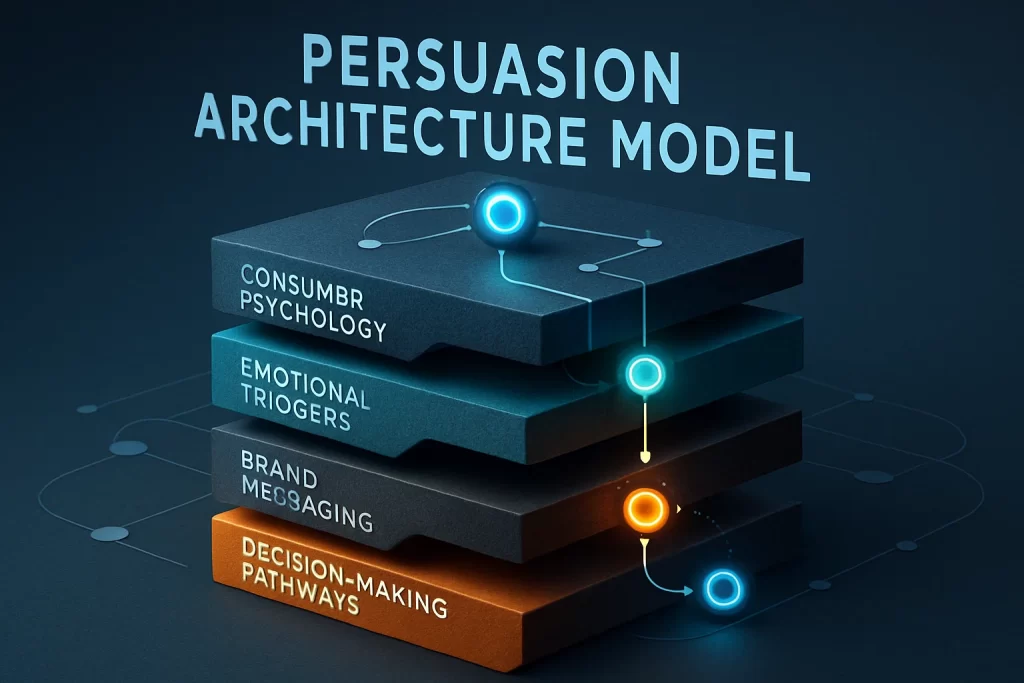
Let’s build a working Persuasion Architecture Model that integrates emotional branding with behavioral triggers.
Emotional Anchoring
Define 1–3 core emotional responses you want every user to associate with your brand (e.g., freedom, trust, empowerment).
These become the north star for your messaging, design, and interaction style.
Messaging Blueprint
Design a hierarchy of belief
Why we exist → What we believe → How we help → Proof we deliver
Each layer supports the one above, reinforcing emotion and logic together.
Sensory Identity System
Assign each emotional anchor to a design principle
- Trust → blue color palette, slower animation, soft tones
- Empowerment → bold typography, contrast colors, active voice
Touchpoint Trigger Map
Map the customer journey and mark each moment where you insert a behavioral trigger:
- Homepage → social proof
- Cart abandonment → email with urgency and scarcity
- Loyalty email → reciprocity trigger (“a gift just for you”)
This is where emotional design meets conversion science.
Feedback Loop
Design measurement points for
- Emotional engagement (via sentiment analysis, NPS)
- Behavioral conversion (clicks, shares, retention)
This closes the architecture into a living system—not a one-time campaign.
Case Studies / Examples
Nike: From Function to Feeling
Nike shifted from being a performance brand to an emotional movement brand.
Their “Just Do It” campaign isn’t about shoes—it’s about identity, empowerment, and emotional defiance.
They use:
- Authority (athletes)
- Unity (we’re all athletes)
- Commitment (challenges, clubs)
Duolingo: Behavioral Nudging in Action
Duolingo’s push notifications are textbook FBM:
- Motivation: playful tone
- Ability: app opens instantly
- Trigger: daily reminder with humor
They use System 1 humor to build System 2 habits (daily learning).
Solving Key Challenges
Many brands know what they want users to do but don’t know how to design the moment for it.
Persuasion architecture fixes that by giving structured behavioral scaffolding to emotional intent.
Implementing Persuasion Architecture: Step by Step
This section serves as a practical guide to building a persuasion-first brand from the ground up. It turns abstract frameworks into clear, actionable steps, helping marketers, founders, and designers align emotion, messaging, and behavior across the customer journey.

Audit Your Brand: Where Are You Now?
Before building a new architecture, you need to assess the cracks in the current foundation. A brand audit focused on persuasion asks:
- Do users feel anything when they engage with us? If so, what?
- Is our messaging emotionally consistent across channels?
- Do our visuals evoke the right emotion?
- Where are users dropping off in the journey—and what are they feeling at those points?
Tools to use
- Brand Perception Surveys – ask how customers feel about the brand
- Google Analytics + Session Replay (Hotjar/Clarity) – find where users hesitate or drop
- Tone Consistency Audit – check copy from emails, ads, website, product—all should “sound” aligned
Common red flags
- Friendly brand tone in social, but robotic onboarding emails
- Mission statement says “inspiring change” but visuals are grayscale and bureaucratic
- Calls-to-action that appeal to logic, not emotion
Solving Key Challenges
Brands often feel off to customers—not because of bad intent, but inconsistency across touchpoints.
Define Emotional Pillars & Messaging Strategy
Your brand should not try to evoke all emotions—only the ones that serve your positioning and promise.
Step 1: Pick Your Emotional Pillars
Choose 2–3 core emotions that your brand should always trigger. Examples:
- Reassurance + Control for fintech
- Inspiration + Belonging for fitness
- Freedom + Joy for travel
Every message, visual, sound, and motion should be run through this filter.
Step 2: Build a Messaging Architecture
This defines how your brand persuades users in stages.
Example Messaging Funnel
- Ethos (belief): “We believe everyone deserves financial dignity.”
- Pathos (emotion): “Imagine breaking free from debt stress.”
- Logos (logic): “Our platform reduces 98% of paperwork in loan consolidation.”
- CTA (action): “Let’s design your freedom plan.”
Map the Customer Journey with Behavioral Triggers
You’re not just designing a funnel—you’re designing an emotional path.
Create a customer journey map that marks:
- Emotional valleys (anxiety, doubt, overwhelm)
- Emotional peaks (hope, excitement, clarity)
Then insert behavioral triggers where needed.
Quote
“Behavior precedes belief. We trust what we already emotionally acted on.” – Daniel Kahneman, Nobel Laureate
Design Visual & Sensory Assets to Reinforce Emotion
Your brand’s visual identity should evoke its emotional pillars at a glance.
Match Visual Cues to Emotions
- Trust → blues, rounded shapes, slower transitions
- Excitement → reds, asymmetry, fast-paced microinteractions
- Joy → yellows, bounce animation, upward shapes
Also consider
- Sound Branding – Jingles, notification chimes
- Tactile Branding – Texture in packaging (if applicable)
- Motion Design – The “feel” of the UI when clicked
These sensory signals influence System 1 processing, per Kahneman’s model—our brains react before we realize.
Solving Key Challenges
Your visuals might look great, but if they don’t reinforce your emotional positioning, they dilute your persuasion.
Testing & Iteration
A persuasion architecture is not static—it evolves with user insight.
What to Test
- Emotional impact – A/B test visuals or CTAs that trigger different emotions
- Conversion by emotion – Track whether emotional messaging outperforms feature-first messaging
- Retention metrics – Do emotionally engaged users stick longer?
Use
- Heatmaps
- Emotion AI (e.g., Affectiva)
- User interviews with emotional recall analysis
Benefits & Business Impact
This section bridges theory to ROI—highlighting how persuasion architecture directly impacts key business metrics. It helps decision-makers move from “this sounds good” to “this makes us money,” while reinforcing the emotional logic behind user behavior.
Tangible Benefits of Persuasion Architecture
Implementing Brand Persuasion Architecture isn’t just a creative or theoretical exercise—it’s a high-leverage business strategy.
1. Increased Customer Retention
When brand experiences are architected for emotional resonance, users are more likely to return. According to a Capgemini study, 70% of emotionally engaged customers spend twice as much as those who are merely satisfied.
“Emotionally connected customers have a 306% higher lifetime value.” – Harvard Business Review
Retention is the product of trust + memory + emotional stickiness—all outcomes of persuasion architecture.
2. Higher Conversion Rates
Behavioral triggers embedded at key journey points (pricing pages, exit popups, abandoned cart flows) turn passive visitors into active users. Brands using emotion‑driven persuasion design have reported:
- 17–22% lift in conversions on landing pages
- 30% higher engagement on emotional CTAs
3. Brand Advocacy and Shareability
Emotion fuels virality. People don’t share rational offers—they share how brands made them feel. A well-architected brand evokes:
- Belonging → shared community
- Surprise → delight in social posts
- Empowerment → social signaling
In turn, brand equity compounds through referrals and word-of-mouth.
The Intangible Impact
Not all brand growth can be plotted on a spreadsheet—but that doesn’t make it less real.
1. Brand Recall and Differentiation
In markets crowded with similar features and prices, emotional branding is a moat.
A user may forget what your SaaS tool does—but they’ll remember how onboarding felt. That memory becomes brand equity.
2. Internal Alignment
Persuasion architecture doesn’t just align the brand outward—it aligns teams inward:
- Sales and marketing speak the same emotional language
- Designers know the “why” behind color, layout, tone
- Support teams reinforce emotional promises made at awareness stage
It becomes a shared belief system—not just a style guide.
Case Insights: Brands That Benefited
Airtable: From Functional Tool to Empowerment Brand
Airtable started as a spreadsheet alternative. But by architecting its story around creativity and empowerment, it now serves enterprise innovation teams.
Their messaging doesn’t just sell functionality—it sells a feeling of limitless possibility.
Persuasion Tactics Used
- System 1 language: “Unlock creativity” instead of “Optimize workflows”
- Social proof: Highlighting innovation teams (Unity + Authority)
- Emotional visuals: Bright, flexible, modular UI
Headspace: Emotional Resonance at Scale
Meditation apps compete heavily on features. Headspace wins by architecting calmness into every microinteraction:
- Soft animations
- Pastel colors
- Slow pacing in transitions
- Empathetic copy
Result? Industry-high retention and loyalty.
Emotional Architecture vs. Traditional Branding
| Traditional Branding | Persuasion Architecture | |
| Focus | Consistency in logos/colors | Emotional consistency across experiences |
| Tools | Design systems, visual identity | Behavioral triggers, emotional journey mapping |
| Outcome | Brand recognition | Brand relationship |
| Measured By | Impressions, reach | Lifetime value, emotional NPS |
Solving Key Challenges
Many marketers say, “We have a great brand guide, but users still don’t connect.”
What’s missing is the emotional layer, the behavioral triggers, the narrative architecture.
Common Challenges & How to Overcome Them
While persuasion architecture promises significant impact, it’s not without hurdles. This section surfaces common barriers brands face—strategic, operational, and psychological—and offers practical ways to navigate them.
Inconsistent Messaging Across Channels
Problem
Your brand sounds confident on your homepage, quirky on social media, and dry in emails. This inconsistency confuses users and fractures emotional trust.
Why It Happens
- Multiple teams owning different channels
- No centralized messaging architecture
- Tone varies with designer or copywriter’s style
Solution
Create a Core Messaging Pyramid that includes
- Emotional pillars
- Brand voice guidelines
- Message “filters” (e.g., every message should evoke “security + joy”)
Conduct channel audits quarterly to test consistency.
Expert Tip
“Users don’t care about departments—they care about seamless emotion. If your Twitter voice makes them laugh but your onboarding emails confuse them, persuasion fails.” – Nancy
Mis-aligned Visual Identity or Sensory Cues
Problem
Your visual assets are beautiful—but they don’t match the emotion your brand wants to evoke. Users feel disconnected even when the design is high-quality.
Examples
- A healthcare app using harsh reds and angles (evokes urgency, not calm)
- A premium brand using playful UI microinteractions (diminishes luxury perception)
Solution
Audit your visual and sensory branding against your emotional pillars. Use emotional swatchboards, test with emotion AI, and run perception tests.
Tool Tip
Platforms like Affectiva, iMotions, or Emotion Mapper can assess unconscious emotional reaction to design.
Measuring Emotional Engagement
Problem
Stakeholders ask, “Where’s the ROI of emotion?” Emotional design often lacks clear, measurable KPIs.
Solution
Use both quantitative and qualitative metrics:
- Emotional Net Promoter Score (eNPS): Measures not just “likelihood to recommend” but emotional association.
- Emotion tagging surveys: After touchpoints, ask: “How did this make you feel?”
- Retention metrics tied to emotional content: Monitor behavior changes after emotional messaging changes.
Resources & Expertise Constraints
Problem
Small teams feel persuasion architecture is a luxury. “We don’t have time for emotion mapping,” they say.
Truth
Emotion doesn’t need big budgets. It needs clarity and consistency.
Lean Solutions
- Use a Brand Emotion Canvas (like a lean canvas, but for feeling)
- Prioritize 2–3 high-impact touchpoints (homepage, onboarding, email)
- Repurpose emotional storytelling across formats (e.g., customer story → social post → email opener)
FAQ
1. How can I implement Brand Persuasion Architecture in a small business?
Start small. You don’t need a full rebrand or a fancy agency. Begin by choosing 2 emotional pillars that reflect your customer promise—like clarity + motivation.
Then apply that lens to:
- Your homepage headline
- Your product description tone
- One core customer journey (e.g., onboarding)
From there, expand to visual consistency and messaging layers. A simple Brand Emotion Canvas can help you maintain clarity.
2. What are the benefits of Persuasion Architecture in branding?
The core benefits include
- Stronger emotional loyalty
- Higher conversion at emotional triggers
- Brand recall in saturated markets
- Consistency across messaging, visuals, tone
- Team alignment across functions
Most importantly, it moves your brand from “we sell features” to “we create belief and action.”
3. What steps are involved in emotional brand design?
- Define emotional pillars (2–3 feelings you want to evoke)
- Map a narrative and message funnel (belief > feeling > logic > action)
- Align visuals and UI/UX cues with those emotions
- Insert behavioral triggers in the customer journey
- Continuously test and measure emotional impact
Use tools like user interviews, emotion surveys, and heatmaps to refine over time.
4. How do I measure if my brand is emotionally connecting with the audience?
You can’t manage what you don’t measure. Consider:
- eNPS (Emotional Net Promoter Score)
- Open-text emotional tagging in surveys
- Social listening for emotional keywords (e.g., “I love this brand,” “makes me feel safe”)
- Engagement lift after emotional content changes (track conversion, bounce, share rates)
5. Which persuasion models work best for building emotional brands?
There’s no single “best” model, but these are powerful:
- Cialdini’s Principles of Influence – great for messaging
- Fogg Behavior Model – best for designing triggers
- Kahneman’s System 1/System 2 – helpful in emotional-vs-rational message balance
- BJ Fogg’s Tiny Habits – useful for behavior scaffolding in retention flows
Integrate these based on what emotion you’re targeting and where users are in the journey.
Conclusion
In a world of algorithmic feeds and hyper-competitive categories, branding is no longer just about being seen—it’s about being felt. Brand Persuasion Architecture offers a powerful framework for brands that want to rise above surface-level messaging and create deep, emotional connections that drive behavior, loyalty, and advocacy.
By integrating behavioral psychology, emotional triggers, and narrative coherence into every layer of your brand experience, you can move beyond design and into transformation. From homepage headlines to microinteractions in your app, persuasion architecture ensures that your brand doesn’t just make an impression—it makes meaning.
Whether you’re a startup founder building emotional equity from day one or an established brand struggling to retain attention, the path forward is the same: clarify your emotional pillars, align your messaging and visuals, map persuasive touchpoints, and test relentlessly.
As the saying goes, people will forget what you said, and they might forget what you did—but they will never forget how your brand made them feel.