
Designing a Brand Emotional Connection Framework: Fostering Deep Engagement
Introduction
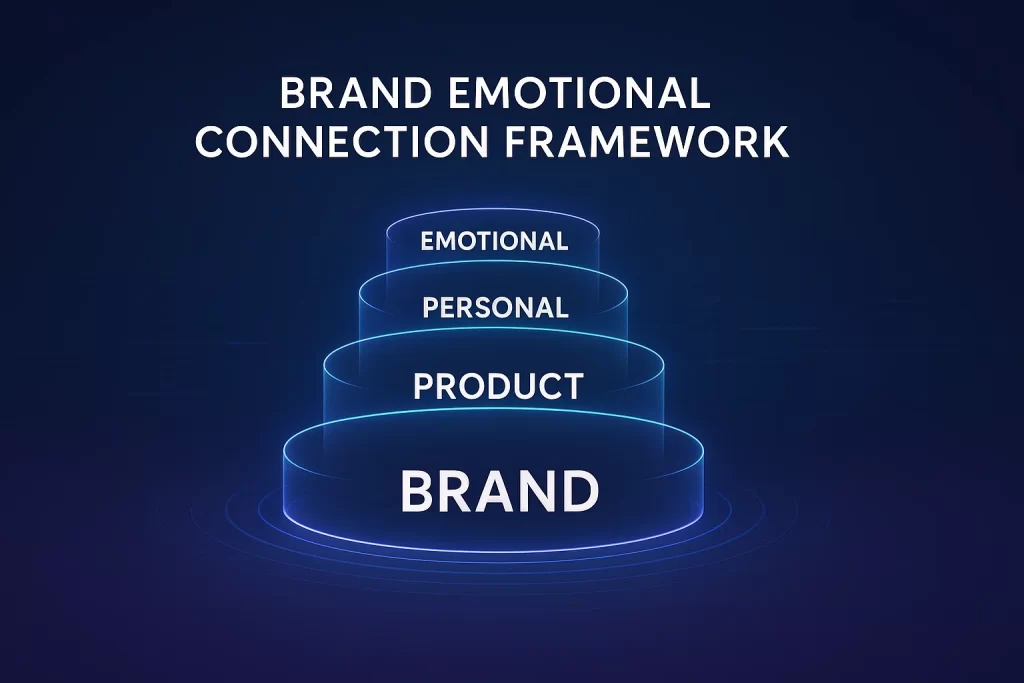
Emotions drive behavior—and in today’s competitive landscape, emotional connection has become the ultimate differentiator between brands that thrive and those that merely survive. As markets saturate and product advantages narrow, designing a Brand Emotional Connection Framework becomes essential not just for retention, but for relevance.
In fact, modern Brand Strategy and Execution hinges on more than clever slogans or sleek logos. It requires an intentional effort to map, evoke, and measure emotional resonance across every consumer touchpoint. (Executing Winning Brand Strategies breaks this down—from planning to performance.)
Scientific studies underscore that humans make purchasing decisions based far more on emotion than logic. The limbic brain, responsible for emotional response, activates faster than the rational neocortex. This means that feelings—not features—often dictate brand preference.
This article introduces a modular, evidence-backed framework to help marketers and brand leaders engineer that emotional bond, using insights from neuroscience, psychology, and real consumer behavior. We’ll cover:
- The difference between loyalty and emotional connection
- The science of how emotions influence decisions
- A step-by-step model to build emotional touchpoints
- Measurement tools to track emotional impact
- Ethical guidelines to avoid manipulation
Whether you’re building a brand from scratch or trying to deepen consumer affinity, this guide provides a scalable blueprint for lasting emotional resonance
The Science of Emotional Connection
Behind every iconic brand is a neuroscientific truth: emotion precedes logic. In fact, emotional responses to branding happen within milliseconds, long before conscious evaluation begins. This makes understanding the psychological and biological mechanisms of emotion crucial to crafting a meaningful brand connection.
Why Emotions Trump Logic in Decision-Making
Neuroscience reveals that the limbic system—the part of the brain responsible for memory, emotion, and motivation—processes feelings 5 times faster than the neocortex, which handles rational thought.
According to Dr. Antonio Damasio, renowned neuroscientist and author of Descartes’ Error,
“We are not thinking machines that feel. We are feeling machines that think.”
This insight reframes brand-building: trust, nostalgia, joy, or even fear are not outcomes of branding—they’re the starting points.
Emotional Triggers in Branding
Certain emotional cues consistently elicit brand attachment:
- Nostalgia (e.g., Coca-Cola’s vintage Christmas ads)
- Belonging (e.g., Apple’s “Think Different” campaign)
- Empowerment (e.g., Nike’s athlete-driven storytelling)
- Security (e.g., Volvo’s focus on safety)
These emotions activate neurotransmitters like dopamine (pleasure), oxytocin (trust), and adrenaline (excitement), reinforcing memory and preference.
“Strong emotional engagement can increase customer lifetime value by over 300%,” reports Harvard Business Review
The Psychological Model: Emotional Hierarchies
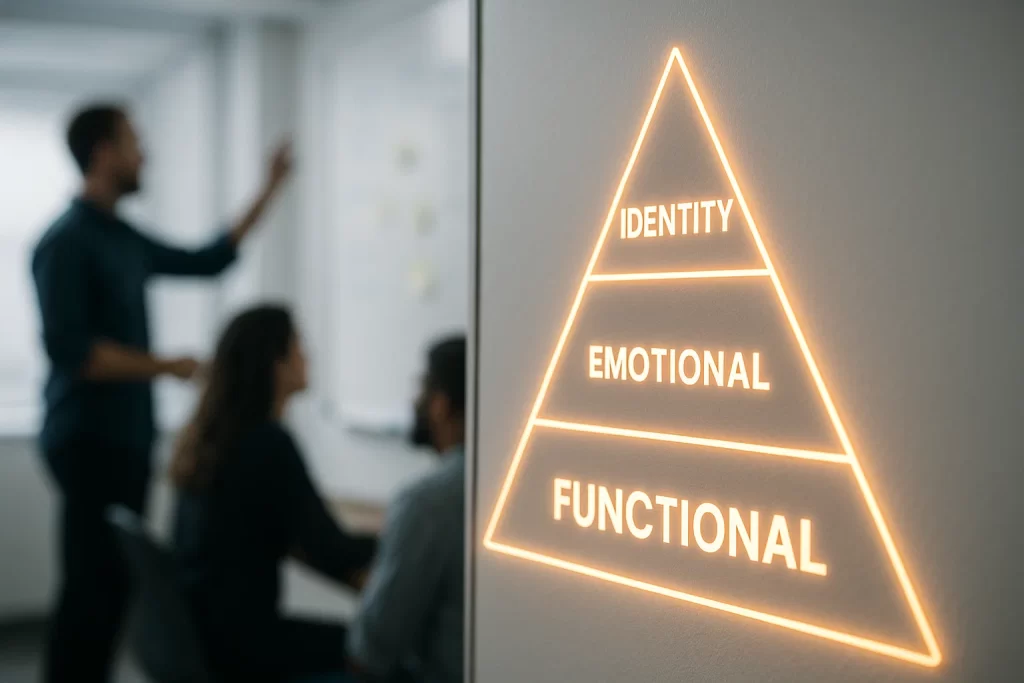
Not all emotional connections are equal. Borrowing from Maslow’s Hierarchy of Needs, emotional branding builds upward:
- Functional Trust – “This works for me.”
- Emotional Satisfaction – “This brand understands me.”
- Identity Integration – “This brand is part of who I am.”
Emotional ROI: A Business Imperative
Emotionally connected customers are:
- 52% more valuable than highly satisfied ones
- 5x more likely to recommend your brand
- 7x more likely to forgive mistakes
Constructing a Modular Framework
Building emotional connection shouldn’t be left to intuition. What brands need is a modular framework—a structured yet flexible model that transforms emotion from an abstract ideal into a repeatable system. This section lays out that framework in four foundational stages, each supported by psychology, branding best practices, and real-world applications.
“A modular approach ensures scalability and adaptability across diverse industries and customer journeys.” — Journal of Consumer Psychology
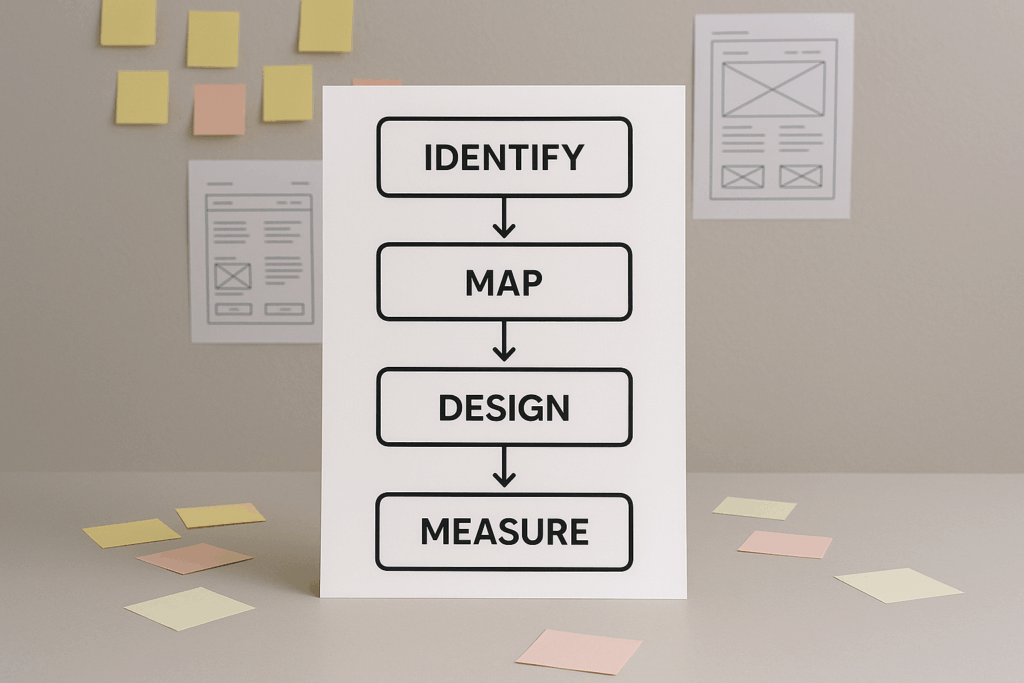
The 4-Stage Emotional Connection Model
1. Identify Core Emotional Drivers
Start by uncovering what truly moves your audience. Is it belonging? Empowerment? Security?
- Use surveys, empathy interviews, and tools like Qualtrics or Google Trends to identify dominant emotional triggers.
- Segment by demographics, psychographics, and emotional intent.
Tip: Look at customer reviews—not just what they liked, but how they felt.
2. Map Customer Emotions to the Journey
Overlay emotional triggers onto the customer journey:
- What do they feel at awareness? (Curiosity, confusion?)
- At consideration? (Hope, anxiety?)
- Post-purchase? (Relief, pride?)
Use an Emotional Touchpoint Map to visualize highs, lows, and gaps.
3. Design Emotional Brand Assets
Once mapped, design experiences that trigger those emotions:
- Brand voice & messaging: Is it empowering, soothing, rebellious?
- Visual identity: Do your colors evoke trust? Passion?
- UX & product design: Does the user flow reduce anxiety or create delight?
Case in Point: Airbnb’s use of warm photography and soft tones isn’t just aesthetic—it’s engineered empathy.
4. Measure, Learn, Iterate
Emotional connection isn’t static. Use tools like:
- Sentiment analysis
- Emotional loyalty metrics (Net Emotional Value, Brand Resonance Index)
- Qualitative feedback loops (Interviews, Reddit comments, open-form NPS)
“What gets measured gets managed—even emotions,” says McKinsey (mckinsey.com).
Adjust campaigns, language, and UX based on emotional insights—not just click-through rates.
Modular = Scalable
The beauty of a modular approach? It’s scalable:
- A startup can focus on just one module (like identity).
- An enterprise can operationalize all four across departments.
Identifying Emotional Drivers & Audience Empathy
Before brands can spark a genuine emotional connection, they must first understand what emotions their audience already feels, needs, or suppresses. The goal here isn’t to invent emotion—it’s to listen deeply, then align brand messaging and experience with the audience’s emotional landscape.
What Are Emotional Drivers?
Emotional drivers are the core feelings that influence purchasing behavior. These include:
- Trust – “Will this brand protect me or deceive me?”
- Belonging – “Do I feel seen and included?”
- Empowerment – “Does this brand make me feel capable or inspired?”
- Security – “Will this product make me feel safe or stable?”
- Excitement – “Does it thrill me or break routine?”
- Pride – “Will this reflect well on me or elevate my status?”
According to Motista, emotionally connected customers are 306% more valuable over their lifetime. That value starts with accurately diagnosing the emotional need your brand can fulfill.
“People don’t buy products; they buy better versions of themselves,” says Seth Godin.
Empathy Mapping: Seeing Through the Customer’s Eyes
To truly understand your customer’s emotional reality, use an Empathy Map, which includes:
- Says – What are they verbalizing about their challenges?
- Thinks – What are their hidden fears or unspoken goals?
- Feels – What emotions dominate their experience?
- Does – What actions reflect these internal states?
Where to Source Emotional Insights
- Customer Interviews: Ask “how did that make you feel?” more than “what did you think?”
- Reddit Threads & Reviews: Look for raw, honest language about brand experience.
- Social Media Listening: Track emotional keywords and emojis.
- Support Tickets & Complaints: These are emotional goldmines.
This single quote reveals loss of trust and abandonment—two powerful emotional drivers to address.
Segmenting by Emotion, Not Just Demographics
Traditional personas look at age, income, or behavior. But what if you segment by core emotion?
| Emotional Segment | Example Brand Strategy |
| Anxious Achievers | Offer structure & trust (e.g., Trello) |
| Passionate Idealists | Empower missions (e.g., Patagonia) |
| Lonely Millennials | Build community (e.g., Glossier) |
This approach helps brands stop generalizing and start humanizing.
Designing Emotional Touchpoints Across the Customer Journey
Emotion doesn’t just live in your ads or mission statement—it lives in the micro-moments that shape a customer’s interaction with your brand. Every click, scroll, unboxing, and email can either deepen connection or create dissonance. Designing emotional touchpoints means mapping where emotions happen and engineering how they feel.
“People will forget what you said, forget what you did, but never forget how you made them feel.” — Maya Angelou
Mapping the Journey: From Awareness to Advocacy
A typical customer journey includes the following emotional stages:
- Awareness
Emotions: Curiosity, skepticism
Touchpoints: Ads, SEO, social media, influencer mentions
Design Tips: Use emotionally charged headlines, visual storytelling, or music to spark interest and reduce doubt. - Consideration
Emotions: Hope, confusion
Touchpoints: Website, comparison charts, customer reviews
Design Tips: Highlight empathy-driven copy, “You’re not alone” language, and social proof. - Purchase
Emotions: Excitement, anxiety
Touchpoints: Checkout flow, payment confirmation, shipping notifications
Design Tips: Use reassuring messages like “You’re in good hands” or thank-you pages with humanized copy. - Onboarding / Use
Emotions: Relief, frustration, joy
Touchpoints: Setup guides, welcome emails, in-app tutorials
Design Tips: Personalize the experience with names, progress bars, and playful affirmations. - Post-Purchase / Retention
Emotions: Pride, boredom, trust, regret
Touchpoints: Follow-up emails, loyalty programs, packaging
Design Tips: Surprise and delight tactics (e.g., hand-written notes, milestone rewards). - Advocacy
Emotions: Validation, passion
Touchpoints: Referral programs, community platforms, social sharing
Design Tips: Make users feel like insiders, give them exclusive recognition.
Tools to Support Emotional Design
- Hotjar & FullStory: Watch user behavior to locate friction points.
- Nudgify or Intercom: Deploy context-aware emotional nudges.
- Tone Checkers: Evaluate if messaging aligns with target emotion (e.g., Grammarly’s tone tool).
“Brands that design for emotion at every step outperform those who treat emotions as afterthoughts,” says Qualtrics CX Institute.
Real-World Example: Apple
Apple’s genius lies not just in product quality, but in emotional engineering:
- Ads focus on freedom and creativity.
- Stores are designed for exploration, not transactions.
- Packaging unboxing is ritualistic, creating anticipation.
Each touchpoint reinforces the emotional value proposition: “You are a creator.”
Emotional Design Checklist
- Is each touchpoint engineered for the dominant emotion at that stage?
- Is the brand’s emotional tone consistent across platforms?
- Are emotional pain points (confusion, anxiety, indifference) reduced or reversed?
Measuring Emotional Connection Effectively
Emotional connection is not just a branding buzzword—it’s a measurable driver of business performance. Brands that understand how to quantify emotion can better optimize messaging, products, and experiences that genuinely move their audience.
Yet most brands still rely on outdated metrics like clicks, impressions, or satisfaction scores—none of which capture emotional resonance. To track what truly matters, you must measure how people feel, not just what they do.
“You can’t manage what you don’t measure. And if you’re not measuring emotion, you’re missing your biggest driver of customer loyalty.” — Leslie Zane, Founder, Triggers Brand Consulting
Metrics That Matter
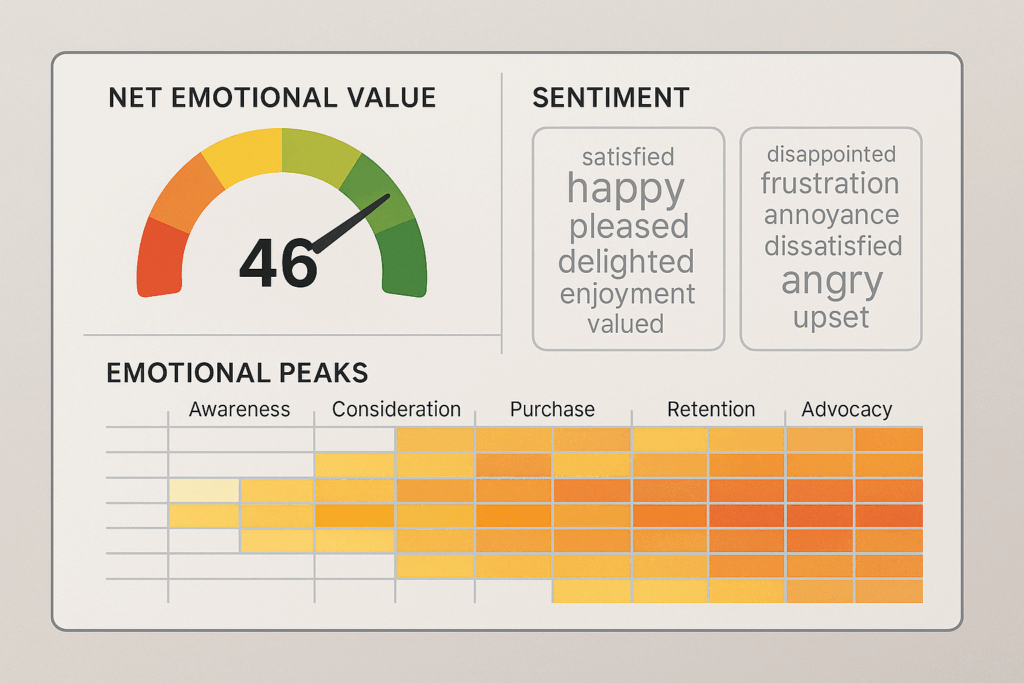
1. Net Emotional Value (NEV)
An adaptation of NPS, NEV quantifies the positive vs negative emotional reactions customers have after a brand interaction.
Formula: % positive emotions – % negative emotions
Example
If 70% feel joy/trust and 20% feel frustration/confusion, NEV = +50
2. Brand Resonance Index (BRI)
Developed by Keller, BRI measures how deeply integrated a brand is into a customer’s identity. It includes:
- Emotional attachment
- Sense of community
- Active engagement
- Brand advocacy
Brands with high resonance don’t just attract—they inspire.
3. Sentiment Analysis
Natural language tools (like MonkeyLearn or IBM Watson) analyze reviews, social posts, and chat logs to classify emotionally charged keywords.
Reddit posts, in particular, offer authentic emotional data.
Reddit user u/overwhelmedCX wrote:
“Their customer support didn’t just help—they reassured me. That made all the difference.”
This is not just a “positive review”—it’s evidence of emotional safety.
4. Behavioral Signals
Track signals of emotional loyalty such as:
- Repeat engagement without discount triggers
- Longer session duration on emotionally themed content
- Sharing emotionally branded stories
Behavior reveals what surveys often miss.
Tools & Platforms
| Tool | What It Measures | Example Use |
| Qualtrics | Emotional sentiment via surveys | Real-time feedback on onboarding emotion |
| Clarabridge | Text analytics from social/support | Detecting emotion drop-off points |
| Emotive.AI | Real-time sentiment in chat | Personalizing tone based on emotion |
| Reddit Mining | Crowd-based emotional language | Identify unmet emotional needs |
Avoid Vanity Metrics
High click-through rates can still mask emotional disconnection. For example:
- A viral campaign may trigger curiosity, but not trust.
- A clever ad may earn laughs, but not build identity alignment.
“Emotion is not just attention. It’s attachment.” — Harvard Business Review
Avoiding Manipulation — Ethical Emotional Branding
Emotion is powerful—and power must be used responsibly. While emotional branding can inspire loyalty, connection, and advocacy, it also opens the door to exploitation if used manipulatively. The line between authentic connection and emotional coercion is razor-thin—and customers are increasingly aware of it.
“People don’t mind being sold to—what they mind is being emotionally tricked.” — Consumer Behavior Study, 2024
Manipulation vs. Authenticity: The Thin Line
Manipulative Branding Tactics Include
- Fear-based urgency that plays on anxiety (“Buy now or miss out forever!”)
- Faux empowerment that hides poor UX or ethics
- Emotional nostalgia that’s hollow or inconsistent
- Over-promising connection and under-delivering experience
These tactics may work short-term—but they erode trust, increase churn, and damage brand equity long-term.
According to a report by Gartner, “Brands perceived as emotionally manipulative saw a 38% drop in long-term NPS scores within 12 months.” (gartner.com)
Principles of Ethical Emotional Design
- Transparency First
Be clear about your intent. Don’t mask sales goals in pseudo-philanthropy. (e.g., “We donate 1%” should also explain where and how.) - Emotions Should Reflect Reality
Don’t use emotional triggers that the product or experience cannot deliver on. If you promise joy, surprise, or intimacy—your delivery must match. - Empower, Don’t Exploit
Focus on uplifting emotions—belonging, identity, achievement—rather than fear or shame. - Use Authentic Storytelling
Let your real customers, employees, and founders share genuine stories. Avoid stock emotionality. Even imperfection feels more real.
Case Study: Emotional Branding Gone Wrong
Pepsi’s Kendall Jenner Ad (2017) attempted to evoke unity during political unrest but came off as tone-deaf and exploitative. It emotionally co-opted a movement without real understanding or engagement.
The backlash hurt both trust and emotional resonance.
Emotional Integrity Checklist
- Does this emotion reflect a real brand value or product truth?
- Are emotional appeals backed by customer experience and not just messaging?
- Is the emotion consistent across actions, copy, and visuals?
- Would your most skeptical customer believe the emotion is genuine?
Final Word: Emotional Trust Is Earned
Consumers are emotionally intelligent. They recognize performative empathy vs real concern. In an age of AI-generated ads and scripted support bots, genuine emotional branding becomes your ultimate differentiator—not just for connection, but for trust.
“Trust is built in drops and lost in buckets.” — Kevin Plank, Under Armour
Adapting Frameworks Across Industries
While the psychology behind emotional branding is universal, its application must be tailored to industry-specific behaviors, purchase cycles, and emotional triggers. A one-size-fits-all approach risks being generic or ineffective. This section breaks down how to customize the Brand Emotional Connection Framework across sectors.
“Emotional resonance is contextual. What works in fashion may feel manipulative in fintech.” — McKinsey & Co. (mckinsey.com)
1. Consumer Goods (FMCG)
Primary Emotional Triggers: Convenience, joy, nostalgia, trust
Touchpoints: Packaging, shelf presence, influencer integration
Tactics: Use sensory branding (smell, texture), nostalgic packaging, storytelling on product origin
Example: Ben & Jerry’s ice cream blends humor + activism to create both joy and purpose.
2. Technology & SaaS
Primary Emotional Triggers: Empowerment, control, confidence, safety
Touchpoints: Product UX, onboarding flow, support experience
Tactics: Reduce friction, personalize first-time setup, humanize interface tone
Example: Notion uses onboarding emails with calming tone and curated templates to reduce overwhelm.
3. Healthcare & Wellness
Primary Emotional Triggers: Safety, empathy, hope, reassurance
Touchpoints: Website clarity, appointment booking, post-visit follow-ups
Tactics: Use calming language, real patient stories, transparent medical expertise
Example: Mayo Clinic embeds videos of physicians explaining procedures to reduce fear and increase trust.
4. Retail & Fashion
Primary Emotional Triggers: Identity, self-expression, aspiration, community
Touchpoints: Product pages, email campaigns, in-store experience
Tactics: Use UGC (user-generated content), style quizzes, community hashtags
Example: Glossier leverages “Skin First” messaging and user selfies to promote self-acceptance.
5. B2B & Professional Services
Primary Emotional Triggers: Trust, credibility, competence, long-term support
Touchpoints: Sales process, client onboarding, content hubs
Tactics: Publish thought leadership, create high-empathy sales collateral, show real team bios
Example: Deloitte’s use of human-first messaging (“Our people make us strong”) reinforces trust and warmth in an otherwise analytical sector.
Industry Adaptation Matrix
| Industry | Emotion to Target | Example Touchpoint | Sample Strategy |
| FMCG | Nostalgia, Joy | Packaging, Ads | Retro visuals, playful copy |
| SaaS/Tech | Empowerment | UI, onboarding | Personalized journeys, UX empathy |
| Healthcare | Reassurance | Patient follow-ups | Humanized support and testimonials |
| Fashion | Self-expression | Product pages, UGC | Influencer stories, community feel |
| B2B Services | Trust, Stability | Whitepapers, Onboarding | Transparent expertise, team focus |
FAQ
1. What is a Brand Emotional Connection Framework — and how is it different from loyalty?
A Brand Emotional Connection Framework is a structured model designed to help brands build deep emotional relationships with customers. Unlike traditional loyalty strategies, which often rely on incentives or rewards, emotional connection taps into feelings like trust, belonging, nostalgia, and inspiration.
While loyalty can be transactional (“I shop here because of points”), emotional connection is transformational (“I shop here because it feels right”). The framework typically involves:
- Identifying emotional drivers
- Mapping those to the customer journey
- Designing emotional touchpoints
- Measuring emotional impact over time
2. How can small brands build emotional connections without sounding fake or manipulative?
Authenticity is everything. Emotional branding doesn’t require a massive budget—it requires deep listening and genuine storytelling. Start by:
- Sharing your founder story
- Highlighting customer voices, not just product benefits
- Being transparent about your brand’s values and actions
- Avoiding manipulative tactics like fear-mongering or false urgency
Stick to real stories, real people, and emotion that matches experience.
3. Are there examples of emotional branding strategies I can model?
Absolutely. Here are three brands doing it right:
- Nike: Uses empowerment and defiance (“Just Do It”) to fuel aspiration.
- Dove: Centers campaigns around self-acceptance and body positivity.
- Spotify: Leverages nostalgia and self-expression through “Your Year in Music” recaps.
All three brands tailor content to core emotions, not just demographics.
4. How do I measure whether my brand is emotionally resonating with customers?
Look beyond clicks and conversions. Use:
- Net Emotional Value (NEV): Do more people feel positive or negative?
- Brand Resonance Index: Are customers identifying with the brand?
- Sentiment Analysis Tools (like MonkeyLearn or Brandwatch): What emotions show up in reviews or social media?
And most importantly, ask open-ended questions
- “How did this make you feel?”
- “What does this brand mean to you?”
Responses will reveal emotional depth far beyond “satisfaction.”
5. What if my audience is in a “boring” industry—does emotional branding still apply?
Yes—especially there. B2B and traditionally “boring” industries often overlook emotion, which becomes a competitive edge. Even in insurance or SaaS:
- Customers crave confidence, clarity, and security
- Emotional cues like tone, color, and trust-building content can make or break engagement
Emotional branding isn’t just about joy—it’s about evoking the right emotion for your audience’s context and needs.
Conclusion
Emotional connection isn’t a marketing trend—it’s a psychological truth. Brands that resonate emotionally don’t just win customers; they win devotion. Through this article, we’ve unpacked the full Brand Emotional Connection Framework—a modular, measurable, and meaningful path toward building real human relationships at scale.
From understanding emotional vs. cognitive loyalty to designing ethically sound touchpoints, this framework offers more than theory. It’s a playbook for execution: guided by empathy, powered by psychology, and grounded in business strategy.
Whether you’re building a DTC brand, launching a B2B service, or reinventing your product experience, remember:
People forget what you said.
They forget what you did.
But they remember how you made them feel