
Creating a Brand Future-Readiness Roadmap: Preparing for Tomorrow’s Challenges
Introduction
A Brand Future‑Readiness Roadmap is not just a strategic document—it’s a journey of building brand agility, resilience, innovation readiness, and digital maturity to stay relevant in a fast‑evolving marketplace. In today’s volatile business environment, marked by technological disruption, changing consumer expectations, and global uncertainty, a future-ready branding approach has become essential. Brands that invest in a digital branding transformation—rather than standing still—report measurable returns in engagement, market share, and long-term relevance.
This article, Creating a Brand Future‑Readiness Roadmap: Prepare Today for Tomorrow’s Challenges, sets the stage for a comprehensive and actionable roadmap. You’ll learn how to assess your brand’s current position using tools like a Business Readiness Matrix and Digital Maturity Model, prioritize your strategic transformation pillars, pilot new initiatives, measure impact, and avoid common roadblocks. Rather than abstract theory, you’ll gain a practical, step-by-step guide that combines brand transformation frameworks, strategic foresight, and innovation velocity—all tied to clear ROI insights.
Why should this matter to you? Many marketing leaders I’ve spoken to express a powerful pain point: uncertainty and confusion about where to begin. You’re not alone if you’ve thought, “I’m juggling digital tactics, but I lack a structured process to future‑proof my brand.” This roadmap will shed light on that path—offering clarity, focus, and measurable value.
Research supports this approach. For instance, McKinsey reports that organizations deliberately investing in both digital and brand transformation—including integrated roadmaps—achieve significantly higher growth and resilience during economic disruption than those that don’t. Harvard Business Review echoes the need for proactive brand adaptation, calling it “a competitive imperative, not just a marketing tactic.”
Additionally, implementing a Brand Strategy and Execution model ensures that your roadmap isn’t just theoretical—but grounded in operational excellence from planning to performance. This model ties together foresight, agility, and brand performance to ensure that your future-ready transformation is scalable and effective.
In this introduction, you’ll also get a preview of the six key pillars we’ll explore—culture of innovation, digital integration, adaptive identity, sustainability, data‑driven insights, and performance measurement. Together, these elements form a strategic foresight engine—a living, evolving mechanism for your brand to anticipate change rather than simply respond.
By the end of this article, you’ll not just understand how to build a brand future‑readiness roadmap—you’ll be equipped to take the very first step today, confidently, with clarity and strategic alignment.
Why Future‑Readiness Matters
The Cost of Standing Still: Why Future‑Readiness Is a Competitive Imperative
In a world of relentless disruption, the question isn’t whether your brand will face change—it’s when and how prepared you’ll be to respond. A Brand Future‑Readiness Roadmap empowers leaders to design for the unknown, using brand agility, strategic foresight, and adaptive frameworks to proactively navigate evolving landscapes. Brands that remain reactive, rather than intentional, often find themselves trapped in cycles of crisis management, loss of relevance, and diminishing customer trust.
According to a 2024 study by Forrester Research, companies that integrate future-proof branding strategies into their operating models outperform competitors by 31% in brand equity growth during periods of market instability. Meanwhile, Harvard Business Review highlights that “future-ready companies embed agility into their brand DNA—not as a project, but as a way of operating.”
Let’s break this down into the three urgent drivers
1. Consumer Behavior Is Changing—Faster Than Brands Are
From Gen Z’s expectation of digitally authentic brand experiences to rising calls for sustainability and personalization, consumer demands are dynamic—and unforgiving. The gap between expectation and delivery is often a reflection of poor foresight and rigid branding models. A future-ready brand strategy anticipates shifts in trust, values, digital interaction, and engagement. It doesn’t guess—it forecasts.
2. Technological Disruption Creates Opportunity—But Only for the Prepared
New technologies like AI, AR, and blockchain are reshaping the brand-consumer relationship. But tech alone won’t make a brand future‑ready. Leaders must build innovation readiness into brand culture and infrastructure—something that traditional brand playbooks never accounted for. The roadmap we’re building will show how to embed tech readiness, not bolt it on.
Expert insight: “Brands that fail to integrate emerging technologies with human-centric design fall into a cycle of chasing trends instead of shaping them,” says Rita McGrath, Columbia Business School
3. The Risk of Irrelevance Is Growing
One of the biggest fears brand leaders express is falling behind. A 2023 Reddit thread in r/marketingstrategy reads:
“We used to be cutting edge, now I feel like we’re always catching up. We talk about future-proofing, but we don’t act on it until it’s too late.”
This sentiment is common—and deeply valid. The Brand Future‑Readiness Roadmap offers a clear response to this fear by providing proactive, structured steps rather than vague aspirations.
This is why future-readiness matters—not just as a concept, but as a survival mechanism for modern brands. In the next section, we’ll explore how to assess your brand’s current readiness state, so you can begin this transformation with confidence and clarity.
Assessing Your Current Brand Readiness
From Gut Feeling to Grounded Insight: Diagnose Your Brand’s Current Readiness
The journey toward a Brand Future‑Readiness Roadmap must begin with an honest diagnosis. Without a clear understanding of where your brand stands today, every strategic decision becomes a gamble. Unfortunately, many organizations confuse activity with readiness—but launching a digital campaign or adopting a new tool doesn’t automatically make a brand future-ready.
That’s where structured evaluation frameworks like the Business Readiness Matrix, Brand Agility Index, and Digital Maturity Model become invaluable.
Brand Readiness: What Are You Measuring?
At its core, brand readiness includes five key dimensions:
- Innovation Readiness – Is your brand structured to test and adopt emerging ideas?
- Cultural Agility – Can your brand pivot narratives in response to social and generational shifts?
- Digital Integration – How seamless is the connection between your brand identity and digital experiences?
- Resilience Capacity – Can your brand endure disruption without losing equity?
- Strategic Foresight – Are decisions made based on scenario planning and future signals?
These dimensions go beyond logos and messaging. They ask: Is your brand’s infrastructure built for the future or stuck in the past?
Tools to Guide Your Diagnosis
Here are three tools to begin benchmarking your brand:
- Business Readiness Matrix (Adapted from McKinsey):
A quadrant-based framework plotting strategic clarity vs executional capability. Brands in the top-right are considered transformation-ready. - Brand Agility Index (based on Forrester):
Measures response time to market shifts, adaptability in brand messaging, and leadership alignment. - Digital Maturity Model (Gov.uk or Gartner variation):
Evaluates your digital capabilities across data, automation, and customer journeys.
These tools help translate vague sentiments like “we’re not future-ready” into specific, actionable insight.
With clarity about your starting point, the next step becomes simpler: defining the roadmap forward. That’s exactly what we’ll tackle in the next section—Designing a Clear, Practical Roadmap for transformation.
Defining a Clear, Practical Roadmap
Turning Strategy into Action: Building the Brand Future‑Readiness Roadmap
Creating a Brand Future‑Readiness Roadmap isn’t about lofty vision statements—it’s about creating a structured path from assessment to adaptation. If the previous section diagnosed your brand’s current position, this one builds the bridge to where you need to be.
A future-ready brand roadmap should be tangible, sequenced, and evidence-driven. It should align internal stakeholders, reduce transformation friction, and accelerate brand adaptability. Most importantly, it should prioritize strategic foresight over reactive fixes.
The Six-Step Roadmap Framework
Let’s walk through the six critical phases:
1. Envision the Future State
- Define your future-ready brand vision: What will your brand look like in five years?
- Use scenario planning to model changes in consumer behavior, tech, and societal shifts.
2. Diagnose Current Gaps
- Revisit findings from the Business Readiness Matrix and Digital Maturity Model.
- Identify gaps across agility, resilience, digital capability, innovation culture.
3. Prioritize Transformation Areas
- Focus on high-impact, high-feasibility opportunities (e.g., digital experience overhauls, brand narrative refreshes).
- Use a Brand Transformation Impact Matrix to decide what to start, stop, scale, and experiment with.
4. Pilot and Prototype
- Apply agile brand sprint methodology.
- Run controlled experiments (e.g., rebranding a product line, testing new digital storytelling formats).
- Expert quote: “Pilots reduce risk and increase stakeholder buy-in by showing what transformation looks like in action,” says Charlene Li, Altimeter Group.
5. Institutionalize the Change
- Codify successes into brand guidelines, digital playbooks, and culture rituals.
- Build transformation into the DNA, not just a department.
6. Measure and Optimize
- Integrate performance metrics like innovation velocity, brand trust uplift, readiness scores.
- Conduct quarterly roadmap reviews.
Avoid the Trap of Vagueness
Many “roadmaps” fail because they are either:
- Too abstract (“Be more innovative”)
- Too tactical without context (“Launch a podcast next month”)
The key is layered strategy: vision → capabilities → actions → metrics.
Case-Inspired Application
Take the example of a global B2B software firm that wanted to become future-ready. Rather than simply revamping its website, it followed this six-step roadmap:
- Reimagined its brand voice using AI brand personas
- Prototyped “empathy mapping” in customer onboarding
- Measured uplift in NPS and share of voice
Result: Brand perception shifted from “legacy” to “trusted innovator” within 12 months.

Now that your roadmap is defined, the question becomes: what pillars should it be built on? In the next section, we’ll break down the foundational pillars of a future-ready brand.
Key Pillars of a Future‑Ready Brand
Beyond Buzzwords: The Five Pillars That Power Brand Future‑Readiness
Creating a Brand Future‑Readiness Roadmap is only as strong as the pillars it rests on. These are not marketing trends—they’re structural elements every brand must embed to ensure long-term relevance, adaptability, and resilience.
A future-ready brand is built not just on digital capabilities, but on deeply ingrained cultural and strategic commitments. Here are the five essential pillars.
1. Innovation Culture
Future-ready brands don’t wait for disruption—they build the muscle to cause it. Innovation culture isn’t just about hackathons and idea boxes. It’s about:
- Empowering experimentation without punishment for failure
- Integrating innovation KPIs into leadership dashboards
- Funding small-scale brand pilots (see Section 4)
Expert insight: “Innovation flourishes not through chaos, but through guided permission to challenge the status quo,” writes Gary Pisano in HBR’s classic essay on innovation strategy.
2. Digital Integration
Many brands adopt digital tools. Few embed digital thinking into the brand’s DNA. Digital integration means your brand’s promise, personality, and experience are consistent and responsive across:
- Websites
- Mobile apps
- Voice interfaces
- Social ecosystems
It also means leveraging customer journey data and real-time analytics to adapt in-flight campaigns, not just post-mortems.
3. Adaptive Brand Identity
Static identities don’t scale in dynamic markets. A future-ready brand maintains core consistency in values and tone, while adapting visuals, narratives, and products for shifting contexts.
Case in point: Spotify adjusts messaging tone and visuals based on user listening behavior and geo-context—without losing its essence.
This also ties directly to a user pain point—many brands fear diluting identity when adapting. But strategic fluidity doesn’t require compromise. It requires intention.
4. Sustainability & Purpose Alignment
Gen Z and millennial audiences demand more than clever taglines—they expect authentic commitments to sustainability, social justice, and ethical sourcing. Future-ready brands tie purpose to profit and embed ESG (Environmental, Social, Governance) metrics in their brand tracking.
5. Data-Driven Insight
The ability to collect, interpret, and act on consumer data in real time is critical. But insight goes beyond dashboards—it’s about generating brand empathy through analytics. Top brands use:
- AI-driven sentiment analysis
- Micro-feedback loops
- Predictive analytics for messaging optimization
This is especially relevant for brands facing uncertainty in what their audience really wants. Data transforms ambiguity into designable opportunity.
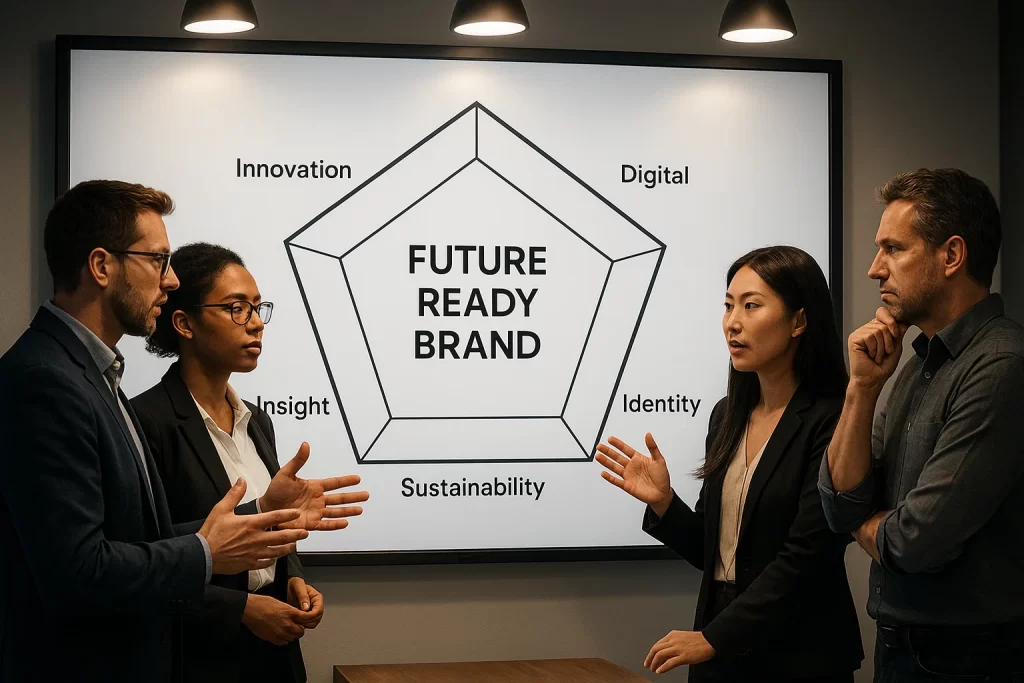
These five pillars form the foundation of transformation. But strategy without execution is just decoration. In the next section, we move from pillars to implementation tactics and tools—where the rubber meets the road.
Implementation Tactics & Tools
From Strategy to Action
A Brand Future‑Readiness Roadmap is only powerful if executed effectively. This section distills key tactics to move from theory to transformation.
1. Brand Prototyping Labs
Set up agile spaces to test messaging, tone, and visual identity. Rapid prototyping validates ideas before scaling.
2. Agile Brand Sprints
Adopt 2-week cross-functional cycles to pilot focused brand initiatives. Targets could include Gen Z onboarding or voice consistency across platforms.
3. Scenario Forecasting
Use tools like PESTLE models or simulation workshops to test future market changes. Brands that rehearse uncertainty adapt faster.
4. Digital Asset Management (DAM)
Ensure consistency and speed using tools like Brandfolder or Frontify for real-time brand asset control.
5. War Room Governance
Align CX, marketing, and leadership in weekly roadmap reviews with live dashboards tracking KPIs like Innovation Velocity and Brand Sentiment.
Measuring and Tracking Progress
Proof of Progress
Future-readiness must be measured to be managed. Here are lean, high-impact metrics:
1. Readiness Index Score
Combines agility, innovation, digital maturity, and culture readiness into one score.
2. Innovation Velocity
Tracks time from idea to pilot to scale—reflecting how adaptive your brand truly is.
3. Brand Trust Uplift
Use NPS, surveys, or tools like Talkwalker to measure perception change.
4. Transformation ROI
Monitor revenue impact, cost savings, and strategic speed. Link brand work to bottom-line outcomes.
Expert: “Transformation ROI compounds in year 2 and 3. Early metrics are learning tools, not verdicts.” — Deloitte
Common Pitfalls & How to Avoid Them
The Hidden Traps That Derail Brand Future-Readiness
A Brand Future‑Readiness Roadmap offers a transformative edge—but only if it’s executed with precision. Too many organizations begin the journey but stumble due to predictable, avoidable mistakes. This section maps the transformation blind spots that often go unaddressed and explains how to navigate around them.
Understanding these roadblocks isn’t just defensive—it’s strategic foresight.
Pitfall 1: Treating Digital as a Siloed Fix
Digital transformation often gets isolated in IT or marketing departments, disconnected from brand strategy. Brands may upgrade systems but fail to align those tools with identity, tone, or purpose.
Solution: Embed digital integration into every pillar of your roadmap—from storytelling to customer experience.
Expert quote
“Digital maturity without brand alignment leads to brand dissonance,” warns Forrester’s VP of Brand Strategy, Dipanjan Chatterjee.
Pitfall 2: No Leadership Buy-In
Transformation requires champions—not just teams. Brands fail when leadership views readiness as a tactical initiative, not a strategic investment.
“Every time we propose a roadmap, the C-suite says, ‘Nice idea, but let’s finish this quarter’s campaign first.’ And nothing changes.”
Solution: Co-create the roadmap with leadership. Involve them in pilot retrospectives and link outcomes to business goals.
Pitfall 3: Ignoring Culture and Talent
Your brand can’t be more future-ready than your people. Ignoring internal adoption—especially among frontline employees—leads to surface-level change without depth.
Symptoms
- Employees don’t understand the new brand vision
- Inconsistent voice across channels
- Resistance to change
Solution: Run internal brand sprints. Develop culture guides. Measure employee brand advocacy as a KPI.
Pitfall 4: Measuring the Wrong Metrics
Many brands default to legacy metrics—impressions, likes, or downloads. These are vanity stats. They don’t reflect transformation effectiveness.
“We launched all this stuff but don’t know if it moved the needle.”
Solution: Focus on metrics like:
- Brand trust uplift
- Time to launch new initiatives
- Pilot conversion rate
- Innovation adoption score
Pitfall 5: Expecting Instant ROI
Brand transformation is a long game. Expecting overnight returns leads to premature abandonment of promising experiments.
Expert insight
“Brands that stay the course on transformation plans outperform by 15–20% in year three,” says McKinsey’s latest report on strategic patience.
You now understand the landmines that kill momentum. In the final core section, we’ll compile real questions and community insights in a future-ready brand FAQ—including quotes from Reddit and brand forums.
FAQ
1. How do I start a brand future‑readiness roadmap if I’m not sure where my brand currently stands?
This is one of the most common roadblocks. Begin with self-diagnosis. Use tools like:
- Brand Agility Index
- Digital Maturity Model
- Business Readiness Matrix
You don’t need a 40-page strategy doc—start with a one-page benchmark. Plot your performance across five pillars: innovation, digital, culture, sustainability, and data. That’s your brand readiness baseline.
2. What are examples of future‑ready brands, and what can I learn from them?
Many global brands are leading examples of future-readiness. A few case studies:
- Nike: Embeds sustainability into storytelling, uses data for dynamic personalization, and pivots brand voice to match cultural trends.
- Spotify: Continuously adapts brand experience to audience behaviors using real-time data and modular design.
- Unilever: Reorganized brand architecture around purpose, with ESG metrics tied directly to brand equity tracking.
What they have in common: a readiness operating model, not just siloed initiatives.
3. How can I measure the ROI of brand transformation?
Start with a dual focus: quantitative performance + qualitative impact.
Metrics to track:
- Innovation Velocity
- Brand Trust Uplift
- Pilot-to-Scale Rate
- Readiness Index Score
Pair these with engagement feedback, NPS shifts, and customer sentiment.
Expert source: “True ROI in brand transformation reveals itself in year 2 and 3—track momentum, not miracles,” advises Deloitte’s Brand Agility report.
4. What’s the first step if I’m worried our brand will be left behind in innovation?
Start small—but start fast. Identify one pillar (e.g., digital integration or innovation culture) and launch a pilot program. Choose something measurable and time-bound, like:
- A new tone-of-voice test on social
- A brand sprint focused on Gen Z onboarding
- Launching a mini content lab for experimentation
This builds both confidence and internal momentum.
5. What if my C-suite doesn’t believe brand transformation is urgent?
Reframe the conversation. Don’t pitch transformation—pitch risk mitigation and growth acceleration. Show how your competitors are shifting. Tie brand readiness to business continuity, revenue protection, and talent retention.
You might say:
- “Our digital engagement is stalling. A brand evolution will improve CX and retention.”
- “Our talent expects values-aligned brands. Readiness affects hiring.”
Use external stats (e.g., McKinsey or Forrester) to back your case.
Conclusion
Future-readiness isn’t a buzzword—it’s a strategic necessity. In an era defined by volatility, technological upheaval, and consumer redefinition, brands that anticipate change are the ones that shape it. This guide walked you through the core of what it means to design a Brand Future‑Readiness Roadmap—not as a one-time initiative, but as a living architecture.
From diagnostic tools like the Digital Maturity Model and Readiness Index, to transformation frameworks grounded in brand agility, strategic foresight, and data-driven insight, every section aimed to demystify the process of brand evolution. You now understand:
- Where your brand stands
- What core pillars drive readiness
- How to implement pilots, measure ROI, and sustain momentum
More importantly, we tackled real pain points: stakeholder buy-in, measurement clarity, internal culture, and the fear of falling behind. These are not just strategic issues—they are human ones. Every rebranding, pivot, or innovation sprint ultimately comes down to how well your teams understand, believe in, and are equipped to live the brand.
Imagine your brand two years from now:
Your tone evolves fluidly across digital platforms. Your innovation labs are running two-week sprints. Your leadership team is guided by a readiness dashboard. Your brand is not reacting to the future—it’s architecting it.
That’s not fiction. That’s a roadmap in motion.
As you take your next steps:
- Prioritize one transformation pillar
- Launch a pilot within 30 days
- Establish KPIs before scaling
- Revisit your roadmap quarterly
Don’t wait for the market to change. Be the brand that sets the pace.