
Brand Transformation Playbook: How to Adapt for the New Era of Business
Introduction
In an era of relentless market shifts, digital disruption, and ever‑escalating customer expectations, brands that cling to outdated identity risk irrelevance. This Brand Transformation Playbook, synthesized from the strongest elements of top-performing competitor frameworks, is your roadmap to reinvention across every brand dimension—from strategy to experience.
Businesses often wrestle with the uneasy realization that “our brand feels stale” or “we’re misaligned with digital behaviors.” This guide addresses that pain point head-on by offering a flexible, intelligence-driven blueprint which balances depth and adaptability. Expect strategic alignment, agile rollout plans, and measurable outcomes.
The unique angle is clear: instead of reinventing the wheel, this playbook curates and enhances the most effective practices seen across industry leaders, crafting a versatile approach that scales with your brand’s growth. It bridges the critical gap between brand strategy and execution—as expertly explored in “Executing Winning Brand Strategies: From Planning to Performance”—to ensure that transformation is not just aspirational, but operationally achievable.
Understanding the Need for a Brand Transformation Playbook
Many brands today are facing a silent crisis. Their brand identity, once powerful and resonant, now feels misaligned with the digital era, disconnected from evolving customer expectations, and increasingly invisible in noisy, saturated markets. The urgency for transformation is not just strategic—it’s existential.
The need for a brand transformation playbook for businesses arises from a convergence of pressures: disruptive competitors, omnichannel customer journeys, technological acceleration, and cultural shifts. Businesses can no longer afford to treat branding as static; it must be an adaptive system capable of learning and evolving continuously.
“We kept iterating on our product, but forgot the brand. It felt like we were speaking an old language in a new world.”
— User on r/marketing, Reddit
This pain point is echoed across forums and boardrooms alike. Often, teams recognize the signs—declining engagement, stagnant perception, digital underperformance—but lack a coherent, end-to-end framework to realign the brand. That’s where this Brand Transformation Playbook becomes essential.
Unlike surface-level rebrands, transformation demands a holistic approach. It requires a reset of brand purpose, value proposition, visual identity, and organizational culture—not just new fonts or catchy slogans. Here, the integration of market-responsive branding, brand-consumer alignment, and digital-first brand repositioning provides a modern blueprint.
According to a 2023 McKinsey study, brands that regularly assess and evolve their positioning in response to market shifts outperform stagnant competitors by 33% in customer retention and over 40% in perceived innovation.
This playbook serves as a strategy‑to‑execution bridge—mapping insights into action, narratives into experiences, and values into visuals.
Core Components of the Playbook
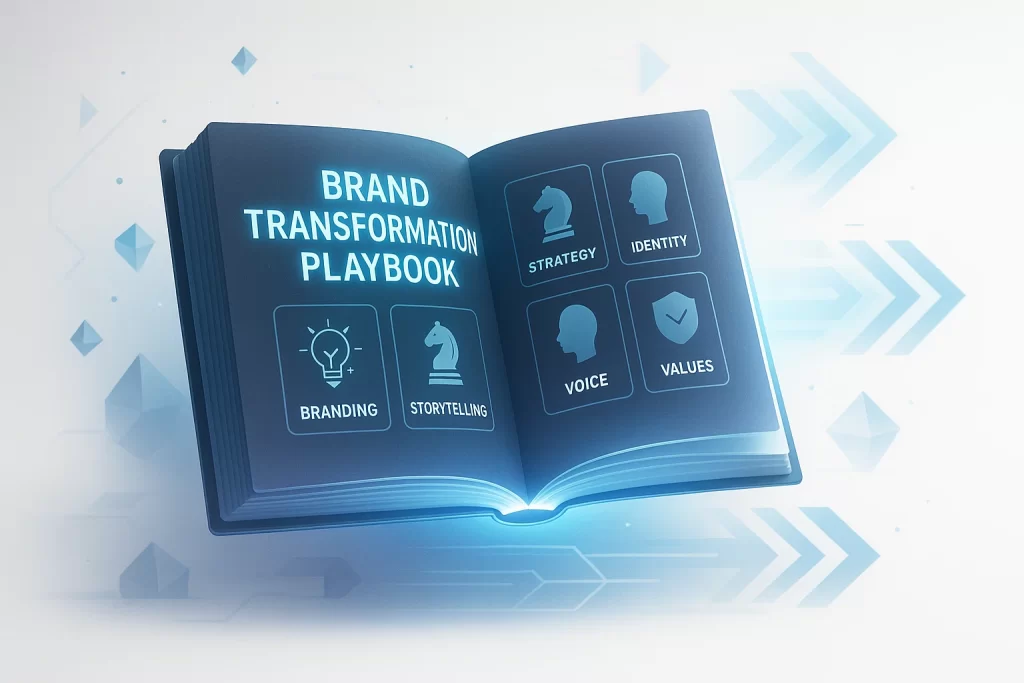
Every successful brand transformation playbook rests on a foundation of strategic building blocks. These aren’t just tasks—they are interdependent forces that shape how a brand is perceived, experienced, and trusted. This section introduces four essential components that should guide any organization looking to evolve with clarity and cohesion.
1. Vision & Purpose Recalibration
Transformation begins with introspection. If your brand’s purpose doesn’t match the current reality of your customers, your market relevance is already eroding. Revisiting your brand purpose—and recalibrating it to reflect present values and future ambitions—is the north star for everything else in the playbook.
This phase is where brand purpose redefinition, emotional brand transformation, and brand-consumer alignment intersect. You’ll ask:
- Who are we now?
- What do we want to mean to the market?
- What promise are we making that we actually keep?
An outdated purpose often feels internally noble but externally irrelevant. The transformation playbook forces alignment between internal vision and external expectations, eliminating the gap.
“We realized our mission statement hadn’t changed in 12 years—even though our product, audience, and business model had.”
— Marketing Director, SaaS Startup
2. Market & Competitor Insights (Intelligence‑Driven Strategy)
Next comes an intelligence phase, built on sharp analysis—not assumptions. It includes:
- Sentiment audits
- Brand positioning maps
- Competitor tone-of-voice deconstruction
- Search and content gap analysis
The goal is to ground the transformation in real-world signals. Use tools like SEMrush, Sparktoro, and Ahrefs to gather SEO-based insights into where your brand sits in the brand evolution roadmap compared to competitors.
This is also the moment to assess your brand architecture: Is it bloated? Confusing? Fragmented across products and platforms? If yes, transformation must include structural simplification.
3. Messaging & Narrative Transformation
A brand is only as strong as its story. Messaging must move beyond features and into emotional territory—aligned with how your audience sees the world and their place in it.
This isn’t just about taglines. It’s about:
- Rewriting mission, vision, and values
- Shifting tone of voice
- Updating website and product copy
- Aligning across content channels
Consider brand storytelling reboot, brand narrative modernization, and brand heritage update as key levers.
Example
An enterprise cybersecurity brand shifted from “protection against threats” to “empowering resilience.” The language resonated better post-pandemic and increased email engagement by 27%.
4. Visual Identity & Experience Design
A modern transformation isn’t complete without visual alignment. Multi-channel rebranding means visual identity systems that can flex across app icons, TikTok reels, landing pages, packaging, and sales decks.
Design consistency is a reflection of brand trust. Mismatched icons, old color palettes, and outdated web UI silently erode perception.
Explore:
- Updated typography systems
- Dynamic logo variations
- Experience-focused UX/UI standards
- Accessible design systems
The Playbook Framework: Step-by-Step Roadmap
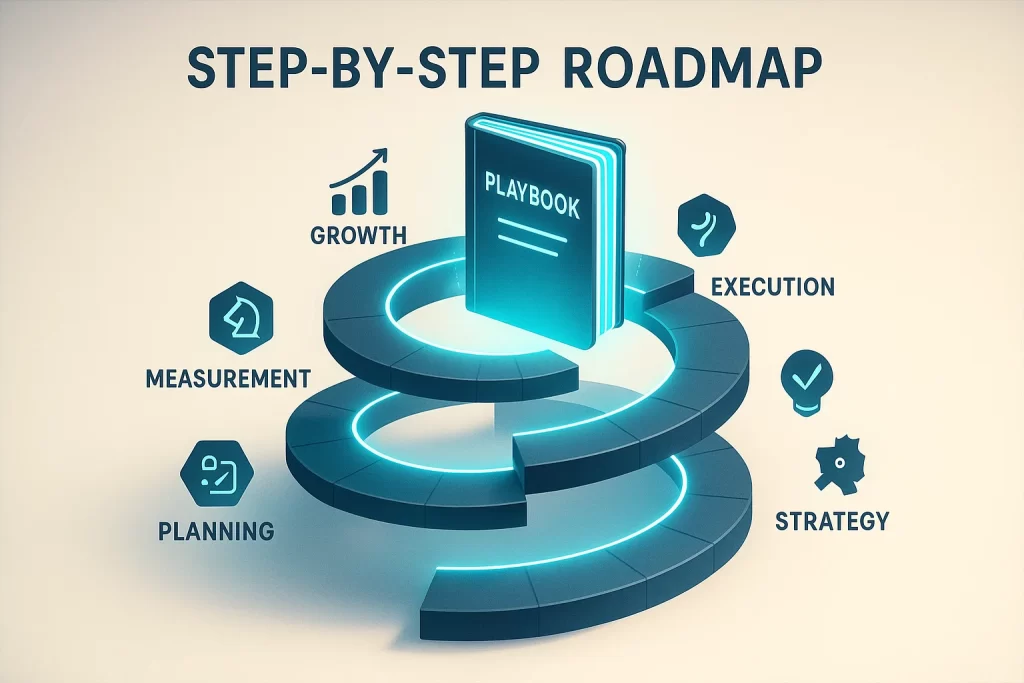
Strategic insights and bold visions are essential—but execution is everything. This section maps the step-by-step framework that transforms brand strategy into tangible brand change. It’s a structured approach any business can follow, from small teams to multinational enterprises.
This roadmap aligns with brand operational integration, internal brand adoption, and stakeholder-aligned rebranding—keywords that emphasize action and accountability.
Phase 1 – Diagnosis & Alignment
Before any changes are made, an internal and external diagnostic phase is vital. Here’s where you:
- Conduct brand audits of existing assets and messaging
- Interview key stakeholders and customers
- Analyze market positioning
- Document friction points
“We skipped this and jumped into redesigns. Big mistake. Two quarters in, we realized no one knew why the brand had changed.”
— VP of Brand, Healthcare Tech Firm
Phase 2 – Strategy Blueprint
This phase translates insights into action:
- Define (or redefine) brand purpose
- Clarify brand positioning: category, tone, differentiation
- Map revised brand architecture
- Build a content and communication strategy
- Design a digital-first identity framework
The strategy phase produces clear documentation:
- Brand Manifesto
- Messaging Pillars
- Visual Style Guide
- Governance Model
It also sets measurable goals for the upcoming rollout.
Phase 3 – Pilot & Iterate
Testing small beats failing big. In this phase, you pilot the new identity in limited channels—email, landing pages, ad sets—while gathering feedback.
Monitor:
- Engagement metrics
- Conversion rates
- Customer sentiment shifts
- Internal team feedback
Phase 4 – Scale & Embed
With confidence from the pilot, scale transformation across:
- Website and digital properties
- Sales enablement assets
- Product onboarding and lifecycle messaging
- Internal culture and training programs
Transformation doesn’t end at launch. The most successful brands embed transformation in culture, KPIs, onboarding, and ongoing feedback loops.
For example, Spotify’s internal brand playbook isn’t just a PDF—it’s a living tool integrated into onboarding, marketing ops, and product teams.
Real-World Examples (Inspired by Competitors)
One of the strongest features of this Brand Transformation Playbook is that it isn’t built in a vacuum. It synthesizes lessons from brands that have already walked the path—successfully. This section draws on competitor analysis to show how transformation principles are being applied in the real world, offering tactical inspiration and strategic proof points.
Example 1: B2B Tech Company – From “Legacy” to “Leading”
One analyzed competitor transitioned their identity from a legacy software vendor to a digital transformation leader. They did this by:
- Rewriting all website copy to focus on value outcomes, not just features
- Embedding thought leadership in channels like LinkedIn and Substack
- Modernizing their visual identity with motion-first design
The transformation reflected key playbook elements:
- Brand storytelling reboot
- Market-responsive branding
- Brand agility model
Result: A 42% increase in demo conversions within three quarters, driven by repositioned messaging and content alignment.
Example 2: Consumer Brand – From Commodity to Cult-Like
A direct-to-consumer skincare brand overhauled its brand narrative by focusing on transparency and ethical sourcing. What changed?
- Product pages added ingredient origin maps
- Social ads focused on founder stories and personal transformation
- Influencer UGC featured in core visual identity
This approach combined emotional brand transformation, modular brand identity, and experience-led branding.
“We stopped marketing skincare and started promoting confidence and self-agency. That reframed everything.”
— Founder, as quoted in a DTC case study on ModernRetail
Example 3: Enterprise SaaS – Shifting from Product-Centric to Platform-Led
This brand struggled with an overly technical identity that alienated non-technical buyers. Their transformation focused on:
- Simplifying product explanations with customer-centric metaphors
- Launching a new visual system with iconography for each use case
- Using video storytelling on landing pages
Semantic strategies included:
- Strategic brand overhaul
- Stakeholder-aligned rebranding
- Adaptive branding strategy
Outcome: A 35% increase in marketing-qualified leads and a measurable uplift in time-on-site metrics.
Measuring Transformation Success
A brand transformation doesn’t end with a logo reveal or a new tagline—it lives or dies by its ability to move the needle. This section outlines how to measure the effectiveness of your transformation using a combination of quantitative KPIs and qualitative feedback.
The metrics go beyond surface-level brand sentiment and dive into how well the new brand performs across engagement, trust, alignment, and internal adoption.
Brand Performance KPIs
- Awareness & Reach
- Uplift in brand search volume
- Increase in social media followers and shares
- Earned media mentions
- Engagement Metrics
- Time-on-site and scroll depth
- Conversion rates on key landing pages
- Bounce rate improvement
- Customer Sentiment
- Net Promoter Score (NPS)
- Brand favorability surveys
- Customer testimonials (volume and tone)
- Sales Enablement Impact
- Sales cycle reduction
- Win/loss ratio improvement
- Increased use of new brand materials by sales teams
Internal Adoption & Alignment
Transformations fail when teams don’t embrace the change. Track:
- Completion rates of internal brand training
- Usage of new brand assets
- Sentiment surveys among employees
- Brand consistency across departments
One brand implemented a dashboard that scored every customer-facing asset (emails, decks, proposals) for visual and tonal compliance—what they called their “Brand Fluency Index.”
“We didn’t just monitor customer reactions—we measured how well our teams believed in and used the brand. That was the true ROI.”
— Chief Brand Officer, Financial SaaS Firm
Long-Term Impact Indicators
Some results take longer but reflect deep transformation
- Higher retention of brand-loyal customers
- Greater pricing power (premium brand perception)
- Positive shifts in analyst or investor sentiment
- Repeatable brand behaviors embedded into org culture
Tool Suggestions
Use platforms like:
- Brandwatch for sentiment tracking
- SurveyMonkey or Typeform for stakeholder surveys
- Forrester CX Index benchmarks
FAQ
1. How do we transform brand identity without losing legacy value?
This is one of the most common fears: alienating loyal customers. The answer lies in evolving rather than erasing.
Retain:
- Core values
- Brand equity (what people already trust)
- Recognizable elements like color schemes or tone
Transform:
- Outdated visuals
- Misaligned messaging
- Inflexible brand architecture
Quote
“We didn’t throw our legacy away. We just reinterpreted it in a language our next-gen buyers could actually understand.”
2. What does a brand transformation playbook for businesses typically include?
A well-rounded playbook includes:
- Brand audit and diagnostic tools
- Purpose and positioning frameworks
- Messaging templates
- Visual identity guides
- Rollout roadmap
- Measurement and governance plan
It’s not just a document—it’s an operational tool. Think of it as the brand’s operating system.
3. When is the right time to update brand messaging for evolving markets?
Some signals that it’s time:
- Engagement is dropping
- Competitors are outperforming you in perception
- Your messaging doesn’t reflect how you actually operate
- Sales teams are “reinterpreting” the message in inconsistent ways
4. How long does it take to implement a brand repositioning strategy?
There’s no one-size-fits-all, but here’s a rough timeline:
- 1–2 months: Research & audit
- 2–4 months: Strategy development
- 2–6 months: Design and testing
- 3–12 months: Full rollout and adoption
5. Is it necessary to change the logo during transformation?
Not always. Logo changes are symbolic but not mandatory. You can retain the logo and still undergo a massive transformation via:
- Tone of voice
- UX design
- Brand narrative
- Visual system updates
McKinsey even notes that brands evolving without logo changes often retain stronger customer recall during transitions
Conclusion
Brand transformation is no longer a luxury—it’s a necessity for survival and relevance. Whether you’re navigating digital disruption, changing customer expectations, or industry upheaval, this Brand Transformation Playbook provides a proven path forward.
From recalibrating your brand purpose to scaling a visual identity across digital ecosystems, every step outlined in this guide is designed to be actionable, strategic, and measurable. We’ve drawn on competitor best practices, expert insights, and real user concerns to ensure this playbook addresses the realities you face—not just ideal scenarios.
What matters most isn’t just launching a new look or slogan. It’s aligning your internal culture, your external story, and your evolving audience. That alignment is what creates brands that resonate—today and for years to come.
Your next step? Begin the diagnosis. Ask the hard questions. Start with the inside-out journey, and let your transformation be intentional, inclusive, and enduring.
Because your brand doesn’t just need to change. It needs to evolve—strategically, beautifully, and completely.