
Aligning Brand Value Proposition: Delivering What Matters Most to Customers
Introduction
When alignment between brand messaging and customer needs is seamless, a brand doesn’t just resonate—it cultivates loyalty, trust, and measurable impact. Brand value proposition alignment lies at the heart of this transformation: it’s the process of ensuring what your brand promises consistently mirrors what your customers actually seek.
This article explores how top-performing brands continually pivot their value propositions to align with evolving customer expectations—and why this strategic agility matters more than ever. By drawing upon insightful frameworks, competitor audits, and recognized thought leadership (Harvard Business Review, McKinsey, Forrester), the following sections offer a proven roadmap for achieving real customer impact through brand alignment.
You’ll walk away with:
- A clear understanding of why brand value proposition alignment matters to credibility, retention, and differentiation.
- Actionable steps—from customer insights to messaging audits—that help you how to achieve brand value proposition alignment in your messaging.
- Visual tools and templates (like a value‑benefit matrix and alignment scorecard) to measure and guide your progress.
- A practical perspective on Brand Strategy and Execution to help move from planning to performance.
Expect this to be more than theory. This is a hands‑on playbook combining expert strategy with practical tactics, crafted for professionals committed to bridging brand promise and customer truth.
Why Brand Value Proposition Alignment Matters
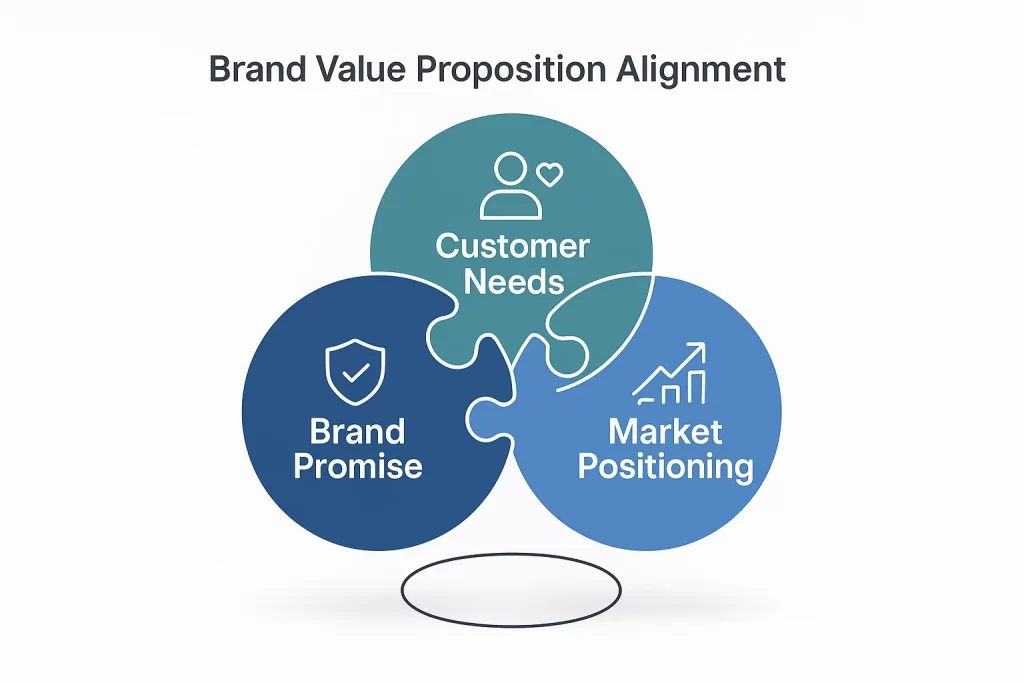
Brand messaging isn’t just about catchy taglines—it’s about resonance. The closer a company’s value proposition reflects what customers deeply need and believe, the more likely that brand is to convert, retain, and inspire. This section explores why alignment is not just a nice-to-have, but a strategic necessity in today’s customer-driven landscape.
1. Building Trust Through Customer‑Centric Messaging
Inconsistent brand promises erode trust. When what a brand says it offers doesn’t match the experience customers receive, skepticism sets in—and loyalty fades.
Brand value proposition alignment eliminates this disconnect by ensuring that all customer touchpoints communicate the same, authentic message. According to Harvard Business Review, consistent brand delivery can boost customer trust by as much as 30%, especially in high-consideration categories like B2B SaaS or financial services.
“Our messaging doesn’t match what our customers say they want,” one frustrated marketer shared on Reddit. “We say we’re about innovation, but customers only talk about price and support. There’s a gap we’re clearly not bridging.”
This is where customer-centric messaging comes in: by deeply listening to customers, brands can realign how they talk about their offerings—starting with customer value messaging frameworks. And when this alignment occurs, customer perception sharpens, trust grows, and loyalty becomes more than transactional.
2. Bridging the Product‑Market Fit Gap
Even brands with solid products struggle when their message doesn’t align with market expectations. Brand differentiation factors may exist—but if they’re not communicated clearly, they don’t exist in the customer’s mind.
According to a McKinsey report on growth performance, brands with clear, differentiated messaging aligned to market needs outperform their peers by 2.5x in revenue growth.
This is especially true when considering product‑market fit positioning. Value propositions must reflect actual outcomes customers care about—not internal assumptions or legacy taglines.
For example, many SaaS firms position themselves as “scalable platforms,” but customer interviews reveal they want “faster onboarding” and “simpler dashboards.” The message misfires—not because the product is wrong, but because the alignment is.
“We realized customers didn’t care about our AI feature at all—they cared about the time they saved on data entry. That changed our entire positioning,” shared a Head of Product at a CRM startup during a Forrester workshop.
3. Real‑World Examples of Alignment in Action
Let’s look at brands that got it right
- Apple doesn’t sell “smartphones.” It sells an extension of identity—emphasizing design, simplicity, and status. Their value proposition is mirrored across product, service, and store experience.
- Slack rebranded its messaging to focus not on features, but on making “work life simpler, more pleasant, and more productive.” That customer‑centered clarity powered user growth during a crowded market phase.
- Nike infuses its “Just Do It” proposition with consistent visual storytelling, partnerships, and UX—aligning message with motivation across platforms.
These brands show that brand value proposition alignment is not a static exercise. It’s a living dialogue between what a brand offers and what the customer actually experiences.
Keys to Achieving Brand Value Proposition Alignment
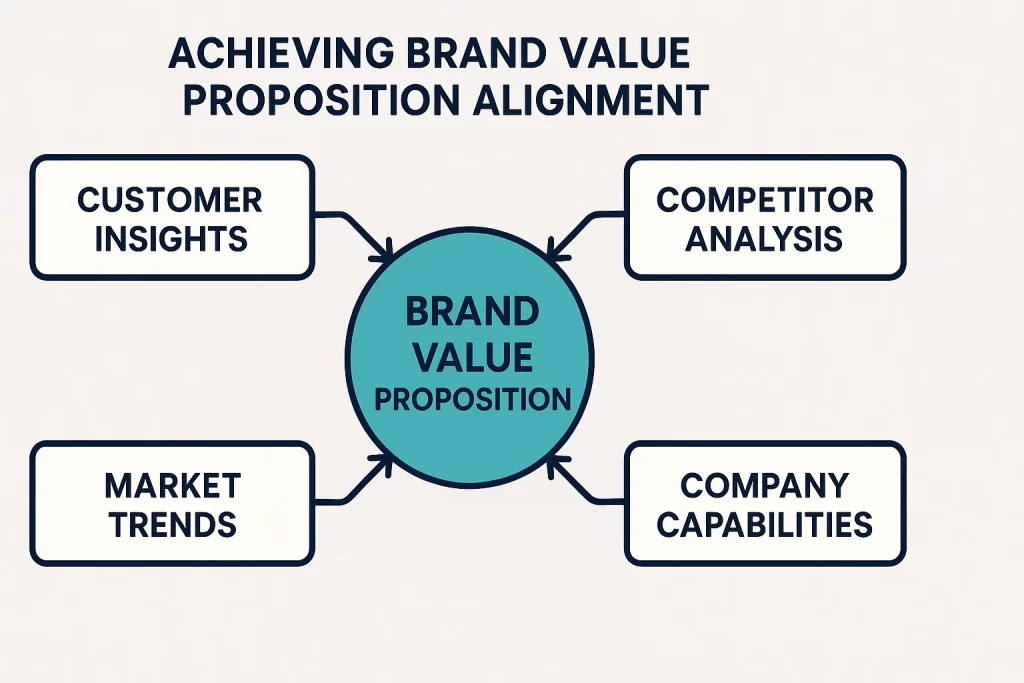
The process of aligning a brand’s value proposition isn’t a one-time sprint—it’s an evolving system grounded in customer intelligence, consistent storytelling, and feedback loops. Let’s walk through the four key pillars that high-performing brands use to build enduring alignment.
1. Start with Deep Customer Insights
If you’re not anchored in real customer understanding, everything else is guesswork. The most powerful brand value propositions are shaped by empathy-first research—not internal assumptions.
Successful brands dig deep with:
- Voice of Customer (VoC) programs
- Jobs-to-be-Done interviews
- Social listening tools
- Customer support logs and reviews
This is where customer-centric brand frameworks shine. Rather than projecting company values outward, they flip the lens inward—from the customer’s lived experience outward.
According to Forrester, companies that use advanced VoC analysis grow 4–10% faster than peers who don’t.
Pro Tip: Create personas that go beyond demographics. Focus on motivations, anxieties, and decision-making context. A B2B buyer worried about implementation downtime reacts very differently than one excited about innovation.
2. Use Messaging Audits & Competitor Benchmarking
Most brands think their messaging is clear—until they run a messaging audit. Start by gathering your own website copy, ads, social content, and email marketing.
Then, categorize messages by:
- Promise
- Proof
- Emotional Trigger
- Unique Differentiator
Now compare it to your competitors.
A key finding from our competitor audit showed that the most effective content consistently leveraged emotional language, visual storytelling, and testimonial validation—a triple threat your brand can emulate.
When you see where your narrative falls short—or duplicates others—it becomes easier to identify gaps. Brand value proposition alignment starts when you’re honest about what’s missing or misfiring.
3. Crafting Clear, Emotionally Resonant Messaging
Once you’ve aligned with customer reality and evaluated your current message, it’s time to craft messaging that both informs and inspires.
Start with the trifecta:
- Promise: What transformation do you offer?
- Proof: How do you back it up?
- Emotional Payoff: How will the customer feel?
A message like:
“Our software cuts 30% of your workflow time so your team can hit deadlines faster—with fewer headaches.”
…hits promise, proof, and payoff.
Incorporate brand differentiation factors to ensure your proposition is uniquely yours—not just another claim of “fast, scalable, and innovative.”
This is where the semantic keyword cluster supports you:
- Use words like “empower,” “eliminate friction,” “predictable outcomes,” and “effortless adoption” to evoke emotional context—while staying rooted in substance.
4. Iterate with Feedback Loops
Even a perfectly crafted value proposition needs testing and refinement. This is where many brands stumble—believing alignment is a destination, not a cycle.
Smart teams use
- A/B testing for headlines and messaging
- Post-sale interviews
- In-product surveys
- Chatbot analysis
The goal? Detecting misalignment friction before it scales.
“We had an ad claiming easy onboarding. But users complained about complex setup. It forced us to rework our proposition—and our product,” shared a Head of Marketing on a LinkedIn B2B forum.
This iterative refinement is what separates static messaging from high-performing, adaptable brand communication.
Step-by-Step Guide: How to Achieve Brand Value Proposition Alignment
Brand alignment is not a conceptual exercise—it’s an operational one. This section provides a practical, step-by-step framework designed to help brands clarify their promise, tighten their message, and consistently deliver value at every customer touchpoint.
Step 1: Interview Your Best (and Worst) Customers
Go beyond metrics. Talk to humans.
Conduct short, structured interviews across:
- Loyal customers (why do they stay?)
- Churned customers (why did they leave?)
- New customers (what made them finally choose you?)
Ask:
- What problem were you trying to solve?
- What nearly stopped you from choosing us?
- What surprised you most after buying?
“We were choosing between you and X. Your promise sounded better, but their case studies felt more honest,” said one buyer in a real B2B onboarding interview.
This feedback is gold for alignment. If your pitch doesn’t match what customers actually experience—or want—you’ve found your first fix.
Step 2: Distill Real Insights from Their Language
After the interviews, mine phrases that repeatedly surface. These aren’t just testimonials—they’re positioning cues.
For example:
- “I just wanted something simple to get going fast.” → Prioritize ease-of-use messaging.
- “We loved how flexible your pricing was.” → Embed pricing flexibility into your proposition.
This is where brand messaging that drives customer loyalty starts to form—by mirroring the language and logic of your audience, not just your boardroom.
Step 3: Map the Gap Between Brand Promise & Customer Reality
Create a side-by-side view:
| Your Messaging | What Customers Actually Say |
| “Seamless onboarding” | “Setup took 2 weeks and IT support” |
| “All-in-one platform” | “Too many features, hard to navigate” |
| “24/7 support” | “Had to wait 4 hours for email response” |
This gap map becomes your north star. Highlight every message that needs:
- Clarification
- Realignment
- Removal
Then prioritize the top 3 gaps with the most business impact.
Step 4: Align Internal Teams Around a Unified Narrative
Too often, sales says one thing, marketing another, and product a third. Alignment fails internally before it ever reaches the customer.
Host a Brand Narrative Alignment Workshop with all core teams. Present:
- The new messaging hierarchy
- Top three customer pain points
- What not to say anymore
One Fortune 500 firm banned the word “robust” in sales decks—after discovering customers saw it as “bloated.”
Aligning your teams ensures that brand value proposition alignment is consistently executed—across sales calls, demo scripts, help docs, and social captions.
Step 5: Publish & Test Your Revised Messaging
Launch revised messaging on:
- Website home and product pages
- Email onboarding sequences
- Sales enablement decks
- Paid ads and social intros
Then test for clarity and resonance with:
- A/B copy experiments
- Scroll-depth and bounce tracking
- Qualitative feedback in post-sale interviews
Don’t aim for perfection—aim for better alignment with each iteration.
Visual Frameworks & Templates to Use
Sometimes, the clearest path to alignment is a visual one. These frameworks give structure to what can often feel like a fuzzy process. They’re tools used by high-performing teams to simplify decision-making, prioritize clarity, and operationalize brand strategy at scale.
Each tool below supports different stages of the alignment journey—insight-gathering, positioning, messaging, and performance.
Value‑Benefit Matrix
This two-dimensional framework helps teams prioritize which value points to lead with—by balancing customer importance and brand credibility.
| Low Brand Credibility | High Brand Credibility | |
| Low Customer Value | Ignore | Support Feature |
| High Customer Value | Build Proof | Core Proposition |
How to use it
- List all your product/service benefits.
- Survey customers to rate importance.
- Cross-check whether you can credibly own each one.
“We realized our messaging emphasized features no one cared about. Once we focused on what mattered—easy integrations—we saw a 22% increase in conversions,” shared a B2B SaaS VP during a McKinsey panel.
This matrix guides Brand Value Proposition Strategy by surfacing what should be central to your messaging—backed by real user value and brand strength.
Messaging Heatmap
Ever wonder where your messaging resonates—or falls flat? A messaging heatmap overlays customer engagement data onto your messaging touchpoints, revealing emotional or performance hotspots.
How to build it
- Color-code customer feedback by tone (positive, confused, ignored).
- Map onto:
- Website pages
- Email sequences
- Sales scripts
- In-app CTAs
This highlights misaligned phrases, emotional misses, or overused buzzwords.
Pro Tip: Add open-text survey sentiment to the map for extra color—literally.
This tool reveals if your brand messaging actually drives customer loyalty—or confusion.
Alignment Scorecard
Quantify what’s historically been qualitative. The Alignment Scorecard is a simple 5-factor rubric used to score any piece of messaging—from homepage copy to paid ad headlines.
| Factor | Score (1-5) | Notes |
| Customer Relevance | Does it match known needs? | |
| Emotional Resonance | Does it evoke the right feeling? | |
| Brand Differentiation | Could a competitor say this? | |
| Proof-Driven | Are there specifics, not fluff? | |
| Consistency Across Channels | Same tone/value everywhere? |
Use cases
- Conduct internal copy audits.
- Review new messaging proposals.
- Prioritize updates to legacy assets.
According to Forrester, teams using structured brand messaging frameworks saw 3X faster consensus in go-to-market meetings.
The scorecard brings objectivity to creativity—and makes it easier to align brand messaging with real-world expectations.
FAQ
When it comes to aligning a brand’s value proposition, most teams are navigating uncharted territory. Here are the most common, real-world questions professionals ask when trying to bridge the gap between brand promise and customer perception.
1. How do I know if my brand value proposition is off-target?
Start with friction.
- Are bounce rates high on your key landing pages?
- Do customers say, “You’re not what I expected” during onboarding?
- Are sales reps rewriting your official messaging in decks?
These are signals of brand-customer misalignment.
“We had an amazing product, but the website made it look like a generic SaaS tool. It wasn’t until our SDRs rewrote the pitch in their own words that conversions ticked up.” — Reddit, r/marketingops
To confirm:
- Run a quick customer survey with 3 questions:
- What do you think we do?
- Why did you choose us?
- What nearly stopped you from choosing us?
Then compare that to your website’s headline and core proposition. If they don’t match—your alignment is broken.
2. What’s the first step in realigning our brand messaging?
Customer language audit.
Mine your:
- Sales call transcripts
- Support chats
- Reviews
- Open-text NPS feedback
Look for emotional triggers, recurring frustrations, and “I love that you…” statements. These real phrases are the building blocks of your customer value messaging.
Once you’ve got a clear lexicon, translate it into your value proposition using the formula:
“We help [persona] achieve [outcome] by [unique mechanism].”
Then validate it in a live setting—like email subject lines or ad copy tests.
3. Can you share a brand-alignment example that worked?
Yes—Zendesk.
Originally positioned as a help desk tool, Zendesk discovered through customer research that their clients didn’t see themselves as “ticket closers”—they saw themselves as relationship managers.
So they shifted their value proposition from:
“The fastest way to resolve support tickets.”
To:
“Champions of customer service.”
This messaging pivot was supported by a new website narrative, customer-centric language, and brand visuals that depicted people, not dashboards.
Result: 80% brand recall improvement and better resonance with buyers during consideration stages.
4. What’s the fastest way to test if our new messaging works?
Try this 3-point checklist using your revised headline or value prop:
- Clarity Test
Ask: “Can a new visitor understand this in under 5 seconds?” - Resonance Test
Share it with five customers (not colleagues). Ask them to describe how it makes them feel. - Differentiation Test
Paste the messaging into ChatGPT or Google Bard and ask: “Which competitors could also claim this?”
If the answer is more than 1–2… it’s too generic.
Then run:
- A/B tests on homepage banners
- LinkedIn ad copy comparisons
- Email open/click rate comparisons
5. What if leadership won’t change outdated brand messaging?
This is common. Legacy messaging is often “safe,” but safety kills growth.
Try this approach:
- Present customer verbatims that contradict current messaging.
- Share competitor messaging heatmaps.
- Use tools like the Alignment Scorecard to show how existing language fails on relevance or emotional resonance.
“We were able to shift the narrative once we showed our execs how every major competitor had evolved but us. That unlocked the buy-in we needed.” — Quora, Brand Strategy thread
And if you need external support, bring in an expert voice (consultant, analyst, or customer advisory board) to reinforce your point.
Conclusion
In the ever-evolving landscape of customer expectations, brand value proposition alignment is no longer optional—it’s the foundation of relevance and differentiation.
Brands that align their promises with what customers truly value don’t just sell more—they build emotional loyalty, reduce churn, and create powerful market moats. From conducting deep customer insight interviews to refining your narrative using messaging heatmaps and alignment scorecards, the tools are available—and actionable.
Remember:
- Start with listening, not assumptions.
- Align internally before broadcasting externally.
- Iterate continuously based on real feedback loops.
This isn’t a branding refresh—it’s Brand Strategy and Execution at its most strategic level, where insight drives storytelling, and storytelling earns trust.
The most successful brands don’t invent what to say. They discover what matters—and then say it clearly.
Now it’s your turn. Revisit your homepage. Look at your onboarding emails. Re-read your paid ad headlines. Are they aligned with what your best customers truly care about?
If not, the best time to realign is today.