
RPA for Reconciliations, Data Sync & Reporting
AI Services > AI Workflow Automation > RPA for Reconciliations, Data Sync & Reporting
RPA for Reconciliations, Data Sync & Reporting
Automate reconciliations, sync cross-platform data, and refresh financial reports instantly with RPA. Cut delays, eliminate errors, and boost team productivity fast.
Finance-Grade RPA
Purpose-built bots that handle complex finance logic, matching, and rules-based reconciliation at scale
Real-Time Sync
Connects apps, sheets, and databases so your financial systems are always aligned and accurate
Report Ready Always
Auto-refresh dashboards and reports from live data sources, enabling informed decisions at any hour
Why Choose Us
Automation That Powers Precision
We design RPA flows that automate high-risk, high-volume tasks like reconciliations and data sync—saving hours and reducing reporting errors to near zero
“Reconciliation time dropped from 3 days to 3 hours. We now close faster and trust our data completely”
Leila Gonsalves
― Finance Controller
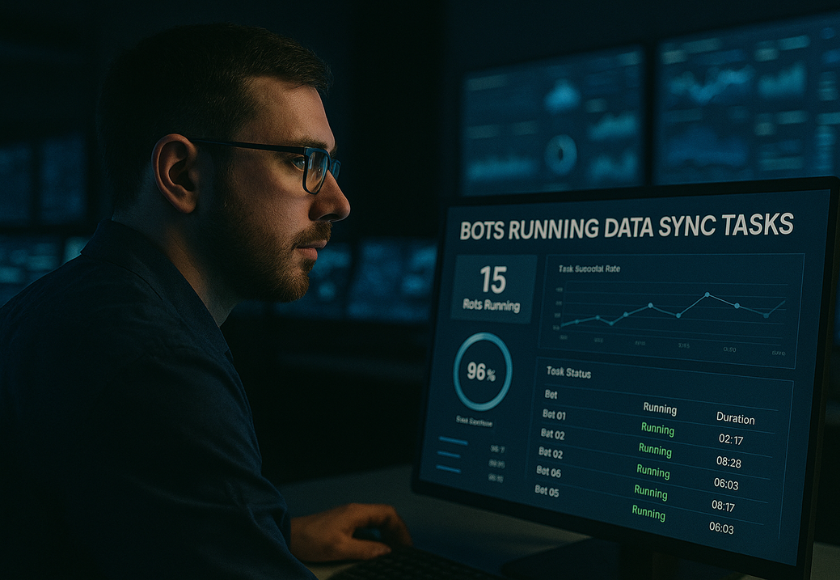
Automated Reconciliation Engine
Our RPA bots automate ledger, bank, and intercompany reconciliations—comparing entries, flagging mismatches, and generating audit-ready logs automatically
- Auto Match Entries
- Audit Trail Ready
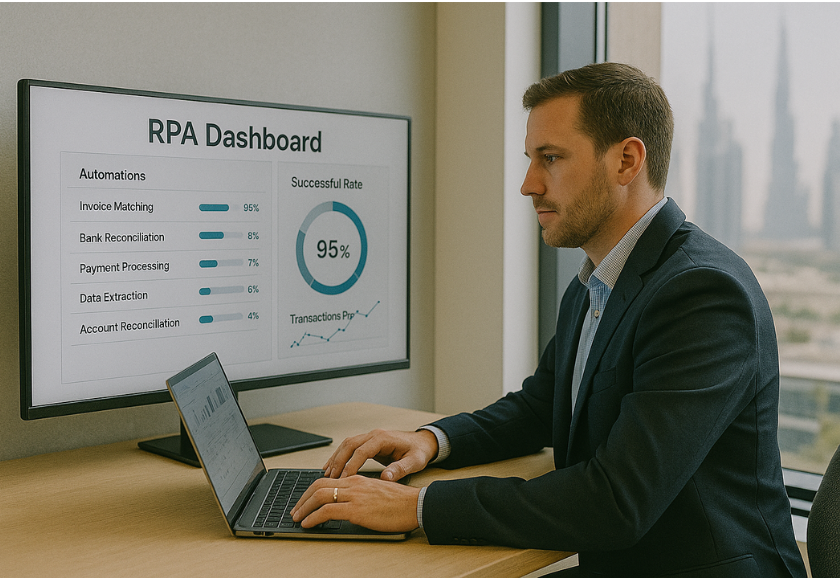
Real-Time Data Sync & Refresh
Syncs data between CRMs, ERPs, and spreadsheets in real time. Dashboards and reports get refreshed with zero manual effort and high data integrity
- No Manual Updates
- System-Wide Sync
Our Services
Automate Your Finance Backbone with RPA
From reconciliations to report refresh cycles, explore 12 subservices built to automate the most time-sensitive and detail-critical finance processes

Bank Reconciliation
Automate matching between bank statements and accounting ledgers with rule-based precision

Intercompany Matching
Bot-driven reconciliation between intercompany invoices, journals, and adjustments for group-level accuracy

Trial Balance Sync
Keep trial balances updated across entities by syncing data between finance tools and ledgers in real time

Invoice Validation
Cross-check invoice details with POs and delivery notes using RPA to ensure billing accuracy
ERP-to-Excel Refresh
Auto-pull live data from ERP systems into Excel sheets used for financial models and reports

GL Entry Reconciliation
Verify and flag discrepancies in general ledger entries without human involvement
RPA for Reconciliations, Data Sync & Reporting
Service Title and Content
In modern finance operations, speed, accuracy, and transparency aren’t just goals—they’re essentials. As businesses deal with increasing volumes of financial data, multiple systems, and tighter reporting timelines, Robotic Process Automation (RPA) emerges as a powerful enabler. At Octopus, we deliver finance-grade RPA solutions built specifically for reconciliations, cross-system data sync, and real-time report refresh cycles.
We don’t offer generic bots. We craft precision automation flows tailored to your ledgers, policies, and reporting requirements. Whether you’re managing bank reconciliations, syncing ERP data, or refreshing Power BI dashboards, our bots eliminate manual work, reduce risk, and accelerate decision-making. With Octopus, financial automation becomes a strategic lever that gives your teams time back while delivering unmatched accuracy and compliance.
Meta Tags
Title Tag: RPA for Reconciliations, Data Sync & Reporting | Octopus UAE
Meta Description: Automate finance tasks with RPA. Octopus delivers secure bots for reconciliations, data syncing, and reporting automation across ERP, Excel, and cloud tools.
Content Optimization
Our RPA bots mimic human behavior across your digital systems—logging into apps, extracting data, matching values, and pushing updates without human intervention. The result is faster closes, real-time reporting, and error-free reconciliations.
Reconciliation bots work across ledgers, bank statements, trial balances, and intercompany transactions. They identify mismatches based on business logic, auto-tag exceptions, and route issues for review. Meanwhile, sync bots keep systems like your ERP, CRM, and Excel models in continuous alignment.
Reporting bots update dashboards on a schedule or trigger basis, pulling fresh data from databases, APIs, or files. With RPA handling the grunt work, finance teams shift from data gathering to strategic analysis. We embed intelligence into every bot to adapt to exception scenarios and log every action for auditability.
Technical SEO
Our bots are designed for secure, scalable deployment. We ensure every automation flow operates under encrypted protocols, with audit trails and access controls baked in. Our RPA engine integrates with platforms like SAP, Oracle, Microsoft Dynamics, NetSuite, QuickBooks, and more.
We use metadata tagging, structured logs, and trigger-based execution to ensure each bot action is traceable. Our bots comply with UAE financial data security regulations and can be hosted on-premise or in cloud environments.
We embed schema definitions into RPA workflows, ensuring bots understand the format, flow, and dependencies of each task. This prevents broken automation and ensures reliable execution even as systems evolve.
Internal Linking
RPA becomes exponentially more valuable when it connects systems. Our bots ensure:
- Invoice validations link to PO records
- Reconciled entries update master ledgers
- Dashboard visuals source data from synced platforms
- Tax filings use values checked by reconciliation bots
By connecting these flows, RPA ensures your data is consistent, your reporting is real-time, and your finance team operates from a single version of truth. This synergy across tools means improved transparency, reduced silos, and faster cycle times.
Schema
We implement clear schemas for each automation type. For reconciliations, bots follow a logic tree:
- Source Data Extract > Compare Entries > Apply Matching Rules > Flag Exceptions > Auto Resolve or Route
For report refresh:
- Trigger > Extract Data > Apply Filters > Refresh Model > Notify Stakeholders
Data sync workflows operate on a schema of:
- Monitor Source > Detect Changes > Map Fields > Sync Destination > Confirm Success
These schemas ensure process resilience, transparency, and adaptability as business logic changes. They enable bots to respond intelligently to data variations and ensure ongoing data integrity.
Mobile
All Octopus RPA workflows are mobile-monitored. You can view bot status, exceptions, and reports from a secure mobile dashboard. Approval requests, mismatch alerts, and daily summaries can be pushed via mobile for decision-makers on the go.
Mobile-first reporting means leadership is never in the dark. Even complex reconciliations or report updates can be reviewed and actioned from a tablet or phone. Teams working remotely or across offices stay aligned and in control.
Why Choose Octopus
We bring more than bots—we bring process expertise, finance acumen, and regional alignment. Our team maps your finance workflows, identifies automation-ready tasks, and builds bots that don’t just execute—they enhance.
From Arabic-English data duality to compliance with GCC regulatory environments, we tailor RPA that fits your exact context. And unlike generic providers, we build solutions with audit readiness, reporting integrity, and exception handling at the core.
Our bots are monitored 24/7, self-heal from known errors, and can be updated without disrupting operations. We deliver automation not as a product but as a performance asset that grows with your business.
Use Cases & Benefits
Businesses use Octopus RPA for tasks like:
- Matching thousands of GL entries across entities in seconds
- Syncing trial balances daily across ERP and BI tools
- Validating VAT filings with rule-based checks
- Refreshing financial dashboards every hour
- Generating draft audit logs with zero manual input
- Reconciling intercompany transfers and FX differences
- Auto-validating incoming invoices against POs and GRNs
- Flagging duplicate journal entries or missing data in ledgers
The result? Month-end close times drop from days to hours. Accuracy rises. Teams focus on insight, not input. Finance leaders gain confidence in every metric reported.
Local Compliance & Integration
Octopus bots are configured to handle:
- VAT-compliant records
- Multi-currency and FX gains/loss logs
- Multi-system reconciliations across platforms
- Language-specific data fields (Arabic/English)
Integration with UAE-based tax systems, finance ERPs, and government portals is seamless. We also prepare bots to adjust quickly when regulatory updates roll out. We build workflows that are auditable, adaptable, and future-proof.
Continuous Optimization
Our engagement doesn’t stop at deployment. We track bot performance, exception frequency, and rule effectiveness. Our reporting dashboards highlight inefficiencies, giving you insights to refine automation.
Bots can be reconfigured without downtime, allowing rapid improvements as your finance operations scale. As regulations shift or internal processes evolve, our RPA adapts with you.
Strategic Value for CFOs
CFOs today must deliver insights in real-time, respond faster to audits, and close books with precision. RPA empowers finance leaders by:
- Reducing dependency on manual reviews
- Improving data accuracy and traceability
- Enabling scalable, repeatable processes
- Providing audit-ready logs with minimal effort
It transforms the finance function from reactive to proactive—freeing teams to focus on strategy, analysis, and innovation.
RPA for Repetitive Tasks: Freeing Teams from Swivel-Chair Work
The Problem: Staff Stuck in Swivel-Chair Work
Across finance, operations, and supply chain, staff often spend large portions of their day on swivel-chair work—manually moving data between systems, reconciling numbers, or refreshing reports. These tasks aren’t strategic, but they are necessary. The result is that highly skilled employees end up bogged down in repetitive processes that sap morale and productivity.
In industries like manufacturing, logistics, and field services, the problem is magnified. Teams often manage multiple systems—ERP, inventory, CRM, and vendor portals—and spend hours re-entering the same data across platforms. This slows down operations, increases error rates, and prevents staff from focusing on higher-value activities like vendor negotiations, customer service, or process optimization.
The Solution: RPA Bots for Reconciliations, Data Sync & Report Refresh
Robotic Process Automation (RPA) provides a way out. Instead of people manually repeating the same clicks and keystrokes, software “bots” take over these tasks reliably and at scale.
Some common use cases include:
- Reconciliations → Bots compare transactions across bank feeds, ERP, and payment systems, flagging mismatches instantly.
- Data Sync → Customer, vendor, or order data entered in one system is automatically mirrored across others.
- Report Refresh → Bots log into systems, extract the latest data, and update dashboards without human involvement.
In manufacturing and logistics, RPA can streamline inventory updates, shipment tracking, and supplier confirmations, ensuring data is always up to date without manual intervention. In field operations, RPA can automate work order scheduling and status updates, reducing turnaround times.
The Impact: More Capacity, Fewer Defects
Organizations implementing RPA consistently see:
- 1–3 full-time equivalents (FTEs) freed per automated process, allowing teams to focus on analysis and decision-making.
- Lower defect rates, since bots follow rules precisely and never get tired or distracted.
- Faster cycle times, especially in high-volume transactional processes.
- Scalability, as bots can handle peaks in workload without hiring additional staff.
For industries that run on tight margins like manufacturing and logistics, RPA is more than a cost saver—it’s a way to unlock operational agility and resilience.
Conclusion
Finance doesn’t wait. And your team shouldn’t either. With Octopus RPA, reconciliations get done in hours, data syncs automatically, and reporting cycles shorten dramatically.
We build automation tailored to your finance DNA. Let us help you shift from reactive to real-time finance. With smart automation, your numbers tell the truth faster, and your team spends less time fixing and more time leading.
Let's get started
Be part of the future
Outpace your rivals with Octopus Marketing Agency – be the brand that leads, not follows

Ask Us Anything We’re Ready To Help
Looking for answers? Browse our quick FAQs. Need more details? Explore our comprehensive guide
01. How can I use RPA for financial reconciliations?
RPA is suitable for automating financial reconciliations by mimicking human actions. A bot can be programmed to:
- Automatically extract transaction data from multiple sources, such as bank statements, invoices, and ERP systems.
- Apply predefined rules to compare debits, credits, and other entries to find discrepancies.
- Flag unmatched items for human review, allowing staff to focus on complex investigations instead of manual data checking.
- Generate automated reconciliation reports for management review
02. Where does RPA fit in for data synchronization?
Reddit discussions highlight that RPA is often a “handshake tool” for moving data between incompatible systems that lack direct API connections. Use cases include:
Legacy systems: Connecting new cloud applications with old, on-premise ERPs that don’t have modern APIs.
Temporary solutions: Implementing RPA as a quick fix or prototype to prove value before building a more robust API integration.
Third-party vendors: Extracting and inputting data from external websites or vendor portals where APIs are not available or difficult to obtain.
03. How can RPA help automate report refreshing?
For routine reports that require data to be pulled from various sources and then compiled, RPA can automate the entire process. A bot can be configured to:
- Log into a system or website at a scheduled time.
- Apply necessary filters and download reports in formats like CSV.
- Input the downloaded data into a master file or a reporting tool like Power BI.
- Format the data and send the updated report via email to stakeholders.
04. When is RPA not the best tool for data integration?
The Reddit community agrees that if an API is available, an API-based solution is almost always better than RPA for data integration. RPA should be a last resort when:
- An API does not exist or is too complex to implement.
- You are dealing with legacy systems that can only be accessed via a user interface.
- The data source is an external website that you don’t control.
05. What are the risks of using RPA for critical financial processes?
Reddit threads point out that automating business-critical processes like invoice reconciliation carries high risk and requires a robust automation pipeline. Risks include:
- Breakage: The bot’s process can break if the user interface it interacts with changes.
- Complexity creep: As processes become more complex, RPA can become difficult to manage.
- Debugging: Identifying and fixing errors in a complex RPA workflow can be challenging and time-consuming.
06. What's a good approach to start automating reports?
Instead of tackling the entire process at once, users on Reddit suggest breaking it down into manageable steps:
- Data setup: Focus on automating the data extraction and aggregation first.
- Reconciliation: Develop the rules for comparing and reconciling the data.
- Presentation: Work on compiling and presenting the reconciled data in a final report.
07. Is an RPA career worth it in 2025, given the rise of AI?
Reddit users see RPA as a still-relevant but evolving field. Many companies still have legacy systems that need UI automation. However, a successful career path often involves:
- Combining skills: Integrating RPA with other skills like Python, APIs, SQL, and AI for more robust and intelligent automation.
- Upskilling: RPA developers who can work with AI agents or lead automation initiatives are more valuable.
- Pivoting: Some experienced RPA developers consider transitioning into roles like Product Owner or automation consultant.
08.Which tools are common in RPA and what are the pros/cons?
Reddit conversations mention several key tools:
- UiPath, Automation Anywhere, and Power Automate: These are the most common platforms. UiPath and Power Automate are frequently discussed in terms of their respective strengths and weaknesses.
- Open-source tools: Solutions like n8n are discussed, but some find them more challenging to work with than expected.
- API-based scripting: For developers, Python is often seen as a superior alternative to low-code/no-code RPA tools, especially for complex workflows
09. Where can I practice RPA and find real-world scenarios?
For beginners seeking practice, the Reddit community recommends a variety of approaches:
- Community editions: Tools like UiPath’s Community Edition allow free learning.
- Simple home projects: Automate simple, repetitive personal tasks to build skills.
- Company problems: Identify a small, repetitive process at your job and build a bot to solve it.