
How Google AI Overviews Work: Where Sources Come From and Who Gets Cited
Type a question into Google and, increasingly, the first thing you see is not a list of blue links. It is a block of synthesised text, written in plain language, with a handful of small links tucked beside it. That block is a Google AI Overview, and for anyone who publishes content online it has changed an uncomfortable question from “Where do I rank?” to “Am I one of the sources Google chooses to show?”
That second question is harder to answer. Traditional rankings are visible, measurable and well understood. Citations inside AI-generated answers are less transparent. Google does not publish a citation formula, the sources shown can change from one search to the next, and a page that ranks first organically may not appear in the summary at all. Meanwhile, a page ranking fifth might be linked directly beside a key sentence.
This guide explains how Google AI Overviews work, where their sources come from, and why some websites are cited while others are not. It separates what Google has documented from what the SEO community has observed and inferred, because the difference matters. Acting on a confirmed requirement and acting on an educated guess are two very different things, and any article that blurs them is selling certainty that does not exist.
By the end, you will understand the simplified journey from search query to cited source, the factors that plausibly influence which pages are linked, how to improve your content’s usefulness and eligibility, and how to measure visibility in a search environment where rankings are no longer the whole story.
Google AI Overviews use AI-powered retrieval to find relevant information from Google’s Search index, analyse supporting webpages, and generate concise answers with source links. Through techniques such as query fan-out and retrieval-augmented generation (RAG), Google can explore related subtopics and connect its AI-generated summaries to relevant web sources. Websites that are indexed, helpful, technically accessible and relevant to the query may be eligible for citation, although inclusion is never guaranteed.
What Are Google AI Overviews?
Google AI Overviews are AI-generated summaries that appear at the top of some Google search results. They aim to give a quick, synthesised answer to a question, together with links to webpages where the searcher can read more. Google describes them as a way to help people get to the gist of a topic faster and then dig deeper through the supporting links.
Under the hood, they are generated using Google’s Gemini models, adapted for Search, and connected to Google’s existing search systems. That connection is the key idea of this entire article. An AI Overview is not a chatbot improvising from memory. It is a generated answer designed to be grounded in what Google’s search systems find on the web, and the links displayed are Google’s way of showing that grounding.
How AI Overviews differ from traditional Google search results
A traditional search result page is a ranked list. Google evaluates indexed pages against a query, orders them, and shows each with a title, URL and snippet. The searcher does the synthesis: they open several pages, compare what they say and form an answer.
An AI Overview does that synthesis for the searcher. It reads across multiple sources, assembles a response and presents it in one place. This changes the shape of the page in three important ways:
- The answer comes before the click. Many informational needs may be partly or fully satisfied without visiting a website.
- Visibility is spread across claims, not just positions. Instead of one result occupying position three, several sites can be linked next to different statements within the same answer.
- The unit of competition shifts. Traditional SEO largely competes at page level for a query. AI Overviews pull from pages in a way that can depend on whether a specific passage supports a specific statement.
Traditional results have not disappeared. The standard listings, featured snippets, videos, forums, local packs and other features still sit alongside or below the overview. But the overview takes prime real estate, and it changes how attention is distributed.
When Google displays an AI Overview
Google does not show an AI Overview for every search. It appears when Google’s systems judge that a generative summary would add value beyond the standard results. In practice, that tends to mean:
- Informational queries that benefit from synthesis, such as “how does X work” or “what is the difference between X and Y”.
- Multi-part or conversational questions that would otherwise require several searches.
- Research-style and comparison queries where the searcher is exploring a topic.
By contrast, navigational searches (someone typing a brand name to reach its website), very simple lookups, and many local or transactional queries may show conventional results instead. Sensitive topics are handled with extra caution, and Google has said AI Overviews are designed to show only when they meet quality thresholds.
The practical implication for site owners is that triggering is query-specific and changes over time. An overview that appears today for a given phrase might not appear next month, and the sources it cites may differ. This is why one-off checks tell you very little and why measurement needs a repeatable process, covered later in this guide.
How AI Overviews differ from Google’s AI Mode
AI Overviews and AI Mode are related but distinct. An AI Overview is a summary that appears within the normal search results page. AI Mode is a separate, more conversational search experience in which the user can ask longer questions, follow up, and have a back-and-forth with an AI-driven interface.
Google has described both as using a technique it calls “query fan-out”, where a single question is broken into several related sub-queries that are searched simultaneously across different sources and subtopics. AI Mode generally goes deeper and handles more complex tasks, while AI Overviews are the lighter, embedded summary. For SEO, the underlying principle is the same: content that is indexable, genuinely useful and clearly relevant to the underlying sub-questions has the best chance of being surfaced. The details of interface and behaviour differ, and Google continues to evolve both, so it is worth checking Google’s current documentation rather than relying on any article, including this one, for the latest specifics.
How Google AI Overviews Work Behind the Scenes
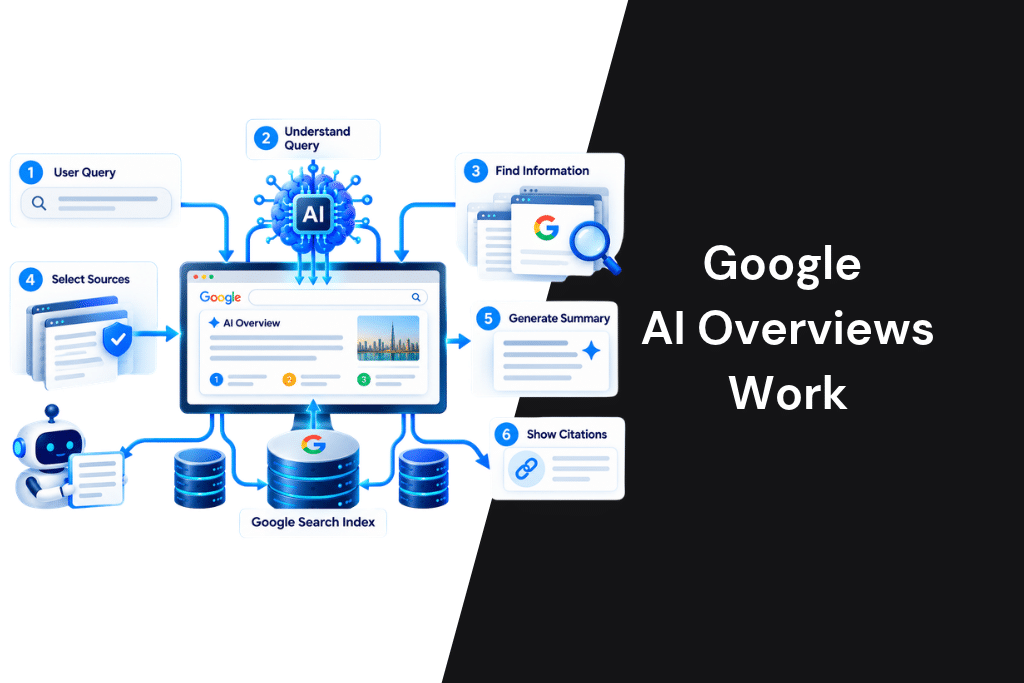
Google has not published its internal architecture, and nobody outside the company can describe it with certainty. What we can do is describe a simplified model that is consistent with Google’s public statements and with observable behaviour. Think of it as a four-step journey:
Search query → relevant information retrieval → AI-generated summary → supporting citations
Treat this as a mental model, not a blueprint. The real system is more complex and changes frequently. But the model is useful because it reveals where your content can win or lose.
Understanding the query and user intent
Everything starts with interpreting the question. Google’s systems work out what the person is really asking, which may differ from the literal words typed. A query like “best time to renew trade licence” implies a location, a business context and a time-sensitive decision. A query like “how do AI Overviews pick sources” is an explanation request with a technical flavour.
Intent matters here because it determines whether an AI Overview is useful at all, and what kind of information would satisfy it. For content creators, this is a reminder that optimising for a keyword string is not enough. The page must serve the underlying need: the definition, the comparison, the process, the decision criteria or the practical steps the searcher actually wants.
Using Google’s search systems to find relevant information
Next, Google’s search systems retrieve relevant information. Google has said that AI Overviews use its core search infrastructure, including the index of crawled webpages, its ranking and quality systems, and the Knowledge Graph for entities and facts. With query fan-out, the system may issue several related searches covering different facets of the question.
This is the stage where traditional SEO fundamentals still apply. If Google cannot crawl, index and understand your page, it cannot retrieve it. If your page is thin, duplicated or unrelated to the facets of the question, it is unlikely to be among the candidates. Retrieval is the gate that every cited page must pass through first.
Generating a response from multiple information sources
Once candidate information has been retrieved, a language model synthesises a response. It combines facts and explanations from multiple places into a coherent answer, aiming to be concise and readable. This is also the stage where AI-generated content can go wrong, which is why Google invests in grounding the output and why the summary is not guaranteed to be perfect.
For publishers, the key insight is that the model is assembling an answer from passages and facts, not simply copying the top result. A page that contains a clear, accurate, self-contained statement on one sub-question can contribute even if the rest of the page is not the best on the web for the whole topic.
Connecting statements in the answer to supporting webpages
Finally, the overview links to webpages that support what it says. Google’s documentation explains that AI Overviews include links to supporting pages so people can explore further. The exact mechanism by which a particular link is matched to a particular statement is not public, but the visible result is that different parts of the answer can be associated with different sources.
This is the stage most people mean when they talk about being “cited”. It is also the stage with the least transparency, which is why the next sections focus on what we can reasonably say about source selection without overclaiming.
Where Do Google AI Overviews Get Their Sources?
The short answer is that the sources come from the web that Google already knows about. There is no separate secret database for AI Overviews, and there is no special submission process. According to Google’s guidance for site owners, the foundational requirements for appearing as a supporting link are the same as for appearing in Google Search generally.
Google’s search index and the role of indexed webpages
Google states that to be eligible to appear as a supporting link in AI Overviews, a page must be indexed and eligible to be shown in Google Search with a snippet. There are no additional technical requirements, and no special markup is needed.
That has practical consequences:
- Indexing is non-negotiable. A page blocked by robots.txt, set to noindex, hidden behind a login or failing to render properly cannot be a source.
- Snippet eligibility matters. Pages using controls such as nosnippet, data-nosnippet or restrictive max-snippet settings limit what Google can show, and these controls can affect how your content appears in AI features. If you apply them, do so deliberately.
- Standard crawlability applies. Clean internal linking, working status codes, accessible content and reasonable performance help Google find and process your pages.
If you want to confirm the basics, start with Google’s official documentation on AI features and your website, which sets out exactly what Google says about eligibility and controls.
Organic search results and supporting web content
Because AI Overviews draw on Google’s search systems, there is naturally an overlap between pages that rank well organically and pages that get cited. Many cited pages do appear in the top organic results for related queries. This is intuitive: the same signals that help a page rank for relevance and quality also help it become a candidate for retrieval.
But overlap is not identity. Studies by SEO platforms have repeatedly found that a meaningful share of AI Overview citations come from pages outside the top ten for the exact query. We will explore why shortly, but the key takeaway is that organic ranking is a helpful proxy, not a guarantee.
Supporting content also includes more than classic articles. Depending on the topic, sources may include product and service pages, documentation, news reports, academic or government material, forums and community discussions, video platforms and review sites. The type of source that fits best varies by query.
Fresh information, authoritative websites and specialist sources
Three kinds of source tend to be valuable, and each connects to a different type of query:
- Fresh sources matter when the information changes. For questions about regulations, prices, product updates or recent events, outdated pages are a poor fit, and recent, clearly dated content has an advantage.
- Authoritative sources matter when accuracy carries weight, especially for health, finance, legal and other topics where mistakes can harm people. Google applies particular care to these areas.
- Specialist sources matter when the question is narrow. A small site with deep, first-hand expertise on a niche topic can be a better supporting source than a large generalist publisher.
The lesson is that “authority” is contextual. The best source for a question about free zone company setup is not necessarily the biggest website. It is the one whose content most credibly and specifically supports the claim being made.
Why AI Overviews may cite pages that rank below the top organic result
It can seem odd when an AI Overview links to a page ranking sixth, eighth or even lower while ignoring the top result. Several factors plausibly explain it:
- Query fan-out broadens the candidate pool. The overview may be answering sub-questions that differ from your head query. A page ranking poorly for the main phrase might rank well for one of the underlying sub-queries.
- Passage-level fit. A lower-ranked page might contain the cleanest, most direct statement supporting a particular sentence, even if the page overall is less competitive.
- Diversity of sources. A good summary benefits from drawing on different perspectives, formats and types of site rather than citing only the highest-ranked results.
- Different goals. Organic ranking balances many signals for a list of results. Selecting a source to support a sentence is a different task with different priorities.
This is genuinely good news for smaller sites. You do not necessarily need to beat every competitor for the head term. You need to be the best available support for the specific questions and claims inside the topic.
How Does Google Choose Which Websites to Cite?
Here we need to be careful. Google has not disclosed a formula for choosing citations, and it is unlikely that a single formula exists. What follows are factors that plausibly support eligibility and usefulness, drawn from Google’s public guidance on helpful content and from patterns that SEO practitioners have observed. They are not a confirmed or complete list of ranking signals, and no one should present them as such.
Relevance to the specific question
Relevance is the foundation. A page must address the question being answered, not merely the general subject. If the searcher asks how AI Overviews select sources and your page spends most of its length on the history of search engines, it is unlikely to be the best support for the answer.
Relevance operates at multiple levels: the page’s topic, its sections and the individual passages. Well-organised pages with focused sections give Google’s systems more precise material to match against a claim.
Clear evidence and useful supporting information
An AI-generated answer needs facts, explanations and examples it can rely on. Pages that provide clear evidence, such as definitions, figures with sources, step-by-step explanations and concrete examples, give the system more to work with than pages that make vague assertions.
Think about the difference between two sentences. “Many businesses benefit from good SEO” supports almost nothing. “A trade licence renewal in Dubai must be completed before the licence expiry date to avoid fines” is specific, checkable and attributable. Specificity makes a passage useful as support.
Content quality, originality and demonstrated expertise
Google’s guidance on creating helpful, reliable, people-first content encourages publishers to consider questions about originality, depth, accuracy and expertise. Does the content provide substantial, complete information? Does it offer insight beyond the obvious? Would a reader trust it enough to act on it? Does it show first-hand experience where relevant?
These are the same ideas often summarised as E-E-A-T: experience, expertise, authoritativeness and trustworthiness. It is worth being precise about what E-E-A-T is. Google has said it is a framework used by its quality raters to evaluate the quality of search results, and that it is not a single ranking factor. But the qualities it describes align with what Google’s systems aim to reward, which makes it a sensible lens for content planning.
Website reputation and trust signals
Source selection plausibly takes into account signals about the website as a whole: whether it is established, whether it is mentioned and referenced elsewhere, whether it has clear authorship and contact information, and whether it has a track record of reliable content on the topic. For sensitive subjects, trust signals carry even more weight.
Brand recognition appears to matter too, although the evidence is correlational. Brands that are frequently discussed and linked across the web tend to appear more often in AI-generated answers. Whether that is causal, or simply a reflection of their overall strength in search, is unclear. Either way, building genuine reputation is sound strategy.
The importance of matching a source to a specific claim
The most useful way to think about citations is claim-level matching. An AI Overview makes statements, and for each it needs support. The best source for one statement is not necessarily the best source for another, which is why a single overview can link to several different sites.
This suggests a different approach to content creation. Instead of asking “How do I rank for this keyword?”, ask “Which specific claims, explanations and facts would an answer to this question need, and does my page contain the clearest, best-supported version of them?”
An illustrative example
The following example is illustrative only. It is not a record of a real AI Overview, and it simplifies how Google’s systems work.
Suppose someone searches: “Do AI Overviews only cite the top-ranking pages?” A well-formed answer might include three claims:
- AI Overviews draw on pages in Google’s search index.
- Cited pages do not have to be the first organic result.
- Eligibility requires indexing and snippet eligibility, not special markup.
Now consider the kinds of pages that could support each claim. Google’s official documentation on AI features is the natural support for claims one and three, because it directly states the eligibility requirements. For claim two, a page presenting original analysis of citation overlap, with a clear methodology and data, would be strong support. A generic blog post saying “AI is changing SEO” supports none of the three, however well it ranks.
The lesson: a page is useful as a citation when it contains a specific, verifiable statement that maps onto a specific claim in the answer.
Why Some Websites Get Cited While Others Do Not
If two pages are both indexed and both broadly relevant, why would one be cited and the other ignored? There is no definitive answer, but several patterns recur.
Content that directly answers the search query
Pages that state the answer clearly, early and in plain language are easier to use. That does not mean every page should be a short answer box. It means the key answer should be findable without wading through preamble. A section that opens with a direct, one- or two-sentence answer, followed by explanation and evidence, serves both human readers and retrieval systems.
By contrast, pages that circle a topic without ever making a clear statement, or that bury the answer in marketing language, give the system little to extract.
Original research, data and first-hand experience
Original information is hard to replace. If your page is the primary source of a statistic, a benchmark, a case study or a first-hand account, then any answer that wants to include that information has a reason to point to you. If your page merely rephrases what ten other pages say, the system can cite any of them interchangeably, and often will choose the original or the most authoritative.
Practical sources of originality include proprietary surveys, anonymised client data, documented experiments, expert interviews, process walkthroughs with real screenshots, and local knowledge that generalist publishers lack.
Specific, well-supported statements instead of generic content
Generic content is interchangeable. Specific, supported content is not. Compare these:
- Generic: “Content quality is important for AI search.”
- Specific: “Google says pages are eligible to appear as supporting links in AI Overviews if they are indexed and eligible to be shown in Search with a snippet, and links to its documentation for confirmation.”
The second statement can be checked, attributed and reused. The first cannot.
Content gaps, duplication and outdated information
Several problems commonly keep pages out of consideration:
- Content gaps. The page covers a topic superficially and misses the sub-questions the overview needs to answer.
- Duplication. The page is substantially similar to many others, offering no distinctive reason to be chosen.
- Outdated information. The page presents old figures, expired rules or superseded advice, which makes it risky as a source.
- Contradictions. The page conflicts with better-supported sources, which reduces its credibility as support.
- Weak structure. Important facts are buried in dense paragraphs, images or interactive elements that are hard to parse.
Why a strong organic ranking does not guarantee an AI Overview citation
Ranking and citing are related but separate outcomes. A page can rank first because of links, brand strength, user engagement and overall relevance, yet not contain the specific passage the overview needs. Conversely, a lesser-ranked page might contain exactly that passage.
It is also possible that the overview draws on information Google already holds in other forms, such as the Knowledge Graph, and links to a source that confirms it. There may be cases where the top-ranking page is simply not the cleanest support for any individual claim.
The practical conclusion is to treat organic rankings and AI citations as two measurements of visibility, each of which deserves its own tracking.
How Citations Appear Inside Google AI Overviews
Understanding how citations are displayed helps you interpret what you see when you check your own visibility.
Links attached to supporting statements
In many AI Overviews, links appear alongside the text, either as small link icons next to relevant statements or as source cards beside or beneath the answer. These are intended to show where the information is supported and to give users a path to read more. The same link may support several statements, and one statement may be associated with multiple links.
Source panels and additional reference links
On desktop and mobile, the overview may also show a panel or expandable list of sources. Users can expand the overview to see more of the answer and more of the linked pages. The exact design changes often, so any description should be treated as a snapshot rather than a permanent rule.
How users move from an AI-generated answer to a website
A user who wants more detail clicks a supporting link, and arrives with context: they have already read a summary and are looking for depth, verification or a next step. Google has argued that clicks from pages with AI features can be higher quality, with people spending more time on the destination. Independent research has been less reassuring about volume. Pew Research Center’s analysis of browsing data in 2025, for example, found users clicked on traditional results less often when an AI summary appeared. The honest position is that effects vary by query type, industry and intent, and that you should look at your own data.
What citation placement does and does not tell you about visibility
It is tempting to read the order or prominence of a link as a ranking. That is probably a mistake. Citation placement may reflect how the answer was constructed, not how Google ranks sources by importance. Being cited does not guarantee clicks, and not being cited does not mean you have no visibility, because your page may still rank organically below the overview. Use placement as a rough signal, never as a scoreboard.
How to Optimise Content for Google AI Overview Citations
No tactic guarantees a citation. But the following practices improve the usefulness, clarity and eligibility of your content, and they benefit human readers regardless of what Google does next. Notice that most of them are not “AI tricks”. They are good publishing habits applied with a more precise understanding of how answers are assembled.
Answer important questions clearly and directly
Identify the questions your audience genuinely asks, then answer each one plainly near the top of the relevant section. A useful pattern is: a direct answer in one or two sentences, then the explanation, then evidence, then a practical next step.
For example, if your page is about business setup, do not make readers scroll through three paragraphs of context before learning whether a particular licence type allows a particular activity. State it, then qualify it. Clarity is not the same as brevity. You can write 3,000 words and still make every key answer easy to find.
Structure pages with descriptive headings and logical sections
Headings act as labels that tell both readers and machines what each section covers. Use descriptive headings that reflect real questions or topics, keep one main idea per section, and maintain a logical hierarchy from H1 down to H3. Avoid vague headings such as “Overview” or “More information” when a specific one would help.
Good structure also supports passage-level matching. If your section on “How to renew a licence” is self-contained, with its own definitions and steps, it can stand on its own as support for a claim without depending on context elsewhere on the page. Lists, tables and short summaries can help when the content genuinely has that shape, but do not chop prose into fragments just to look scannable.
Support claims with credible evidence and primary sources
Whenever you make a factual claim, ask whether a sceptical reader could verify it. Link to primary sources such as government portals, official documentation, original studies and company filings. Name the source and date where it matters. Distinguish clearly between what is documented, what is widely reported and what is your own interpretation.
This habit does two things. It makes your content more trustworthy to readers, and it gives your page the kind of verifiable specifics that make a passage useful as support. It also protects you: an article that openly separates fact from hypothesis ages far better than one that presents guesses as rules.
Demonstrate experience, expertise and topical authority
Show who is behind the content and why they are qualified. That means real author names with relevant credentials, an about page that explains your business, case studies from actual work, and original examples that only someone with direct experience could provide. On sensitive topics, expert review and transparent sourcing are especially valuable.
Topical authority is built through depth and consistency. A site that publishes one article on AI search is a weaker signal than one with a connected set of pages covering the fundamentals, the tactics, the measurement and the pitfalls. Plan content as a cluster, not a pile of isolated posts, and link the pieces together sensibly.
Keep factual information accurate and up to date
Audit your most important pages on a schedule. Check statistics, regulations, prices, product names, screenshots and external links. Add a visible “last updated” date when it is genuine, and update the content in substance, not just the timestamp. Outdated pages carry a double risk: they can mislead readers and they are a poor choice as a supporting source.
When something changes, such as a regulatory update or a Google policy shift, revise the page quickly and note what changed. Fresh, accurate information is a practical advantage for time-sensitive queries.
Strengthen internal links and technical crawlability
Technical hygiene still decides whether you are even considered. Make sure important pages are crawlable and indexable, return the right status codes, load reliably on mobile, and are linked from other relevant pages on your site. Use descriptive internal anchor text so both users and crawlers understand how pages relate.
Internal links also help you build the topic cluster described above. For example, a guide like this one can naturally link to your pages on AI SEO services in Dubai, What is Answer Engine Optimisation?, Generative Engine Optimisation (GEO), How AI search differs from traditional search and Local SEO in Dubai, so that readers and crawlers can move from the overview to the detail.
Check that you are not accidentally limiting your eligibility. Review robots.txt, meta robots tags, and snippet controls to confirm that they reflect your intentions. Google’s Search Essentials is the right reference for technical and policy fundamentals.
Use structured data where it accurately describes the page
Structured data helps search engines understand a page’s content and can enable certain rich results. Google has said that no special schema is required for AI features, and that markup does not guarantee inclusion in an AI Overview. Still, accurate markup such as Article, Organization, Person, Product, FAQPage where appropriate, and BreadcrumbList clarifies entities and relationships, and it is good practice.
Two rules apply. First, markup must match visible content, and misleading markup can violate Google’s guidelines. Second, do not treat schema as a shortcut. It is a supporting layer, not a substitute for genuinely useful content.
How to Measure Google AI Overview Visibility
What you cannot measure, you cannot manage. Unfortunately, measurement is one of the weakest points in AI search today. Google does not currently provide a dedicated AI Overview report in Search Console, and traffic from AI Overviews is counted within the standard Web search data rather than shown separately. That means you need a combination of Google’s tools, third-party tools and manual sampling.
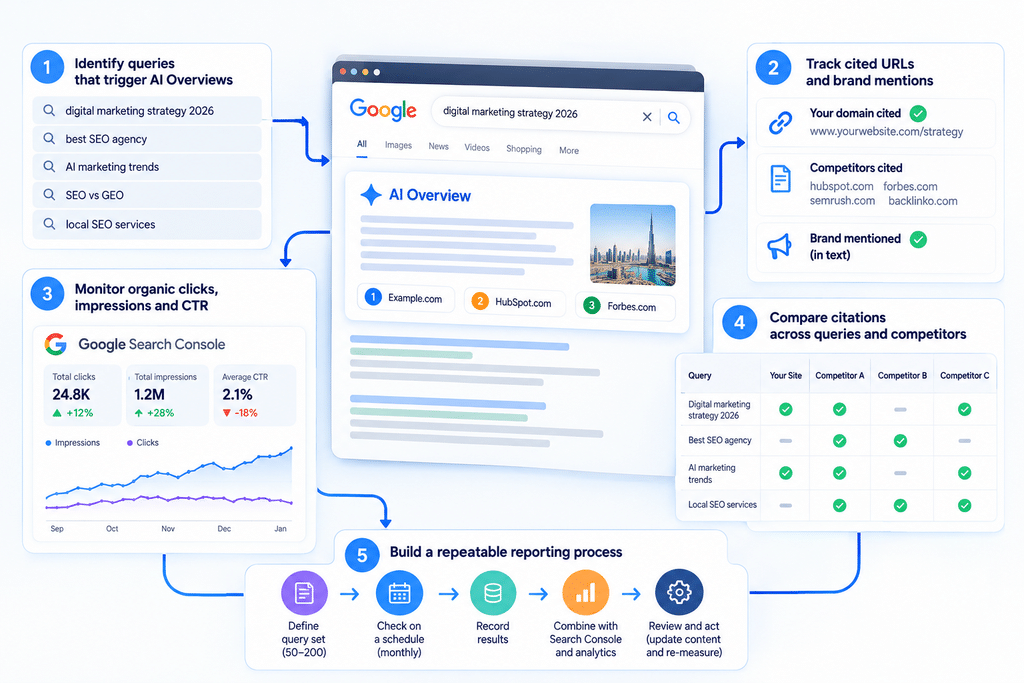
Identify queries that trigger AI Overviews
Start with your priority topics and build a query set: head terms, long-tail questions, comparison queries and commercial-intent searches. Then check which of them trigger an AI Overview. Many SEO platforms now flag AI Overview presence in their rank-tracking features. For smaller sets, manual checks work, though they require care.
When checking manually, search in a clean browser session, note your location and language settings, and record the date. Results can vary by location, device, personalisation and time, so repeat checks and look for patterns rather than relying on a single observation.
Track cited URLs and brand mentions
For each query that triggers an overview, record:
- Whether your domain is cited, and which URL.
- Which statement or section the link appears beside.
- Which competitors and third-party sites are cited.
- Whether your brand is mentioned in the text even without a link.
Brand mentions matter because an overview may name an organisation without linking to it. That is still a form of visibility, even though it will not appear in a click report.
Monitor organic clicks, impressions and click-through rates
Use Google Search Console to monitor impressions, clicks, average position and click-through rate for your key queries and pages. Compare periods before and after AI Overviews begin appearing for those queries. A pattern of stable or rising impressions with falling click-through rates may suggest that more searchers are getting answers without clicking, although you should be cautious about attributing causes, since seasonality, ranking changes and SERP layout shifts can produce similar effects.
Pair Search Console with analytics data. Look at engagement, conversions and assisted conversions from organic traffic, not just sessions. If clicks fall but qualified leads hold steady, the commercial picture may be healthier than raw traffic suggests.
Compare citations across relevant queries and competitors
Building a simple matrix helps. List your target queries down one side and your domain and key competitors across the top, then mark who is cited. Over time, you can see where you are consistently present, where you are absent, and which competitor pages keep earning citations.
Then study the cited competitor pages. What do they include that yours lacks? A clearer definition, original data, a better-structured comparison, more recent information, stronger sourcing? Treat this as content gap analysis, not copying.
Build a repeatable AI search visibility reporting process
A workable process looks like this:
- Define a fixed query set of 50 to 200 queries across your core topics.
- Check on a schedule, such as monthly, using the same method each time.
- Record results in a consistent format: trigger status, cited domains, your URL, brand mention and date.
- Combine with Search Console and analytics to connect visibility to clicks and business outcomes.
- Review and act: update pages, fill gaps, create new content and re-measure.
Be honest in reporting about limitations. AI Overview results are variable, sampling is imperfect and attribution is incomplete. Present trends and ranges, not false precision.
Common Misconceptions About Google AI Overview Citations
Where information is scarce, myths spread quickly. Here are the ones worth correcting.
Ranking first does not guarantee a citation
As covered earlier, an overview may cite pages that rank lower, or may not link to the top result at all. A first-place ranking improves your chances of being retrieved, but it does not ensure that your page is the best support for any particular statement.
There is no guaranteed formula for earning citations
Anyone promising a guaranteed method, a specific word count, a magic heading format or a proprietary “AI ranking factor” is overstating what they know. Google has not published a citation formula, and the system changes frequently. Reliable advice focuses on fundamentals: be indexable, be genuinely useful, be specific and be trustworthy.
Schema markup does not guarantee inclusion
Structured data can help Google understand your page, but Google has said no special markup is required for AI features and that markup does not by itself earn a link. Implement schema because it is accurate and helpful, not because you expect it to unlock citations.
AI citations and organic rankings measure different forms of visibility
A site can lose a ranking and gain a citation, or the reverse. A brand can be mentioned in an overview without a click, and a page can earn clicks without ever being cited. Treat these as complementary signals and report them separately. Collapsing them into one number hides what is actually happening.
The Future of SEO in an AI Overview Search Environment
It is tempting to conclude that SEO is dying. A more accurate reading is that SEO is widening. The fundamentals, such as crawlability, relevance, quality and trust, remain the entry ticket. What changes is where the competition takes place and how success is measured.
Several themes are likely to matter more over time:
- Useful, original content. As summaries make generic information abundant, the pages that add something new, such as data, experience and expert judgement, become more valuable as sources.
- Credible sourcing. Systems that must support statements with evidence favour content that is itself well-supported.
- Brand recognition. Being known, mentioned and trusted across the web helps both users and systems recognise you as a reliable source.
- Topical depth. Comprehensive coverage of a subject, organised into connected content, builds the kind of authority that is hard to fake.
- Measurement beyond rankings. Visibility will increasingly be assessed through citations, mentions, share of voice in AI answers, and downstream business outcomes, alongside traditional positions.
For businesses in competitive markets such as Dubai, where searchers often have urgent, high-intent questions about licensing, property, finance and services, the opportunity is to become the clearest, most credible answer to those questions, in whatever format the search experience presents. The details of Google’s interface will keep changing. The underlying advice, to be genuinely helpful and verifiably reliable, will not.
Conclusion
Google AI Overviews do not replace the web. They depend on it. Every cited statement traces back to a page someone wrote, and the pages most likely to earn that role are the ones that are findable, clear, specific, well-evidenced and trustworthy. Optimising for that is not a separate discipline from good SEO. It is good SEO, applied with a sharper focus on the evidence behind each claim.
Start with the fundamentals: confirm your key pages are indexed and snippet-eligible, answer real questions directly, back your statements with primary sources and original insight, and keep everything current. Then measure visibility across both rankings and citations, and iterate. No one can promise you a place in an AI Overview, but you can make your content the kind that deserves one.
Frequently Asked Questions
Does Google AI Overview use websites from its search index?
Yes. Google has stated that AI Overviews are connected to its search systems and that pages must be indexed and eligible to appear in Search with a snippet to be shown as supporting links. There is no separate submission route.
How does Google select sources for AI Overviews?
Google has not published a complete selection method. Based on public guidance and observed behaviour, sources appear to be chosen from pages retrieved by its search systems, with relevance to the specific claim, content quality, accuracy and trustworthiness likely playing roles. Treat any specific list of signals as informed guidance rather than confirmed fact.
Can a website appear in an AI Overview without ranking first?
Yes. Cited pages are not limited to the first organic result, and many appear lower in the rankings or outside the top ten for the exact query. Query fan-out and claim-level matching help explain why.
How can I get my website cited in Google AI Overviews?
There is no guaranteed method, but you can improve your chances by ensuring your pages are indexable and snippet-eligible, answering questions clearly, supporting claims with evidence, publishing original and expert content, keeping information current, and building a strong, trustworthy reputation on your topics.
Does structured data help a page get cited?
Structured data helps Google understand your content, but Google says no special markup is needed for AI features and that it does not guarantee inclusion. Use it accurately, and treat it as a supporting layer.
Can Google AI Overviews reduce organic website traffic?
They can for some queries, particularly simple informational ones where the summary fully answers the question. Independent studies have found lower click rates when AI summaries appear, while Google has argued that the clicks it does send are higher quality. The impact varies by industry and query type, so measure your own data in Search Console.
How can I check whether Google AI Overviews cite my website?
Search your priority queries manually in a consistent setup, use SEO tools that track AI Overview presence and cited URLs, and compare results over time. Remember that Search Console does not break out AI Overview traffic separately, so combine these checks with click and impression analysis.