
Reimagining Brand Business Models: Innovation for a Competitive Edge
Introduction
In today’s rapidly evolving economy, brand business model innovation is no longer a luxury—it’s a necessity for survival and leadership. Research by McKinsey & Company reveals that companies pursuing business model innovation outperform their peers by nearly 6x in revenue growth over a ten-year period. This surge in performance is attributed not just to operational agility, but to reimagining how value is created, delivered, and captured in increasingly volatile markets.
Brand business model innovation differs from conventional strategy revisions—it involves strategic brand positioning, market disruption, and next-gen business model design to deliver differentiated experiences that deeply align with shifting consumer behaviors. As digital platforms democratize access, and customer expectations shift toward personalization and sustainability, brands that cling to legacy models risk falling behind. Harvard Business Review asserts that “70% of legacy brand leaders fail to pivot in time, even with clear warning signals.”
The core semantic dimensions of this transformation—business model transformation, brand reinvention, innovative branding, and strategic value shifts—frame the new rules of engagement. These are not merely cosmetic changes in marketing; they represent structural reconfigurations of what a brand is, what it offers, and how it sustains relevance and revenue in a networked world.
Brands must now answer:
- Can a direct-to-consumer pivot revive a declining heritage brand?
- Will subscription models, platform ecosystems, or co-creation economies offer defensible growth paths?
- How do emerging customer expectations—on ethics, convenience, and tech—reshape the core brand promise?
This article explores how pioneering brands—large and small—are challenging outdated frameworks. Through competitor-backed insights, case-based storytelling, and a step-by-step innovation roadmap, this guide dissects the anatomy of successful brand model reinvention.
Most importantly, it addresses the real pain points voiced by marketers, founders, and executives:
- “We’re stuck in a model that once worked, but now feels irrelevant.”
- “We fear the cost of innovation more than the cost of inertia.”
- “We know we need to evolve—but where do we start?”
The answer lies in structured creativity—driven by customer empathy, platform leverage, and data-informed experimentation. It also hinges on refining your brand strategy and execution to align bold ideas with real market outcomes.
Let’s decode how brands move from disruption to dominance.
The Imperative for Reinventing Brand Business Models
For decades, brands operated within familiar frameworks: build a product, advertise it, distribute it through known channels, and repeat. But today, that linear system is fractured. What once drove predictable growth is now the root of stagnation. Legacy systems—often the pride of heritage companies—have become roadblocks in an era where agility, direct access, and innovation rule the competitive landscape.
Brand business model innovation has emerged not only as a strategic choice but as a survival imperative.
Why Traditional Brand Models Fail in Modern Markets
Consumer behavior has shifted dramatically. The rise of DTC (direct-to-consumer) channels, the dominance of digital communities, and the expectation for purpose-driven brands have changed the game. In this climate, sticking to outdated playbooks can result in declining relevance and trust.
“Most companies are still operating with 20th-century assumptions about value creation. The future demands exponential, not incremental, thinking.”
— Boston Consulting Group report on brand-led growth
Consider Kodak, which failed to adapt to digital imaging despite inventing it. Or Toys “R” Us, which collapsed under the weight of its own outdated retail model. Meanwhile, brands like Glossier and Peloton disrupted their sectors by fundamentally rethinking their brand models—not just what they sold, but how and why they sold it.
Real Struggles from Real Leaders
From founder forums to Reddit threads, the same fears echo:
“We know our model is outdated, but changing it feels risky—what if we alienate loyal customers?”
— r/Entrepreneur
“We can’t afford to make mistakes. Innovation feels like a gamble, not a plan.”
— r/Marketing
These concerns are valid. But clinging to stability in a volatile market is its own gamble.
The Strategic Shift: From Static to Adaptive Branding
Modern brands must move from positioning as identity to positioning as behavior—a shift that requires business model transformation as much as messaging clarity. This is where brand strategy and execution must converge.
- Strategic Brand Positioning now means anticipating future customer needs—not just responding to current ones.
- Innovative Branding involves embedding adaptability into your model—whether via dynamic pricing, modular offerings, or crowdsourced innovation.
- Market Disruption isn’t a threat; it’s a test of a brand’s evolutionary fitness.

Core Elements of Effective Brand Business Model Innovation
The most resilient brands don’t just rebrand—they reengineer. True brand business model innovation starts at the architecture level: redefining how the brand operates, delivers value, and creates defensible differentiation. From startups to enterprise brands, successful transformations share key characteristics—anchored in strategic brand positioning, agile systems, and customer-led thinking.
Let’s break down the core pillars that structure innovative brand models.
1. Customer‑Centric Model Pivot
At the heart of any successful transformation is a radical realignment around the customer. This isn’t just about user personas—it’s about letting customer behavior shape the business model itself.
Beauty brand Glossier used its community as both a test lab and a channel. Rather than leading with retail partnerships, Glossier built its model through user-generated feedback, social dialogue, and content co-creation. Its brand reinvention was structural: community-first, digital-native, and feedback-loop-driven.
Why It Works
- Customers become co-creators, not just end users
- Feedback fuels continuous optimization
- Loyalty deepens through inclusion
“A true brand model pivot happens when companies stop asking ‘How do we sell more?’ and start asking ‘What value do we deliver next?’” — Forrester CX Report
2. Digital‑First Innovation
Legacy systems often rely on physical infrastructure and sequential delivery models. In contrast, digital-first brands leverage platform economies, automation, and real-time analytics to stay ahead.
Key components
- Platform-as-a-service ecosystems (e.g., Nike’s app suite and connected gear)
- Subscription logic (e.g., Dollar Shave Club’s recurring model)
- Direct-to-avatar strategy (e.g., fashion brands selling digital clothing for gaming avatars)
These aren’t just digital enhancements—they are brand strategy execution frameworks where the product experience and delivery method are inseparable.
3. Agile Value Delivery
Traditional brand models rely on set plans and slow adaptation. Innovative brands operate like startups inside an enterprise—small, fast teams testing hypotheses and pivoting weekly.
Techniques include
- Minimum viable offers
- Feedback-driven microcampaigns
- Rapid prototyping with real user data
Example
Spotify’s micro-pods team restructured their business model around emotional moments (e.g., “gym”, “morning coffee”), not genres. That decision informed everything from their UI to ad monetization to their artist dashboard.

These elements don’t work in isolation. Their strength lies in interdependence—customer insights informing digital tools, which in turn empower agile cycles of delivery and testing. That’s how brand strategy evolution becomes both structured and flexible.
Illustrative Case Studies: Innovation in Action
Theory only gets a brand so far. The best insights into brand business model innovation come from those who’ve walked the path, risked the pivot, and emerged as market leaders—or cautionary tales.
This section unpacks real-world case studies of brands that redefined themselves through business model transformation, offering both inspiration and strategic benchmarks.
Case Study 1: LEGO – From Product Maker to Ecosystem Brand
By the early 2000s, LEGO was nearing bankruptcy. Overextended product lines and a scattered licensing strategy left the iconic toy brand struggling. Their pivot wasn’t just about better toys—it was about redefining their entire business model.
Transformation Strategy
- Refocused on core play themes driven by user data
- Expanded into digital with LEGO Video Games and LEGO Digital Designer
- Built an entire content ecosystem: movies, games, theme parks
Outcome
Revenue more than tripled in 10 years, with over 25% now from content and experience, not just bricks.
“By moving beyond toys into storytelling and platforms, LEGO created a brand ecosystem where the brick was just the entry point.”
— Harvard Business School analysis
Case Study 2: Patagonia – Business as a Vehicle for Activism
Patagonia didn’t just tweak its model—it inverted it. Instead of maximizing profit as its core aim, the brand doubled down on environmental activism, even discouraging customers from buying more.
Business Model Innovation
- Launched “Worn Wear” repair and resale program
- Redirected Black Friday sales to environmental charities
- Incorporated activist storytelling into product launches
Why It Worked
- Authenticity enhanced trust
- Strategic brand positioning appealed to values-first consumers
- Created a differentiated brand story that converted across all channels
This wasn’t just bold—it was a strategic execution that turned brand values into brand revenue.
Case Study 3: Peloton – Subscription Fitness Ecosystem
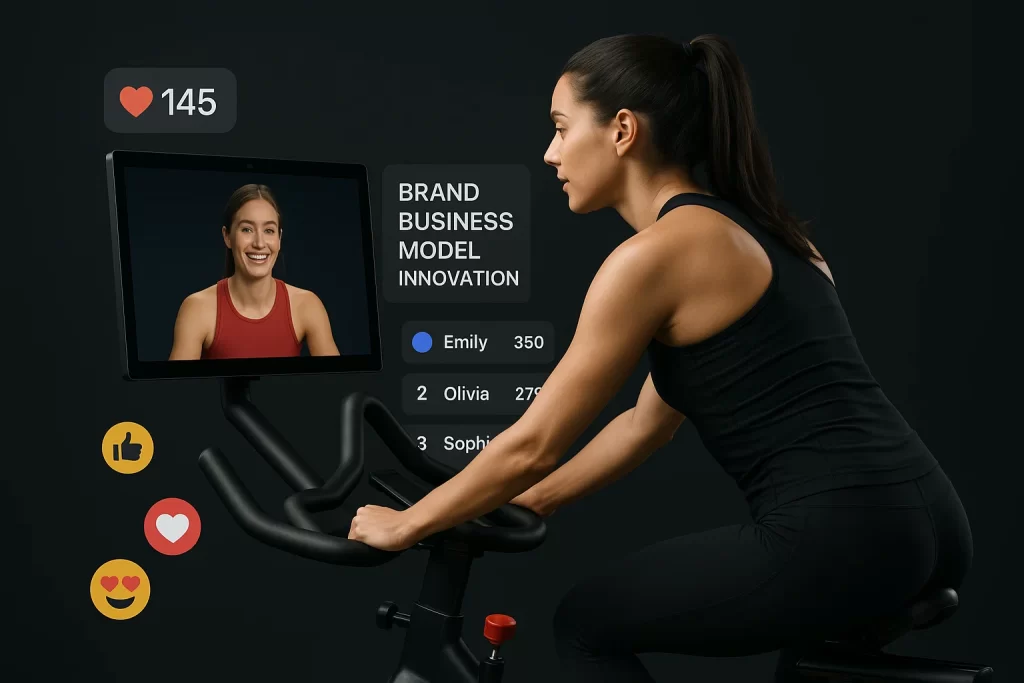
Peloton reimagined home fitness not as a product, but a platform—connecting hardware, content, community, and software.
Core Model Elements
- Subscription-first recurring revenue
- Data-driven personalization of fitness journeys
- Social features (leaderboards, live classes, shoutouts) embedded into the value loop
While the brand faced challenges post-pandemic, its brand reinvention taught an industry to think beyond one-time sales.
Overcoming Common Barriers to Innovation
Even when the need for brand business model innovation is clear, executing change is rarely smooth. Leaders often face internal resistance, resource constraints, and the invisible weight of legacy systems. Many teams are caught between ambition and anxiety—wanting to evolve but fearing what change might cost.
This section addresses the real barriers that hold brands back, and how to overcome them without sacrificing stability or alienating loyal audiences.
Barrier 1: Organizational Inertia
Change is threatening—especially in companies that have long succeeded with their current models. Teams often cling to “what’s worked” as a safety net. This is where change fatigue and cognitive bias hinder agility.
“If your team only innovates during crises, then your culture isn’t innovative—it’s reactive.”
— Dr. Rita Gunther McGrath, Columbia Business School
Solution
- Deploy “safe-to-fail” pilot projects
- Use cross-functional tiger teams to explore innovation outside the core workflow
- Tie KPIs to learning—not just results
Barrier 2: Lack of Resources or Budget
Smaller brands and bootstrapped teams often believe they need a massive war chest to innovate. But innovation doesn’t always require disruption—it can begin with small systemic experiments.
Real Insight
“We thought brand innovation meant a total overhaul. Turns out, testing a new pricing structure with 20 loyal customers gave us our biggest breakthrough.” — r/Startups
Solution
- Start with low-cost validation: landing pages, surveys, clickable prototypes
- Use no-code tools to build MVPs
- Outsource early phases to agile agencies for fixed costs
Barrier 3: Fear of Alienating Existing Customers
A common fear: Will changing the model confuse or frustrate loyal buyers?
Case Example
Netflix’s pivot from DVDs to streaming came with backlash. But through clear brand messaging, transitional offers, and tiered pricing, they brought most of their base along.
Solution
- Communicate WHY before HOW
- Build tiered offers to let users “choose their comfort zone”
- Maintain brand values across formats
Barrier 4: Lack of Strategic Alignment
Sometimes innovation efforts die because they lack C-suite sponsorship or don’t align with the company’s brand strategy execution roadmap.
Solution
- Integrate innovation goals into annual strategic planning
- Frame innovation as risk mitigation, not just opportunity
- Link innovation metrics to revenue, retention, or CX benchmarks
Action Roadmap: Implementing Brand Business Model Innovation
For many leaders, the question isn’t if they should innovate—it’s how. Moving from insight to execution requires more than creativity; it demands a structured, testable framework for change. This roadmap outlines a step-by-step process that blends brand strategy execution with the agility of business model transformation.
Phase 1: Discovery – Clarify Your Value Shift
Key Questions
- What core problems does your brand solve today—and for whom?
- How are customer expectations evolving?
- What assumptions about your current model are holding you back?
Tools to Use
- Jobs-to-be-Done interviews
- Brand perception audits
- Value proposition canvas
- Competitor business model mapping
Phase 2: Design – Draft the New Model
This is where ideation becomes structure.
Design Elements to Define
- Revenue logic: One-time vs subscription vs freemium vs hybrid
- Value delivery: Self-serve, concierge, co-creation
- Brand voice alignment: Does the tone, messaging, and UX reflect the repositioning?
Expert Insight
“Designing a business model isn’t about choosing formats. It’s about aligning every choice to your brand’s core purpose and promise.” — Osterwalder, Business Model Generation
Phase 3: Prototype & Test
Innovation fails when ideas jump straight to scale. Prototype your model like a product.
Prototype Options
- Landing page with mock pricing
- Concierge MVP (manual backend, simulated experience)
- Beta test with a closed user group
Tools
- Webflow, Typeform, Notion, Figma
- Feedback loops with tools like Maze or Hotjar
Phase 4: Launch & Scale
When confidence in the model grows, it’s time to scale—with structured rollout strategies.
Checklist
- Align internal teams: Sales, Support, Ops, Product
- Design customer onboarding that reflects the new brand promise
- Measure metrics: Churn, CAC, LTV, NPS, brand salience
Quote
“The best pivot we made started with 12 loyal users and a Typeform. Now it’s our core offer.”
Keep a Feedback Loop Alive
Post-launch is the beginning—not the end.
- Conduct quarterly customer interviews
- Track shifts in customer needs and friction points
- Review emerging competitors every 90 days
The best brands treat their model like software—always in beta, always iterating.
FAQ
1. How can startups use brand business model innovation strategies for startups when budgets are tight?
Innovation doesn’t have to mean huge spending. Many early-stage brands have reimagined their models using no-code platforms, manual MVPs, and micro-tests to validate demand.
“We prototyped our subscription model using Airtable and Stripe. No devs. Just hustle and clarity.” — r/Startups
Start with clarity on customer pain points, then prototype new delivery or pricing formats. Focus on value loops, not vanity features.
2. What are some innovative branding case studies I can learn from in my industry?
We covered LEGO, Peloton, and Patagonia earlier—but here are more niche examples:
- Chubbies redefined men’s shorts with humor, social-first commerce, and weekend-ready storytelling.
- Oatly turned oat milk into a lifestyle brand by flipping their tone from bland to bold.
- Bumble changed dating dynamics with a woman-first experience and scalable freemium model.
Each used strategic brand positioning + model tweaks to dominate their lane.
3. How top brands reinvented their models—what common patterns emerge?
Across industries, patterns include:
- From product to platform (Peloton, Nike)
- From transaction to subscription (Adobe, Spotify)
- From control to co-creation (LEGO Ideas, Glossier)
- From profit to purpose (Patagonia)
These shifts are fueled by customer involvement, data feedback loops, and bold narrative consistency.
4. Is it risky to overhaul my brand’s business model if we are doing okay currently?
Absolutely—but staying the same can be riskier. Market relevance isn’t static. Your model might be fine today, but:
- Is it scalable?
- Is it future-proofed for emerging platforms?
- Is it emotionally resonant with the next generation?
Use a dual-path approach: maintain the core while exploring innovation sprints.
5. What if customers don’t understand our new model? Won’t it confuse or frustrate them?
Clear communication mitigates confusion. Brands like Netflix, Adobe, and Mailchimp transitioned users by:
- Offering parallel paths (e.g., legacy + new pricing)
- Using transparent messaging: Why change is happening, how it benefits them
- Giving power to the user: tiered onboarding, opt-in models, pre-launch betas
Conclusion
In a world of relentless change, brand business model innovation is no longer optional—it’s the defining edge between relevance and obsolescence. The most iconic brands of tomorrow won’t just market better; they’ll operate differently. They’ll rewire how they deliver value, build ecosystems around experiences, and evolve alongside their customers.
We’ve explored the full journey—from the strategic “why” to the tactical “how.” We’ve examined:
- The imperative to evolve amid changing markets
- The core elements of modern brand models
- Real-world case studies that prove transformation is possible
- Practical strategies to overcome internal barriers
- A step-by-step implementation roadmap
- And honest, authentic answers to the most pressing questions
But above all, we’ve emphasized one truth: your business model is your brand. It’s not just how you make money—it’s how you make meaning.
So whether you’re a founder, a CMO, or a solo creator, the challenge is clear: don’t just manage a brand—design a better business around it.
Start small. Stay brave. Iterate fast. And lead with intention